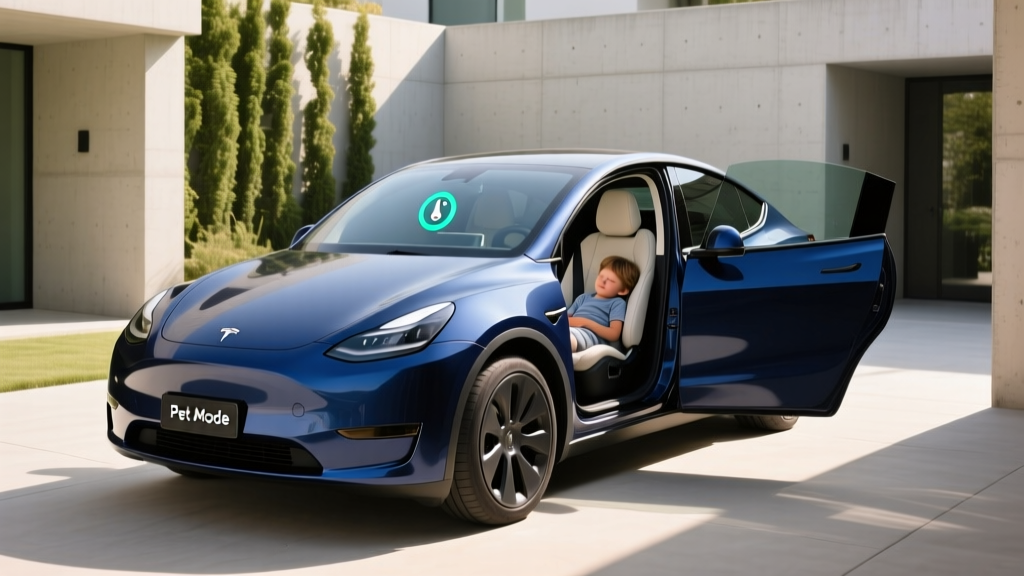
If you leave your dog in a parked car on a warm day, cabin temperatures can exceed 120°F within minutes — a lethal scenario that has prompted dozens of U.S. states to pass "hot car" rescue laws. Tesla's answer is Pet Mode, a climate-control feature that keeps the cabin at a safe, set temperature while the driver is away, displays a message on the touchscreen so passersby know the animal is safe, and draws power from the high-voltage traction battery rather than a running engine.
Pet Mode is not a standalone vehicle — it is a software feature available on every Tesla sold since mid-2019, including the 2026 Model 3, Model Y, Model S, Model X, and the new Cybertruck. Below, we break down exactly how it works, what it costs in range, and how the vehicles that support it stack up on the metrics EV buyers actually care about: range, charging, pricing, and tax-credit eligibility.
What Tesla Pet Mode Actually Does
Activated from the climate menu on the center touchscreen (or via the Tesla app), Pet Mode holds the cabin at a driver-selected temperature — typically 68–72°F — using the vehicle's heat pump (on Model 3/Y built after 2021 and all Model S/X/Cybertruck) or resistive PTC heater on older vehicles. The touchscreen displays a persistent message: "My driver will be back soon. Don't worry, the A/C is on and the temperature is [XX]°F."
Key behaviors:
- The vehicle cannot be shifted into Drive while Pet Mode is active — a safeguard against accidental movement.
- Windows and the sunroof remain locked; the touchscreen stays on but limits access to navigation and media to prevent tampering.
- If the battery's State of Charge (SoC) drops below 20%, the vehicle sends a push notification to the owner's phone warning that Pet Mode will soon shut down.
- The system logs cabin temperature history, viewable in the Tesla app.
How Much Battery Does Pet Mode Use?
Tesla does not publish an official watt-hour draw for Pet Mode, but independent logging by EV owners and testing by outlets like Tesla's own support documentation converges on these real-world figures:
| Scenario | Avg. Power Draw | kWh Used per Hour | Range Loss per Hour* |
|---|---|---|---|
| Mild day (70°F ambient, cooling to 68°F) | ~500–800 W | 0.5–0.8 | ~1.5–2.5 mi |
| Hot day (95°F ambient, cooling to 70°F) | ~1,200–1,800 W | 1.2–1.8 | ~4–6 mi |
| Cold day (30°F ambient, heating to 70°F) | ~1,500–2,500 W | 1.5–2.5 | ~5–8 mi |
*Range loss estimated using average efficiency of ~280 Wh/mi (Model Y Long Range AWD). Actual figures vary by model, battery size, and ambient conditions.
The practical takeaway: on a 2026 Model Y Long Range with its 75 kWh usable battery, you can safely run Pet Mode for 8–10 hours on a hot day before hitting the 20% SoC warning threshold — far longer than any reasonable errand. On a Model 3 RWD with its smaller ~57 kWh LFP pack, plan for roughly 5–6 hours in peak heat.
Which 2026 Tesla Models Support Pet Mode?
Every current-production Tesla includes Pet Mode at no extra cost — it is not gated behind a subscription or trim level. Here is how the 2026 lineup compares on the metrics that matter to EV buyers:
| Spec | Model 3 RWD | Model 3 Long Range AWD | Model Y Long Range AWD | Model S LR | Model X LR | Cybertruck AWD |
|---|---|---|---|---|---|---|
| EPA Range | 272 mi | 346 mi | 320 mi | 402 mi | 335 mi | 340 mi |
| Usable Battery | ~57 kWh (LFP) | ~75 kWh (NMC) | ~75 kWh (NMC) | ~95 kWh (NMC) | ~95 kWh (NMC) | ~123 kWh (NMC) |
| Max DC Charge | 170 kW | 250 kW | 250 kW | 250 kW | 250 kW | 350 kW (est.) |
| 10–80% DC Time | ~25 min | ~28 min | ~28 min | ~30 min | ~32 min | ~20 min |
| Level 2 (Home) | 11.5 kW / ~44 mi/hr | 11.5 kW / ~44 mi/hr | 11.5 kW / ~44 mi/hr | 11.5 kW / ~44 mi/hr | 11.5 kW / ~44 mi/hr | 11.5 kW / ~44 mi/hr |
| 0–60 mph | 5.8 s | 4.2 s | 4.8 s | 3.1 s | 3.8 s | 3.9 s |
| Horsepower | 271 hp | 384 hp | 384 hp | 670 hp | 670 hp | 600 hp |
| Drivetrain | RWD | Dual-Motor AWD | Dual-Motor AWD | Dual-Motor AWD | Dual-Motor AWD | Tri-Motor AWD |
| MPGe (Combined) | 132 MPGe | 125 MPGe | 117 MPGe | 120 MPGe | 102 MPGe | ~90 MPGe |
| Cargo (rear seats up) | 23 cu ft | 23 cu ft | 30 cu ft | 28 cu ft | 37 cu ft | 34 cu ft (bed) |
| Rear Legroom | 35.3 in | 35.3 in | 41.6 in | 35.4 in | 41.1 in | ~38 in |
| Base MSRP (2026) | $38,990 | $45,990 | $46,990 | $79,990 | $84,990 | $79,990 |
| Battery/Powertrain Warranty | 8 yr / 100k mi | 8 yr / 120k mi | 8 yr / 120k mi | 8 yr / 150k mi | 8 yr / 150k mi | 8 yr / 120k mi |
Sources: EPA / fueleconomy.gov, Tesla.com order pages (2026 model year). Range and efficiency figures are EPA estimates; real-world results vary.
Real-World Range: What to Actually Expect
The single most common question EV shoppers ask is: "What's the real range, not the EPA sticker?" For the 2026 Tesla lineup, the answer depends heavily on driving style, terrain, and temperature.
In independent highway testing by EV reviewers, the Model 3 Long Range AWD consistently achieves 300–315 miles at 65 mph in mild weather — close to its 346-mile EPA sticker. Push the speed to 75 mph and that drops to ~275–290 miles. The Model Y Long Range AWD, with its taller, heavier crossover profile, typically returns 275–295 miles at highway speeds in fair conditions.
Cold weather is the great equalizer. At 20°F, expect a 20–30% range reduction across all models due to the energy cost of heating the cabin and battery, plus increased internal resistance in the battery cells. Tesla's standard heat pump (on all current models) mitigates this somewhat compared to older resistive-heater vehicles, but physics still wins. If you live in the upper Midwest or Northeast, budget your trips around ~70% of the EPA number in winter.
For Pet Mode specifically, the range impact is negligible on a per-errand basis. Even on a 95°F day, a 90-minute grocery run costs roughly 6–9 miles of range on a Model Y — less than a detour around a block.
Charging Speed: DC Fast and Home Level 2
Charging speed is the top concern for EV buyers who road-trip, and Tesla's Supercharger network remains the gold standard for reliability and coverage. Here is what to expect:
| Level | Power (kW) | Miles Added per Hour | Notes |
|---|---|---|---|
| Level 1 (120V household) | ~1.4 kW | 3–5 mi/hr | Emergency/trickle only |
| Level 2 (240V home, Wall Connector) | 11.5 kW | ~44 mi/hr | Full overnight charge in 7–10 hrs |
| DC Fast (Supercharger V3) | Up to 250 kW | ~1,000 mi/hr (peak) | 10–80% in ~25–30 min |
| DC Fast (Cybertruck, V4) | Up to 350 kW (est.) | ~1,200 mi/hr (peak) | 10–80% in ~20 min |
Charging-curve reality check: The peak kW figure is not sustained. A Model Y Long Range may hit 250 kW at 10% SoC, but by 50% SoC it tapers to ~150 kW, and above 80% it drops below 50 kW. This is normal lithium-ion behavior to protect cell longevity. Tesla's navigation system automatically preconditions the battery when a Supercharger is set as the destination, warming the pack to optimize charge speed — a feature that meaningfully improves real-world charging times, especially in cold weather.
All 2026 Teslas use the NACS (North American Charging Standard) connector natively. With the industry-wide adoption of NACS by Ford, GM, Rivian, and others, Tesla Superchargers are now open to non-Tesla EVs via the Magic Dock adapter at select locations — but Tesla owners retain the simplest plug-and-charge experience.
Pricing, Trims, and Federal Tax Credit Eligibility
Tesla's 2026 pricing has stabilized after years of volatility. Here is where each model lands before and after the federal EV tax credit:
| Model / Trim | Base MSRP | As-Tested (typical) | §30D Credit Eligible? | Effective Price (if eligible) |
|---|---|---|---|---|
| Model 3 RWD | $38,990 | $40,490 | Yes — up to $7,500 | ~$31,490 |
| Model 3 Long Range AWD | $45,990 | $48,490 | Yes — up to $7,500 | ~$38,490 |
| Model Y Long Range AWD | $46,990 | $49,990 | Yes — up to $7,500 | ~$39,990 |
| Model S Long Range | $79,990 | $86,000 | No — exceeds $55k MSRP cap | $79,990 |
| Model X Long Range | $84,990 | $92,000 | No — exceeds $80k SUV cap | $84,990 |
| Cybertruck AWD | $79,990 | $85,000 | No — exceeds $80k truck cap | $79,990 |
- MSRP caps: Sedans ≤ $55,000; SUVs/pickups/vans ≤ $80,000.
- Buyer income caps (MAGI): $150k single / $225k head of household / $300k joint.
- Battery sourcing: Increasing percentages of critical minerals and battery components must be sourced from the U.S. or free-trade-agreement countries. Tesla's U.S.-built vehicles with LFP and NMC packs have generally met the threshold, but rules tighten annually — verify at the point of sale.
- Point-of-sale transfer: Eligible buyers can apply the credit as an immediate price reduction at the dealer, rather than waiting for a tax refund.
- Always confirm eligibility with your tax professional and the IRS's official vehicle eligibility list before purchase. Rules are subject to change.
Pet Mode vs. Competitor Climate-Monitoring Features
Tesla is not the only automaker offering a pet- or occupant-safe climate mode, but its implementation remains the most mature. Here is how it compares:
| Feature | Tesla Pet Mode | Hyundai/Kia Pet Mode | Ford BlueCruise Comfort (parked) | Rivian Pet Mode |
|---|---|---|---|---|
| Maintains set cabin temp | ✅ | ✅ | Partial (fan only, limited) | ✅ |
| External message on screen | ✅ | ❌ | ❌ | ✅ |
| App-based temp monitoring | ✅ | ✅ (Bluelink/UVO) | ✅ | ✅ |
| Low-battery shutoff warning | ✅ (20% SoC) | ✅ | ❌ | ✅ |
| Drive-lock while active | ✅ | ❌ | N/A | ✅ |
Tesla's combination of the external reassurance message, drive-lock safety, and app-based monitoring is the most complete package. Hyundai and Kia's versions (on the Ioniq 5, EV6, and EV9) are strong runners-up, but lack the external-facing screen message that prevents well-meaning bystanders from breaking a window.
Who Should Buy a Tesla for Pet Mode — and Who Shouldn't
Choose a Tesla (Model 3 or Model Y) if:
- You frequently run errands with a pet in the car and want the most mature, longest-tested Pet Mode implementation.
- You value the Supercharger network's reliability for road trips with your animal — rest stops with shade and quick 20-minute charges minimize pet stress.
- You want a vehicle where Pet Mode is included at no extra cost on every trim, not gated behind a premium package.
- You can charge at home (Level 2) and start every day with a full battery, making Pet Mode's draw trivial.
Look at competitors (Hyundai Ioniq 5, Kia EV9, Rivian R1S) if:
- You need more rear cargo space than the Model Y offers (the EV9 and R1S are significantly larger).
- You prefer physical buttons and a more traditional interior layout over Tesla's minimalist touchscreen-only approach.
- You want a vehicle eligible for the §30D credit at a higher MSRP tier — the Rivian R1S (under $80k) and Kia EV9 (under $80k) qualify where the Model S/X do not.
- You need a third row for family hauling — the Model Y does not offer one in 2026; the EV9 and R1S do.
Pros and Cons
- Pet Mode included free on every trim — no subscription or package required
- External touchscreen message prevents bystander panic and window-smashing
- Drive-lock and 20% SoC warning add critical safety layers
- Heat pump on all 2026 models reduces Pet Mode energy draw vs. older PTC heaters
- Supercharger network remains the most reliable DC fast-charging ecosystem in the U.S.
- Model 3 and Model Y qualify for up to $7,500 §30D credit, bringing effective prices under $40k
- Over-the-air updates have improved Pet Mode since launch (app monitoring, temp history)
- Model S, Model X, and Cybertruck exceed §30D MSRP caps — no federal credit
- Model 3 RWD's 57 kWh LFP battery limits Pet Mode runtime in extreme heat (~5–6 hrs)
- No third-row option on Model Y; competitors like the EV9 and R1S offer more family flexibility
- Touchscreen-only controls can be frustrating for passengers or pet-sitters unfamiliar with Tesla's UI
- Insurance premiums for Teslas remain 15–30% higher than comparable non-Tesla EVs in many states
- Service center wait times in some metro areas can stretch to weeks for non-critical repairs
Frequently Asked Questions
Can I activate Tesla Pet Mode remotely from my phone?
Yes. The Tesla app allows you to turn Pet Mode on or off, adjust the target temperature, and monitor the current cabin temperature in real time — as long as the vehicle has cellular connectivity (standard on all Teslas).
Does Pet Mode drain the 12V auxiliary battery?
No. Pet Mode draws from the high-voltage traction battery. The vehicle's DC-DC converter keeps the 12V battery topped up as long as the traction pack has charge. This is a key advantage over leaving a pet in a gas car with the engine idling, which can strain the alternator and 12V system.
What happens if the battery drops below 20% while Pet Mode is active?
The vehicle sends a push notification to the owner's phone warning that Pet Mode will shut down soon. If the SoC reaches a critically low level (typically around 5%), the system will disable Pet Mode to preserve enough energy for the vehicle to be driven to a charger. Plan accordingly — if you are leaving your pet for an extended period in extreme heat, start with at least 50% SoC.
Is Pet Mode safe in freezing weather?
Yes. Pet Mode maintains the set cabin temperature in cold weather using the heat pump. However, energy draw increases in sub-freezing conditions (see the consumption table above), so runtime on a given battery charge is shorter. A Model Y Long Range starting at 80% SoC can maintain 70°F in 20°F weather for roughly 6–8 hours before the 20% warning.
Does using Pet Mode void the battery warranty?
No. Tesla's battery warranty (8 years / 100,000–150,000 miles depending on model, with a minimum 70% capacity retention threshold) covers defects and excessive degradation regardless of Pet Mode usage. The energy draw is well within normal operating parameters.
Can I leave my pet in the car overnight with Pet Mode?
While technically possible, it is not recommended. Pet Mode is designed for short-duration absences (errands, appointments). Leaving an animal unattended for many hours raises welfare concerns beyond temperature — hydration, anxiety, and the risk of vehicle theft or vandalism. Most animal-welfare organizations advise against leaving pets in vehicles for more than a few hours even with climate control active.
Which Tesla model is best for pet owners?
The Model Y Long Range AWD offers the best balance: 320 miles of EPA range, 30 cu ft of cargo space (enough for a large crate), easy liftgate access for dogs, and eligibility for the $7,500 federal tax credit. For larger dogs or multiple animals, the Model X's 37 cu ft and falcon-wing rear doors (which open wide for crate loading) are compelling, though the higher price puts it outside §30D eligibility.
This article reflects 2026 model-year specifications and pricing as of publication. Federal tax credit rules under IRS §30D are subject to change; always verify eligibility at irs.gov and consult a tax professional before purchasing. Range, charging, and efficiency figures sourced from fueleconomy.gov and Tesla.com. Safety ratings referenced from NHTSA and IIHS.