What Is Tesla Pet Mode (Dog Mode) and How Does It Work?
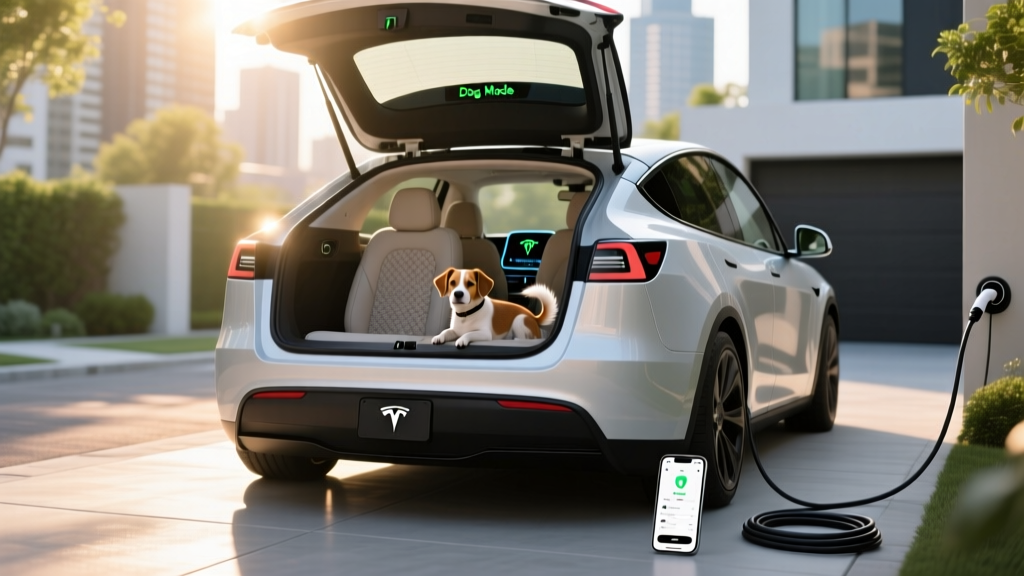
If you've searched for pet mode Tesla, you're likely a pet owner evaluating whether a Tesla can safely keep your dog or cat comfortable while you step away from the vehicle. Tesla's official feature is called Dog Mode, though owners and media frequently refer to it as "Pet Mode." The function debuted in 2019 via an over-the-air software update and remains one of Tesla's most talked-about cabin-climate features.
Dog Mode maintains a set cabin temperature while the vehicle is parked and locked. The touchscreen displays a prominent message visible through the windshield — something like "My driver will be back soon. The cabin is currently 72°F" — to reassure passersby and first responders that the animal inside is safe. The HVAC system runs using the high-voltage traction battery, not the 12V auxiliary battery, which means it can sustain climate control for hours without risk of stranding you with a dead starter battery.
As of the 2025–2026 model years, Dog Mode is available on every Tesla vehicle currently in production: Model 3, Model Y, Model S, Model X, and the Cybertruck. It is accessed through the climate controls on the touchscreen or via the Tesla mobile app, which also lets you monitor cabin temperature remotely.
Which Tesla Models Support Pet Mode? A Model-by-Model Breakdown
Because Dog Mode is a software feature rather than a hardware option, it is standard on every Tesla sold today. What differs significantly is how long each model can sustain Dog Mode, how much range you'll lose, and whether the vehicle's cabin volume is practical for your pet. Below is a specification comparison of the current Tesla lineup with Dog Mode context.
| Spec | Model 3 Long Range AWD | Model Y Long Range AWD | Model S Long Range | Model X Long Range | Cybertruck AWD |
|---|---|---|---|---|---|
| EPA Range | 341 mi | 320 mi | 402 mi | 335 mi | 340 mi |
| Battery (usable) | ~75 kWh (NMC) | ~75 kWh (NMC) | ~95 kWh (NMC) | ~95 kWh (NMC) | ~123 kWh (NMC) |
| Efficiency | 132 MPGe / 25 kWh/100mi | 122 MPGe / 28 kWh/100mi | 124 MPGe / 27 kWh/100mi | 110 MPGe / 31 kWh/100mi | ~100 MPGe / 34 kWh/100mi |
| Max DC Fast Charge | 250 kW | 250 kW | 250 kW | 250 kW | 350 kW |
| 10–80% DCFC Time | ~25 min | ~27 min | ~30 min | ~32 min | ~20 min |
| Level 2 Home Charge | 11.5 kW (~44 mi/hr) | 11.5 kW (~44 mi/hr) | 11.5 kW (~44 mi/hr) | 11.5 kW (~44 mi/hr) | 11.5 kW (~44 mi/hr) |
| 0–60 mph | 4.2 sec | 4.8 sec | 3.1 sec | 3.8 sec | 3.9 sec |
| Horsepower | ~346 hp | ~384 hp | ~670 hp | ~670 hp | ~600 hp |
| Cargo Volume | 23 cu ft (rear seats up) | 30 cu ft (rear seats up) | 28 cu ft (rear seats up) | 88 cu ft (rear seats folded) | 67 cu ft (vault bed) |
| Base MSRP (2025–26) | $47,740 | $44,990 | $79,990 | $84,990 | $79,990 |
| Battery/Drive Warranty | 8 yr / 120,000 mi | 8 yr / 120,000 mi | 8 yr / 150,000 mi | 8 yr / 150,000 mi | 8 yr / 120,000 mi |
Source: EPA estimates via fueleconomy.gov and Tesla's official specification pages. Real-world results vary by driving style, temperature, and terrain.
Real-World Range and Dog Mode Battery Drain: What Pet Owners Need to Know
For Dog Mode specifically, the energy draw depends on the outside temperature and your target cabin temperature. In mild weather (60–80°F ambient), Dog Mode typically consumes between 200 and 400 watts to maintain a comfortable cabin — roughly equivalent to running a few household light bulbs. Over one hour, that translates to approximately 0.2 to 0.4 kWh of battery consumption.
In extreme heat (above 95°F), the air conditioning compressor works harder, and draw can rise to 1–2 kW, consuming roughly 1–2 kWh per hour. In extreme cold (below 20°F), the heat pump or resistive heater may draw 2–4 kW, meaning you could lose 2–4 kWh per hour. On a Model Y with a ~75 kWh usable battery at 80% SoC (60 kWh available), you could theoretically sustain Dog Mode in moderate weather for well over 100 hours — far longer than any practical errand. Even in extreme cold, you'd have roughly 15–25 hours before hitting the 20% SoC cutoff.
The practical takeaway: Dog Mode battery drain is negligible for typical use cases like grocery runs, restaurant stops, or vet visits lasting 30 minutes to 2 hours. The feature is far safer and more reliable than idling a gas car, which produces carbon monoxide risk and burns fuel continuously.
Charging Speeds: How Fast Can You Recharge After a Dog Mode Stop?
| Charge Level | Power (kW) | Miles of Range Added per Hour | Best For |
|---|---|---|---|
| Level 1 (120V outlet) | 1.4 kW | 3–5 mi/hr | Emergency/overnight trickle |
| Level 2 (240V home) | 7.7–11.5 kW | 30–44 mi/hr | Daily home charging |
| DC Fast Charge (Supercharger) | 150–350 kW (peak) | Up to ~200+ mi in 15 min | Road trips |
All current Tesla models use the NACS (North American Charging Standard) connector natively. This means Tesla owners have direct access to the Supercharger network — widely considered the most reliable public DC fast-charging network in the U.S. — without adapters. As of 2025, Tesla's V4 Supercharger stalls can deliver up to 350 kW, though most existing V3 stalls peak at 250 kW.
For context on the charging curve: a Model Y Long Range at a V3 Supercharger will peak near 250 kW at low SoC but tapers significantly above 60%. The advertised 10–80% time of approximately 27 minutes reflects this taper. Charging from 80–100% can take an additional 20–30 minutes — a pattern common to all lithium-ion batteries due to cell-protection protocols.
Home charging setup is where most Tesla owners do 90%+ of their charging. Tesla's Wall Connector, installed on a 60-amp circuit (48-amp continuous), delivers 11.5 kW — adding roughly 44 miles of range per hour on a Model 3 or Model Y. A typical overnight session of 8 hours restores roughly 350 miles, more than enough for virtually any daily use plus Dog Mode consumption. Installation costs typically range from $800 to $2,000 depending on panel capacity and conduit run length.
Tesla Dog Mode vs. Competitor Climate Features for Pets
Several other EVs offer cabin-climate retention features, but Tesla's Dog Mode remains the most recognized and purpose-built implementation. Here's how it compares:
- Hyundai Ioniq 5 / Kia EV6: Offer a "Utility Mode" that maintains HVAC while parked, but lack the external-facing display message that alerts passersby. Owners must leave a note on the window manually.
- Ford Mustang Mach-E: Does not have a dedicated pet mode. Climate can remain on in accessory mode but lacks the same automated safeguards and notifications.
- Rivian R1S / R1T: Offers a "Pet Mode" with a similar screen message and temperature maintenance. A strong competitor for pet owners who need SUV/truck utility and off-road capability.
- BMW iX / i4: Offers a "Climate Now" feature via the app but no dedicated pet-specific mode with an external display.
Tesla's advantage lies in the combination of the large, visible touchscreen message, remote monitoring via the app, automatic SoC cutoff with phone alerts, and the ubiquity of the Tesla Supercharger network for road-tripping pet owners. Rivian's Pet Mode is the closest functional equivalent, but Rivian's charging infrastructure (relying on CCS adapters for DC fast charging) still lags Tesla's native NACS ecosystem.
Pricing, Trims, and Federal Tax Credit Eligibility
| Model | Base MSRP | MSRP Under §30D Cap? | Potential Federal Credit |
|---|---|---|---|
| Model 3 Long Range AWD | $47,740 | Yes (Sedan cap: $55,000) | Up to $7,500* |
| Model Y Long Range AWD | $44,990 | Yes (SUV cap: $80,000) | Up to $7,500* |
| Model S Long Range | $79,990 | Yes (Sedan cap: $55,000 — NO, exceeds) | Not eligible |
| Model X Long Range | $84,990 | No (SUV cap: $80,000 — exceeds) | Not eligible |
| Cybertruck AWD | $79,990 | Yes (Truck cap: $80,000) | Up to $7,500* |
*Under IRS §30D Clean Vehicle Credit, eligibility depends on multiple factors: buyer modified adjusted gross income (MAGI) must not exceed $150,000 single / $225,000 head of household / $300,000 joint; the vehicle must meet critical-mineral and battery-component sourcing requirements that change annually; and MSRP must fall within category caps ($55,000 for sedans, $80,000 for SUVs/trucks/vans). The credit can be transferred to the dealer at point of sale as an instant discount. Always consult a tax professional and verify current-year rules before purchasing.
For pet owners prioritizing value and tax-credit eligibility, the Model Y Long Range AWD at $44,990 (potentially $37,490 after the full $7,500 credit) is the strongest option. It offers the best combination of cabin space, range, and Dog Mode reliability in the Tesla lineup.
Who Should Buy a Tesla for Pet Mode? Decision Framework
Choose the Model Y if: You need maximum rear cargo space for a large dog crate, want the best value after tax credits, and take regular road trips where the Supercharger network matters.
Choose the Model 3 if: You have a smaller pet, prioritize efficiency and lower cost, and primarily commute rather than haul cargo.
Choose the Model X if: You need three-row seating plus pet space, falcon-wing doors for easy pet loading in tight spaces, and budget is not a primary constraint (no tax credit eligibility).
Choose the Cybertruck if: You need a truck bed for outdoor gear alongside your pet, want the most rugged build, and qualify for the credit at the $79,990 AWD trim.
Consider Rivian R1S instead if: You want comparable Pet Mode functionality with more traditional SUV proportions, genuine off-road capability, and don't mind relying on CCS/adapter-based fast charging.
Pros and Cons of Tesla Dog Mode for Pet Owners
✓ Pros
- Large, visible touchscreen message prevents well-meaning strangers from breaking your window
- Runs off the traction battery — no 12V death risk
- Remote monitoring via Tesla app (temperature, SoC)
- Automatic phone alert if battery drops below 20%
- Available on all current Tesla models at no extra cost
- Tesla Supercharger network makes pet-friendly road trips practical
- Heat pump (standard on all current models) improves cold-weather efficiency
✗ Cons
- No dedicated rear-seat climate vents in Model 3 — rear cabin may be slightly warmer/cooler than front
- 20% SoC cutoff means you must plan charging around extended Dog Mode use
- Not a substitute for proper pet restraint — dogs should be in a crash-tested harness or crate
- Tesla insurance premiums can be higher than competitors in some states
- Model S/X exceed MSRP caps for federal tax credit
- No physical rear-view mirror option for checking on pets (camera-based only)
Frequently Asked Questions About Tesla Pet Mode
Is Tesla Dog Mode safe for leaving my dog unattended?
Dog Mode maintains cabin temperature reliably and the external screen message reduces the risk of emergency interventions. However, Tesla and animal-welfare experts recommend limiting unattended time to brief stops. The feature is designed for errands — not for leaving pets in the car all day. Always leave water available for longer stops.
Does Dog Mode work on older Tesla models?
Dog Mode was introduced via an OTA software update in early 2019. Any Tesla Model S, Model X, Model 3, or Model Y running software version 2019.8 or later supports Dog Mode. Vehicles built before approximately 2018 with older hardware (MCU1) may need a media control unit upgrade to support the feature reliably.
Can I use Dog Mode while Supercharging?
Yes. If you're on a road trip and need to use a restroom or grab food while your Tesla charges, Dog Mode works perfectly while plugged in. The charging power far exceeds the HVAC draw, so your battery will continue to gain SoC even with Dog Mode active.
Does the Tesla Model Y have enough space for a large dog?
The Model Y offers 30 cubic feet of cargo space behind the second row and up to 76 cubic feet with the rear seats folded. This is sufficient for a large wire or plastic crate (up to approximately 42-inch length). The low load floor and wide hatch opening make loading easier than in the Model 3 sedan.
How does Dog Mode affect my electricity cost?
At a typical residential rate of $0.13–$0.16 per kWh, running Dog Mode for one hour in moderate weather costs approximately $0.03–$0.06. Even in extreme heat for a full hour, the cost is roughly $0.15–$0.30. This is dramatically cheaper than idling a gasoline vehicle, which burns approximately 0.2–0.5 gallons per hour at idle ($0.60–$1.50+ at current fuel prices).
Does Dog Mode qualify as a safety feature for insurance discounts?
Currently, no major insurer offers a specific discount for Dog Mode. However, Tesla's broader Autopilot and active-safety suite may qualify for usage-based discounts through programs like Tesla Insurance's Safety Score in states where it's offered.