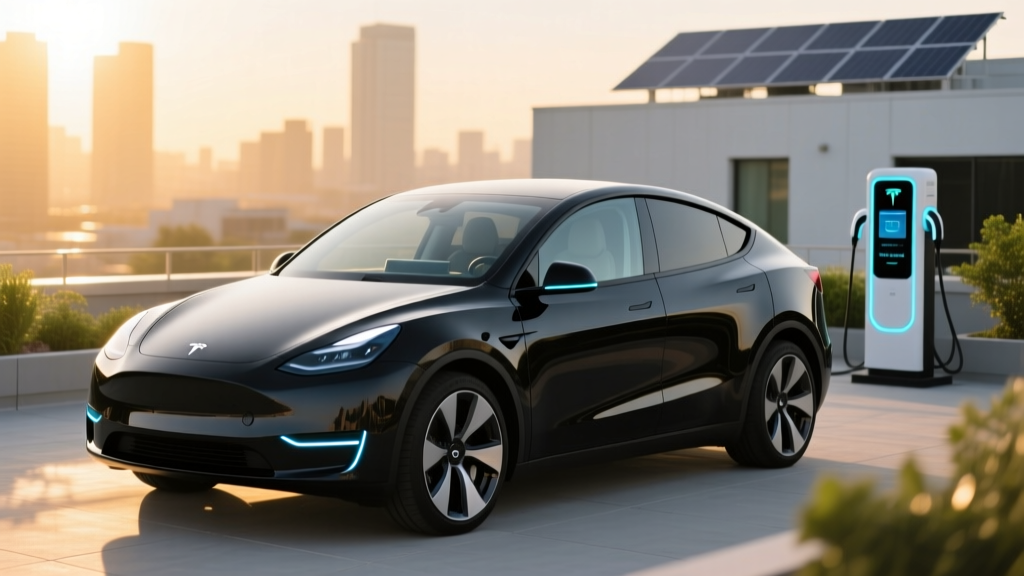
Tesla's stock has long traded at a price-to-earnings multiple that baffles traditional auto analysts. The question — why is Tesla P/E ratio so high — doesn't have a single answer. Part of it is the market pricing in future earnings from energy, autonomy, and software. But another critical piece is the product itself: Tesla's vehicles, particularly the 2026 Model Y, continue to set benchmarks in efficiency, charging infrastructure access, and software that justify premium valuation from the buyer's side. If Tesla can command strong margins on compelling products, the earnings side of that ratio has a solid foundation.
This review examines the 2026 Tesla Model Y Long Range AWD to determine whether the vehicle delivers enough value to support Tesla's market positioning — looking at real-world range, charging speed, pricing after federal tax credits, and how it stacks up against key rivals like the Hyundai Ioniq 5 and Ford Mustang Mach-E.
2026 Tesla Model Y Long Range: Core Specifications
| Attribute | Value |
|---|---|
| EPA Range | 320 miles |
| Battery (usable) | ~78 kWh, NMC (nickel manganese cobalt) |
| Drivetrain | Dual-motor AWD |
| Horsepower | 384 hp (combined) |
| 0–60 mph | 4.8 seconds |
| Peak DC Fast Charge | 250 kW (Supercharger V3) |
| 10–80% DC Fast Charge | ~27 minutes |
| Level 2 Home Charge Rate | 11.5 kW (~44 mi/hr) |
| EPA Efficiency | 122 MPGe combined / 28 kWh/100 mi |
| Cargo Volume (rear seats up) | 30.2 cu ft |
| Cargo Volume (rear seats folded) | 72.1 cu ft |
| Rear Legroom | 39.4 inches |
| Battery & Drive Unit Warranty | 8 years / 120,000 miles |
| Base MSRP | $48,990 (before incentives) |
Real-World Range: What You'll Actually Get
EPA Sticker: 320 miles
Real-World Highway (70–80 mph): Expect 260–285 miles depending on temperature and terrain
Cold-Weather (below 32°F): Range can drop to 220–250 miles without preconditioning; ~250–270 miles with battery preconditioning active
City/Commuter Driving: Closer to EPA or slightly above, thanks to regenerative braking — 310–330 miles is achievable in mild conditions
Tesla's efficiency is genuinely class-leading. At 28 kWh/100 miles, the Model Y extracts more distance per unit of energy than most crossover rivals. The heat pump (standard on all 2026 trims) significantly reduces cold-weather cabin-heating energy draw compared to resistive heaters found on older EVs. That said, EPA estimates assume a mixed driving cycle — sustained 80 mph highway driving with headwinds or elevation gain will reveal the gap between sticker and reality.
For context, the EPA's fueleconomy.gov listing for the Model Y Long Range confirms the 320-mile combined figure and 122 MPGe rating.
Charging Speed: DC Fast, Supercharger Access & Home Level 2
| Charge Level | Power (kW) | Miles Added per Hour | Notes |
|---|---|---|---|
| Level 1 (120V outlet) | ~1.4 kW | ~5 mi/hr | Emergency/trickle only |
| Level 2 (240V home, 48A) | 11.5 kW | ~44 mi/hr | Full charge in ~7 hours |
| DC Fast (Tesla Supercharger V3) | 250 kW peak | ~170 mi in 15 min | 10–80% in ~27 min |
| DC Fast (CCS adapter, EA/others) | Up to 150–175 kW typical | Varies by station | CCS adapter required ($200–250) |
The Model Y's native NACS connector gives it seamless access to Tesla's Supercharger network — now exceeding 25,000 stalls in North America. This is one of the most significant ownership advantages Tesla retains. While competitors have adopted NACS for their 2025+ models, Tesla owners benefit from the most mature, reliable network with integrated navigation and automatic billing.
The charge curve matters: the Model Y peaks near 250 kW between roughly 10–30% state of charge, then tapers. Expect sustained rates around 150–175 kW through 50%, dropping further above 70%. The 10–80% time of ~27 minutes is competitive but not class-leading — the Hyundai Ioniq 5's 800V architecture can achieve 10–80% in about 18 minutes at a 350 kW charger.
For home charging, Tesla's Wall Connector ($420) at 48 amps on a 60A circuit delivers the full 11.5 kW. A licensed electrician will typically charge $800–$2,000 for installation depending on panel proximity and whether a 200-amp service upgrade is needed.
Pricing, Tax Credits & Total Cost of Ownership
| Trim | Base MSRP | Est. Federal Credit (§30D) | Effective Price |
|---|---|---|---|
| Long Range AWD | $48,990 | Up to $7,500 (if eligible) | ~$41,490 |
| Performance AWD | $53,990 | Up to $7,500 (if eligible) | ~$46,490 |
Federal tax credit eligibility under IRS §30D is not automatic. The 2026 Model Y qualifies on MSRP (the SUV cap is $80,000), but buyers must meet income thresholds ($150,000 single / $300,000 joint AGI) and the vehicle's battery must satisfy critical-mineral and battery-component sourcing requirements that tighten annually. As of 2026, Tesla has worked to localize sourcing, but buyers should verify eligibility at the point of sale or consult a tax professional.
The point-of-sale transfer option allows eligible buyers to apply the credit as an immediate discount rather than waiting for tax filing. Tesla's checkout flow supports this, but confirming eligibility before ordering is essential.
Regarding the broader "why is Tesla P/E ratio so high" question: Tesla's ability to price the Model Y near $49K while maintaining industry-leading margins (gross margins around 17–19% on automotive in recent quarters) reflects manufacturing efficiency through gigacasting, vertical integration, and minimal dealer overhead. That margin story is a core pillar supporting the stock's valuation multiple.
Interior, Tech & Driver Assistance
The 2026 Model Y continues Tesla's minimalist interior philosophy. The 15.4-inch center touchscreen handles virtually all vehicle functions — HVAC, navigation, media, and vehicle settings. There is no traditional instrument cluster; a slim secondary display sits ahead of the driver showing speed and basic trip info. Rear passengers get an 8-inch screen for climate and entertainment.
Standout Tech:
- Tesla Supercharger network integration — route planning automatically includes charging stops with preconditioning
- Over-the-air updates — meaningful feature additions arrive quarterly without dealer visits
- Sentry Mode & Dashcam — integrated security recording using the vehicle's camera suite
- Phone-as-key — seamless Bluetooth entry with no fob required
- Frunk + powered liftgate — practical cargo flexibility with 72.1 cu ft total volume
Notable Drawbacks:
- Turn signal stalks removed — signals are on the steering wheel (polarizing in practice)
- No Apple CarPlay or Android Auto — Tesla's native infotainment only
- Minimalist cabin can feel sparse compared to Hyundai/Kia's more button-rich layouts
- Ride quality on 20-inch wheels is firm over rough pavement
Driver Assistance — SAE Level 2: Tesla's Autopilot (standard) and Full Self-Driving (Supervised) ($8,000 option or $99/mo subscription) are SAE Level 2 systems. They require continuous driver attention and hands-on or eyes-on supervision at all times. FSD (Supervised) handles highway lane changes, city intersections, and parking, but it is not autonomous driving. Only Level 4 robotaxi services like Waymo operate without a human driver in defined areas.
How the Model Y Compares to Key Competitors
The Model Y's position in the market is strong but not unchallenged. Here's how it stacks up against two top rivals:
| Spec | Tesla Model Y LR AWD | Hyundai Ioniq 5 LR AWD | Ford Mach-E ER AWD |
|---|---|---|---|
| EPA Range | 320 mi | 290 mi | 300 mi |
| Battery (usable) | ~78 kWh NMC | ~77.4 kWh NMC | ~91 kWh NMC |
| Peak DC Charge | 250 kW | 240 kW (800V) | 150 kW |
| 10–80% Time | ~27 min | ~18 min | ~45 min |
| 0–60 mph | 4.8 sec | 5.1 sec | 5.6 sec |
| Base MSRP | $48,990 | $49,850 | $48,495 |
| Cargo (seats up) | 30.2 cu ft | 27.2 cu ft | 29.7 cu ft |
| NACS Native? | Yes | Yes (2025+) | Adapter required |
The Ioniq 5 wins on DC charging speed thanks to its 800-volt architecture. The Mach-E offers a larger battery but slower charging and slightly less range efficiency. The Model Y's advantages remain the Supercharger network, cargo capacity, and software ecosystem. For buyers who road-trip frequently, Tesla's charging infrastructure edge is difficult to overstate.
Pros
- Class-leading efficiency (28 kWh/100 mi)
- Native Supercharger network access — most reliable DC charging in the US
- Spacious cargo area (72.1 cu ft max) with practical frunk
- Strong OTA update cadence adds features post-purchase
- Competitive 0–60 performance (4.8 sec) for a family crossover
- Heat pump standard — better cold-weather range retention
Cons
- 250 kW peak charge rate trails Ioniq 5's 800V capability
- Turn-signal buttons on steering wheel frustrate some drivers
- No Apple CarPlay / Android Auto
- FSD (Supervised) remains expensive and requires full driver attention
- Panel gaps and interior material quality trail some competitors
- Insurance costs tend to be 15–25% higher than comparable non-Tesla EVs
Who Should Buy the 2026 Tesla Model Y?
Choose the Model Y if:
- You road-trip regularly and want the most reliable public charging network
- You value cargo space and efficiency in a mid-size electric crossover
- You prefer software-driven features and OTA improvements over traditional dealership service
- You want strong performance without stepping to a dedicated sports EV
Look elsewhere if:
- Maximum DC charging speed is your top priority (Ioniq 5's 18-minute 10–80%)
- You want Apple CarPlay or physical HVAC buttons
- You need a third row — the Model Y's optional third row is best suited for small children only
- You prefer a more traditional dealership service experience
For daily commuters with home charging, the Model Y's 320-mile EPA range means most drivers will charge once or twice per week. For families, the cargo volume and safety ratings (5-star NHTSA overall) make it one of the most practical electric crossovers available. Road trippers benefit most from the Supercharger advantage — plan a cross-country drive and the Model Y's routing eliminates most charging logistics anxiety.
Connecting the Product to the P/E Story
Returning to the question of why Tesla's P/E ratio remains so high: the Model Y demonstrates several factors that support premium valuation. Tesla achieves roughly 17–19% gross margins on automotive — significantly above legacy automakers' EV divisions, many of which have operated at a loss or near breakeven. The company's vertical integration (battery cell partnerships, in-house software, direct sales model, Supercharger revenue) creates multiple margin layers that a traditional OEM relying on dealers and third-party charging cannot easily replicate.
The market also prices in optionality: FSD licensing potential, energy storage growth (Megapack), and the Optimus robotics program. Whether those bets pay off is debated, but the underlying automotive product — as demonstrated by the Model Y — remains competitive on specs, efficiency, and ownership experience. For buyers, the practical question is simpler: does the Model Y deliver enough value at ~$41,500–$49,000 to justify the purchase? On range, efficiency, charging access, and cargo utility, the answer for most shoppers in this segment is yes.
Frequently Asked Questions
What is the real-world range of the 2026 Tesla Model Y?
The EPA rates it at 320 miles combined. In real-world highway driving at 70–80 mph, expect 260–285 miles. In cold weather below freezing, range can drop to 220–250 miles without preconditioning. City driving with regenerative braking often matches or slightly exceeds the EPA figure.
How fast does the Model Y charge at home and on the road?
At home on a 240V Level 2 charger (48A), the Model Y charges at 11.5 kW, adding about 44 miles per hour — a full charge takes roughly 7 hours. On a Tesla Supercharger V3, it peaks at 250 kW and charges from 10–80% in approximately 27 minutes. Using a CCS adapter at Electrify America or similar networks, expect 150–175 kW typical speeds.
How much does the 2026 Model Y cost after the federal tax credit?
The Long Range AWD starts at $48,990. If you qualify for the full $7,500 federal §30D credit (meeting income, sourcing, and MSRP requirements), the effective price drops to approximately $41,490. Eligibility is not guaranteed — check IRS guidelines and verify at point of sale.
Does the 2026 Tesla Model Y qualify for the federal EV tax credit?
The Model Y qualifies on MSRP (under the $80,000 SUV cap). However, buyer income must not exceed $150K single / $300K joint, and the battery must meet 2026 critical-mineral and component sourcing thresholds. Tesla has been working to comply, but rules tighten annually. Confirm eligibility before ordering or consult a tax professional.
Is the Model Y worth buying vs. the Hyundai Ioniq 5 or Ford Mach-E?
The Model Y wins on range efficiency, cargo space, and Supercharger network access. The Ioniq 5 charges faster on DC (18 vs. 27 minutes 10–80%) and offers a more conventional interior with physical controls. The Mach-E provides a larger battery but charges significantly slower. If charging infrastructure reliability is your priority, the Model Y remains the strongest choice in 2026.
Why is Tesla's P/E ratio so high compared to other automakers?
Tesla trades at a premium because investors price in higher automotive margins (~17–19% gross), recurring software revenue (FSD subscriptions), energy storage growth, and future optionality (robotaxis, robotics). Legacy automakers' EV divisions have largely operated at lower or negative margins, making Tesla's earnings profile look more like a tech company than a traditional OEM.
What is the Model Y's battery warranty?
Tesla covers the battery and drive unit for 8 years or 120,000 miles (whichever comes first), with a minimum 70% capacity retention threshold. This is competitive with the industry standard of 8 years / 100,000 miles, and Tesla's additional 20,000 miles of coverage is a modest advantage.