Why Tesla's Valuation Matters to EV Buyers
If you've searched for the P/E ratio of Tesla, you've likely seen a number that dwarfs legacy automakers — often hovering between 60x and 90x trailing earnings, compared to 5x–8x for companies like Ford or Toyota. That premium reflects Wall Street's bet on Tesla's energy division, software revenue (FSD subscriptions), and manufacturing scale. But for the person actually spending $45,000 on an EV, the real question is narrower: does a Tesla deliver proportional value in metal, battery, and charging infrastructure — or are you paying for a stock-market narrative?
This review uses the 2026 Tesla Model Y Long Range AWD as the lens to answer that question. We'll cover EPA range versus real-world results, charging speeds on NACS and third-party networks, tax-credit math under current IRS §30D rules, and how the Model Y stacks up against the Hyundai Ioniq 5, Ford Mustang Mach-E, and Kia EV6.
2026 Tesla Model Y: Core Specifications
| Spec | 2026 Model Y Long Range AWD |
|---|---|
| EPA Range | 320 miles |
| Battery Capacity | ~75 kWh usable (NMC) |
| Drivetrain | Dual-motor AWD |
| Horsepower | 384 hp combined |
| 0–60 mph | 4.8 seconds |
| Efficiency | 122 MPGe / 28 kWh/100 mi |
| Max DC Fast Charge | 250 kW peak (NACS) |
| 10–80% DC Time | ~27 minutes |
| Level 2 Home Charge | 11.5 kW (~37 mi/hr) |
| Cargo (rear seats up) | 30.2 cu ft |
| Cargo (rear seats folded) | 72.1 cu ft |
| Base MSRP | $44,990 |
| Battery Warranty | 8 years / 120,000 miles |
Real-World Range vs. EPA Sticker
The EPA rates the 2026 Model Y Long Range at 320 miles. In mixed suburban/highway driving at 65–70 mph with climate control on, expect 270–290 miles of usable range. In cold weather (below 32°F), range drops an additional 15–25%, putting realistic winter highway range near 230–250 miles. Tesla's heat pump helps, but physics still wins in sub-freezing conditions. On warm city routes with heavy regen, some owners report matching or slightly exceeding the EPA figure.
Charging Speed: Supercharger Network and Beyond
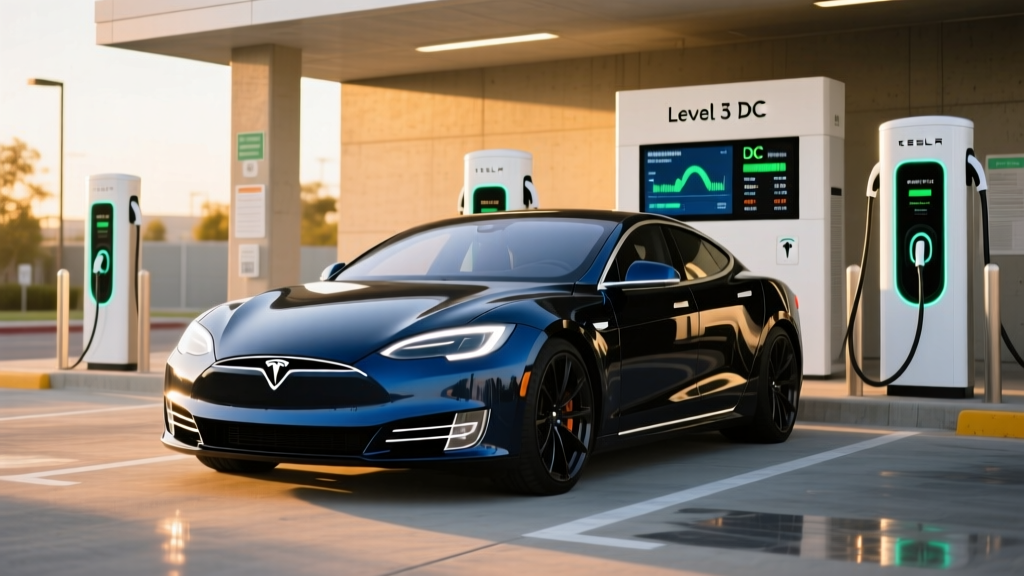
Tesla's Supercharger network remains the most reliable DC fast-charging ecosystem in the U.S., with over 20,000 stalls nationwide. The 2026 Model Y Long Range peaks at 250 kW on V3 Superchargers, though that peak is sustained only briefly — typically between 10% and 30% state of charge. The charge curve tapers progressively: by 60% SoC, you're seeing roughly 120 kW, and above 80%, speeds drop below 50 kW to protect battery longevity.
The 10–80% charge takes approximately 27 minutes under ideal conditions (warm battery, preconditioned via navigation routing). Without preconditioning — for example, pulling into a Supercharger after the car has been sitting cold — expect 35+ minutes.
| Charging Level | Power | Miles Added per Hour | Use Case |
|---|---|---|---|
| Level 1 (120V outlet) | ~1.4 kW | ~4 mi/hr | Emergency / overnight trickle |
| Level 2 (240V, 48A) | 11.5 kW | ~37 mi/hr | Home daily charging |
| DC Fast (V3 Supercharger) | 250 kW peak | ~180 mi in 15 min | Road trips |
| DC Fast (CCS adapter, EA/Ionity) | Up to 150–250 kW | Varies by station | Non-Tesla networks |
Since Tesla opened Superchargers to NACS-equipped non-Tesla EVs, the network has become the de facto national standard. If you own a Tesla, you're on the native connector — no adapter needed at home or at Superchargers. For third-party networks like Electrify America, Tesla sells a CCS adapter (~$175) that enables access, though peak speeds depend on the station's hardware.
Pricing, Trims, and Federal Tax Credit Eligibility
The 2026 Model Y lineup includes three primary trims:
- Long Range AWD: $44,990 MSRP
- Performance AWD: $48,990 MSRP (0–60 in 3.5 sec, 21" wheels, track mode)
- Long Range RWD (if available): ~$41,990 MSRP
Add-ons like FSD (Supervised) at $8,000 or $99/month, premium paint ($1,000–$2,000), and 20" wheels ($1,500) push as-tested prices well above $50,000.
| Scenario | Price |
|---|---|
| Long Range AWD MSRP | $44,990 |
| After §30D Credit (if eligible) | $37,490 |
| Performance AWD MSRP | $48,990 |
| After §30D Credit (if eligible) | $41,490 |
| As-Tested (LR + FSD + Paint) | $54,990 (credit ineligible above $80K SUV cap — N/A here) |
Does the 2026 Model Y Qualify for the $7,500 Federal Tax Credit?
Under current IRS §30D rules, the Model Y qualifies as an SUV (MSRP cap: $80,000). However, the full $7,500 credit depends on two sub-credits:
- $3,750 battery component requirement: battery components must be manufactured or assembled in North America (phased percentages increase annually).
- $3,750 critical minerals requirement: critical minerals must be sourced from the U.S. or FTA partners.
Tesla has shifted significant battery production to U.S. plants (notably the Nevada and Texas Gigafactories using LFP cells from CATL in some trims and NMC from Panasonic in others). Eligibility can change mid-year as sourcing rules tighten. Income caps apply: $150,000 single / $300,000 joint AGI. The credit can now be transferred at point of sale to reduce the purchase price directly. Always verify current eligibility on fueleconomy.gov before purchasing.
Performance, Efficiency, and Daily Driving
The dual-motor AWD Model Y delivers 384 hp and a 4.8-second 0–60 time — quick enough to merge onto any freeway with authority, though the Performance trim's 3.5-second run is noticeably more aggressive. The single-speed transmission means power delivery is instant and linear, with no shift interruptions.
Efficiency is where Tesla's engineering shows. At 122 MPGe combined (28 kWh/100 mi), the Model Y extracts more miles per kilowatt-hour than most competitors. The Ioniq 5 AWD achieves 110 MPGe; the Mach-E Extended Range AWD lands at 101 MPGe. Over 12,000 miles/year at $0.14/kWh (national average home electricity), the Model Y costs roughly $470/year to charge at home — versus $1,600+ for a 25-MPG gas crossover at $3.50/gallon.
Regenerative braking is strong and predictable. Tesla's one-pedal driving mode (now adjustable in settings after earlier removal and reinstatement) allows most daily driving without touching the friction brakes. Brake pad wear on Teslas is typically minimal — many owners report original pads at 80,000+ miles.
Interior, Cargo, and Technology
The Model Y interior remains minimalist: a 15.4" center touchscreen handles navigation, climate, media, and vehicle settings. There is no instrument cluster — speed and range appear in the upper-left corner of the main screen. Build quality on 2026 Fremont and Austin-built units has improved, with tighter panel gaps and updated acoustic glass reducing cabin noise at highway speeds.
Cargo space is a standout: 30.2 cu ft behind the second row and 72.1 cu ft with seats folded. The rear trunk floor is flat, and the front trunk (frunk) adds roughly 4.1 cu ft for charging cables or groceries. Rear legroom measures 40.5 inches — adequate for adults on longer trips, though the sloping roofline limits headroom for passengers over 6'2".
Tech highlights:
- Over-the-air (OTA) software updates add features quarterly
- Sentry Mode dashcam recording with 4 cameras
- Tesla app with remote climate, location, and charge management
- HEPA air filtration (Bioweapon Defense Mode)
- Autopilot standard (SAE Level 2 — driver must remain engaged)
Autopilot & FSD (Supervised): SAE Level 2 — Not Self-Driving
Both the standard Autopilot and the $8,000 FSD (Supervised) package are SAE Level 2 driver-assistance systems. The driver must keep hands on the wheel (or demonstrate attentiveness via cabin camera) and eyes on the road at all times. FSD handles city streets, stop signs, and traffic lights with increasing competence, but it still makes errors — unprotected left turns, construction zones, and faded lane markings require immediate human intervention. Tesla's own documentation calls it "supervised." Only Level 4 services like Waymo operate without a human driver.
Model Y vs. Key Competitors: Value Comparison
Tesla's P/E ratio may reflect investor optimism, but the product itself competes on tangible metrics. Here's how the Model Y Long Range AWD compares to its closest rivals:
| Metric | 2026 Model Y LR AWD | 2026 Ioniq 5 AWD | 2026 Mach-E ER AWD |
|---|---|---|---|
| EPA Range | 320 mi | 290 mi | 300 mi |
| Battery (usable) | 75 kWh (NMC) | 77.4 kWh (NMC) | 91 kWh (NMC) |
| Max DC Charge | 250 kW | 238 kW | 150 kW |
| 10–80% Time | ~27 min | ~18 min (800V) | ~41 min |
| Efficiency (MPGe) | 122 | 110 | 101 |
| 0–60 mph | 4.8 sec | 5.1 sec | 5.1 sec |
| Base MSRP | $44,990 | $49,950 | $48,495 |
The Ioniq 5's 800V architecture charges faster (18 min vs. 27 min, 10–80%), a meaningful advantage on road trips. But the Model Y's efficiency edge means fewer stops overall — 320 miles of range covers most single-day drives without charging. The Mach-E offers a larger battery but heavier weight hurts its MPGe. On price, the Model Y undercuts both by $3,500–$5,000 before any credits.
Pros
- Class-leading efficiency (122 MPGe) means lower charging costs
- Supercharger network reliability — few broken stalls, consistent speeds
- OTA updates continuously improve the vehicle post-purchase
- Strong cargo capacity (72.1 cu ft) and practical hatchback form factor
- Competitive base MSRP under $45,000 for AWD long-range EV
- Low brake wear thanks to aggressive regen
Cons
- Charging curve tapers significantly above 60% SoC — 27 min 10–80% trails Ioniq 5
- Minimalist interior lacks physical buttons — climate and mirror adjustments are screen-only
- FSD ($8,000) remains Level 2; value proposition debated among owners
- Rear visibility compromised by sloping roofline and small rear window
- No Apple CarPlay or Android Auto — Tesla's native infotainment only
- Insurance premiums run 15–30% higher than comparable gas crossovers
Who Should Buy the 2026 Model Y?
Choose the Model Y if:
- You want the lowest cost-per-mile in the electric crossover segment
- You road-trip regularly and want Supercharger network access without adapters
- You value OTA software updates and a tech-forward ownership experience
- Cargo space and hatchback utility are priorities (family hauling, Costco runs, bikes)
Look elsewhere if:
- Fastest possible DC charging is your top priority (Ioniq 5's 800V system wins)
- You want Apple CarPlay/Android Auto (Ford, Hyundai, Kia all offer it)
- You prefer physical buttons and a traditional instrument cluster
- You need three rows of seating (consider the Kia EV9 or Tesla Model X)
Frequently Asked Questions
What is the real-world range of the 2026 Tesla Model Y?
EPA-rated at 320 miles, real-world highway range averages 270–290 miles in moderate temperatures. In cold weather (below 32°F), expect 230–250 miles on highway trips. City driving with regen can match or slightly exceed the EPA number.
How fast does the Model Y charge at home and on the road?
On a 48-amp Level 2 home charger (240V), the Model Y adds roughly 37 miles of range per hour — a full overnight charge from 20% to 100% takes about 8–9 hours. On a V3 Supercharger, it peaks at 250 kW and charges 10–80% in approximately 27 minutes with battery preconditioning.
How much does the Model Y cost after the federal tax credit?
The Long Range AWD starts at $44,990. If you qualify for the full $7,500 §30D credit (subject to income caps, battery sourcing rules, and MSRP limits), the effective price drops to $37,490. The point-of-sale transfer option lets you apply the credit as an immediate discount at purchase.
Does the 2026 Model Y qualify for the $7,500 federal EV tax credit?
The Model Y qualifies as an SUV under the $80,000 MSRP cap. Whether you receive the full $7,500, a partial $3,750, or nothing depends on battery component and critical mineral sourcing (which shifts quarterly) and your adjusted gross income ($150K single / $300K joint). Verify current status on fueleconomy.gov and consult a tax professional.
Is the Model Y worth buying over the Ioniq 5 or Mach-E?
The Model Y wins on efficiency, range, base price, and charging-network access. The Ioniq 5 wins on DC charging speed and interior design. The Mach-E offers a larger battery and a more traditional driving feel. If Supercharger reliability matters to you, the Model Y's ecosystem advantage is difficult to replicate.
What is Tesla's battery warranty?
Tesla covers the Model Y battery and drive unit for 8 years or 120,000 miles (whichever comes first), with a minimum 70% capacity retention threshold. If degradation drops below 70% within the warranty period, Tesla will repair or replace the battery at no cost.
Why is Tesla's P/E ratio so much higher than other automakers?
Tesla's P/E ratio (typically 60x–90x trailing earnings) reflects investor expectations for revenue beyond vehicle sales: energy storage (Megapack, Powerwall), FSD software licensing, Supercharger network revenue, and potential robotaxi services. Legacy automakers trade at 5x–8x because their revenue is predominantly from one-time vehicle sales with lower software margins. Whether that premium is justified depends on execution — but for buyers, the product-level value proposition is what matters at the dealership.