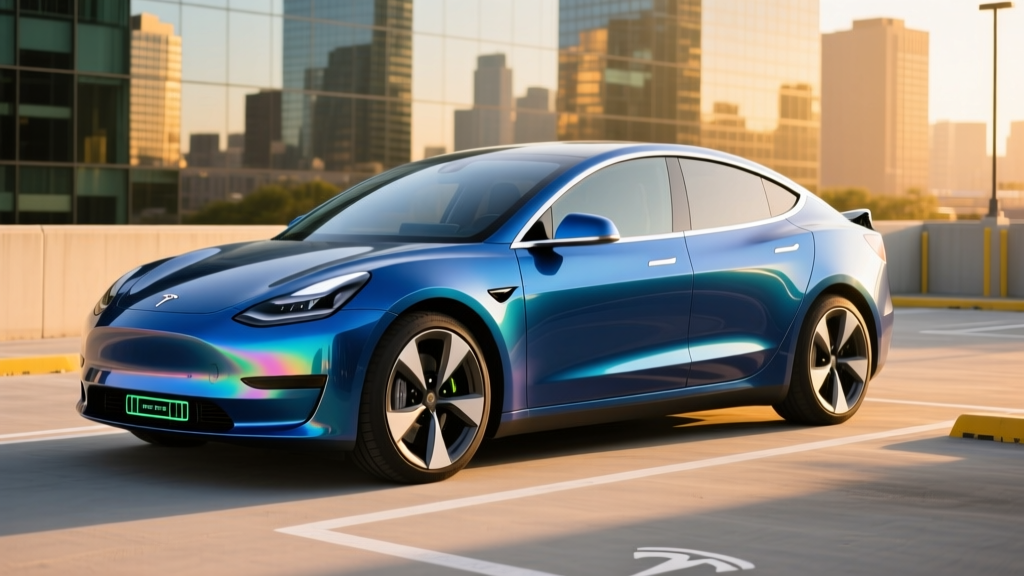
If you've ever left your Tesla parked for a weekend and returned to find the range estimate lower than when you left it, you're not imagining things. "Tesla parked" is one of the most-searched ownership questions in 2026, and for good reason: understanding what happens to your battery, energy consumption, and range while the car sits idle is critical for apartment dwellers, airport parkers, and anyone without daily home charging access.
This guide covers every current Tesla model — the Model 3, Model Y, Model S, and Model X — with a specific focus on idle energy loss (vampire drain), Sentry Mode power draw, battery chemistry differences, and best practices for short-term and long-term parking. We'll also provide the full spec breakdown you need as a buyer, including EPA range, charging speeds, pricing, and federal tax credit eligibility.
Why Does a Tesla Lose Range While Parked?
Unlike a gas car that simply sits without consuming fuel, a Tesla parked and turned off still draws small amounts of energy from the high-voltage traction battery. This is commonly called vampire drain or phantom drain. Several systems remain active even when the vehicle appears off:
- Thermal management: The battery management system (BMS) periodically checks cell temperatures and may activate cooling or heating to keep the pack within safe limits.
- Telematics and connectivity: The car maintains a cellular connection for app communication, OTA update checks, and remote commands.
- Sentry Mode: When enabled, cameras and the onboard computer stay active, drawing significantly more power.
- Cabin overheat protection: In hot climates, the system may run the A/C compressor to prevent interior temperatures from exceeding safe thresholds.
- 12V battery maintenance: The high-voltage pack periodically tops off the 12V lithium auxiliary battery.
According to Tesla's own documentation and owner data aggregated across forums, a Tesla parked with all energy-draining features disabled typically loses 1–3% of state of charge (SoC) per day. With Sentry Mode active, that figure jumps to 5–10% per day depending on how frequently the cameras trigger recording events.
Tesla Parked Drain: Model-by-Model Range Impact
The table below shows EPA-estimated range for each 2026 Tesla model alongside expected daily range loss while parked under different conditions. These figures are derived from EPA data via fueleconomy.gov and real-world owner reporting.
| Model / Trim | EPA Range | Usable Battery | Chemistry | Drain (Standby) | Drain (Sentry On) |
|---|---|---|---|---|---|
| Model 3 RWD | 272 mi | 57.5 kWh | LFP | ~2 mi/day | ~8–12 mi/day |
| Model 3 Long Range AWD | 363 mi | 78.1 kWh | NMC | ~3 mi/day | ~10–15 mi/day |
| Model Y Long Range AWD | 320 mi | 78.1 kWh | NMC | ~3 mi/day | ~10–14 mi/day |
| Model S LR / Plaid | 402 / 396 mi | 95 kWh | NMC | ~3–4 mi/day | ~12–18 mi/day |
| Model X LR / Plaid | 335 / 326 mi | 95 kWh | NMC | ~3–4 mi/day | ~12–16 mi/day |
Battery Chemistry Matters: LFP vs NMC While Parked
Not all Tesla batteries behave the same way while parked. The base Model 3 RWD uses a lithium iron phosphate (LFP) pack, while Long Range, Performance, Model S, and Model X variants use nickel manganese cobalt (NMC) chemistry. Here's how that affects parked behavior:
| Factor | LFP (Model 3 RWD) | NMC (LR / Performance / S / X) |
|---|---|---|
| Daily charge recommendation | 100% (Tesla recommends weekly 100% charge) | 80% for daily; 100% only for trips |
| Self-discharge rate | Slightly lower | Slightly higher at high SoC |
| Calendar degradation risk at 100% SoC | Low — LFP tolerates full charge well | Higher — prolonged 100% SoC accelerates wear |
| Cold-weather parked loss | Similar phantom drain, but LFP has lower energy density so absolute miles lost feel larger | Better energy density buffers absolute mile loss |
| Long-term parking recommendation | Leave at 50–80% SoC | Leave at 50% SoC; avoid 100% or below 20% |
The key takeaway: if you drive a Model 3 RWD with LFP and routinely charge to 100%, parking it fully charged for a few days is relatively harmless. But if you own a Long Range or Performance model with NMC, parking at 100% SoC for extended periods accelerates calendar degradation. Set your charge limit to 50% before leaving the car for a week or more.
Charging Specs: How Quickly Can You Recover Parked Range Loss?
If your Tesla has lost 15–30 miles of range over a parked weekend, how fast can you top it back up? Here are the 2026 charging specifications across the lineup:
| Model | Max DC Fast Charge | 10–80% Time | Level 2 Home Rate | Level 2 Miles/Hr |
|---|---|---|---|---|
| Model 3 RWD | 170 kW | ~25 min | 11.5 kW (48A) | ~33 mi/hr |
| Model 3 LR AWD | 250 kW | ~22 min | 11.5 kW (48A) | ~41 mi/hr |
| Model Y LR AWD | 250 kW | ~24 min | 11.5 kW (48A) | ~37 mi/hr |
| Model S LR | 250 kW | ~28 min | 11.5 kW (48A) | ~41 mi/hr |
| Model X LR | 250 kW | ~30 min | 11.5 kW (48A) | ~34 mi/hr |
All current Teslas use the NACS (North American Charging Standard) connector natively. Tesla's Supercharger network remains the most reliable DC fast-charging ecosystem in the U.S., with V4 cabinets delivering up to 250 kW (and select locations testing higher rates). A critical note on charge curves: peak kW is not sustained. A Model 3 Long Range may hit 250 kW briefly between 10–20% SoC, then taper to ~150 kW by 50%, and drop below 50 kW past 80%. That's why the 10–80% metric is the industry standard — charging from 80–100% can take as long as 10–80%.
For home Level 2 charging, a Tesla Wall Connector on a 60-amp circuit (48A continuous) adds enough range overnight to fully recover any parked drain for any model. If you're parking at an airport for a week and returning to a depleted battery, a 20-minute Supercharger stop will recover most of the lost range.
Minimizing Tesla Parked Drain: Settings That Matter
Here are the specific settings to adjust before leaving your Tesla parked for more than 24 hours:
- Disable Sentry Mode — This is the single largest phantom drain source. Go to Controls > Safety > Sentry Mode and turn it off. If security is a concern, enable it only in high-risk locations.
- Turn off Cabin Overheat Protection — Unless you're parking in extreme heat with pets or sensitive items inside, this feature can consume 1–2 kWh per activation cycle.
- Disable "Always Connected" / Standby Mode — Some software versions include a standby connectivity mode that keeps the car's modem active. Disabling it reduces drain but increases the latency of app wake-up commands.
- Close the Tesla app — Frequently opening the app forces the car to wake from sleep, interrupting low-power mode. Check your range once, then leave the car alone.
- Set charge limit appropriately — 50% SoC for NMC vehicles parked longer than a week; 50–80% for LFP. Avoid parking at 100% or below 10%.
- Disable scheduled departure preconditioning — If you won't be driving at a set time, turn this off to prevent the car from heating or cooling the battery unnecessarily.
With all of these settings optimized, a Tesla parked for 7 days should lose no more than 5–8% SoC — roughly 15–25 miles of range on a Long Range model.
Long-Term Parking: Airport, Storage & Vacation Scenarios
Leaving a Tesla parked for two weeks or more requires additional planning:
Airport parking (1–2 weeks): Set SoC to 50%, disable Sentry Mode and Cabin Overheat Protection, and close the app. Expect to lose 8–15% SoC over 14 days. Plan a Supercharger stop on your return if the nearest charger isn't at the airport.
Long-term storage (1–3 months): Tesla recommends leaving the vehicle plugged into a Level 2 charger with the charge limit set to 50%. The car will maintain that SoC automatically, topping up only as phantom drain depletes it. If plugging in isn't possible, leave at 50% SoC and expect roughly 2–3% loss per month with all systems disabled. The 12V lithium auxiliary battery is maintained by the high-voltage pack, so as long as the main pack has charge above ~5%, the 12V battery will not die.
Extreme cold storage (below 0°F / -18°C): Lithium-ion cells can be damaged if charged while below freezing. The BMS prevents charging in these conditions, but if the car is parked unplugged in sustained extreme cold, the battery may drop to a SoC where it cannot self-heat. Tesla recommends keeping the vehicle plugged in during sub-zero parking whenever possible.
Pricing, Tax Credits & Ownership Costs (2026)
Here's what each Tesla model costs before and after the federal EV tax credit, per current IRS §30D rules. Eligibility depends on buyer income caps ($150K single / $300K joint MAGI), vehicle MSRP caps ($55K sedans / $80K SUVs, trucks, vans), and battery component/critical mineral sourcing requirements.
| Model / Trim | Base MSRP | MSRP Cap Status | Est. Credit | Effective Price |
|---|---|---|---|---|
| Model 3 RWD | $38,990 | Under $55K cap ✓ | Up to $7,500* | ~$31,490* |
| Model 3 LR AWD | $45,490 | Under $55K cap ✓ | Up to $7,500* | ~$37,990* |
| Model Y LR AWD | $44,990 | Under $80K SUV cap ✓ | Up to $7,500* | ~$37,490* |
| Model S LR | $79,990 | Over $55K sedan cap ✗ | $0 | $79,990 |
| Model X LR | $84,990 | Over $80K SUV cap ✗ | $0 | $84,990 |
*Credit amount depends on battery sourcing compliance, which Tesla updates periodically. Verify current eligibility on the IRS clean vehicle credit page or with a tax professional. Point-of-sale transfer is available at participating dealers, reducing the purchase price directly rather than waiting for tax filing.
Performance, Efficiency & Warranty Snapshot
| Spec | Model 3 RWD | Model 3 LR | Model Y LR | Model S LR | Model X LR |
|---|---|---|---|---|---|
| 0–60 mph | 5.8 sec | 4.2 sec | 4.8 sec | 3.1 sec | 3.8 sec |
| Horsepower | 271 hp | 384 hp | 384 hp | 670 hp | 670 hp |
| Drivetrain | RWD | AWD (Dual Motor) | AWD (Dual Motor) | AWD (Dual Motor) | AWD (Dual Motor) |
| MPGe (combined) | 132 MPGe | 125 MPGe | 117 MPGe | 120 MPGe | 109 MPGe |
| kWh/100 mi | 25 | 27 | 29 | 28 | 31 |
| Cargo (rear seats up) | 23 cu ft | 23 cu ft | 30 cu ft | 28 cu ft | 37 cu ft |
| Rear legroom | 35.3 in | 35.3 in | 41.6 in | 39.6 in | 41.0 in |
| Battery warranty | 8 yr / 100K mi | 8 yr / 120K mi | 8 yr / 120K mi | 8 yr / 150K mi | 8 yr / 150K mi |
| Retention threshold | 70% of original capacity during warranty period | ||||
Tesla's battery warranty guarantees that the pack will retain at least 70% of its original capacity over the warranty period. Real-world degradation data from large owner datasets (including TeslaFi and Recurrent Auto) shows that most Tesla packs lose only 5–8% capacity over the first 100,000 miles, with the steepest drop occurring in the first 10,000–20,000 miles before the curve flattens significantly.
Autopilot, FSD & Tech: What's Active While Parked?
While parked, Tesla's tech suite includes several features that affect energy consumption:
- Sentry Mode: Records camera footage when motion or impacts are detected. Stores clips on a USB drive. Major battery drain source.
- Dog Mode: Maintains cabin temperature for pets while displaying a message on the touchscreen. Draws ~1–3 kW continuously.
- Camp Mode: Keeps climate control and USB ports active for overnight camping. Similar draw to Dog Mode.
- Smart Summon: Allows the car to navigate a parking lot to your location via the app. Requires the car to be powered on and uses the full ADAS compute stack.
- OTA Updates: Tesla frequently pushes software updates. If scheduled during parked hours, the download and install process can consume 0.5–1 kWh.
The 15.4-inch touchscreen runs Tesla's proprietary infotainment OS with native navigation, Spotify, Netflix/YouTube (while parked), and a built-in trip planner that accounts for charging stops and battery preconditioning.
Who Should Buy a Tesla (and Who Shouldn't)?
Choose a Tesla if:
- You have access to home Level 2 charging or live near reliable Superchargers
- You value the Supercharger network for road trips (the most seamless public charging experience in the U.S.)
- You want strong performance per dollar — the Model 3 LR at ~$38K after credit is one of the fastest sedans at any price
- You prioritize software features, OTA improvements, and app-based vehicle management
Look elsewhere if:
- You park on the street with no charging access and rely entirely on public infrastructure
- You need Apple CarPlay / Android Auto (Tesla does not support either)
- You want a traditional dealership service experience with loaner vehicles
- You need a sub-$30K new EV — consider the Chevrolet Equinox EV or Nissan Leaf instead
Pros and Cons at a Glance
- Supercharger network: 6,000+ U.S. stalls with industry-best uptime
- Class-leading efficiency (kWh/100mi) across the lineup
- Strong real-world range — Model 3 LR delivers 320+ mi in mixed driving
- OTA updates continuously add features post-purchase
- LFP battery on Model 3 RWD offers excellent longevity at a lower price
- Minimal parked drain when settings are optimized (~2 mi/day standby)
- Sentry Mode is a major battery drain (up to 12 mi/day)
- No Apple CarPlay or Android Auto
- Model S and Model X exceed MSRP caps — no federal tax credit
- Service center wait times can be weeks in high-demand metro areas
- Build quality inconsistencies still reported (panel gaps, paint)
- NMC models require careful SoC management during long parking periods
Frequently Asked Questions
What is the real-world range of a Tesla parked for a week?
With Sentry Mode off and all standby features minimized, expect to lose roughly 5–8% SoC over 7 days. On a Model 3 Long Range (363 mi EPA), that translates to about 18–29 miles of range lost — leaving you with roughly 334–345 miles of range when you return. With Sentry Mode on, losses can reach 15–20% or more.
How fast does a Tesla charge after being parked and drained?
At a 250 kW Supercharger, a Model 3 Long Range can recover 200 miles of range in about 15 minutes. At home on a Level 2 Wall Connector (11.5 kW), you'll add roughly 37–41 miles per hour — an overnight charge fully replenishes any parked drain.
How much does a Tesla cost after tax credits in 2026?
The Model 3 RWD starts at $38,990 and can drop to approximately $31,490 with the full $7,500 federal credit, subject to IRS §30D income caps ($150K single / $300K joint), MSRP caps, and battery sourcing requirements. Model S and Model X exceed MSRP limits and do not qualify.
Is a Tesla worth buying vs. competitors like the Hyundai Ioniq 6 or BMW i4?
Tesla's advantages are the Supercharger network, efficiency, and software. The Hyundai Ioniq 6 offers comparable range (361 mi EPA) with 800V ultra-fast charging and Apple CarPlay. The BMW i4 provides premium build quality and a traditional dealer experience. If public charging reliability is your top priority, Tesla still leads. If you want CarPlay or dealer service, look at legacy automakers.
Does a Tesla qualify for the federal EV tax credit?
The Model 3 (RWD and Long Range) and Model Y (Long Range and Performance) currently qualify for up to $7,500 under IRS §30D, provided the buyer meets income caps and the vehicle's battery components and critical minerals meet domestic sourcing thresholds. Always verify on irs.gov before purchasing, as sourcing compliance can change quarterly.
Should I leave my Tesla plugged in while parked long-term?
Yes — if you have Level 2 access, Tesla recommends leaving the car plugged in with the charge limit set to 50% for extended parking. The car will maintain that SoC automatically, preventing both over-charge degradation and deep-discharge risk.
Can a Tesla's 12V battery die while parked?
The 12V lithium auxiliary battery is maintained by the high-voltage traction pack as long as the main battery has charge. Current Tesla models use a lithium 12V battery (replacing the older lead-acid units), which is more reliable and longer-lasting. If the main pack drops below ~5%, the 12V battery may no longer receive maintenance charges, but this scenario is extremely rare with normal parked drain rates.
Understanding what happens to your Tesla parked — whether for a weekend at the airport or a month in storage — comes down to managing a few key settings and respecting the battery chemistry in your specific model. Disable Sentry Mode when unnecessary, set your SoC appropriately for your chemistry type, and plug in whenever possible. With these practices, phantom drain becomes a minor inconvenience rather than a genuine ownership concern.