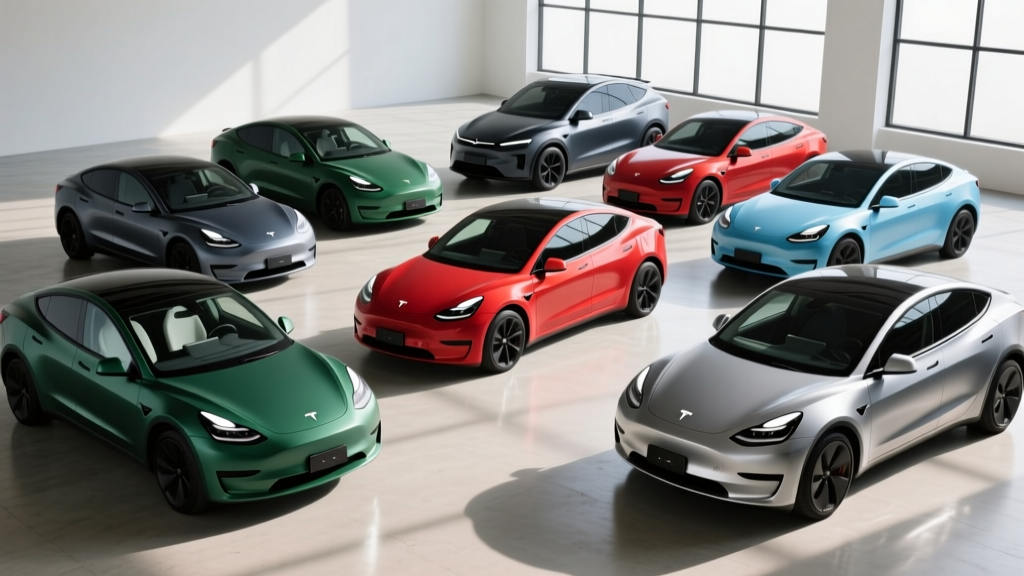
If you've been browsing Tesla's configurator and wondering what colors do Teslas come in, the answer has expanded considerably over the last few years. Tesla has moved well beyond the basic five-color palette that defined its earlier lineup, introducing premium multi-coat finishes, regional exclusives, and a new Ultra Red that replaced the older Red Multi-Coat. But paint is only part of the purchase decision. Below, we map every current Tesla factory color to each model, then dive into the range, charging, pricing, and ownership data you actually need before configuring your order.
Every Tesla Color Available in 2026, by Model
Tesla's color availability varies by model and, occasionally, by region. Here is the complete factory paint menu as of the current model year. Note that Tesla periodically rotates offerings — Ultra White and Solid Black remain the longest-standing staples, while colors like Quicksilver and Midnight Cherry Red are newer additions.
| Color | Model 3 | Model Y | Model S | Model X | Cybertruck |
|---|---|---|---|---|---|
| Pearl White Multi-Coat | ✓ | ✓ | ✓ | ✓ | — |
| Solid Black | ✓ | ✓ | ✓ | ✓ | — |
| Deep Blue Metallic | ✓ | ✓ | ✓ | ✓ | — |
| Ultra Red | ✓ | ✓ | ✓ | ✓ | — |
| Quicksilver | ✓ | ✓ | ✓ | ✓ | — |
| Midnight Cherry Red | ✓ (Highland) | ✓ (Juniper) | ✓ | ✓ | — |
| Stealth Grey | — | — | — | — | ✓ (wrap) |
| Satin White | — | — | — | — | ✓ (wrap) |
| Stainless Steel (raw) | — | — | — | — | ✓ (default) |
Paint pricing note: Pearl White Multi-Coat is typically the no-cost default on Model 3 and Model Y. Solid Black, Deep Blue Metallic, Ultra Red, and Quicksilver generally add $1,000–$2,500 depending on the model and finish complexity. Midnight Cherry Red, a multi-coat premium option, commands $2,500 on most configurations. Cybertruck's stainless-steel exoskeleton ships unpainted by default; color options are applied via vinyl wrap at delivery or aftermarket.
Tesla Model Lineup: Range, Battery, and Charging Specs
Color catches the eye, but the powertrain determines daily livability. Here's how each current Tesla stacks up on the numbers that matter.
| Spec | Model 3 LR AWD | Model Y LR AWD | Model S LR | Model X LR | Cybertruck AWD |
|---|---|---|---|---|---|
| EPA Range | 346 mi | 320 mi | 402 mi | 348 mi | 340 mi |
| Battery (usable) | ~79 kWh (NMC) | ~78 kWh (NMC) | ~95 kWh (NMC) | ~95 kWh (NMC) | ~123 kWh (NMC) |
| Max DC Fast Charge | 250 kW | 250 kW | 250 kW | 250 kW | 250 kW (350 kW capable) |
| 10–80% DC Time | ~25 min | ~27 min | ~30 min | ~32 min | ~28 min |
| Level 2 Home Rate | 11.5 kW (~44 mi/hr) | 11.5 kW (~44 mi/hr) | 11.5 kW (~41 mi/hr) | 11.5 kW (~35 mi/hr) | 11.5 kW (~34 mi/hr) |
| 0–60 mph | 4.2 sec | 4.8 sec | 3.1 sec | 3.8 sec | 4.1 sec |
| Horsepower | 346 hp | 384 hp | 670 hp | 670 hp | 600 hp |
| Drivetrain | Dual Motor AWD | Dual Motor AWD | Dual Motor AWD | Dual Motor AWD | Tri Motor AWD (Beast) / Dual AWD |
| Efficiency (MPGe) | 132 MPGe | 122 MPGe | 120 MPGe | 105 MPGe | 72 MPGe |
| kWh/100 mi | 25 | 28 | 28 | 32 | 47 |
Charging Infrastructure: Home, Supercharger, and NACS
Tesla's proprietary North American Charging Standard (NACS) connector is now the industry standard, with Ford, GM, Rivian, Volvo, and others adopting it through 2025–2026. This gives Tesla owners the most mature fast-charging network in the country — over 17,000 Supercharger stalls across North America as of early 2026, per Tesla's public network data.
Home Charging Setup
All current Teslas accept up to 11.5 kW on Level 2 (48 amps on a 60-amp circuit). A Tesla Wall Connector costs $475 and delivers up to 44 miles of range per hour of charging on a Model 3. Professional installation of a 240V/60A circuit typically runs $800–$2,000 depending on panel proximity and local permitting. If your electrical panel is at capacity, a panel upgrade to 200A can add $1,500–$3,000.
DC Fast Charging Reality
Tesla's V3 Superchargers peak at 250 kW. The Cybertruck is architected for 800V charging and can accept up to 350 kW at compatible V4 stalls, though V4 deployment is still expanding. The critical nuance: peak kW is not sustained kW. A Model 3 Long Range hitting 250 kW at 10% SoC will taper to ~100 kW by 60% and ~50 kW by 80%. The 10–80% time (~25 minutes) reflects this charge curve taper. Always precondition your battery via the Tesla app or in-car navigation before arriving at a Supercharger — skipping preconditioning can add 5–10 minutes to your session in cold weather.
Pricing, Trims, and Federal Tax Credit Eligibility
Tesla pricing shifts frequently — sometimes monthly. Below are base MSRPs as listed on Tesla's configurator for the current model year. The federal EV tax credit under IRS §30D remains a key purchase factor, but eligibility is far from universal.
| Model / Trim | Base MSRP | §30D Credit Eligible? | Est. After-Credit Price |
|---|---|---|---|
| Model 3 RWD | $38,990 | Yes (up to $7,500, subject to sourcing rules) | ~$31,490 |
| Model 3 LR AWD | $45,490 | Yes (up to $7,500) | ~$37,990 |
| Model 3 Performance | $52,990 | Yes (up to $7,500) | ~$45,490 |
| Model Y LR AWD | $44,990 | Yes (up to $7,500) | ~$37,490 |
| Model Y Performance | $48,990 | Yes (up to $7,500) | ~$41,490 |
| Model S LR | $79,990 | No (exceeds $55,000 sedan MSRP cap) | $79,990 |
| Model X LR | $79,990 | No (exceeds $80,000 SUV cap in some configs) | $79,990 |
| Cybertruck AWD | $79,990 | Partial (battery sourcing rules may reduce to $3,750) | ~$76,240 |
Interior, Cargo, and Tech: What You Live With Daily
Cargo and Passenger Space
The Model Y remains Tesla's most practical family hauler with 72 cu ft of cargo space (rear seats folded) and an available third-row option for seven-passenger seating. The refreshed Model 3 (Highland) offers 23 cu ft of trunk space plus a usable frunk. Model S and X provide generous rear legroom (40+ inches) but their premium pricing puts them in a different ownership tier.
The Cybertruck's 6-foot bed with powered tonneau cover and 121 cu ft of total lockable storage (including frunk and sail pillars) is genuinely functional for work use, though the angular bed geometry limits some traditional truck-bed accessories.
Infotainment and Driver Assistance
All Teslas run Tesla's proprietary infotainment OS on a 15.4-inch center touchscreen (Model 3/Y) or 17-inch display (Model S/X/Cybertruck). There is no Apple CarPlay or Android Auto — Tesla's native navigation, media, and phone integration are robust but require buy-in to the Tesla ecosystem.
Who Should Buy a Tesla — And Who Should Look Elsewhere
Best For
- Commuters with home charging: Wake up to a full battery every morning; never visit a gas station.
- Tech-forward buyers: OTA updates, app integration, and the Supercharger network are unmatched.
- Families needing cargo space: Model Y offers crossover practicality with EV running costs.
- Road-trip enthusiasts: Supercharger density means reliable long-distance travel across all 48 states.
Look Elsewhere If
- No home charging access: Relying solely on public charging adds cost, time, and frustration.
- You want CarPlay/Android Auto: Tesla's walled garden isn't for everyone.
- Build quality is a priority: Panel gaps and trim inconsistencies, while improved, still trail legacy luxury brands.
- You need a traditional truck bed: Cybertruck's geometry and stainless steel limit aftermarket accessories.
Warranty and Long-Term Ownership
Tesla's warranty structure is straightforward but worth understanding before purchase:
- Basic Vehicle: 4 years / 50,000 miles
- Battery & Drive Unit (Model 3/Y RWD with LFP): 8 years / 100,000 miles, minimum 70% capacity retention
- Battery & Drive Unit (Model 3/Y LR, Model S/X): 8 years / 120,000 miles, minimum 70% capacity retention
- Cybertruck Battery: 8 years / 120,000 miles
The 70% retention threshold means Tesla warrants that your battery will hold at least 70% of its original capacity during the warranty period. Real-world degradation data from fleet analyses shows most Tesla NMC batteries lose ~8–12% capacity over the first 100,000 miles, with the curve flattening significantly after the initial break-in period. LFP batteries (used in Model 3 RWD) tolerate regular 100% charging and show slower long-term degradation but offer lower energy density and reduced cold-weather performance.
Tesla vs. Key Competitors: Is It Still the Default Choice?
The competitive landscape has shifted dramatically. The Hyundai Ioniq 5 and Kia EV6 match or exceed Tesla's charging speeds (up to 350 kW on 800V architecture, 10–80% in ~18 minutes). The Ford Mustang Mach-E offers competitive range and now accesses Superchargers via NACS adapter. The Rivian R1S and R1T compete directly with Model X and Cybertruck in the premium electric SUV/truck space.
Tesla's enduring advantages remain the Supercharger network (though opening to other brands dilutes exclusivity), software maturity, and resale value — though Tesla depreciation has accelerated as price cuts have compressed used values. For buyers prioritizing charging convenience and ecosystem integration, Tesla still leads. For those wanting faster peak charging, more interior material quality, or CarPlay support, competitors deserve serious evaluation. Check fueleconomy.gov for side-by-side EPA efficiency comparisons across all models.
Frequently Asked Questions
What is the cheapest Tesla color?
Pearl White Multi-Coat is the no-cost default on Model 3 and Model Y. On Model S and Model X, Pearl White is also typically included at no extra charge. Every other color adds $1,000–$2,500 to the purchase price.
Does Tesla offer matte or satin finishes from the factory?
Not as paint. The Cybertruck offers Satin White and Stealth Grey as factory-applied vinyl wraps. For other models, any matte or satin finish requires an aftermarket wrap, typically $3,000–$5,000 installed.
Can I change my Tesla's color after ordering?
Before delivery, you can modify your configuration in the Tesla app. After delivery, your options are aftermarket paint protection film (PPF) with color tint or a full vinyl wrap. Tesla does not offer factory repaints.
Which Tesla color hides dirt and scratches best?
Quicksilver and Deep Blue Metallic are the most forgiving for daily drivers — they mask dust, water spots, and light swirl marks far better than Solid Black, which shows every imperfection. Pearl White hides light dust well but shows road tar and bug splatter prominently.
Do Tesla colors affect resale value?
Mildly. Pearl White and Deep Blue Metallic tend to have the broadest buyer appeal on the used market. Ultra Red and Quicksilver, being premium-cost options, don't fully recoup their upcharge at resale but do attract more listing attention. Solid Black, while popular new, faces the most competition in used listings.
Does the Cybertruck come in any color besides stainless steel?
The default Cybertruck exterior is raw stainless steel. Tesla offers factory wraps in Stealth Grey and Satin White at additional cost. Third-party wrap shops offer unlimited color options, and the stainless steel panels can also be ceramic-coated for a subtle darkened sheen without altering the metal.