The Tesla Model S P85D occupies a strange place in the EV world. Launched for the 2015 model year, it was the first dual-motor, all-wheel-drive Tesla and the car that introduced "Ludicrous Mode" to the world — a 3.2-second 0-60 mph time that embarrassed supercars costing three times as much. But in 2026, the P85D is no longer a new-car proposition. It's a used-market wildcard, typically trading between $18,000 and $32,000 depending on mileage, battery health, and condition.
This guide is built for buyers evaluating a used P85D today. We'll cover what the 85 kWh NMC battery actually delivers after a decade of use, how fast it charges on modern Superchargers, what maintenance and battery replacement really cost, and whether it still makes sense against newer, cheaper EVs. If you're cross-shopping a used P85D against a new Chevy Equinox EV or a used Model 3, the numbers below will make the decision clearer.
P85D Specs at a Glance: What Tesla Built in 2015
| Specification | 2015 Tesla Model S P85D |
|---|---|
| EPA Range (original sticker) | 253 miles |
| Battery Capacity | 85 kWh (nominal), ~81 kWh usable |
| Battery Chemistry | NMC (Nickel Manganese Cobalt), Panasonic cells |
| Drivetrain | Dual-motor AWD |
| Peak Horsepower | 691 hp (combined, SAE rated) |
| 0-60 mph | 3.2 seconds (Ludicrous Mode) |
| Top Speed | 155 mph |
| Max DC Fast Charge | ~120 kW (V2 Supercharger peak) |
| Level 2 Home Charging | Up to 10 kW (40A) / ~29 mi/hr |
| EPA Efficiency | 93 MPGe combined (25 kWh/100mi) |
| Cargo Volume | 26.3 cu ft (rear) + ~5.3 cu ft (frunk) |
| Original Base MSRP | ~$120,000 (before incentives) |
| Used Price Range (2026) | $18,000 – $32,000 |
| Battery Warranty (original) | 8 years / unlimited miles |
Real-World Range: What 85 kWh Delivers a Decade Later
When new, the P85D carried an EPA-estimated 253 miles of range. That figure assumed a brand-new battery at full capacity. In 2026, most P85D packs have experienced measurable degradation — and the real-world usable range is meaningfully lower.
EPA (new): 253 miles
Typical 2026 used (80-90% battery health): ~190–220 miles at 100% SoC
Highway driving at 75 mph: Expect ~165–195 miles
Cold weather (below 32°F): Expect ~140–170 miles (30-40% reduction from EPA original)
Practical daily range (charging to 80% for battery longevity): ~150–175 miles
Tesla's NMC 85 kWh packs from this era typically show 10-18% degradation after 8-10 years and 80,000-130,000 miles, based on owner-reported data across Tesla forums and aggregated fleet studies. The degradation curve is non-linear: most loss occurs in the first 30,000 miles (roughly 5-8%), then slows considerably. A P85D that was regularly charged to 100% and frequently Supercharged will sit at the worse end of that range; one that was home-charged to 80% daily may retain closer to 88-90% of original capacity.
The critical number isn't the 100% range — it's what you get at 80% State of Charge (SoC), because daily charging to 100% accelerates degradation on NMC chemistry. At 80% SoC on a pack with 85% health, you're looking at roughly 170 miles of real-world mixed driving. That's adequate for most commutes but requires planning on road trips over 200 miles.
Charging Speed: Supercharger V2 Era, Not V4
The P85D was designed for Tesla's V2 Supercharger network, which peaked at 120 kW. It cannot take advantage of the V3 (250 kW) or V4 Superchargers now populating Tesla's network. The car's onboard charge controller limits DC fast charging to approximately 120 kW at low SoC, tapering aggressively above 60%.
| Charging Method | Max Power | Speed / Time |
|---|---|---|
| Level 1 (120V household) | ~1.4 kW | ~4 miles per hour |
| Level 2 (240V, 40A) | ~10 kW | ~29 miles per hour |
| Level 2 (240V, 32A Mobile Connector) | ~7.7 kW | ~22 miles per hour |
| DC Fast Charge (V2 Supercharger) | ~120 kW peak | 10-80% in ~40-50 minutes |
| DC Fast Charge (CCS adapter*) | ~120 kW peak | 10-80% in ~40-50 minutes |
*The P85D uses Tesla's proprietary connector. Tesla now offers a CCS1 adapter for legacy vehicles, enabling access to Electrify America and other CCS networks. However, the car's charge controller — not the station — is the bottleneck.
Here's the charging-curve reality that spec sheets omit: the P85D hits peak charge rate only below roughly 30% SoC. From 10-50%, you'll average around 80-90 kW. From 50-80%, that drops to 40-60 kW. The result is a 10-80% session lasting 40-50 minutes — roughly double the time a modern 800V architecture vehicle like the Hyundai Ioniq 5 or Porsche Taycan requires. On a road trip with three Supercharger stops, that's an extra hour compared to current-gen EVs.
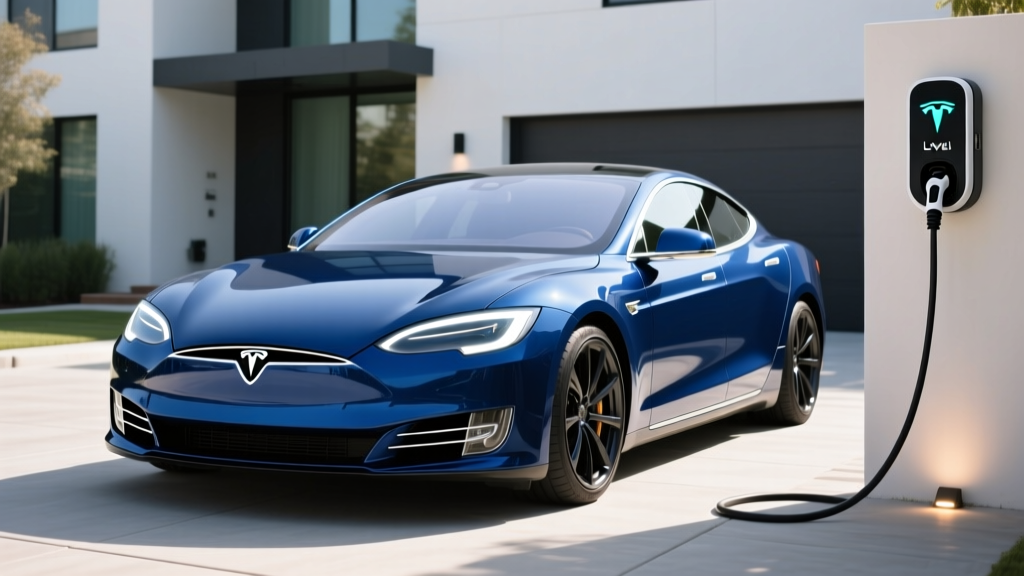
At home on a Level 2 wall connector, a full overnight charge (10 hours at 10 kW) replenishes roughly 290 miles of rated range — more than enough to refill the pack completely. Most P85D owners report that a 40-amp circuit is the practical sweet spot for daily use, adding enough range overnight for a 100-mile round-trip commute with margin to spare.
Performance That Still Holds Up
The P85D's performance credentials haven't aged the way its range has. The dual-motor setup — a large rear motor paired with a smaller front motor — delivers 691 SAE-rated horsepower and all-wheel-drive traction. The 3.2-second 0-60 mph time (with Ludicrous Mode engaged) was verified independently by multiple outlets at launch and remains quicker than most new performance EVs you can buy in 2026.
The instant torque delivery and low center of gravity make the P85D feel planted in corners for a 4,800-pound sedan. Regenerative braking is strong enough for one-pedal driving in most conditions, though it lacks the adjustable regen levels found in newer EVs. The steering is precise but heavy, and the air suspension (standard on P85D) provides a compliant ride when the components are in good condition.
That last caveat matters: air suspension struts on 2013-2016 Model S vehicles are a known wear item. Replacement runs $1,500-$2,500 per corner if using aftermarket units, or significantly more through Tesla Service. Budget for this when evaluating any used P85D with over 80,000 miles.
Battery Health, Warranty, and the Replacement Question
The P85D shipped with an 8-year, unlimited-mile battery and drive unit warranty. For 2015 model-year vehicles, that warranty expired in 2023. Any battery failure today is an out-of-pocket expense unless you purchased an extended warranty.
A replacement 85 kWh battery from Tesla Service currently runs between $14,000 and $20,000 including labor, depending on whether a new, remanufactured, or refurbished pack is used. Third-party EV battery shops have emerged as a more affordable option, with refurbished pack replacements ranging from $10,000 to $14,000. Module-level repair — replacing only the degraded or failed modules within the pack — can cost $3,000-$6,000 if only a few modules are affected.
Before purchasing any used P85D, request a battery health reading. You can check this yourself by charging to 100% and noting the displayed rated range, then comparing it to the original 253-mile EPA figure. A more precise assessment comes from third-party tools like Scan My Tesla (using an OBD-II dongle and app), which reads the pack's actual nominal full-pack capacity (NFP) in kWh. A pack reading below 68 kWh (roughly 80% health) is approaching the threshold where range becomes restrictive for road-trip use.
Tech, Interior, and the Infotainment Generation Gap
The P85D's interior was luxurious by 2015 standards — premium leather, a 17-inch touchscreen, panoramic glass roof, and a minimalist center console. But the technology generation gap is stark in 2026.
What still works well:
- The 17-inch touchscreen remains large and responsive, even if the processor (NVIDIA Tegra 3 era) feels sluggish compared to modern Ryzen-based Tesla infotainment
- Over-the-air updates continue, though the P85D no longer receives major new feature rollouts
- Navigation with real-time traffic and Supercharger routing remains functional
- Premium audio system (if equipped) still sounds excellent
Where it shows its age:
- Autopilot hardware is HW1 (Mobileye-based), which Tesla no longer actively develops. It provides basic adaptive cruise and lane-keeping — SAE Level 2 driver-assist only, requiring constant driver supervision — but cannot run FSD (Supervised) and will never receive FSD updates
- No HEPA air filtration (introduced with the 2016 refresh)
- No rear-seat entertainment screens or wireless phone charging
- USB-A ports only; no USB-C
- Instrument cluster is a simple LCD, not the modern configurable display
The P85D's HW1 Autopilot is a basic SAE Level 2 driver-assistance system. It provides adaptive cruise control and lane-centering on highways, but the driver must remain fully engaged with hands on the wheel and eyes on the road. It is not self-driving. It cannot navigate city streets, respond to traffic lights, or handle construction zones. Tesla has discontinued feature updates for HW1 vehicles.
Used P85D vs. 2026 Alternatives: What Else Can You Buy?
| Attribute | Used Tesla P85D (~$25K) | New Chevy Equinox EV 2LT (~$33K) | Used Tesla Model 3 LR AWD 2021 (~$24K) |
|---|---|---|---|
| Real-World Range | ~190-220 mi (degraded) | ~300 mi (new pack) | ~280-300 mi (slight degradation) |
| 0-60 mph | 3.2 sec | ~7.8 sec | 4.2 sec |
| DC Fast Charge (10-80%) | ~40-50 min | ~30 min | ~25-30 min |
| Battery Warranty | Expired | 8 yr / 100,000 mi remaining | ~3 yr / ~40,000 mi remaining |
| ADAS Hardware | HW1 (obsolete) | Super Cruise capable | HW3 (FSD capable) |
| Federal Tax Credit | Used EV credit up to $4,000 (IRS §25E) | Up to $7,500 (§30D, if eligible) | Used EV credit up to $4,000 (§25E) |
| Cargo Space | 26.3 + 5.3 cu ft | 26.4 cu ft (no frunk) | 15 + 3.1 cu ft |
The P85D wins on outright performance and cargo space (it's a full-size liftback sedan). The Equinox EV wins on range, warranty, and modern tech. The used Model 3 Long Range AWD splits the difference — it's quicker than the Equinox, has better charging speed and range than the P85D, and still receives Tesla's latest software and FSD updates on HW3 hardware.
Tax Credits, Pricing, and Total Cost of Ownership
Because the P85D is only available on the used market in 2026, the relevant incentive is the IRS §25E Used Clean Vehicle Credit, not the §30D new-vehicle credit.
| Cost Factor | Details |
|---|---|
| Typical Used Price | $18,000 – $32,000 (depending on mileage, battery health, condition) |
| Federal Used EV Credit (§25E) | Up to $4,000 (30% of sale price, capped at $4,000) |
| §25E Income Caps | $75K single / $112,500 HOH / $150K MFJ (modified AGI) |
| §25E Sale Price Cap | $25,000 maximum sale price to qualify |
| Effective Price After Credit | $14,000 – $21,000 (for qualifying buyers on cars priced ≤$25K) |
| Estimated Annual Insurance | $1,800 – $2,800 (varies by state, driver, coverage) |
| Estimated Annual Charging Cost | $500 – $900 (home charging, 12,000 mi/yr at $0.14/kWh) |
| Annual Maintenance | $400 – $1,200 (tires, cabin filter, fluid top-offs, potential suspension) |
Critical caveat on §25E: The $25,000 sale price cap means many P85Ds listed above $25,000 will not qualify for the credit at all. To maximize the credit, negotiate a purchase at or below $25,000. The credit is non-refundable, so you need sufficient tax liability to claim it. The credit can only be claimed once per vehicle VIN. Always verify eligibility with a tax professional and check the latest IRS guidance on §25E before purchase.
Who Should Buy a Used P85D — and Who Shouldn't
- Want supercar-level acceleration on a sub-$25K budget
- Primarily commute under 100 miles round-trip and can charge at home
- Value the Model S liftback's cargo space (26.3 cu ft + frunk) over a compact sedan
- Are comfortable budgeting $3,000-$5,000 for potential repairs (suspension, drive unit, MCU) over 3 years
- Understand that Autopilot HW1 is functionally frozen and won't receive new features
- Regularly drive 200+ miles between charging stops on road trips
- Need modern ADAS features (automatic emergency braking improvements, blind-spot monitoring updates)
- Want active battery warranty coverage
- Live in a cold climate where the already-reduced range will drop another 30-40%
- Don't have reliable home Level 2 charging access
Frequently Asked Questions
What is the real-world range of a used Tesla P85D in 2026?
Most P85Ds on the used market today show 80-90% battery health, translating to roughly 190-220 miles at a full 100% charge. For daily driving (charging to 80% to preserve the NMC pack), expect 150-175 usable miles. Highway driving at 75 mph reduces this to 165-195 miles, and cold weather below freezing can drop range to 140-170 miles. Always verify the specific vehicle's pack health via an OBD-II scan before purchase.
How fast does the P85D charge at home and on road trips?
At home on a 240V/40A Level 2 charger, the P85D adds roughly 29 miles of range per hour — a full overnight charge covers any daily driving. On DC fast chargers (Tesla V2 Superchargers), it peaks at around 120 kW below 30% SoC, but the charge curve tapers significantly above 50%. A 10-80% session takes approximately 40-50 minutes. The P85D cannot utilize V3 or V4 Supercharger speeds due to its onboard charge controller limitations.
Does the Tesla P85D qualify for any federal EV tax credit?
The P85D is only available used, so the relevant credit is the IRS §25E Used Clean Vehicle Credit — up to $4,000 (30% of sale price). To qualify, the sale price must be $25,000 or less, the buyer's modified AGI must be under $75K (single) or $150K (married filing jointly), and the vehicle must be purchased from a licensed dealer. The credit is non-refundable and can only be claimed once per VIN. It does not qualify for the §30D new-vehicle credit.
Is the P85D worth buying vs. a used Model 3 or a new budget EV?
It depends on priorities. The P85D offers unmatched performance (3.2-second 0-60), generous cargo space, and premium ride quality for under $25K. But a 2021 Model 3 Long Range AWD at a similar price delivers more range (~280-300 mi), faster charging, active HW3 Autopilot with FSD capability, and several remaining years of battery warranty. A new Chevy Equinox EV or Hyundai Kona Electric offers full warranty coverage, 250-300+ miles of range, and modern safety tech — but can't match the P85D's acceleration. If performance is your top priority and you accept the range and maintenance trade-offs, the P85D is uniquely compelling. If daily usability and low running costs matter more, choose a newer vehicle.
What are the biggest pros and cons of owning a P85D in 2026?
Pros: Supercar acceleration, spacious liftback body, air suspension comfort, Supercharger network access, low per-mile energy cost with home charging, strong regenerative braking for one-pedal driving, premium interior materials.
Cons: Degraded battery limits range to ~150-175 practical miles, expired battery warranty means $14K-$20K replacement risk, slow DC charging by modern standards (40-50 min 10-80%), obsolete Autopilot HW1 with no future updates, air suspension repair costs ($1,500-$2,500 per corner), aging MCU processor feels sluggish, higher insurance premiums than newer compact EVs.
How long will the P85D battery last before needing replacement?
NMC packs from this era typically retain 75-85% capacity at 150,000-200,000 miles based on fleet data. If your P85D currently shows 85% health at 100,000 miles, it may still have 8-10 years of usable life before dropping below 70% — the point where range becomes genuinely restrictive. However, individual cell failures can occur at any mileage. Budget for a potential $10,000-$15,000 battery service within your ownership window as a contingency, and prioritize vehicles with documented home-charging habits (slower degradation) over those that were exclusively Supercharged.