What Is Tesla Overheat Protection?
When Tesla owners search for Tesla overheat protection, they're usually asking about two distinct systems: the Cabin Overheat Protection feature that keeps a parked car's interior from reaching dangerous temperatures, and the broader battery thermal management system that prevents the high-voltage pack from overheating during driving, charging, or idle periods. Both are critical to understanding how a Tesla performs in extreme heat — and how much range you'll sacrifice to keep things cool.
This guide breaks down exactly how these systems work across the 2026 Tesla lineup (Model 3, Model Y, Model S, Model X, and Cybertruck), what energy they consume, and how Tesla's thermal engineering stacks up against competitors like Hyundai, Ford, and Rivian. We'll also cover the full ownership picture: range, charging speeds, pricing, tax credits, and whether a Tesla is the right EV for hot-climate buyers.
Cabin Overheat Protection: How It Works and What It Costs
Cabin Overheat Protection (COP) is a software-controlled feature available on all Tesla vehicles. When enabled, it activates after you exit the car and monitors interior temperature via cabin sensors. If the temperature exceeds a user-set threshold — typically 105°F (40°C) by default — the system engages climate control to cool the cabin.
Owners can configure COP in three modes:
- On: Runs the full air conditioning compressor, using high-voltage battery energy to actively cool the cabin.
- No A/C: Runs only the ventilation fans without the compressor, consuming far less energy but providing limited cooling.
- Off: The system does not activate. Interior temperatures can exceed 150°F on a hot summer day in Phoenix or Las Vegas.
Tesla's documentation notes that Cabin Overheat Protection may operate for up to 12 hours after you exit the vehicle, depending on battery state of charge and ambient conditions. In practice, testing in 110°F+ Arizona heat shows that COP in "On" mode consumes roughly 1-3% of battery SoC per hour, depending on solar load, cabin volume, and whether the car is parked in direct sunlight or shade.
Tesla added a COP scheduling feature in recent software updates, allowing owners to set time windows (e.g., only activate between 10 AM and 6 PM) to reduce unnecessary energy use during mild mornings or evenings.
Battery Thermal Management: Keeping the Pack Alive
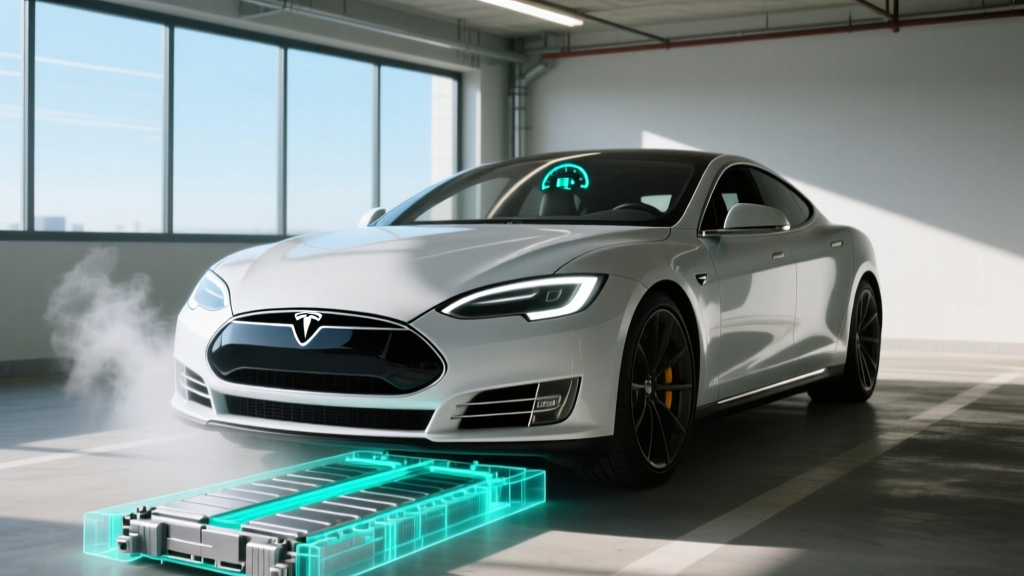
Beyond cabin comfort, Tesla's overheat protection extends to the high-voltage battery pack — the most expensive and degradation-sensitive component in any EV. Tesla uses an active liquid cooling/heating system that circulates a glycol-water mixture through channels embedded between battery cells.
Key thermal management behaviors across the 2026 lineup:
- During DC fast charging: The system preconditions the battery to an optimal temperature window (typically 95-115°F / 35-46°C at the cell level) before the car reaches peak charge rate. If the pack is too hot, charge speed is throttled to prevent thermal damage.
- During high-performance driving: Track Mode (Model S Plaid, Model 3 Performance) actively manages battery and motor temperatures, limiting power output if thermal limits are approached.
- While parked in extreme heat: The battery cooling system can activate autonomously if cell temperatures approach upper safety thresholds, even when the car is off and unplugged. This is separate from Cabin Overheat Protection and draws minimal energy.
- During preconditioning for Supercharging: Navigation to a Supercharger triggers active battery heating or cooling to ensure the pack arrives at optimal temperature for maximum charge speed.
Tesla's battery chemistry varies by model and trim. The Model 3 RWD and Model Y RWD use LFP (lithium iron phosphate) cells, which are inherently more thermally stable than the NMC (nickel manganese cobalt) cells found in Long Range and Performance variants. LFP chemistry offers a higher thermal runaway threshold (~518°F / 270°C vs. ~410°F / 210°C for NMC), providing an additional margin of safety in extreme heat scenarios.
2026 Tesla Lineup: Range, Charging, and Performance Specs
Below is a consolidated spec table for the current Tesla lineup. Note that all range figures are EPA-estimated; real-world range varies significantly based on temperature, driving style, and terrain.
| Spec | Model 3 LR AWD | Model Y LR AWD | Model S LR | Cybertruck AWD |
|---|---|---|---|---|
| EPA Range | 363 mi | 320 mi | 402 mi | 340 mi |
| Battery (usable) | ~75 kWh, NMC | ~75 kWh, NMC | ~95 kWh, NMC | ~123 kWh, NMC |
| Max DC Charge Rate | 250 kW | 250 kW | 250 kW | 250 kW |
| 10-80% DC Time | ~25 min | ~27 min | ~30 min | ~35 min |
| Level 2 Home Rate | 11.5 kW (~44 mi/hr) | 11.5 kW (~44 mi/hr) | 11.5 kW (~52 mi/hr) | 11.5 kW (~37 mi/hr) |
| 0-60 mph | 4.2 sec | 4.8 sec | 3.1 sec | 3.9 sec |
| Horsepower | 346 hp | 384 hp | 670 hp | 600 hp |
| MPGe (combined) | 132 MPGe | 122 MPGe | 124 MPGe | 102 MPGe |
| Base MSRP | $47,740 | $48,630 | $79,990 | $79,990 |
Sources: fueleconomy.gov, Tesla.com order pages. Real-world highway range at 75 mph typically falls 10-15% below EPA. In cold weather (below 30°F), expect 20-30% range reduction without preconditioning.
Charging Speed and Thermal Throttling in Hot Climates
Tesla's DC fast charging performance is well-documented, but hot-climate buyers should understand how thermal management affects sustained charge rates. At a V3 or V4 Supercharger, a Model 3 Long Range can peak at 250 kW, but that peak is typically sustained for only the first 10-15% of the charge session. The charge curve tapers progressively:
| State of Charge | Approximate Charge Rate | Notes |
|---|---|---|
| 5-20% | 200-250 kW | Peak rate, preconditioned pack |
| 20-50% | 120-170 kW | Steady taper |
| 50-80% | 60-100 kW | Significant taper to protect cells |
| 80-100% | 20-40 kW | Trickle charge; avoid for road trips |
In extreme ambient heat (110°F+), the thermal management system may reduce peak charge rates by 10-20% to protect the battery. This is not a defect — it's intentional thermal throttling. Competitors like the Hyundai Ioniq 5 (which peaks at 238 kW with an 800V architecture) can sustain higher rates longer in some conditions, though the Ioniq 5's smaller 77.4 kWh pack means shorter overall range.
For home Level 2 charging, all current Teslas accept up to 11.5 kW on a 48-amp circuit (hardwired Wall Connector). This adds approximately 37-52 miles of range per hour depending on the model's efficiency, fully replenishing any Tesla overnight on a standard 8-10 hour sleep cycle.
Pricing, Tax Credits, and What You'll Actually Pay
Tesla's pricing has fluctuated frequently, but as of early 2026, the lineup positions as follows. Federal tax credit eligibility under IRS §30D depends on MSRP caps, buyer income limits, and battery component/critical mineral sourcing requirements.
| Model / Trim | Base MSRP | §30D Credit | Est. Net Price |
|---|---|---|---|
| Model 3 RWD | $38,990 | $3,750 (partial) | ~$35,240 |
| Model 3 LR AWD | $47,740 | $3,750 (partial) | ~$43,990 |
| Model Y LR AWD | $48,630 | $3,750 (partial) | ~$44,880 |
| Model S LR | $79,990 | $0 (over MSRP cap) | $79,990 |
| Cybertruck AWD | $79,990 | $0 (over MSRP cap) | $79,990 |
Critical caveats: The §30D credit has an MSRP cap of $55,000 for sedans (Model 3) and $80,000 for SUVs/trucks (Model Y, Cybertruck). Buyer income must not exceed $150,000 (single) / $300,000 (joint). Battery sourcing requirements continue to tighten annually, which has reduced several Tesla trims from the full $7,500 to a partial $3,750 credit. The credit can be transferred to the dealer at point of sale as an instant discount. Always verify current eligibility at fueleconomy.gov before purchasing, as rules change frequently.
Cargo Space, Interior, and Daily Practicality
For buyers evaluating a Tesla beyond thermal management, interior volume and cargo capacity matter for daily usability:
- Model 3: 23 cu ft trunk + 3.1 cu ft frunk. Rear legroom: 35.2 in. Tight for tall rear passengers on long trips.
- Model Y: 30.2 cu ft behind second row (76.2 cu ft folded) + 4.1 cu ft frunk. Rear legroom: 41.6 in. The default family EV for good reason.
- Model S: 28 cu ft trunk + 3.1 cu ft frunk. Rear legroom: 35.4 in. Premium interior with ventilated seats standard — relevant for hot-climate comfort.
- Cybertruck: 6.5-ft bed (approx. 67 cu ft) + lockable frunk. Rear legroom: 41.2 in. Stainless steel exterior reflects solar radiation, reducing cabin heat soak vs. dark-painted vehicles.
All Tesla models come with a HEPA air filtration system ("Bioweapon Defense Mode") that pressurizes the cabin and filters outside air — useful during wildfire smoke events common in western US summers.
How Tesla's Thermal Management Compares to Competitors
Tesla's liquid-cooled battery thermal management is mature and effective, but it's no longer class-leading in every metric. Here's how key competitors handle heat:
- Hyundai Ioniq 5 / Kia EV6: 800V architecture enables faster preconditioning and more consistent charge rates in heat. Heat pump standard on all trims (Tesla includes a heat pump on all 2026 models as well). Cabin Overheat Protection equivalent is not as configurable — Hyundai offers "ventilation mode" but lacks Tesla's granular scheduling.
- Ford Mustang Mach-E: Active liquid cooling with preconditioning. Ford's cabin overheat feature is less aggressive and lacks scheduling. Charge rate peaks at 150 kW — significantly slower than Tesla in all conditions.
- Rivian R1S/R1T: Robust thermal management designed for off-road and towing heat loads. Cabin cooling is excellent given the large glass area. DC charging peaks at 200 kW with a more linear curve than Tesla in some testing.
Tesla's advantage remains the Supercharger network — over 30,000 stalls globally — and the navigation-integrated preconditioning that ensures the battery arrives at optimal temperature. Non-Tesla EVs on Electrify America or other networks cannot precondition to a specific charger, which can result in slower initial charge rates in extreme temperatures.
Pros, Cons, and Who Should Buy
Pros
- Best-in-class Cabin Overheat Protection with scheduling and configurable thresholds
- Mature liquid-cooled battery thermal management with autonomous park-mode cooling
- Supercharger network with nav-integrated preconditioning for optimal charge speed
- Heat pump standard on all models — efficient cabin heating in cold weather too
- LFP battery option (Model 3/Y RWD) offers superior thermal stability
- HEPA cabin filtration for wildfire smoke and extreme heat air quality
- Over-the-air updates continuously improve thermal algorithms
Cons
- COP on "Full A/C" mode consumes significant range (up to 17% SoC over 8 hours)
- DC fast charging throttles noticeably above 110°F ambient to protect battery
- 250 kW peak charge rate is no longer segment-leading (Hyundai/Kia at 800V charge faster in some conditions)
- Large glass roofs on Model 3/Y increase solar heat load — aftermarket tint often needed
- Model S/X/Cybertruck exceed §30D MSRP caps — no federal tax credit
- Panel gaps and interior material quality still lag German competitors at similar price points
Who This EV Suits Best
Hot-climate commuters: The Model 3 or Model Y with Cabin Overheat Protection scheduling is ideal if you park outdoors in Phoenix, Las Vegas, or Houston. Set COP to "No A/C" for minimal SoC loss, or use a sunshade to reduce thermal load. The heat pump ensures efficient winter operation too.
Families needing cargo space: Model Y Long Range remains the best all-around EV for families — 320 miles EPA, Supercharger access, and enough room for strollers, groceries, and road-trip luggage. Consider ceramic window tint to reduce cabin heat soak.
Performance enthusiasts in warm states: Model S Plaid's Track Mode manages battery thermals during repeated hard launches, but expect reduced range and longer cooldown periods between sessions. Not ideal for daily track use without dedicated cooling infrastructure.
Truck buyers who tow: Cybertruck's thermal management handles towing loads, but expect 40-50% range reduction when towing near max capacity (11,000 lbs rated). Plan Supercharger stops accordingly.
Frequently Asked Questions
Does Tesla overheat protection drain the battery significantly?
Yes, but the amount depends on settings and conditions. Cabin Overheat Protection on full A/C mode consumes approximately 1-3% SoC per hour in extreme heat (110°F+ direct sun). Over an 8-hour workday, this can total 10-17% of your battery. Using "No A/C" mode or parking in shade reduces this to under 4% total. Battery thermal protection while parked draws negligible energy unless cell temperatures approach critical thresholds.
Can I leave my Tesla plugged in with overheat protection on?
Yes — and this is the recommended approach for hot-climate owners. When plugged into a Level 2 home charger, Cabin Overheat Protection draws power from the grid rather than the battery, preserving your state of charge. Set your charge limit to 80% (or 100% for LFP models) and let COP manage cabin temperature without range penalty.
Does Tesla's battery overheat protection affect Supercharging speed?
It can. In extreme ambient heat (above 105°F), the thermal management system may limit peak charge rates to protect cell health. Expect peak rates of 200-225 kW instead of the rated 250 kW in these conditions. Navigation-based preconditioning helps mitigate this by arriving at the charger with the battery at optimal temperature, but ambient heat still affects sustained charge rates.
Which Tesla model is best for extremely hot climates?
The Model Y Long Range AWD offers the best combination of range (320 mi EPA), cabin volume, Supercharger access, and configurable overheat protection. For maximum thermal battery safety, the Model 3 RWD with its LFP battery chemistry offers a higher thermal runaway threshold, though with less range (272 mi EPA). The Model S includes ventilated front seats standard, which improves perceived comfort in extreme heat.
Do I need to tint my Tesla's windows for heat protection?
Many Tesla owners in hot climates add aftermarket ceramic window tint, particularly to the large glass roof on Model 3 and Model Y. While Tesla's glass blocks most UV radiation, infrared heat transmission through the roof can increase cabin temperatures by 10-15°F compared to a vehicle with a solid roof. A quality ceramic tint (35-50% VLT on the roof, 25-35% on side windows where legal) can reduce solar heat gain by 40-60%, lowering COP energy consumption and improving cabin comfort.
How does Tesla's warranty cover thermal damage?
Tesla's battery warranty covers defects and capacity degradation below 70% for 8 years or 100,000-120,000 miles (varies by model). Thermal damage caused by the vehicle's own systems failing to protect the battery would be covered. Damage from owner negligence (e.g., ignoring thermal warnings, modifying cooling systems) would not be covered. The warranty does not cover range loss from using Cabin Overheat Protection — that's considered normal energy consumption.