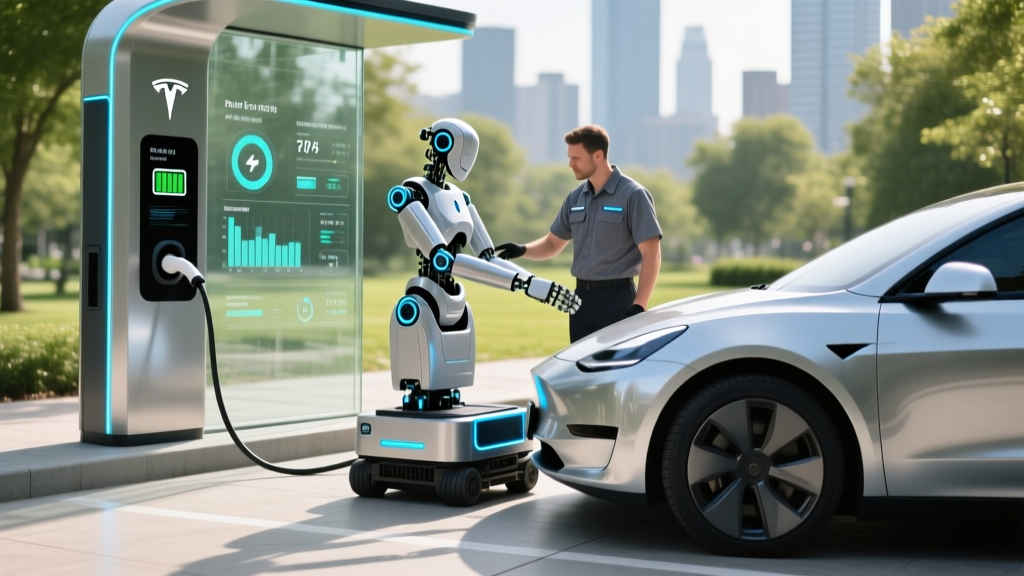
The phrase "Tesla robot attacks worker" has circulated across social media and news feeds, sparking genuine concern about the safety of humanoid robots in industrial environments. As Tesla's Optimus (Gen 2) robot moves from prototype to limited factory deployment in 2026, it's worth separating viral fear from engineering reality. This profile examines what Optimus actually is, the documented safety incidents, the safeguards in place, and what the data tells us about human-robot coexistence on the factory floor.
To be clear up front: Optimus is not a vehicle, and this is not a conventional EV review. But as Tesla integrates humanoid robotics into its Fremont, Austin, and Shanghai Gigafactories — the same facilities that build the Model Y, Cybertruck, and next-gen platforms — EV buyers and industry watchers alike need accurate information about what these machines can and cannot do.
What Is Tesla Optimus (Gen 2)?
Tesla Optimus, also called the Tesla Bot, is a general-purpose humanoid robot standing approximately 5'8" (173 cm) and weighing roughly 125 lbs (57 kg). The Gen 2 variant, which began limited deployment in Tesla's own manufacturing facilities in early 2025, features significant upgrades over the 2022 prototype:
- Actuators: 28 custom electromechanical actuators across limbs, plus 11 degrees of freedom in each hand
- Sensors: Vision-based perception using Tesla's FSD neural network architecture, force/torque sensors in fingers and joints, IMU for balance
- Compute: Onboard SoC running Tesla's inference stack, with cloud connectivity for fleet learning
- Payload: Up to 45 lbs (20 kg) carrying capacity, ~150 lbs (68 kg) deadlift capacity
- Walking speed: Approximately 2.2 mph (3.5 km/h) — deliberate, not sprinting
- Battery: ~2.3 kWh internal pack, targeting a full shift of light-duty operation
- Price target: Tesla has stated a long-term goal of under $20,000 per unit at scale, though 2026 internal deployment carries no public per-unit MSRP
Optimus is designed for repetitive, physically taxing tasks: parts handling, bin sorting, component transfer between stations. Tesla has been candid that the robot is not intended for precision assembly or unsupervised operation near humans.
The 'Tesla Robot Attacks Worker' Incident: What Actually Happened
The viral claim traces back to reporting from late 2023 and early 2024, primarily a Reuters investigation that cited internal documents and sources describing an incident during a laboratory testing session, not a factory-floor deployment. Here's what the reporting established:
- An engineer was testing Optimus's grasping capability in a controlled lab environment
- The robot's gripper unexpectedly closed on the engineer's hand
- The engineer sustained puncture wounds and lacerations — described as "bloody" but not requiring hospitalization
- The incident occurred during software debugging, not during autonomous operation
- The engineer was reportedly inside the robot's working envelope without a physical safety barrier — a deviation from standard industrial-robot protocol
No verified report has documented an Optimus robot injuring a worker during autonomous factory-floor operation. Tesla has not publicly commented on specific incidents but has stated that Optimus operates under strict safety protocols including speed limiting, force limiting, and human-proximity detection.
Safety Systems: How Optimus Is Designed to Avoid Harm
Humanoid robots operating near humans fall under collaborative-robot (cobot) safety frameworks. Tesla has described several layers of protection in Optimus, though independent third-party certification details remain limited as of early 2026:
| Layer | Mechanism | Purpose |
|---|---|---|
| Force limiting | Torque sensors in every joint actuator | Detect unexpected resistance and halt motion within milliseconds |
| Speed limiting | Software governor capping limb velocity near detected humans | Reduce kinetic energy in any potential contact |
| Vision-based proximity | FSD-derived perception identifying humans within 2m/1m/0.5m zones | Progressive slowdown as humans approach |
| Emergency stop | Physical e-stop button on torso + remote kill switch | Immediate power cut to all actuators |
| Geofencing | Factory-floor localization restricting operation to marked zones | Prevent robot from entering unauthorized areas |
| Gravity fail-safe | Brake locks on all joints when power is lost | Prevent collapse or uncontrolled limb movement |
For comparison, traditional industrial robot arms (like those welding Cybertruck frames) operate inside physical cages precisely because they lack these collaborative features. Optimus is designed to operate outside cages, which raises both its utility and its safety burden.
Optimus vs. Industrial Robots: Putting the Risk in Perspective
To evaluate whether the "Tesla robot attacks worker" framing is warranted, consider the broader context of industrial robot safety:
| Metric | All Industrial Robots (US) | Humanoid/Cobots |
|---|---|---|
| Estimated US installed base | ~400,000+ units | ~15,000 cobots (all brands) |
| OSHA-recorded fatalities (cumulative, 1984-present) | ~40+ documented | 0 verified cobot-specific fatalities |
| Common injury mechanism | Crushing/pinning in celled areas | Pinch points, unexpected gripper closure |
| Primary safety standard | ANSI/RIA R15.06 | ISO/TS 15066 (collaborative robots) |
The data makes clear that caged industrial robots are far more dangerous than collaborative systems — but only when protocols are followed. The Optimus lab incident occurred precisely when a protocol (staying outside the working envelope during testing) was not followed.
What This Means for Tesla's Factory Workforce
Tesla employed approximately 140,000 people globally as of its most recent annual report. Optimus deployment in 2026 is measured in dozens of units, not thousands, and is concentrated in material-handling roles at Giga Texas and Fremont. The company has described a phased rollout:
- Phase 1 (2024-2025): Internal testing in controlled cells, Tesla employees as handlers
- Phase 2 (2025-2026): Supervised deployment on select material-handling lines, dedicated safety officers
- Phase 3 (2027+): Broader deployment contingent on safety record and regulatory approval
Worker sentiment is mixed. Some Tesla factory employees have expressed concern about job displacement and physical safety, while others describe Optimus as handling the "dull, dirty, dangerous" tasks that cause repetitive-strain injuries in human workers. The United Auto Workers (UAW), which does not currently represent Tesla workers, has called for federal safety standards specific to humanoid robots in workplaces.
Regulatory Landscape: Who Oversees Humanoid Robot Safety?
As of 2026, humanoid robots in workplaces fall under existing OSHA general-duty clauses and the ANSI/RIA R15.08 standard for industrial mobile robots. There is no federal agency specifically certifying humanoid robots for workplace deployment — a gap that multiple lawmakers have flagged.
The National Institute of Standards and Technology (NIST) has published preliminary frameworks for humanoid-robot safety testing, and ISO working groups are developing updates to ISO 13482 (personal care robot safety) that may extend to industrial humanoids. Tesla has stated it participates in these standards processes but has not published independent third-party safety certifications for Optimus.
Should the 'Tesla Robot Attacks Worker' Story Affect Your EV Purchase Decision?
For EV buyers, the short answer is: no. Optimus is a separate product line from Tesla's vehicles. The safety of the Model Y, Model 3, Cybertruck, and upcoming next-gen platform is governed by entirely different engineering teams, NHTSA crash-testing, and IIHS evaluation.
However, the Optimus story is relevant if you're evaluating Tesla as a company — its engineering culture, its approach to safety validation, and its willingness to deploy pre-production hardware in real environments. These are legitimate considerations for investors and for buyers who weight corporate behavior in their purchase decisions.
Frequently Asked Questions
Did a Tesla robot actually attack a worker?
No verified incident describes Optimus "attacking" anyone. A documented 2023 lab-testing incident involved the robot's gripper unexpectedly closing on an engineer's hand during software debugging, causing lacerations. The engineer was inside the robot's working envelope without standard safety barriers — a protocol deviation, not autonomous behavior.
Is Tesla Optimus currently working in factories?
Yes, in limited, supervised deployment at Tesla's Giga Texas and Fremont facilities as of 2025-2026. Units handle material-transfer and bin-sorting tasks under continuous human oversight. Broad unsupervised deployment has not occurred.
How does Optimus compare to other humanoid robots?
Competitors include Boston Dynamics' Atlas (hydraulic, more agile, not commercially sold for factory work), Figure AI's Figure 02 (backed by OpenAI and BMW, targeting similar roles), and Agility Robotics' Digit (bipedal, focused on warehouse logistics). Optimus differentiates on Tesla's vertical integration — its FSD vision stack and in-house manufacturing — but is earlier in commercial deployment than Digit.
What safety standards apply to humanoid robots?
Currently, ANSI/RIA R15.08 for industrial mobile robots and ISO 13482 for service robots. ISO/TS 15066 covers force and speed limits for collaborative robots but was written for fixed-base arms, not bipedal humanoids. New standards specific to humanoid industrial robots are under development by ISO and NIST working groups.
Could an Optimus robot injure someone if it malfunctioned?
Any 125-lb machine with powered actuators can cause injury if safety systems fail. Optimus's force-limiting, speed-limiting, and proximity-detection systems are designed to prevent this, but no system is fail-proof. That's why supervised deployment, physical e-stops, and geofencing remain mandatory layers.