Quick Verdict: Optimus Is a Platform Play, Not a Car
If you landed here expecting a vehicle review, let's reset the frame immediately. The Tesla Optimus (Gen 2.5, as of early 2026) is a humanoid robotics platform, not a drivable EV. It has no EPA range, no battery measured in traction-grade kWh, and no NACS charge port. It also has no MSRP you can configure on Tesla's website today.
That said, Optimus is tightly woven into Tesla's broader autonomy stack — the same vision-only neural nets that power FSD (Supervised) in the Cybertruck and Robotaxi. For EV owners and investors tracking the Tesla ecosystem, Optimus progress in 2026 matters because it previews where Tesla's autonomy, battery supply chain, and manufacturing philosophy are headed. This profile treats Optimus the way we'd treat a concept vehicle: with hard numbers where available, and clear "announced/preliminary" labels everywhere else.
What Is Tesla Optimus, Technically?
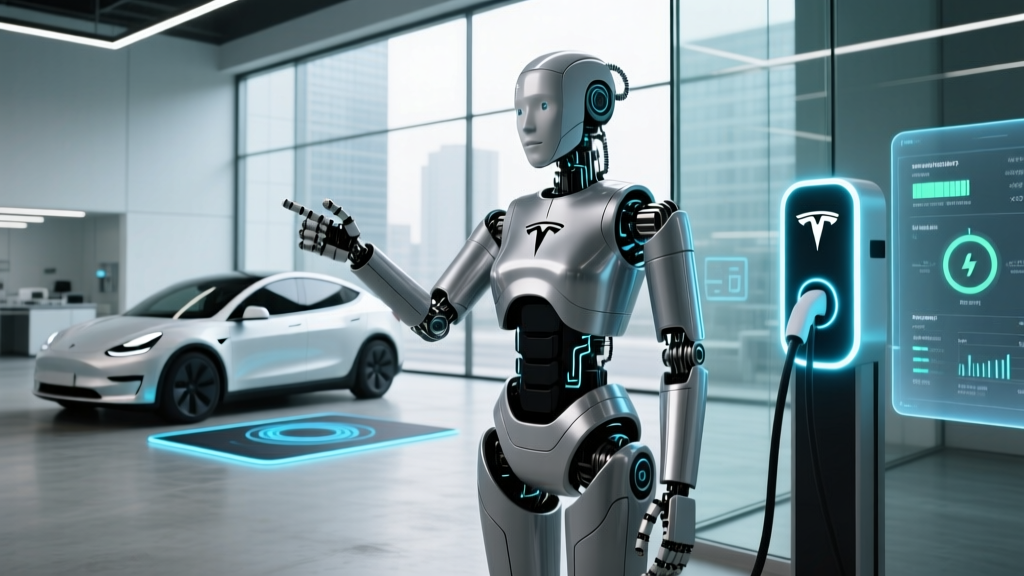
Optimus is a bipedal humanoid robot roughly 5'8" tall and ~125 lbs (per Tesla's most recent public disclosures). It is designed for repetitive, structured labor — factory tasks first, eventually in-home assistance. Unlike Tesla's vehicles, Optimus is not a consumer product you can buy today; Tesla has described 2025-2026 as a limited internal-deployment and external-pilot phase, with external sales targeted no earlier than late 2026 or 2027.
Critically, Optimus shares DNA with Tesla's EV line:
- Vision stack: Camera-only perception, the same architecture behind Autopilot and FSD (Supervised) — a Level 2 driver-assist system, not self-driving.
- Actuators: Tesla-designed rotary and linear actuators, manufactured on EV-adjacent lines.
- Compute: A derivative of the FSD/Hardware 4 inference chip, adapted for low-power locomotion.
- Battery: A pack sized in the low kWh range (announced ~2.3 kWh usable), not the 60-100+ kWh traction packs in vehicles.
Spec Table: Optimus vs. Tesla Vehicles (Apples-to-Oranges)
Because Optimus is not a vehicle, the standard EV spec table doesn't apply cleanly. Below is the closest apples-to-oranges mapping we can responsibly build, with "N/A" where a vehicle metric has no robot equivalent.
| Attribute | Tesla Optimus (Gen 2.5, announced) | Reference: Model Y Long Range AWD (2026) |
|---|---|---|
| Category | Humanoid robot (not a vehicle) | BEV crossover |
| EPA Range | N/A (runtime, not range) | ~320 mi |
| Battery Capacity | ~2.3 kWh (announced, NMC-chemistry cells) | ~75 kWh usable, NMC |
| Charge Port | None (dock / cable charge) | NACS, Supercharger native |
| DC Fast Charge | N/A | ~250 kW peak, 10-80% ~25 min |
| Level 2 Charge | Low-power dock (preliminary) | 11.5 kW (~44 mi/hr) |
| 0-60 mph | N/A (walking speed ~5 mph) | 4.8 sec |
| Horsepower | Actuator torque, not HP-rated | 384 hp |
| Drivetrain | Bipedal locomotion | Dual-motor AWD |
| Base MSRP | Not on sale (announced $20-30k long-term target) | ~$48,990 |
| Federal §30D Credit | Not eligible (not a motor vehicle) | Up to $7,500 if sourcing/income/MSRP rules met |
| Warranty | TBD at launch | 8 yr / 120,000 mi battery & drive unit |
| MPGe / Efficiency | N/A | ~117 MPGe combined |
| Cargo / Payload | ~20 lb carry capacity (announced) | ~76 cu ft cargo (rear seats folded) |
| SAE Automation Level | Not classified under SAE J3016 | Level 2 (FSD Supervised) |
Why Optimus Matters to EV Buyers in 2026
Three concrete reasons an EV shopper should care about a robot they can't buy:
- Autonomy stack validation. If Optimus can navigate unstructured factory floors using the same vision-only stack as FSD, it's a high-stress proving ground for the neural nets Tesla is pushing into its vehicles. Watch Optimus task-completion rates as a leading indicator for FSD reliability.
- Battery cell demand. Optimus units at scale would consume 4680-format cells from the same lines feeding Cybertruck and next-gen vehicles. High robot volumes could tighten cell supply or, conversely, accelerate Gigafactory expansion — both of which affect vehicle pricing and delivery timelines.
- Manufacturing cost curve. Tesla's stated $20-30k long-term robot target, if achieved, implies actuator and sensor costs dropping to a level that could cross-subsidize cheaper ADAS hardware in vehicles.
Charging & Power: What "Filling Up" a Robot Looks Like
Because Optimus isn't a vehicle, the familiar kW/kWh framework applies in miniature rather than at EV scale.
| Charge Mode | Power (kW) | Energy Added | Estimated Time |
|---|---|---|---|
| Docking station (announced) | ~0.5-1 kW | 0-100% of ~2.3 kWh pack | ~3-5 hours |
| Direct cable (preliminary) | ~1-2 kW | 0-100% | ~1.5-3 hours |
| DC fast charge | N/A | N/A | N/A |
| Public Supercharger | Not compatible | — | — |
kW vs kWh reminder: kW is the rate of charge (how fast energy flows in); kWh is the total energy stored. Optimus's ~2.3 kWh pack is roughly 1/30th the size of a Model Y's battery — so even a modest 1 kW dock tops it up in a few hours, similar to Level 1 (120V) charging for an EV.
Pricing, Availability, and the Tax-Credit Question
As of 2026, Tesla Optimus is not available for consumer purchase. Internal factory deployment is ongoing, and external pilot programs have been announced but not broadly shipped. Tesla executives have publicly targeted a long-term unit price in the $20,000-$30,000 range, which would undercut most industrial collaborative robots — but that figure is preliminary and not contractually offered.
| Item | Status (2026) |
|---|---|
| Consumer MSRP | Not on sale — announced long-term target $20-30k |
| §30D Federal EV Credit | Not eligible — Optimus is not a qualified motor vehicle under IRS rules |
| Commercial/Industrial Incentives | Potentially eligible for robotics/automation depreciation (consult a tax professional) |
| Expected First External Sales | Late 2026 or 2027 (announced, subject to change) |
For reference, the IRS §30D clean vehicle credit applies only to qualified plug-in EVs and fuel-cell vehicles meeting MSRP caps ($80k SUVs/pickups/vans, $55k sedans), buyer income limits, and battery-sourcing/critical-minerals requirements. Optimus satisfies none of these criteria.
Who Is Optimus Actually For?
Use-case fit, framed the way we'd frame "who this EV suits":
- Factory operators & logistics firms — first-wave adopters for repetitive pick/place, sorting, and light-assembly tasks.
- Tesla's own production lines — internal validation before external sale.
- In-home assistance — Tesla's long-stated goal, but likely years away from reliable, safe deployment around children, pets, and unstructured environments.
- NOT for: Anyone expecting a drivable vehicle, a robotaxi, or a near-term consumer product.
Optimus vs. the Broader Autonomy Landscape
Optimus competes — philosophically, not directly — with two adjacent categories:
- Industrial cobots (Universal Robots, FANUC): Proven, stationary, task-specific, and available today. Optimus's bet is that a general-purpose humanoid can outperform fixed-arm cobots across varied tasks.
- Robotaxis (Waymo, Zoox): SAE Level 4 driverless services operating in geofenced areas. Optimus is not classified under SAE J3016 because it isn't a vehicle, but its autonomy stack shares lineage with Tesla's Level 2 FSD (Supervised) — which requires continuous driver engagement and is not self-driving.
Pros and Cons (As a Platform, Not a Purchase)
Pros
- Shared autonomy stack with Tesla vehicles — cross-platform learning
- Manufacturing at EV-scale could drive unit cost below industrial cobots
- Vision-only approach avoids expensive lidar hardware
- 4680 cell commonality with Tesla vehicle supply chain
Cons
- Not on sale — announced timelines have slipped historically
- Runtime and payload specs are preliminary and unverified by third parties
- No consumer warranty, service network, or regulatory framework yet
- In-home use case is likely years from safe deployment
FAQ: Tesla Optimus Robot Progress 2026
Is Tesla Optimus available to buy in 2026?
No. Optimus is in internal deployment and limited pilot phases. Tesla has announced a long-term consumer price target of $20-30k, but no public MSRP or configurator exists as of this writing.
Does Optimus qualify for the $7,500 federal EV tax credit?
No. The IRS §30D credit applies only to qualified motor vehicles meeting MSRP, income, and battery-sourcing rules. Optimus is classified as a robot, not a vehicle.
What's the real-world range or runtime of Optimus?
Tesla has described roughly one shift of runtime under light factory tasks on the announced ~2.3 kWh pack. Expect meaningful runtime compression under continuous locomotion or heavy payloads — analogous to EV range loss in cold weather or at highway speeds.
How fast does Optimus charge?
On the announced low-power dock, a full charge of the ~2.3 kWh pack is expected in roughly 3-5 hours. It does not use a NACS port and cannot charge at Tesla Superchargers.
Is Optimus self-driving or autonomous?
Optimus is not classified under SAE J3016 (which governs vehicle automation). Its autonomy stack shares lineage with FSD (Supervised), which is a Level 2 driver-assist system requiring continuous human engagement. It is not "self-driving."
Should I wait for Optimus instead of buying a Tesla vehicle?
No — they solve different problems. If you need transportation, evaluate Tesla's current vehicle lineup (Model Y, Cybertruck, Robotaxi availability in your market). Optimus is a long-term platform play, not a substitute for a vehicle purchase in 2026.
Where can I track official Optimus updates?
Tesla's quarterly earnings calls and official tesla.com product pages are the primary sources. Treat social-media timelines with skepticism; Tesla's announced dates have historically slipped.
Sources referenced: Tesla product disclosures, IRS clean vehicle credit guidance at irs.gov, and EPA/fueleconomy.gov for the Model Y comparison baseline. Optimus specs are preliminary and subject to change; verify against official Tesla communications before making purchasing or investment decisions.