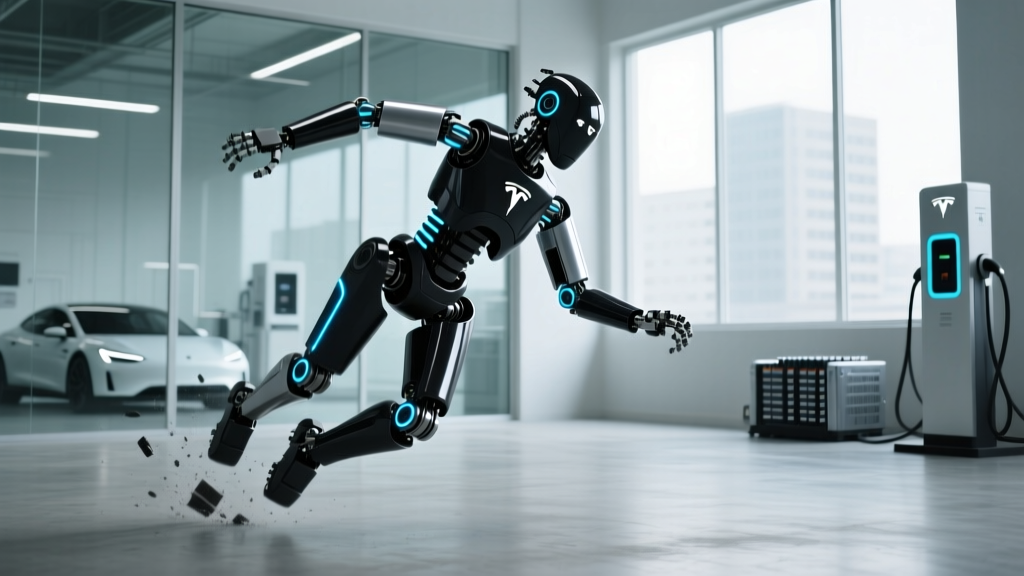
If you have spent any time on EV forums or social media in the past year, you have likely seen the clips: a Tesla Optimus humanoid robot stumbling on a factory floor, catching itself awkwardly, or in some viral cases, toppling over entirely. The "Tesla Optimus robot fall" searches have spiked as critics and enthusiasts alike debate whether Tesla's humanoid robotics program is a credible engineering effort or an expensive distraction from its core electric-vehicle business.
As of early 2026, Tesla has deployed Optimus Gen 2 units in limited internal factory roles at Gigafactory Texas and Giga Shanghai, and CEO Elon Musk has reiterated plans for external sales — though no consumer pricing or delivery timeline has been confirmed. This article examines what the widely circulated fall incidents actually reveal about Optimus's current capabilities, how the robot's hardware has evolved, and what Tesla's robotics ambitions mean for the EV buyers and investors who fund them.
What the Tesla Optimus Robot Fall Videos Actually Show
The most-viewed Optimus fall clips fall into three categories, each revealing something different about the robot's current state of development:
- Static balance loss: Optimus standing still and slowly tipping when nudged or when shifting weight between feet. These clips typically involve early Gen 1 or prototype units with less refined balance algorithms.
- Dynamic walking stumbles: Units tripping over cables, floor transitions, or debris on factory floors. These demonstrate that bipedal locomotion in unstructured environments remains an unsolved problem at production scale.
- Manipulation-induced falls: The robot losing balance while lifting or carrying objects, revealing the tight coupling between upper-body payload management and lower-body stability.
Tesla has not publicly addressed specific fall incidents but has acknowledged in earnings calls that Optimus units undergo "thousands of hours of fall-and-recovery training" using reinforcement learning. The company's approach mirrors what Boston Dynamics demonstrated with Atlas over a decade ago — falling is part of the development process, not necessarily a sign of fundamental failure.
Optimus Gen 2 Hardware: Specs and What Changed
Tesla unveiled Optimus Gen 2 in late 2023 and began factory deployment throughout 2024 and 2025. Here is what we know about the hardware based on Tesla's official disclosures and teardown analyses:
| Attribute | Specification |
|---|---|
| Height | 5'8" (173 cm) |
| Weight | ~125 lbs (57 kg) — reduced ~22 lbs from Gen 1 |
| Actuators | 28 custom electromechanical actuators (up from 24 in Gen 1) |
| Hands | 11 degrees of freedom per hand, tactile sensing arrays |
| Processor | Tesla-custom SoC (same FSD chip architecture as vehicles) |
| Sensors | 8-camera vision array, IMU, joint-torque sensors, foot-pressure arrays |
| Battery | 2.3 kWh (estimated), integrated into torso |
| Battery Chemistry | Not publicly disclosed — likely NMC for energy density |
| Operating Time | ~4-5 hours per charge (estimated, task-dependent) |
| Walk Speed | ~0.6 m/s (approx. 1.3 mph) — improved from Gen 1 |
| Payload Capacity | ~20 lbs (9 kg) per hand |
| Consumer Price | Not announced — Musk has suggested $20,000-$30,000 target (unconfirmed) |
The weight reduction from Gen 1 to Gen 2 is significant. Lighter mass means less inertia to manage during balance corrections, which directly addresses the type of slow-tipping falls seen in earlier videos. The addition of foot-pressure sensor arrays also gives the balance controller real-time ground-contact feedback — a critical input that Gen 1 lacked in its earliest iterations.
Why Balance Remains Hard: The Engineering Reality
Every viral Optimus fall is, at its core, a physics problem. A 125-pound bipedal robot has a small base of support (two feet, each roughly 10 inches long) and a high center of gravity. Compare that to a quadruped robot like Boston Dynamics' Spot, which has four widely spaced contact points and a low center of mass — it is inherently harder to tip over.
The specific challenges Tesla's robotics team faces include:
- Real-time control loop latency: Balance corrections must happen in milliseconds. Any delay between the IMU detecting a tilt and the ankle actuators responding can turn a recoverable wobble into a fall.
- Unstructured terrain: Factory floors have cables, grating, oil spots, and uneven surfaces that are far harder to navigate than a flat lab environment. Tesla's vision system must classify these hazards in real time.
- Payload shifts: Picking up a 15-pound battery module shifts the robot's center of gravity forward. The balance controller must compensate instantly, and any misestimation of the object's weight leads to over- or under-correction.
- Energy constraints: Aggressive balance corrections draw significant current. With a ~2.3 kWh battery, the robot cannot afford to run high-torque actuators continuously — it must be efficient in its corrections.
These are not unique to Tesla. Every humanoid robotics company — including Agility Robotics (Digit), Figure AI, and Apptronik — deals with the same fundamental trade-offs between stability, speed, payload, and energy efficiency.
How Optimus Connects to Tesla's EV Ecosystem
For EV buyers and Tesla owners, the Optimus program matters because of shared technology infrastructure, not because you will be buying a humanoid robot for your garage anytime soon.
The most direct technology transfer is in the vision and neural-network stack. Optimus uses the same Tesla Vision camera-based perception system (no lidar) that powers Autopilot and FSD (Supervised) in Tesla vehicles. Improvements in object detection, depth estimation, and path planning developed for Optimus's factory navigation can feed back into vehicle FSD performance — and vice versa.
Additionally, Tesla's custom actuator designs for Optimus share engineering DNA with the company's steer-by-wire system in the Cybertruck and the next-generation vehicle platform. The high-torque, compact motor technology developed for robot joints has potential applications in EV powertrain components.
The Financial Question: Is Optimus a Drain or an Investment?
Tesla does not break out Optimus R&D spending in its financial reports, but analyst estimates place annual robotics-program expenditure in the $500 million to $1 billion range when accounting for hardware, personnel, and compute infrastructure. For context, Tesla's total R&D spending was approximately $4.5 billion in 2025.
The bull case — articulated by Musk and supportive analysts — is that Optimus represents a potential market larger than Tesla's vehicle business. If humanoid robots can be produced at scale for $20,000-$30,000 per unit, the addressable market in manufacturing, logistics, and eventually in-home assistance could reach trillions of dollars.
The bear case is that every dollar and engineering hour spent on Optimus is a dollar and hour not spent on improving Tesla's vehicle lineup, expanding Supercharger infrastructure, or accelerating the next-generation affordable EV platform. The fall videos, in this view, are evidence that the robot is years away from commercial viability — and that Tesla's core automotive customers are subsidizing a moonshot.
For current Tesla EV owners, the practical impact is minimal so far. Vehicle quality, software updates, and Supercharger expansion have continued on their own trajectory. The question is whether this remains true as Optimus scales.
Competitor Landscape: How Optimus Stacks Up
| Robot | Company | Weight | Payload | Status (2026) | Target Price |
|---|---|---|---|---|---|
| Optimus Gen 2 | Tesla | ~125 lbs | ~20 lbs/hand | Internal factory deployment | $20-30K (unconfirmed) |
| Digit | Agility Robotics | ~143 lbs | 35 lbs (two hands) | Commercial deployment (logistics) | Not publicly listed |
| Figure 02 | Figure AI | ~154 lbs | Not disclosed | Pilot programs (BMW, warehouse) | Not announced |
| Apollo | Apptronik | ~160 lbs | 55 lbs | Pilot programs (Mercedes-Benz) | ~$250K (enterprise) |
| Atlas (electric) | Boston Dynamics | ~195 lbs | Not disclosed | Research/development | Not for sale |
Agility Robotics' Digit is the closest thing to a commercially deployed humanoid robot as of 2026, working in warehouse logistics. Figure AI's Figure 02 has attracted significant investment and BMW pilot programs. Tesla's advantage — if it can execute — is vertical integration: it designs its own chips, actuators, batteries, and AI training infrastructure, which could enable dramatically lower per-unit costs at scale.
But the fall videos remind us that Tesla is not leading in deployed hours. Digit has been working in real warehouses since 2024. Tesla is still proving basic reliability in its own controlled environments.
What Tesla Owners and EV Buyers Should Take Away
If you are evaluating a Tesla vehicle purchase in 2026 — whether a refreshed Model 3, Model Y, Cybertruck, or the anticipated next-generation platform — the Optimus program should factor into your decision in exactly one way: as a signal of where Tesla allocates engineering talent and capital.
The positive interpretation is that Tesla's AI and robotics capabilities are compounding. The same neural networks that help Optimus navigate a factory floor improve FSD's ability to handle construction zones and edge-case driving scenarios. The negative interpretation is that Tesla's focus is divided, and vehicle innovation may slow relative to competitors like Hyundai, BMW, and Rivian that are fully concentrated on automotive.
Neither interpretation changes the specs, range, charging speed, or price of the Tesla vehicle in front of you today. Judge the car on its own merits — and treat Optimus as a long-term bet that may or may not pay off during your ownership cycle.
Has Tesla recalled or paused Optimus because of fall incidents?
No. Tesla has not issued any public recall or pause of Optimus operations. The robot is used internally in Tesla factories, not on public roads, so it does not fall under NHTSA jurisdiction. Fall-and-recovery is a normal part of humanoid robot development.
Can consumers buy a Tesla Optimus robot in 2026?
No. Optimus is not available for consumer purchase. Tesla has not announced pricing, availability, or a pre-order process. Any claimed availability is not from an official Tesla source.
Does Optimus development improve Tesla's FSD for vehicles?
Indirectly, yes. Optimus and Tesla vehicles share the same Tesla Vision perception stack and neural-network training infrastructure. Advances in spatial reasoning and object manipulation for Optimus can inform vehicle FSD development, though the use cases differ significantly.
Are the Tesla Optimus robot fall videos real or staged?
Most widely circulated clips appear to be genuine footage from factory environments or internal demonstrations. Tesla has not disputed their authenticity. Some may show older Gen 1 prototypes rather than current Gen 2 hardware.
Is FSD in Tesla vehicles the same as Optimus autonomy?
They share underlying AI architecture but are fundamentally different applications. Vehicle FSD (Supervised) is an SAE Level 2 driver-assist system for road use. Optimus autonomy is for bipedal navigation and manipulation in structured environments. Neither is "self-driving" in the unsupervised sense.