If you've been following Tesla's earnings calls or Elon Musk's product roadmaps, you've likely encountered the Tesla Optimus — the company's humanoid robot project. Searches for Tesla Optimus cost have surged as prototypes appear at shareholder events and Tesla's social channels. But here's the critical distinction every autoedgeview.com reader needs to understand upfront: Optimus is not a vehicle. It is a general-purpose humanoid robot, and as of early 2026, it is not available for consumer purchase.
That said, the Optimus project intersects with Tesla's EV ecosystem in meaningful ways — from shared battery and AI technology to its potential role in Tesla's manufacturing and long-term labor economics. Below, we break down everything confirmed about Optimus pricing, capabilities, timeline, and what the cost picture actually looks like for anyone researching this topic.
Optimus (Gen 2) Announced Specifications
| Attribute | Detail |
|---|---|
| Status | Announced / Limited internal deployment |
| Target Consumer Price | $20,000–$30,000 (per Tesla guidance, unconfirmed) |
| Height | 5'8" (173 cm) |
| Weight | ~125 lbs (57 kg) |
| Battery | ~2.3 kWh, integrated into torso |
| Actuators | 28 mechanical degrees of freedom (hands: 11 DOF each) |
| AI Platform | Tesla FSD computer (shared architecture) |
| Top Walking Speed | ~5 mph (estimated) |
| Payload Capacity | ~45 lbs (20 kg) per arm |
| Consumer Availability | Not yet on sale; internal factory trials ongoing |
What Is the Tesla Optimus, Exactly?
Optimus (also referred to as "Tesla Bot") is a bipedal humanoid robot Tesla first announced in August 2021. The Gen 2 prototype, revealed in late 2023, demonstrated improved dexterity — including the ability to handle delicate objects like eggs — and a lighter, more integrated design than the original proof-of-concept.
Tesla's stated vision is for Optimus to perform repetitive, dangerous, or boring tasks in factories, warehouses, and eventually homes. The robot leverages the same neural-network vision and planning stack that powers Tesla's Full Self-Driving (FSD) software in its vehicles. This is not a coincidence: Tesla is betting that its real-world AI training infrastructure — billions of miles of FSD data — gives it a head start in general-purpose robotics.
For EV owners and shoppers, the relevant takeaway is that Optimus shares component DNA with Tesla vehicles: the FSD inference chip, battery cell formats, and manufacturing techniques. But it is categorically not a car, truck, or any form of transportation.
Tesla Optimus Cost: What We Know and What's Speculation
The most-cited figure for Tesla Optimus cost comes from Elon Musk's public statements that the robot could eventually sell for between $20,000 and $30,000 — roughly the price of an entry-level compact car. Musk has compared this to the cost of a "cheap car," suggesting that at scale, Optimus could undercut human labor costs dramatically.
Here's the reality check:
- No official MSRP exists. Tesla has not opened pre-orders or published a consumer price sheet.
- The $20K–$30K figure is a long-term target, contingent on manufacturing at automotive-scale volumes — something no humanoid robot company has achieved.
- Early units will likely cost far more. For context, Boston Dynamics' Atlas robot (research-only, not for sale) is estimated to cost well into six figures per unit. Even industrial collaborative robots (cobots) from companies like FANUC or Universal Robots typically run $25,000–$50,000 for a single arm, let alone a full bipedal platform.
- Enterprise and fleet pricing may come first. Tesla's initial Optimus deployments are inside its own factories. If external sales begin, they will likely target commercial customers before consumers.
For anyone budgeting around the announced $20,000–$30,000 figure: treat it as an aspirational floor, not a launch price. First-generation consumer units, if and when they arrive, could realistically command $50,000+ based on current robotics industry benchmarks.
Does the Optimus Qualify for the Federal EV Tax Credit?
No. The IRS §30D Clean Vehicle Credit applies exclusively to qualified plug-in electric vehicles — specifically, four-wheeled motor vehicles with a gross vehicle weight rating under 14,000 lbs that are propelled primarily by an electric motor drawing from a battery of at least 7 kWh.
Optimus is a bipedal robot, not a motor vehicle. It does not have a VIN, is not registered with any DMV, and cannot be driven on public roads. The §30D credit's MSRP caps ($55,000 for sedans, $80,000 for SUVs/trucks/vans), buyer income limits, and critical-mineral sourcing requirements are all irrelevant to this product category.
For context on what does qualify: Tesla's current vehicle lineup — the Model 3, Model Y, Model S, and Model X — has varying §30D eligibility depending on trim, battery sourcing, and the buyer's modified adjusted gross income. The Model 3 Rear-Wheel Drive and Long Range AWD, for example, have maintained eligibility for up to $7,500 in recent tax years, while Model Y trims have similarly qualified under the SUV MSRP cap. Always verify current eligibility on fueleconomy.gov before purchasing.
Optimus Battery and Powertrain: Shared EV Technology
While Optimus isn't a vehicle, its power system borrows heavily from Tesla's EV playbook:
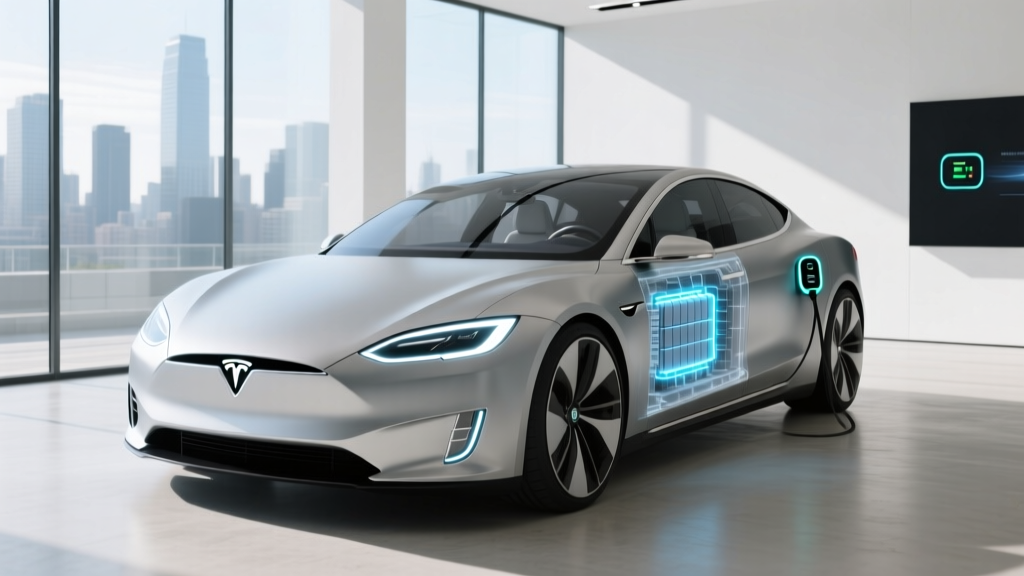
- Battery capacity: Approximately 2.3 kWh, housed in the robot's torso. For comparison, a Tesla Model 3 carries roughly 60 kWh (RWD) to 82 kWh (Long Range) — enough to power Optimus's battery roughly 26 to 35 times over.
- Cell chemistry: Tesla has not confirmed whether Optimus uses LFP (lithium iron phosphate) or NMC (nickel manganese cobalt). Given the relatively small pack and the emphasis on cycle life and thermal stability in an indoor robot, LFP would be a logical choice — it trades energy density for longevity and safety, both priorities for a robot operating near humans.
- Charging: Optimus is expected to charge via a wired connection (details unconfirmed). At 2.3 kWh, even a standard 120V household outlet (Level 1, ~1.4 kW) could fully recharge the battery in under two hours.
- Compute: The robot uses a version of Tesla's FSD inference computer, the same silicon that processes vision data in Tesla vehicles. This shared platform is central to Tesla's argument that Optimus can improve rapidly via over-the-air software updates — similar to how your Model Y gets new features without a service center visit.
How Does Optimus Compare to Other Humanoid Robots?
Tesla isn't alone in the humanoid robotics space. Here's how Optimus stacks up against announced or available competitors on key metrics:
| Feature | Tesla Optimus (Gen 2) | Boston Dynamics Atlas | Figure 01 | Agility Digit |
|---|---|---|---|---|
| Status | Internal trials | Research (new electric version) | Announced / demos | Limited commercial |
| Target Price | $20K–$30K (goal) | Not for sale | Not disclosed | Not disclosed |
| Height | 5'8" | 5'6" | 5'6" | 5'9" |
| Payload (per arm) | ~45 lbs | ~25 lbs (est.) | ~44 lbs | ~35 lbs |
| AI Approach | End-to-end neural net | Model-based + ML | LLM-integrated | Task-specific ML |
| Consumer Sales | Not yet | No | Not yet | Enterprise only |
The key differentiator Tesla claims is cost at scale. No competitor has publicly committed to a sub-$30,000 price point. Whether Tesla can achieve that depends entirely on manufacturing volume, supply-chain control, and component cost reduction — the same playbook it applied (with mixed success) to vehicle pricing.
Timeline: When Can You Actually Buy One?
Tesla's public timeline for Optimus has shifted multiple times:
- 2024–2025: Tesla deployed early Optimus units for simple tasks inside its Fremont and Gigafactory Texas facilities — sorting parts, carrying components, and performing repetitive assembly-adjacent duties.
- 2026 (current): Optimus remains in limited internal use. Tesla has not announced a consumer pre-order window, retail configuration tool, or delivery timeline.
- 2027+ (speculative): Musk has suggested that external sales could begin within a few years of internal deployment, but Tesla's historical track record with timelines (Cybertruck, Roadster 2.0, FSD milestones) warrants caution.
For practical planning purposes: do not budget for or expect to purchase an Optimus in 2026. If you're a fleet operator or industrial buyer, monitoring Tesla's enterprise channels is worthwhile. For consumers, this remains a future product — and "future" in Tesla-speak has historically meant longer than stated.
What This Means for EV Buyers and Tesla Owners
If you're researching Tesla Optimus cost because you're evaluating Tesla as a company or considering a Tesla vehicle purchase, here's the practical framing:
- Optimus does not affect your vehicle purchase decision. It generates no revenue today, qualifies for no tax credits, and has no impact on Tesla's current vehicle lineup, Supercharger network, or FSD pricing.
- Shared AI investment may benefit FSD. The neural-network training infrastructure Tesla builds for Optimus — particularly manipulation and spatial reasoning — could eventually improve vehicle autonomy. But this is indirect and long-term.
- Manufacturing cost reductions could matter. If Optimus eventually lowers Tesla's factory labor costs, that savings could (in theory) flow into vehicle pricing. But this is speculative and years out.
- If you want a Tesla product today, the actionable purchases are the Model 3 (from ~$38,990), Model Y (from ~$44,990), Model S (from ~$74,990), Model X (from ~$79,990), Cybertruck (from ~$60,990), and Powerwall/home energy products — all with their own spec sheets, tax-credit profiles, and ownership economics.
Optimus Potential Pros
- Ambitious target price of $20K–$30K undercuts all current humanoid platforms
- Leverages Tesla's proven FSD AI stack and manufacturing scale
- Over-the-air updates could improve capabilities over time
- Could reduce Tesla's own manufacturing costs long-term
- LFP battery chemistry (if confirmed) offers safety and longevity
Optimus Key Drawbacks
- Not available for purchase — no pre-order, no MSRP, no delivery date
- Does not qualify for any federal or state EV incentives
- Timeline promises have historically slipped across Tesla products
- No confirmed consumer use cases, safety certifications, or regulatory framework
- $20K–$30K price is a long-term target, not a launch commitment
- Not a vehicle — cannot replace any transportation need
Frequently Asked Questions
How much does the Tesla Optimus robot cost?
Tesla has stated a long-term target price of $20,000 to $30,000 for the Optimus humanoid robot. However, no official MSRP has been published, no pre-orders are open, and the robot is not currently available for purchase. Early units deployed internally are likely significantly more expensive per unit than the target consumer price.
Can I buy a Tesla Optimus in 2026?
No. As of 2026, Optimus is in limited internal deployment at Tesla factories. Tesla has not opened consumer sales, pre-orders, or a reservation system. No delivery timeline has been confirmed.
Does the Tesla Optimus qualify for the $7,500 federal EV tax credit?
No. The IRS §30D Clean Vehicle Credit applies only to qualified plug-in electric motor vehicles — four-wheeled, road-registered, with a VIN. Optimus is a humanoid robot, not a vehicle, and does not meet any §30D eligibility criteria. It also does not qualify for state EV rebates, HOV lane access, or any vehicle-related incentive.
What battery does Tesla Optimus use?
Optimus carries an approximately 2.3 kWh battery pack integrated into its torso. Tesla has not confirmed the cell chemistry (LFP or NMC) or the specific cell format. At this capacity, a full charge from a standard 120V outlet would take under two hours.
Is Tesla Optimus self-driving or autonomous?
Optimus is designed to operate autonomously in structured environments (factories, warehouses) using Tesla's neural-network AI. However, the SAE automation levels used for vehicles (Level 0–5) do not directly apply to bipedal robots. Unlike Tesla's FSD (Supervised) in vehicles — which is Level 2 and requires constant driver attention — Optimus is intended to perform tasks without human supervision, though real-world deployment is still in early stages with limited task complexity.
How does Optimus compare to buying a Tesla vehicle?
They serve entirely different purposes. A Tesla Model 3 or Model Y is a purchasable, road-legal electric vehicle with EPA-rated range (up to 363 miles for Model 3 Long Range), DC fast charging (up to 250 kW), and §30D tax credit eligibility. Optimus is an unreleased robot with no transportation function. If your goal is personal transportation, Optimus is not a relevant product.
Will Optimus ever be sold to consumers?
Tesla has stated that consumer sales are part of the long-term plan, with Musk suggesting Optimus could eventually be used for household tasks like cooking, cleaning, and yard work. However, no timeline, safety certification pathway, or consumer product specification has been published. Regulatory frameworks for humanoid robots operating in homes near children and untrained users do not yet exist at scale.