Quick Verdict: Still the Benchmark for EV Software Integration
The Tesla operating system remains the most cohesive, responsive, and feature-rich infotainment and vehicle-control platform in the EV market. Unlike legacy automakers bolting smartphone-mirroring onto conventional architectures, Tesla built its OS around a single 17-inch touchscreen that controls everything from climate and suspension to over-the-air (OTA) updates and Full Self-Driving (Supervised). The 2026 Model S Long Range pairs this software advantage with a 402-mile EPA range, 250 kW DC fast charging, and dual-motor AWD — though at a starting price of $74,990, it competes in a luxury tier where rivals like the Lucid Air and BMW i5 are closing the gap in ride comfort and material quality.
Range, Battery, and Efficiency
The 2026 Model S Long Range uses an estimated 100 kWh battery pack (approximately 95 kWh usable) with NMC (nickel-manganese-cobalt) chemistry, chosen for its higher energy density compared to LFP. This enables the 402-mile EPA rating — the longest of any current Tesla sedan.
| Specification | 2026 Tesla Model S Long Range |
|---|---|
| EPA Range | 402 miles |
| Battery Capacity (usable) | ~95 kWh (NMC) |
| MPGe (combined) | 124 MPGe |
| Efficiency | 28 kWh/100 mi |
| Drivetrain | Dual-Motor AWD |
| 0–60 mph | 3.1 seconds |
| Horsepower | 670 hp |
| Top Speed | 155 mph |
Efficiency stands at 124 MPGe combined (28 kWh per 100 miles) per fueleconomy.gov. That's among the best in the luxury EV segment, translating to roughly $0.04–$0.06 per mile on residential electricity at $0.16/kWh — roughly one-third the per-mile cost of a comparable gas sedan.
Charging Speed: DC Fast and Home Level 2
Tesla's Supercharger network remains the most reliable public charging ecosystem in the U.S., and the Model S leverages it fully. The 2026 Long Range supports peak DC fast charging at 250 kW on V3 Superchargers (CCS-compatible via the North American Charging Standard adapter now native on all new Teslas).
| Charging Level | Power (kW) | Speed / Notes |
|---|---|---|
| Level 1 (120V household) | ~1.4 kW | ~3–4 miles per hour |
| Level 2 (240V home wall connector) | 11.5 kW (48A) | ~34 miles per hour; full charge in ~9 hours |
| DC Fast (Tesla V3 Supercharger) | Peak 250 kW | 10–80% in ~27 minutes; taper above 80% |
| DC Fast (third-party CCS 350 kW) | ~200 kW sustained | 10–80% in ~32 minutes via NACS adapter |
Charging-curve reality check: The 250 kW peak is not sustained. The Model S pulls maximum power between roughly 10–40% state of charge, then tapers progressively. From 80–100%, charging slows dramatically to protect the NMC cells. For road trips, plan stops around the 10–80% window for optimal throughput.
Home charging via the Tesla Wall Connector (Level 2, 48 amps) adds approximately 34 miles of range per hour — enough to fully replenish the pack overnight. Installation typically requires a 60-amp dedicated circuit; expect $800–$2,000 for equipment and electrician labor depending on panel proximity.
The Tesla Operating System: Software as the Differentiator
This is where the "Tesla operating system" keyword earns its weight. Tesla's vertically integrated software stack is arguably the single biggest reason buyers choose the Model S over competitors with comparable range or luxury appointments.
Core OS capabilities in the 2026 Model S:
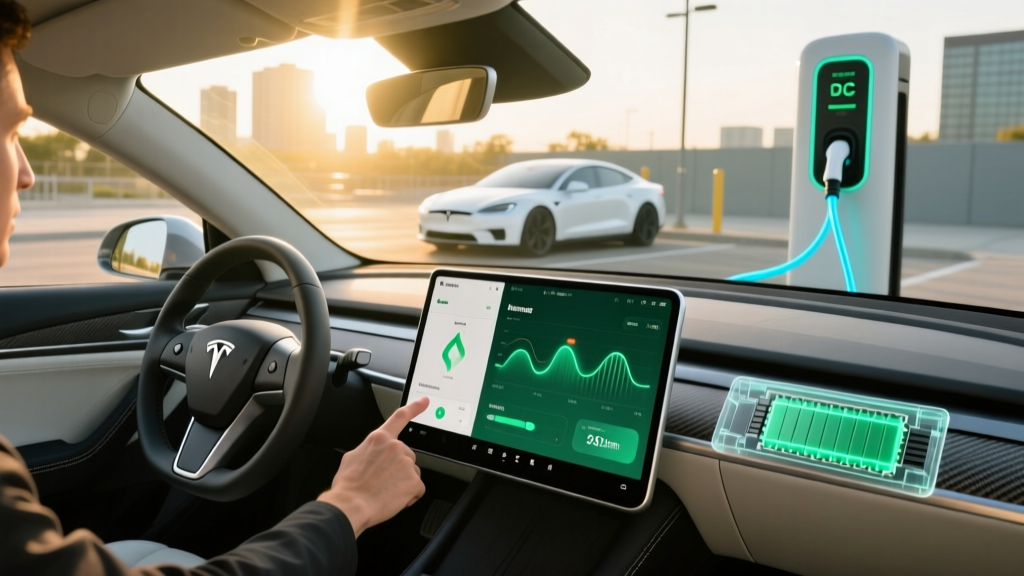
- 17-inch center touchscreen (cinematic display, 2200 x 1300 resolution) controls climate, media, navigation, vehicle settings, and gaming
- Over-the-air (OTA) updates — Tesla pushes feature additions, UI refinements, and performance improvements remotely, often monthly
- Native navigation with real-time Supercharger routing — the OS automatically calculates charging stops, preconditioning the battery for optimal charge speed on arrival
- Theater mode — rear passengers get a dedicated 8-inch screen for streaming (Netflix, YouTube, Disney+)
- Gaming — the AMD Ryzen-based infotainment chip supports titles like Cyberpunk 2077 at near-console quality while parked
- Dashcam and Sentry Mode — integrated multi-camera recording with cloud and USB storage
- Phone-as-key — Bluetooth-based passive entry, no fob required
- Voice commands — natural-language navigation, climate, and media control
The Tesla OS does not support Apple CarPlay or Android Auto. For some buyers, this is a dealbreaker; for Tesla loyalists, the native integration (navigation-aware preconditioning, Supercharger-native routing, OTA-driven feature expansion) makes phone-mirroring feel redundant.
Autopilot and FSD (Supervised): Standard Autopilot includes Traffic-Aware Cruise Control and Autosteer (lane-centering). The optional FSD (Supervised) package ($8,000 one-time or $99/month subscription in 2026) adds automatic lane changes, Navigate on Autopilot, Autopark, and Smart Summon. FSD's real-world performance varies significantly by geography and road complexity — it excels on well-marked highways but requires heightened vigilance in construction zones, unmapped areas, and adverse weather. Always treat it as an assist, not a replacement for active driving.
Performance and Driving Dynamics
The dual-motor AWD powertrain delivers 670 horsepower and a 3.1-second 0–60 mph time — quick enough to embarrass most sports sedans at a stoplight. The Plaid trim (tri-motor, 1,020 hp, 1.99-second 0–60) exists for those who need supercar acceleration, but the Long Range strikes the better balance of performance, range, and price.
Ride quality has improved with the 2024+ refresh's adaptive air suspension, though some reviewers still note the Model S rides firmer than a Lucid Air or Mercedes EQS. Cabin noise isolation is excellent at highway speeds, and the yoke steering option remains polarizing — we recommend the standard round wheel for daily driving.
Interior Space, Cargo, and Practicality
The Model S is a full-size luxury liftback, and its hatchback design delivers practical cargo volume that sedans can't match.
- Cargo (rear, seats up): 28 cu ft
- Cargo (rear, seats folded): 64 cu ft
- Frunk (front trunk): 3.1 cu ft
- Rear legroom: 35.4 inches
- Front headroom: 38.8 inches
- Seating: 5 passengers standard
The rear seat accommodates adults comfortably on longer trips, though the floor-mounted battery creates a slightly elevated floor position. The frunk is modest — useful for charging cables and a small bag, but not a primary luggage compartment.
Pricing, Trims, and Federal Tax Credit Eligibility
The 2026 Model S is offered in two trims:
| Trim | Base MSRP | §30D Credit Eligibility | Effective Price (if eligible) |
|---|---|---|---|
| Long Range (AWD, 402 mi) | $74,990 | Not eligible (exceeds $55,000 sedan MSRP cap) | $74,990 |
| Plaid (AWD, 396 mi, 1,020 hp) | $89,990 | Not eligible (exceeds $55,000 sedan MSRP cap) | $89,990 |
Critical tax credit note: Under current IRS §30D rules, the federal EV tax credit for new sedans caps eligibility at an MSRP of $55,000. The Model S, at $74,990+, does not qualify for the $7,500 federal credit regardless of buyer income or battery sourcing. Buyers with modified adjusted gross income (MAGI) above $150,000 (single) or $300,000 (joint) are also excluded from §30D credits on any vehicle. For full eligibility rules, consult IRS.gov §30D guidance and a qualified tax professional.
Some states offer additional rebates or HOV-lane access that partially offset the lack of federal credit — check your state's EV incentive program for current availability.
Warranty Coverage
- Basic vehicle: 4 years / 50,000 miles
- Battery and drive units: 8 years / 150,000 miles (with minimum 70% capacity retention)
- Roadside assistance: 4 years / 50,000 miles
Tesla's battery warranty guarantees that the pack will retain at least 70% of its original capacity over the 8-year/150,000-mile term. NMC chemistry typically degrades 10–15% over the first 100,000 miles based on fleet data, then stabilizes. Out-of-warranty battery replacement currently ranges from $12,000–$18,000 depending on pack size and labor — a significant long-term cost to factor in for high-mileage owners.
Pros and Cons
- 402-mile EPA range — longest in Tesla's current sedan lineup
- Tesla operating system is best-in-class for integration, OTA updates, and native Supercharger routing
- 250 kW DC fast charging with ~27-minute 10–80% time
- Supercharger network reliability far exceeds third-party CCS networks
- Hatchback cargo practicality (28 cu ft rear + 64 cu ft folded)
- Strong resale value relative to luxury EV competitors
- Continuous OTA improvements add features post-purchase
- $74,990 starting price — no federal §30D tax credit eligibility (exceeds sedan MSRP cap)
- No Apple CarPlay or Android Auto support
- FSD (Supervised) is SAE Level 2, not autonomous — requires constant driver engagement
- Ride quality and interior materials lag Lucid Air and Mercedes EQS at this price point
- Yoke steering is divisive and less practical for low-speed maneuvers
- Service center wait times remain long in many metro areas
Who Should Buy the 2026 Tesla Model S?
Choose the Model S Long Range if: You prioritize software integration, Supercharger access, and maximum range in a luxury EV sedan. You want a car that improves via OTA updates and don't mind skipping CarPlay. You drive frequently on corridors well-served by Superchargers.
Consider the Lucid Air Pure or BMW i5 instead if: You value traditional luxury materials, a smoother ride, Apple CarPlay, or need to stay under $55,000 MSRP for federal tax credit eligibility. The Lucid Air Pure (419-mile range, ~$69,900) offers comparable range with a more premium interior; the BMW i5 eDrive40 (~$56,000, eligible for partial credit) offers a more conventional luxury experience.
Choose the Model S Plaid if: You want 1,020 hp and sub-2-second 0–60 performance and budget is secondary. For most buyers, the Long Range delivers 95% of the experience at $15,000 less.
Frequently Asked Questions
What is the real-world range of the 2026 Tesla Model S?
The EPA rates it at 402 miles. In real-world highway driving at 70 mph, expect 340–365 miles. In cold weather (below 32°F), plan for 280–310 miles. Range varies with driving style, terrain, temperature, and climate-control usage.
How fast does the Model S charge at home and on the road?
At home on a Level 2 Tesla Wall Connector (11.5 kW / 48A), the Model S gains approximately 34 miles of range per hour, fully recharging in about 9 hours. On a V3 Supercharger (peak 250 kW), a 10–80% charge takes approximately 27 minutes, though the charge curve tapers significantly above 80%.
Does the 2026 Tesla Model S qualify for the federal EV tax credit?
No. Under current IRS §30D rules, new sedans must have an MSRP at or below $55,000 to qualify for the $7,500 federal credit. The Model S starts at $74,990, which exceeds this cap. Additionally, buyer income caps ($150K single / $300K joint MAGI) and battery-sourcing requirements apply to all §30D-eligible vehicles. Consult IRS.gov for current rules.
Is the Tesla operating system better than CarPlay or Android Auto?
It depends on your priorities. Tesla's OS offers deeper vehicle integration — battery preconditioning for Superchargers, native route planning with charge stops, OTA feature updates, and built-in streaming/gaming. However, it lacks the familiarity and app ecosystem of CarPlay/Android Auto. If you rely heavily on Google Maps, Spotify playlists, or specific phone apps while driving, the absence of phone-mirroring may frustrate you.
Is Tesla's Full Self-Driving (FSD) actually self-driving?
No. FSD (Supervised) is an SAE Level 2 driver-assistance system. It can handle lane changes, highway interchanges, and some city streets, but the driver must remain fully engaged and ready to take over at any moment. It is not a Level 4 autonomous system like Waymo. Treat it as an advanced cruise-control and lane-keeping aid, not a chauffeur.
How does the Model S compare to the Lucid Air and BMW i5?
The Model S wins on Supercharger network access, software/OTA integration, and proven long-term battery data. The Lucid Air Pure offers slightly more EPA range (419 miles) and a more luxurious interior at a similar price. The BMW i5 provides a more traditional luxury experience with CarPlay, better dealer service infrastructure, and potential §30D credit eligibility at lower trims. Your choice depends on whether you value Tesla's software ecosystem (Model S), luxury refinement (Lucid), or conventional ownership (BMW).
What does battery replacement cost out of warranty?
Out-of-warranty Model S battery replacement currently ranges from approximately $12,000 to $18,000, depending on pack size and service center labor rates. Most Model S packs retain 85–90% capacity at 100,000 miles based on fleet telemetry data, and Tesla's 8-year/150,000-mile warranty covers degradation below 70%. Complete replacement is rare but worth budgeting for if you plan to own the vehicle beyond the warranty period.
Sources: EPA fueleconomy.gov, Tesla Model S specifications, IRS §30D Clean Vehicle Credit.