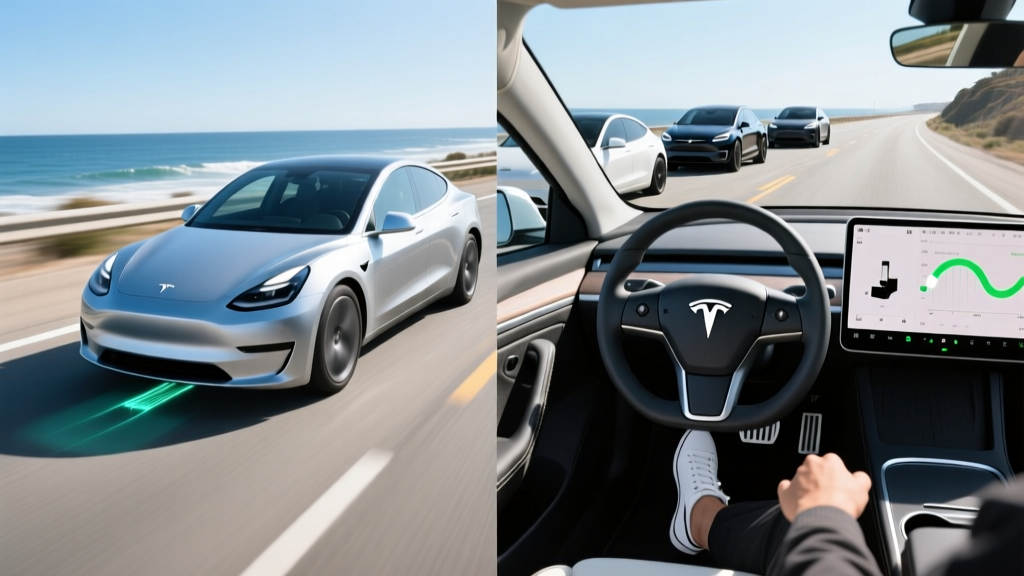
If you have ever lifted off the accelerator in a Tesla and felt the car decisively scrub speed without touching the brake pedal, you have experienced what enthusiasts and owners shorthand as Tesla one pedal driving. It is not a marketing gimmick; it is the direct result of aggressive regenerative braking mapped to the right pedal. In the 2026 lineup, Tesla has quietly standardized the behavior across the Model 3, Model Y, Model S, Model X, and Cybertruck, after a brief period where buyers could toggle between "Standard" and "Low" regen. Today, the experience is consistent, predictable, and central to how Teslas extract range from their battery packs.
This guide breaks down how one-pedal driving actually works in a Tesla, how it affects real-world efficiency, and pairs that with a complete 2026 spec profile so you can decide whether the system suits your commute, your passengers, and your right foot.
What "One Pedal Driving" Actually Means in a Tesla
Tesla does not officially brand its system as "one-pedal driving" the way Nissan does with the Leaf or Chevrolet did with the Bolt. But functionally, a Tesla in its default (and now only) regen setting behaves like one. Lift off the accelerator, and the drive motors reverse torque, converting kinetic energy back into electricity that is fed into the high-voltage pack. At typical city speeds (25-45 mph), you can modulate deceleration entirely with your right foot: press to accelerate, ease off to slow, hold at a precise position to coast at a steady speed.
Two nuances matter here. First, Teslas do not always come to a complete stop and hold without brake input — the behavior varies by model year and software version. On current 2026 software, the car will creep at very low speeds (1-3 mph) unless you enable the "Hold" mode in the driving settings, which brings the car to a full stop and engages the friction brakes to hold it there. Second, regen strength is not infinite. On a cold battery (below roughly 50°F / 10°C) or when the pack is near 100% state of charge, regen is software-limited to protect the cells. You will see a dotted line on the energy bar in the instrument display indicating reduced regen. Plan for more friction-brake use in those conditions.
2026 Tesla Lineup: Spec Table With One-Pedal Context
Because Tesla one pedal driving is consistent across the fleet, the bigger purchase decision is which vehicle's mass, battery, and drivetrain you want behind that regen feel. Heavier vehicles (Cybertruck, Model X) deliver a more noticeable deceleration "bite" because there is more kinetic energy to recapture. Lighter cars (Model 3 RWD) feel nimble and easier to modulate in stop-and-go traffic.
| Spec | 2026 Model 3 LR AWD | 2026 Model Y LR AWD | 2026 Model S LR | 2026 Cybertruck AWD |
|---|---|---|---|---|
| EPA Range | 363 mi | 320 mi | 402 mi | 340 mi |
| Battery (usable / chemistry) | ~75 kWh / NMC | ~75 kWh / NMC | ~95 kWh / NMC | ~123 kWh / NMC |
| 0-60 mph | 4.2 s | 4.8 s | 3.1 s | 4.1 s |
| Horsepower | ~346 hp | ~384 hp | ~670 hp | ~600 hp |
| Drivetrain | Dual-motor AWD | Dual-motor AWD | Dual-motor AWD | Dual-motor AWD |
| Efficiency (MPGe) | 131 MPGe | 122 MPGe | 124 MPGe | ~112 MPGe |
| Base MSRP | $47,740 | $49,630 | $84,990 | $79,990 |
Source: fueleconomy.gov and Tesla's 2026 order configurator. Prices include destination before any incentives.
Real-World Range: What One-Pedal Driving Does (and Doesn't) Add
Regenerative braking recovers energy that would otherwise be wasted as heat in the friction brakes, but it is not a perpetual-motion machine. The physics ceiling is the vehicle's kinetic energy at a given speed, and every conversion step (mechanical → electrical → chemical storage → back again) carries losses. Independent testing by Edmunds and owner logs on TeslaFi consistently show that regen-heavy drivers squeeze 3-7% more range out of the same pack compared to drivers who coast and brake conventionally. That translates to roughly 10-25 extra miles on a Model 3 LR per full charge — meaningful, but not transformational.
The bigger range variable is driving style itself. One-pedal driving rewards anticipation: lifting early for red lights, timing merges to avoid full stops. Drivers who adopt this rhythm naturally tend to drive slightly more efficiently. Those who stomp the accelerator and then rely on regen to bail them out will not see the same benefit. In stop-and-go urban traffic, regen's advantage is largest; at steady highway speeds, aero drag dominates and regen contributes little.
Charging Speed: DC Fast, Level 2, and Preconditioning
Tesla's Supercharger network remains the benchmark for public charging reliability in the U.S., and the 2026 lineup takes advantage of the newer V4 cabinets. Here is what the numbers look like in practice:
| Level | Power | Typical Delivery | Notes |
|---|---|---|---|
| Level 1 (120V) | ~1.4 kW | 3-5 mi/hr | Emergency / overnight trickle only |
| Level 2 (240V home) | 7.7 - 11.5 kW | 30-44 mi/hr | Full charge overnight; Mobile Connector or Wall Connector |
| DC Fast (Supercharger V4) | Peak 250 kW (Model 3/Y) / 325 kW (Model S Plaid) | 10-80% in ~25 min (Model 3 LR) | Curve tapers hard above 80%; precondition via nav |
A critical detail often missed in spec sheets: the 250 kW figure is a peak, not a sustained rate. On a Model 3 Long Range with a preconditioned pack (the car warms the battery automatically when you navigate to a Supercharger), you will see 200-250 kW for roughly the first 15-20% of the session, then the curve tapers to ~150 kW around 50% SoC, and drops below 60 kW past 80%. That is why the industry-standard 10-80% metric matters more than peak kW claims. Plan your road-trip stops around the 10-80% window — pushing to 100% at a Supercharger wastes time and adds battery stress.
Tax Credit Eligibility: The §30D Reality Check
Federal EV tax credit eligibility for 2026 Teslas is more constrained than many buyers assume. Under IRS §30D rules, the credit is up to $7,500 but is gated by three moving targets: buyer income caps, vehicle MSRP caps, and battery critical-mineral / component sourcing requirements that tighten annually.
| Model / Trim | MSRP | Under MSRP Cap? | Est. Credit (2026) | Effective Price |
|---|---|---|---|---|
| Model 3 LR AWD | $47,740 | Yes (sedan cap $55k) | Up to $7,500* | ~$40,240 |
| Model Y LR AWD | $49,630 | Yes (SUV cap $80k) | Up to $7,500* | ~$42,130 |
| Model S LR | $84,990 | No (over $55k sedan cap) | $0 | $84,990 |
| Cybertruck AWD | $79,990 | Yes (truck cap $80k) | Partial / varies* | ~$72,490 - $79,990 |
*Credit availability depends on the buyer's modified AGI (≤ $150k single / $300k joint), and on Tesla's evolving battery-sourcing compliance. The credit can now be transferred at point of sale as a down-payment reduction. Always confirm current-year eligibility on irs.gov and with a tax professional before purchase.
Interior, Cargo, and Tech That Shapes the Driving Experience
The 2026 Model 3 "Highland" refresh and Model Y "Juniper" update brought meaningful interior upgrades: ventilated front seats, ambient lighting, rear-seat touchscreen, acoustic glass, and a more compliant suspension. Cargo volume remains a Tesla strength — the Model Y offers 76 cu ft with rear seats folded (including the frunk), enough for a week's family luggage or a full Costco run. The Model 3 trunk is smaller at 23 cu ft but still generous for a sedan. Cybertruck's 6.5-foot bed and ~120 cu ft enclosed vault (with tonneau) suit work and gear-heavy buyers.
On the tech side, every Tesla ships with the same 15.4-inch center display running a custom Linux-based OS, over-the-air updates, and a phone-as-key experience that is still among the smoothest in the industry. The 16-camera vision suite supports Autopilot (standard) and FSD (Supervised) at ~$8,000 extra or $99/month. Remember: FSD is SAE Level 2, not self-driving. It handles highway lane-keeping and some city navigation impressively well, but you must remain attentive and ready to intervene at all times.
Notable drawbacks: turn-signal stalks were removed on the refreshed Model 3 and new Model Y — signals are now on steering-wheel buttons, which many drivers find unintuitive at roundabouts. There is no Apple CarPlay or Android Auto, and the absence of physical HVAC or volume controls forces everything through the touchscreen or voice. These are deal-breakers for some buyers and non-issues for others.
Pros and Cons of the Tesla One-Pedal Experience
Pros
- Consistent, predictable regen feel across the entire 2026 lineup
- "Hold" mode enables true stop-and-go one-pedal behavior in traffic
- Measurable range benefit (3-7%) vs friction-brake-heavy driving
- Dramatically reduced brake pad wear — many owners report 80k+ miles on original pads
- Supercharger network reliability remains an industry benchmark
- OTA updates continue to refine energy management years after purchase
Cons
- No adjustable regen level — you accept Tesla's tuning or don't
- Reduced regen when battery is cold or near 100% SoC catches new owners off guard
- Removed turn-signal stalk on newer models is polarizing
- No Apple CarPlay / Android Auto
- Insurance premiums run 15-30% higher than equivalent ICE sedans
- FSD (Supervised) remains Level 2 despite the name — supervision is mandatory
Who This EV (and This Driving Style) Suits Best
Choose a Tesla with one-pedal driving if: you commute in stop-and-go urban or suburban traffic where regen shines, you have reliable home Level 2 charging, you value OTA updates and the Supercharger network for road trips, and you are comfortable with a screen-centric interior. The Model 3 LR AWD at ~$40k after credit is the sweet spot for efficiency-minded commuters. The Model Y LR AWD fits families needing cargo room. The Cybertruck targets work and adventure buyers who want the bed and the vault.
Look elsewhere if: you want adjustable regen (try Hyundai Ioniq 5 or Ford Mustang Mach-E), you need Apple CarPlay, you prefer physical buttons, you drive mostly long steady Interstate miles where regen contributes little, or you live in an apartment without charging access and your public-charging options are sparse.
Frequently Asked Questions
What is the real-world range of a 2026 Tesla Model 3 Long Range?
EPA-rated at 363 miles, expect roughly 300-320 miles in mixed suburban driving at moderate temperatures, 265-280 miles at sustained 80 mph highway speeds, and 230-260 miles in sub-30°F winter conditions. Preconditioning the battery while plugged in mitigates cold-weather losses significantly.
How fast does a 2026 Tesla charge at home and on the road?
On a 240V Level 2 home charger (48A Wall Connector), Teslas add 30-44 miles per hour depending on the model, filling a Model 3 LR from 10-100% overnight in roughly 9 hours. On a V4 Supercharger, the Model 3 LR peaks at 250 kW and reaches 10-80% in about 25 minutes, though the curve tapers hard above 80%.
How much does a 2026 Tesla cost after the federal tax credit?
The Model 3 LR AWD starts at $47,740 and can drop to roughly $40,240 if you qualify for the full $7,500 §30D credit (income ≤ $300k joint, MSRP under cap, battery sourcing compliance). Model Y LR AWD lands near $42,130 after credit. Model S is ineligible due to the sedan MSRP cap. Always verify current rules on irs.gov.
Is a Tesla worth buying versus competitors like the Ioniq 5, Mach-E, or BMW i4?
Tesla's advantages are Supercharger access (though now opening to rivals via NACS), OTA maturity, and class-leading efficiency (MPGe). Competitors win on interior materials, adjustable regen, CarPlay, and sometimes pricing after incentives. Test-drive at least two rivals before committing — one-pedal feel and UI preference are highly personal.
Does Tesla one pedal driving damage the brakes or battery?
No. Regen actually extends friction-brake life dramatically — pads routinely last 80,000+ miles. Battery impact is minimal because regen current is software-limited to safe C-rates. The only caveat: avoid repeated hard regen into a very cold or very full battery, which the car already protects against by tapering regen automatically.
Can I turn off one-pedal driving in a 2026 Tesla?
Not fully. Tesla removed the "Low" regen toggle several model years ago. You can choose between "Hold" (full stop and hold) and "Roll/Creep" behavior at very low speeds, but the strong regen feel on lift-off is fixed. If adjustable regen is a deal-breaker, test a Hyundai, Kia, or Ford EV instead.
Safety ratings for the 2026 Tesla lineup are published by NHTSA and IIHS; both the Model 3 and Model Y carry Top Safety Pick+ histories. Always check the current model year's results before purchase.