Tesla One-Pedal Driving in 2026: What You Actually Get
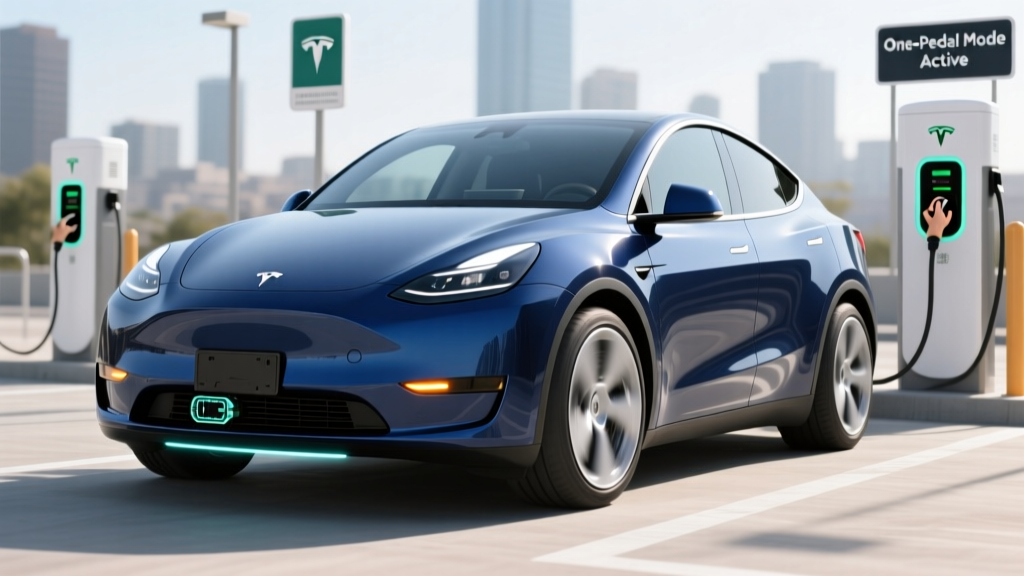
Search for "tesla one pedal" and you'll find years of forum debates, software-update complaints, and confused new owners. The short version: Tesla does not offer a true one-pedal driving mode with a hold-to-stop function the way Nissan Leaf, Chevrolet Bolt, or Hyundai Ioniq 5 do. What Tesla does offer is aggressive regenerative braking tied to a single "Regenerative Braking: Standard" setting — strong enough that most daily driving can be done without touching the brake pedal, but the car will creep at low speeds and requires the friction brake for a full stop.
In 2026, Tesla's lineup (Model 3, Model Y, Model S, Model X, and the Cybertruck) ships with regenerative braking locked to its maximum setting. There is no longer a user-toggleable "Low" regen option in the US market, a change that began with the 2020 model year and was briefly reversed following a 2023 NHTSA recall before being reinstated with updated driver-alert software. The result is a driving experience that feels like one-pedal driving in stop-and-go traffic, but demands discipline at parking-lot speeds and in low-traction conditions.
This guide covers how Tesla's regen system actually behaves across the 2026 lineup, pairs it with the real-world range, charging, and pricing data you need, and helps you decide whether a Tesla's regen character suits your commute.
How Tesla's Regenerative Braking Actually Works
Tesla's regen system converts kinetic energy back into battery storage when you lift off the accelerator. The inverter reverses the motor's role, turning it into a generator. The deceleration force is substantial — roughly 0.2g to 0.3g of braking at highway speeds, tapering off below ~5 mph where the system hands off to the friction brakes.
Key behavioral traits to understand before you buy:
- No hold function: The car will not brake to a complete stop and hold itself. You must press the brake pedal to stop fully and hold position, unless Auto Hold is engaged after stopping.
- Speed-dependent strength: Regen is strongest between roughly 15 and 70 mph. Below 10 mph, deceleration fades noticeably, which surprises new EV drivers in parking lots.
- Cold and full-battery limitations: When the battery is near 100% state of charge or extremely cold (below ~40°F), regen is software-limited to protect the cells. Tesla displays a dotted line on the speedometer and a "regen limited" icon. Expect 30–50% less deceleration in these conditions, which means more friction-brake use.
- No adjustable levels: Unlike Hyundai/Kia/Genesis EVs with paddle-adjustable regen (0 through 3 plus i-PEDAL), Tesla offers one setting: maximum. You modulate deceleration by how gradually you lift the accelerator.
2026 Tesla Lineup: Range, Battery, and Efficiency Specs
Tesla publishes EPA range figures on fueleconomy.gov. Below is the 2026 lineup with the data that actually matters for ownership.
| Model | Trim | EPA Range | Battery (kWh usable) | Chemistry | MPGe (combined) | kWh/100mi |
|---|---|---|---|---|---|---|
| Model 3 | Long Range AWD | 363 mi | ~75 kWh | NMC (CATL LG) | 132 | 25 |
| Model 3 | RWD | 272 mi | ~57.5 kWh | LFP (CATL) | 132 | 25 |
| Model Y | Long Range AWD | 320 mi | ~75 kWh | NMC | 122 | 27 |
| Model Y | RWD | 277 mi | ~57.5 kWh | LFP | 125 | 27 |
| Model S | Long Range | 402 mi | ~95 kWh | NMC | 120 | 28 |
| Model X | Long Range | 335 mi | ~95 kWh | NMC | 109 | 31 |
Charging Speeds: DC Fast, Level 2, and the Curve
Tesla's Supercharger network remains the most reliable public DC fast-charging ecosystem in North America, and the 2026 lineup leverages the native NACS connector without adapters. Here's what the charging data actually looks like:
| Model | Peak DC kW | 10–80% Time | Sustained Avg kW (10–80%) | Level 2 (kW / mi per hr) |
|---|---|---|---|---|
| Model 3 LR AWD | 250 kW | ~25 min | ~165 kW | 11.5 kW / ~44 mi/hr |
| Model 3 RWD (LFP) | 170 kW | ~30 min | ~120 kW | 11.5 kW / ~44 mi/hr |
| Model Y LR AWD | 250 kW | ~27 min | ~155 kW | 11.5 kW / ~40 mi/hr |
| Model Y RWD (LFP) | 170 kW | ~32 min | ~115 kW | 11.5 kW / ~40 mi/hr |
| Model S LR | 250 kW | ~30 min | ~155 kW | 11.5 kW / ~36 mi/hr |
| Model X LR | 250 kW | ~33 min | ~145 kW | 11.5 kW / ~30 mi/hr |
Charge curve reality check: Peak kW is a headline number, not a sustained rate. A Model 3 Long Range hitting 250 kW at 10% SoC will taper to ~180 kW by 40%, ~110 kW by 60%, and ~50 kW by 80%. That's why the 10–80% average matters more for road-trip planning. Charging past 80% slows dramatically — budget an extra 20+ minutes for 80–100% if you need the full battery for a long leg.
LFP-specific charging note: Tesla recommends charging LFP-equipped RWD models to 100% at least once per week to maintain accurate state-of-charge calibration. NMC Long Range models should be kept at 80% daily and only charged to 100% before trips. This affects how you use one-pedal regen on a daily basis — an LFP Model 3 charged to 100% will have reduced regen for the first 10–15 miles of your commute.
Performance, Cargo, and Interior Space
| Model | Drivetrain | Horsepower | 0–60 mph | Cargo (cu ft) | Rear Legroom (in) |
|---|---|---|---|---|---|
| Model 3 LR | AWD Dual-Motor | ~382 hp | 4.2 sec | 23 (trunk) + 3 (frunk) | 35.2 |
| Model Y LR | AWD Dual-Motor | ~384 hp | 4.8 sec | 30 + 41 seats-down + 4 frunk | 41.6 |
| Model S LR | AWD Dual-Motor | ~670 hp | 3.1 sec | 28 + 68 seats-down | 38.0 |
| Model X LR | AWD Dual-Motor | ~670 hp | 3.8 sec | 15 + 82 seats-down (5-seat) | 38.4 |
The Model Y remains Tesla's practicality champion for families, with genuine crossover cargo volume and comfortable rear seating for adults. The Model 3 Highland refresh (introduced for 2024) improved rear-seat cushion length and cabin materials substantially. Model S and X continue to offer the most range and performance but at a premium that's hard to justify against newer competitors unless you specifically want Tesla's Supercharger integration and software ecosystem.
2026 Pricing and Federal Tax Credit Eligibility
| Model / Trim | Base MSRP | MSRP Cap (§30D) | Potential Credit | Est. After Max Credit |
|---|---|---|---|---|
| Model 3 RWD | $38,990 | Passes (sedan cap $55k) | Up to $7,500 | ~$31,490 |
| Model 3 LR AWD | $44,990 | Passes | Up to $7,500 | ~$37,490 |
| Model Y LR AWD | $44,990 | Passes (SUV cap $80k) | Up to $7,500 | ~$37,490 |
| Model Y RWD | $39,990 | Passes | Up to $7,500 | ~$32,490 |
| Model S LR | $79,990 | Passes | Up to $7,500 | ~$72,490 |
| Model X LR | $84,990 | Fails (over $80k SUV cap) | $0 | $84,990 |
- Income caps: AGI must not exceed $150,000 (single), $225,000 (head of household), or $300,000 (married filing jointly).
- MSRP caps: Sedans/wagons must be under $55,000; SUVs, trucks, and vans under $80,000. The Model X Long Range exceeds the SUV cap.
- Battery sourcing: A percentage of critical minerals and battery components must be sourced from the US or FTA partners. The full $7,500 requires meeting both halves of the requirement ($3,750 each). Tesla's US-built vehicles with CATL/Panasonic supply chains have generally qualified for the full credit, but IRS rules are updated periodically — verify at purchase.
- Point-of-sale transfer: As of 2024, you can transfer the credit to the dealer at purchase, reducing your out-of-pocket cost immediately rather than waiting for tax filing.
Tech, Driver Assistance, and the One-Pedal Experience
Every 2026 Tesla ships with Autopilot standard (Traffic-Aware Cruise Control + Autosteer). Full Self-Driving (Supervised) is an $8,000 option or $99/month subscription that adds automatic lane changes, traffic-light recognition, and city-street navigation. Both remain SAE Level 2 systems requiring continuous driver supervision.
From a one-pedal driving perspective, FSD (Supervised) actually complements Tesla's regen character well: the system modulates the accelerator smoothly enough that most deceleration events are handled by regen without friction-brake intervention. On highway commutes, this combination is genuinely relaxing. In city driving with frequent stops, you'll still use the brake pedal 5–10 times per trip.
The 2026 infotainment system runs on Tesla's Ryzen-based hardware with a 15.4-inch center display (Model 3/Y) or 17-inch (Model S/X). Notable features include native Spotify/Apple Music streaming without phone pairing, integrated trip planning with Supercharger preconditioning, Sentry Mode dashcam recording, and over-the-air updates that continue to refine regen behavior and thermal management.
- Bring the car to a full stop and hold it without brake-pedal input.
- Provide maximum deceleration when the battery is cold or above 95% SoC.
- Replace the friction brakes in emergency stops — always use the brake pedal for hard braking.
- Offer adjustable levels — if you want mild regen coasting, Tesla is not the right EV for you.
Warranty and Long-Term Ownership
| Coverage | Model 3 / Y | Model S / X |
|---|---|---|
| Basic Vehicle | 4 yr / 50,000 mi | 4 yr / 50,000 mi |
| Battery & Drive Unit | 8 yr / 100,000 mi (RWD) or 120,000 mi (LR AWD) | 8 yr / 150,000 mi |
| Capacity Retention Threshold | 70% SoH | 70% SoH |
Tesla's battery warranty guarantees at least 70% state of health (SoH) over the coverage period. Real-world degradation data from Tesla's 2025 Impact Report and third-party fleet studies show NMC packs losing roughly 8–12% capacity over 100,000 miles, with LFP packs showing slower initial degradation but a less linear curve. For most owners, battery replacement under warranty is rare — but out-of-warranty replacement costs range from $12,000 to $18,000 depending on the pack, which is worth factoring into 10-year ownership projections.
Who Should Buy a Tesla for Its Regen Behavior?
- Strong, predictable regen enables near-one-pedal highway and suburban driving
- Supercharger network reliability is unmatched for road trips
- Industry-leading efficiency (low kWh/100mi) stretches every charge
- OTA updates continuously improve thermal management and regen tuning
- Point-of-sale tax credit transfer reduces upfront cost significantly on qualifying trims
- No true one-pedal hold — brake pedal required for full stops
- No adjustable regen levels — take it or leave it
- Cold-weather and high-SoC regen limitations catch new owners off guard
- Model X priced above §30D MSRP cap — no federal credit
- Insurance premiums run 15–25% above comparable non-Tesla EVs
- Service center wait times remain a pain point in high-volume metro areas
Look elsewhere if: You want true one-pedal driving with a hold-to-stop function (consider the Hyundai Ioniq 5, Kia EV6, or Ford Mustang Mach-E with one-pedal mode enabled), you live in extreme cold where regen limitations will frustrate you daily, or you want adjustable regen paddles for varied driving conditions.
Frequently Asked Questions
Does Tesla have a one-pedal driving mode?
Tesla does not have a branded "one-pedal" mode. The car uses maximum regenerative braking at all times, which allows most daily deceleration without the brake pedal, but the car will not come to a complete stop and hold without friction-brake input. This is a meaningful distinction from the true one-pedal systems in the Nissan Leaf, Chevy Bolt, and Hyundai/Kia EVs.
Why did Tesla remove the low-regen option?
Tesla phased out user-selectable regen levels starting with 2020 model-year vehicles to simplify the driving experience and maximize efficiency. A 2023 NHTSA recall (affecting nearly 2 million vehicles) addressed concerns that the lack of driver alerts around regen state could contribute to pedal misapplication. Following the recall, Tesla reinstated Standard regen as the sole option with additional audible and visual warnings.
Is Tesla's regen safe in snow and ice?
Aggressive regen on slippery surfaces can cause rear-wheel slip if the lift-off is abrupt. Tesla's traction control manages this reasonably well, but experienced winter EV drivers recommend gentler accelerator modulation in snow. The car automatically reduces regen when wheel slip is detected, but the transition can feel unpredictable. Winter tires are strongly recommended for Tesla owners in snow-belt states.
How much range does regen actually recover?
In city driving with frequent stops, regenerative braking can recover 15–25% of energy that would otherwise be lost to friction brakes. On highway driving with minimal braking events, the benefit drops to 5–10%. This is reflected in Tesla's MPGe ratings, which are typically higher in city driving than highway — the opposite of a gas car.
Which 2026 Tesla qualifies for the full $7,500 tax credit?
As of the current IRS §30D rules, the Model 3 (RWD and Long Range) and Model Y (RWD and Long Range) qualify for up to $7,500 in federal tax credits, subject to buyer income limits and battery-sourcing requirements. The Model S Long Range qualifies if optioned below $55,000 MSRP (which is unlikely with current pricing). The Model X exceeds the $80,000 SUV cap and does not qualify. Always verify eligibility at the time of purchase, as sourcing rules are updated periodically.
How does Tesla's regen compare to Hyundai, Kia, or Ford?
Hyundai (Ioniq 5/6), Kia (EV6/EV9), and Ford (Mach-E) all offer adjustable regen levels via steering-wheel paddles, including a true one-pedal mode (i-PEDAL or similar) that brings the car to a full stop and holds it. Tesla's regen is comparably strong at speed but lacks the hold function and adjustability. If one-pedal driving is your top priority, these competitors offer a more complete implementation.
What's the real-world range of a Tesla in winter?
Expect 20–30% range loss in sustained sub-freezing temperatures (20–35°F) compared to EPA ratings, primarily from cabin heating and battery thermal management. Preconditioning the battery while plugged in mitigates some of this loss. A Model 3 Long Range rated at 363 miles EPA will typically deliver 250–280 miles of real-world winter range. Using a heat pump (standard on all 2026 Teslas) reduces heating energy consumption by roughly 30% compared to resistive heaters.