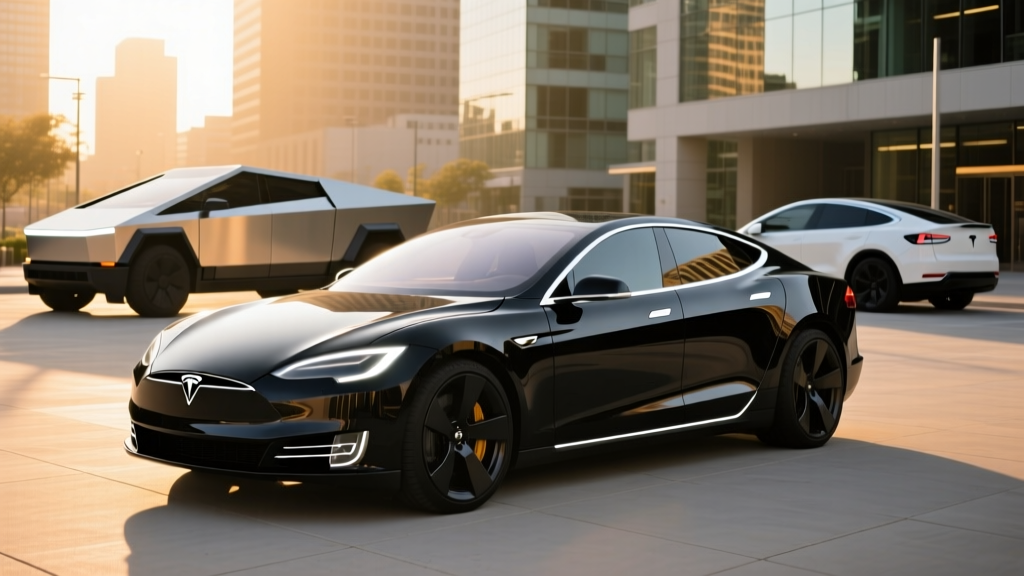
When a senior manufacturing executive departs a company mid-cycle, EV buyers rightly ask: will my car still get built, will quality hold, and should I wait? In early 2026, Tesla executive Omead Afshar exits his role overseeing vehicle programs, prompting exactly those questions from shoppers eyeing the Model S, Model X, and Cybertruck. Afshar was closely associated with the Cybertruck ramp and the broader North American production footprint. Below, we pair that leadership news with the hard numbers buyers actually need — EPA range, battery chemistry, charge curves, pricing, and §30D tax-credit eligibility — so you can decide whether to order now or wait for the next production phase.
Why the Afshar departure matters to buyers
Omead Afshar's tenure at Tesla coincided with some of the company's most difficult production ramps, most notably Cybertruck's stainless-steel exoskeleton and 4680 cell integration. Executive exits at this level can signal three things: a planned succession after a milestone is reached, an internal reorganization of manufacturing responsibilities, or friction over pace and priorities. For buyers, the practical read is narrower than the headlines. Tesla's Gigafactory Texas and Fremont lines run on deeply embedded MES (manufacturing execution systems) and standardized work instructions; a single leader rarely changes day-to-day build quality overnight. What can shift is the cadence of running changes — the small, continuous tweaks to panel gaps, wiring harnesses, and software calibrations that Afshar's teams historically pushed through quickly.
2026 Tesla lineup: range, battery, and efficiency at a glance
| Model | EPA Range | Battery (kWh, chem.) | MPGe (city/hwy) | kWh/100 mi |
|---|---|---|---|---|
| Model S Long Range | 402 mi | ~100 kWh, NMC | 124 / 115 | 28 |
| Model S Plaid | 396 mi | ~100 kWh, NMC | 119 / 112 | 30 |
| Model X Long Range | 348 mi | ~100 kWh, NMC | 109 / 100 | 33 |
| Model X Plaid | 326 mi | ~100 kWh, NMC | 103 / 96 | 35 |
| Cybertruck AWD | 340 mi | ~123 kWh, 4680 NMC | 76 / 70 | 48 |
| Cybertruck Cyberbeast | 320 mi | ~123 kWh, 4680 NMC | 72 / 67 | 51 |
Figures reflect current EPA / fueleconomy.gov listings. Tesla does not officially publish usable kWh; values above are industry-consensus estimates based on teardowns and telemetry.
Charging speed: DC fast, home Level 2, and the curve that matters
Tesla's Supercharger network remains the most reliable public DC network in North America, and the 2026 lineup takes full advantage — with one caveat that catches new owners off guard: peak kW is not sustained kW.
| Model | Peak DC kW | 10–80% time | Level 2 (11.5 kW) rate | Connector |
|---|---|---|---|---|
| Model S / X | 250 kW (V3) | ~27–30 min | ~34 mi/hr | NACS (native) |
| Cybertruck AWD / Beast | 350+ kW (V4 capable) | ~15–20 min | ~28 mi/hr | NACS (native) |
Cybertruck's 800V-class architecture lets it pull higher peak power on V4 Superchargers, but the charge curve tapers sharply above roughly 55–60% state of charge (SoC). In real sessions, you'll see 300+ kW briefly near 10–20% SoC, then a step-down to the 175–200 kW range through the mid-50s, and a long tail above 80%. For road-trip planning, budget 20 minutes for a 10–70% top-up, not the marketing-friendly 10–80% headline.
At home, an 11.5 kW Wall Connector on a 60A circuit adds roughly 30–34 miles per hour of charging for sedans and 25–28 for Cybertruck (more mass, more consumption). Most owners need a 200A residential panel; if you're on a 100A service, expect a $1,500–$3,500 panel upgrade before installation. Always have a licensed electrician confirm conductor sizing and local code — don't spec this from an internet forum.
Performance and drivetrain numbers
| Model | 0–60 mph | Horsepower | Drivetrain |
|---|---|---|---|
| Model S Long Range | 3.1 s | ~670 hp | Dual-motor AWD |
| Model S Plaid | 1.99 s | 1,020 hp | Tri-motor AWD |
| Model X Long Range | 3.8 s | ~670 hp | Dual-motor AWD |
| Model X Plaid | 2.5 s | 1,020 hp | Tri-motor AWD |
| Cybertruck AWD | 3.9 s | ~600 hp | Dual-motor AWD |
| Cybertruck Cyberbeast | 2.6 s | ~845 hp | Tri-motor AWD |
These remain absurd numbers for the mass and price. Model S Plaid's tri-motor torque vectoring still sets the handling benchmark for a four-door EV, while Cybertruck Cyberbeast delivers supercar acceleration in a 6,800-pound stainless wedge. The engineering execution here is exactly the kind of work Afshar's teams were known for protecting through production trade-offs.
Pricing, trims, and the §30D tax credit in 2026
| Model | Base MSRP | As-tested (typical) | §30D eligible? |
|---|---|---|---|
| Model S Long Range | ~$79,990 | $86,000–$95,000 | No (MSRP cap) |
| Model S Plaid | ~$94,990 | $100,000+ | No (MSRP cap) |
| Model X Long Range | ~$84,990 | $92,000–$105,000 | No (MSRP cap) |
| Model X Plaid | ~$99,990 | $108,000+ | No (MSRP cap) |
| Cybertruck AWD | ~$79,990 | $85,000–$95,000 | No (MSRP cap) |
| Cybertruck Cyberbeast | ~$99,990 | $105,000+ | No (MSRP cap) |
Under current IRS §30D rules, the new-vehicle credit is up to $7,500 but only applies to SUVs/pickups/vans with an MSRP at or below $80,000 and sedans at or below $55,000, with buyer AGI caps ($150k single / $300k joint). None of the 2026 Model S, X, or Cybertruck trims clear the MSRP cap at base, so the federal credit does not apply. State and utility incentives may still help — check DSIRE and your local utility. Always confirm current-year rules with a tax professional and the IRS §30D guidance.
If credit eligibility is a hard requirement, Tesla's Model 3 and Model Y (reviewed separately) are the trims to target; they remain the brand's volume and credit-eligible plays.
Cargo, passenger space, and daily usability
- Model S: 28 cu ft rear cargo (71 cu ft folded), plus a generous frunk. Rear legroom is adult-friendly for two, tight for a middle passenger.
- Model X: Up to 88 cu ft behind front seats; available 6- or 7-seat layouts. The third row is best for children. Falcon-wing doors need ~12 inches of side clearance — tight urban garages can be awkward.
- Cybertruck: 6.5-foot bed with ~67 cu ft lockable volume and a powered tonneau. Cabin seats five. The bed's width between wheel wells is narrower than a traditional half-ton pickup, so standard 4x8 sheets of plywood do not lie flat between them.
Towing: Model X is rated up to 5,000 lbs; Cybertruck up to 11,000 lbs. Expect towing to cut range roughly in half at highway speed — plan charging accordingly.
Warranty, service, and what leadership changes can affect
Tesla's baseline coverage holds steady: 4-year/50,000-mile limited vehicle warranty and 8-year/120,000-mile battery and drive unit warranty (Model S/X), with a 70% minimum capacity retention threshold. Cybertruck carries 8-year/120,000-mile coverage as well. The 4680 cells in Cybertruck are still early in their long-term degradation data set; NMC chemistry in the S/X platform has a mature track record with typical 8–12% degradation over 100,000 miles based on owner telemetry aggregations.
Where executive exits can bite is in service responsiveness. Running changes that reduce warranty claims take 6–12 months to flow through the fleet. If Afshar's departure slows that feedback loop, early-2026 builds may see slightly more fit-and-finish variation than late-2025 units. Buyers picking up soon should PDI carefully — check panel gaps, frunk alignment, and Cybertruck bed-seal water ingress before signing.
Tech, driver assist, and what is (and isn't) self-driving
The 2026 infotainment stack continues to lead on responsiveness, with a clean navigation/charging-planner integration and a growing library of streaming apps. Cybertruck's steer-by-wire and 48V electrical architecture remain unique in the segment, enabling tighter low-speed maneuvering than its wheelbase suggests. Drawbacks persist: no Apple CarPlay / Android Auto, minimal physical controls, and vision-only sensing means performance in heavy rain, fog, or direct sun glare can degrade more than radar-equipped competitors.
Pros, cons, and who should buy now
Pros
- Class-leading DC charging network (Supercharger) with native NACS
- Best-in-class sedan range (Model S Long Range, 402 mi EPA)
- Over-the-air updates that still add meaningful features years after delivery
- Cybertruck's 11,000-lb tow rating and 48V architecture
- Strong resale history relative to luxury EV peers
Cons
- No §30D federal credit on any 2026 S/X/Cybertruck trim
- Fit-and-finish variability, especially on early Cybertruck builds
- Vision-only ADAS can struggle in low-visibility weather
- Cybertruck efficiency is poor above 70 mph; real range drops fast
- Service-center capacity still lags the installed base in many metros
Wait if: you want to see whether post-Afshar running changes improve Cybertruck panel consistency and bed-seal reliability through mid-2026, or you're weighing Rivian R1T, Lucid Air, or the refreshed BMW iX against the Tesla options.
Frequently asked questions
What is the real-world range of Tesla's 2026 flagship EVs?
Model S Long Range delivers roughly 320–350 highway miles in fair weather and 260–290 in cold conditions. Cybertruck AWD lands around 260–280 highway miles, falling to ~220 in winter. City and regen-heavy driving lands closer to the EPA sticker.
How fast do they charge on DC fast chargers and at home?
Model S/X peak at 250 kW with 10–80% in about 27–30 minutes. Cybertruck can exceed 350 kW on V4 Superchargers with 10–80% in roughly 15–20 minutes, though the curve tapers sharply above ~60% SoC. Home Level 2 at 11.5 kW adds about 28–34 miles per hour.
How much do these models cost after tax credits?
Because all 2026 Model S, X, and Cybertruck trims exceed the IRS §30D MSRP cap ($55k sedans / $80k SUVs and trucks), the federal $7,500 credit does not apply. Expect to pay sticker plus destination, minus any state or utility incentives you qualify for.
Is it worth buying vs. key competitors?
Model S still wins on range and Supercharger access vs. Lucid Air and Porsche Taycan. Model X competes on packaging with Rivian R1S and BMW iX, where the BMW wins on interior finish and Rivian on adventure utility. Cybertruck trades blows with Rivian R1T and the Ford F-150 Lightning on capability, with Tesla winning on charging and efficiency, and Rivian/Ford on traditional-truck usability.
Does the Omead Afshar exit affect my order or warranty?
Not directly. Existing orders, pricing, and warranty terms are contractual and unchanged. The risk is indirect: a slower cadence of production refinements in 2026 could mean slightly more build variability on early-year vehicles. Inspect your delivery carefully and document any concerns before taking possession.
Does any 2026 Tesla qualify for the federal EV tax credit?
Among the flagship models reviewed here, no. Tesla's Model 3 and Model Y trims that meet MSRP, buyer income, and battery-sourcing requirements may still qualify — see the IRS clean-vehicle credit page for current rules and the point-of-sale transfer option.