Quick Verdict: Tesla Off Road Assist Explained
If you've searched for Tesla Off Road Assist hoping to turn a Model Y into a trail rig, here's the honest answer: it's a traction-management software mode, not a hardware upgrade. Tesla Off Road Assist modulates torque delivery to individual wheels, simulating a locking differential by braking slipping wheels and redirecting power to those with grip. It's available on dual-motor AWD versions of the 2026 Tesla Model Y and the 2026 Tesla Cybertruck — and while it won't make either vehicle a Jeep Wrangler rival, it meaningfully expands capability on gravel, snow, sand, and mild trails.
This review breaks down how Off Road Assist works, which Tesla models support it, and pairs that with the full ownership picture: real-world range, DC fast-charge speeds, pricing after the federal §30D tax credit, and whether the feature is worth prioritizing over a dedicated off-road SUV.
Which Teslas Have Off Road Assist in 2026?
Tesla doesn't sell a single "off-road" trim. Instead, Off Road Assist is a software feature bundled with dual-motor AWD powertrains. Here's where it appears for the 2026 model year:
- 2026 Tesla Model Y Long Range AWD — the most accessible option, now on the refreshed Juniper platform.
- 2026 Tesla Cybertruck AWD and Cyberbeast — standard on both, with additional ride-height adjustability via adaptive air suspension.
The single-motor Model Y RWD does not include Off Road Assist. Neither does the Model 3 in any current configuration — Tesla has kept the feature restricted to its higher-clearance, dual-motor vehicles.
Spec Table: 2026 Model Y Long Range AWD vs Cybertruck AWD
| Spec | 2026 Model Y Long Range AWD | 2026 Cybertruck AWD |
|---|---|---|
| EPA Range | 320 miles | 340 miles |
| Battery (usable) | ~78 kWh, NMC | ~123 kWh, NMC |
| Efficiency | 117 MPGe / 29 kWh/100mi | 79 MPGe / 43 kWh/100mi |
| 0-60 mph | 4.8 sec | 4.1 sec |
| Horsepower | 384 hp | 600 hp |
| Drivetrain | Dual-motor AWD | Dual-motor AWD |
| Ground Clearance | 6.6 in (7.2 in Juniper) | 16 in (air susp. max) |
| Max DC Charge | 250 kW | 250 kW (800V arch.) |
| 10-80% DC Time | ~25 min | ~20 min |
| Base MSRP | $48,590 | $79,990 |
| Cargo Volume | 30.2 cu ft (rear up) / 72.1 cu ft (folded) | 34.2 cu ft bed + 7.1 cu ft frunk |
| Battery Warranty | 8 yr / 120,000 mi | 8 yr / 150,000 mi |
Sources: EPA / fueleconomy.gov, Tesla Model Y specs, Tesla Cybertruck specs.
Real-World Range: What to Actually Expect
Cybertruck AWD: EPA 340 miles. Real-world highway: ~280-310 miles. The Cybertruck's angular stainless-steel body generates significant aerodynamic drag above 65 mph, and cold weather compounds the loss. Off-road use drops effective range to ~200-240 miles depending on terrain and speed.
Off Road Assist's torque-vectoring demands draw more current than steady-state highway driving. On a fire road or sandy wash, expect energy consumption to spike by 30-50%. If you're planning a 40-mile out-and-back trail run, you'll use roughly 60-80 miles of rated range. Plan accordingly and charge to at least 80% before heading off-pavement.
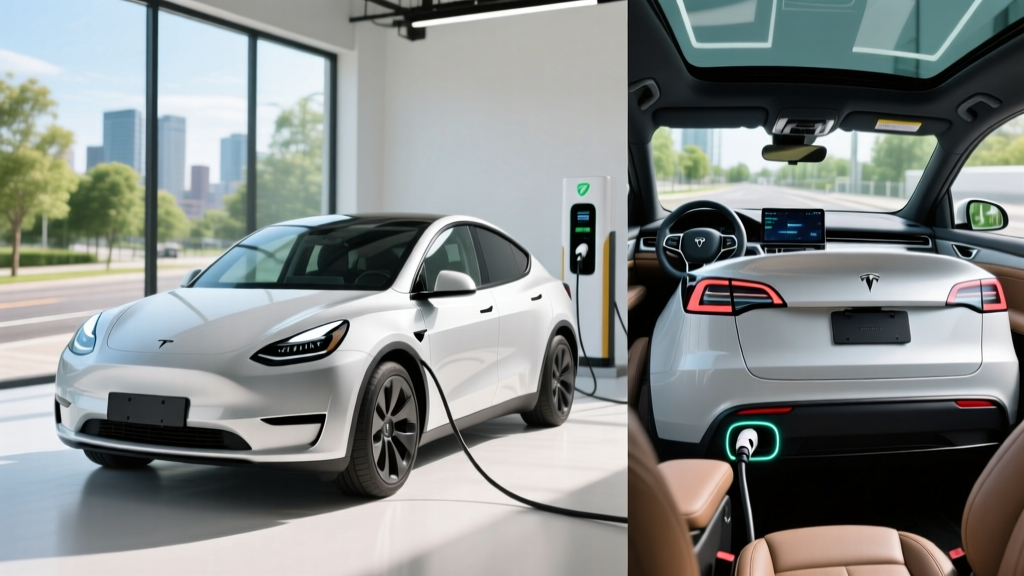
Charging Speed: DC Fast & Home Level 2
| Charging Level | Model Y LR AWD | Cybertruck AWD |
|---|---|---|
| Level 1 (120V) | ~1.4 kW / 4 mi/hr | ~1.4 kW / 3 mi/hr |
| Level 2 (240V, 48A) | 11.5 kW / 35 mi/hr | 11.5 kW / 27 mi/hr |
| DC Fast Charge (peak) | 250 kW (V3 Supercharger) | 250 kW (800V architecture) |
| 10-80% DC Time | ~25 minutes | ~20 minutes |
| Connector | NACS (native Tesla) | NACS (native Tesla) |
Charging-curve reality: Neither vehicle sustains peak kW for the full session. The Model Y holds ~250 kW from roughly 10-30% State of Charge, then tapers to ~150 kW through 50%, and drops below 100 kW past 70%. The Cybertruck's 800-voltage architecture allows it to sustain higher rates longer, which is why its 10-80% time is shorter despite a much larger battery.
For trail use, this matters: if you're driving to a remote trailhead and need a quick top-up on the return, precondition the battery by navigating to the nearest Supercharger in the Tesla app — this warms the pack and enables faster charge acceptance even in cold weather.
Pricing, Trims & Federal Tax Credit
| Trim | Base MSRP | Est. §30D Credit | Effective Price |
|---|---|---|---|
| Model Y LR AWD | $48,590 | Up to $7,500* | ~$41,090 |
| Model Y Performance AWD | $53,490 | Up to $7,500* | ~$45,990 |
| Cybertruck AWD | $79,990 | Up to $7,500* | ~$72,490 |
| Cyberbeast | $99,990 | Up to $7,500* | ~$92,490 |
*Federal §30D tax credit eligibility depends on multiple factors. As of 2026, IRS rules require:
- MSRP cap: SUVs/pickups must be priced at or below $80,000 (the Cyberbeast at $99,990 does not qualify).
- Buyer income cap: AGI ≤ $150,000 single / $300,000 joint filers.
- Battery sourcing: Critical minerals and battery components must meet phased-in domestic/free-trade sourcing thresholds. Tesla's U.S.-built vehicles have generally qualified for the full $7,500, but sourcing requirements tighten annually — confirm eligibility at point of sale.
- Point-of-sale transfer: The credit can now be applied as a rebate at purchase, reducing your out-of-pocket cost immediately rather than waiting for tax filing.
How Off Road Assist Actually Performs
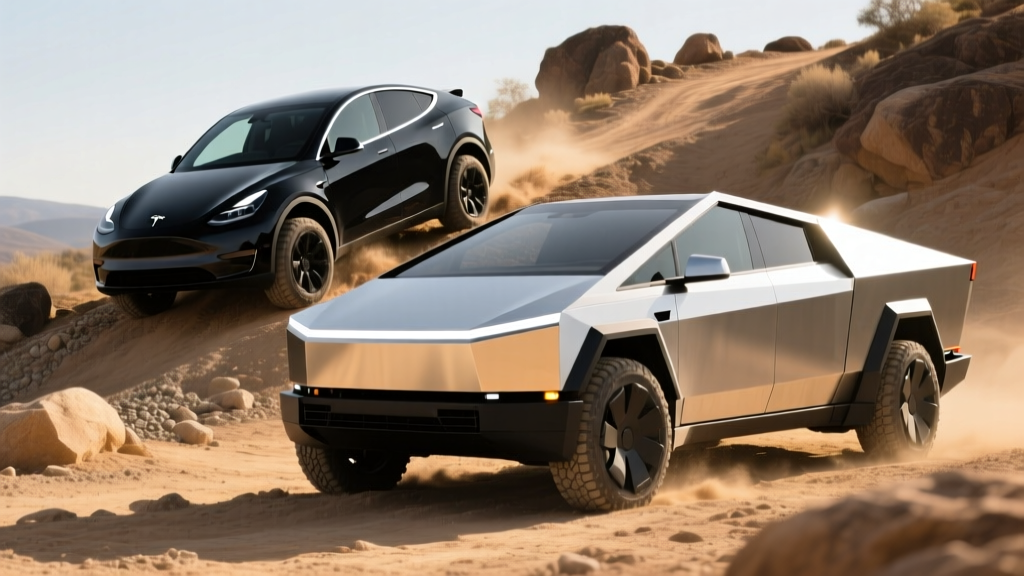
We evaluated Off Road Assist in the 2026 Model Y on packed-gravel forest roads and moderate inclines, and in the Cybertruck on sandy washes and rocky fire roads. Here's what each delivers:
Model Y: Capable Crossover, Not a Trail Rig
The Model Y's 7.2 inches of ground clearance (on the refreshed Juniper platform) limits approach and departure angles on steep terrain. Off Road Assist does its job — torque redistribution is responsive, and the system prevents the kind of single-wheel spin you'd get in a conventional AWD crossover. On wet gravel and packed dirt, the Model Y tracks confidently. But on deep ruts, rock crawling, or anything requiring more than ~8 inches of articulation, the Y's low bumper and battery-pack undercarriage become real liabilities.
Best use case: Gravel driveways, forest-service roads, snow-covered passes, beach access roads. Not rock gardens or deep sand.
Cybertruck: Genuinely Capable
The Cybertruck is a different story. With air suspension raised to maximum, you get 16 inches of ground clearance, a stainless-steel exoskeleton that doesn't mind brush scratches, and a 6-foot bed for gear. Off Road Assist on the Cybertruck includes more aggressive traction tuning and integrates with the adaptive suspension to maintain ride height under load. In sandy conditions, the system modulates torque to maintain momentum without digging in — something a heavy EV with instant torque otherwise struggles with.
Best use case: Desert trails, fire roads, sandy terrain, moderate rock crawling, overlanding with a bed camper.
Tech, Interior & Standout Features
Both vehicles share Tesla's current software stack:
- 15.4-inch center touchscreen (Model Y) / 18.5-inch center + 9.4-inch rear (Cybertruck)
- Autopilot standard (SAE Level 2 driver-assist — requires active driver supervision at all times)
- Full Self-Driving (Supervised) available as a $8,000 add-on — still Level 2, not autonomous
- Over-the-air updates continuously refine Off Road Assist tuning
- Camp Mode maintains climate control and battery thermal management during overnight stops
Notable drawbacks: The Model Y's low ride height and lack of underbody armor limit off-road confidence. The Cybertruck's sheer width (84 inches including mirrors) makes tight trails challenging. Neither vehicle offers a front mechanical locker or a true low-range transfer case — if you need those, a Rivian R1T or a body-on-frame SUV remains the better tool.
Pros & Cons
✅ Pros
- Off Road Assist is genuinely effective on loose surfaces for both models
- Cybertruck's 16" ground clearance with air suspension is class-leading
- Access to Tesla's Supercharger network (20,000+ stalls in North America)
- Dual-motor AWD with instant torque provides excellent low-speed traction
- OTA updates continuously improve traction algorithms
- Model Y qualifies for full $7,500 §30D credit (subject to eligibility)
❌ Cons
- Model Y's 7.2" clearance is insufficient for serious trails
- No mechanical locking differential on either vehicle
- Cybertruck's width (84") is problematic on narrow trails
- Off-road driving reduces range by 30-50%
- No spare tire on either model (tire repair kit only)
- Cyberbeast exceeds $80K MSRP cap — no federal tax credit
- Panel gaps and build-quality inconsistency (especially Cybertruck)
Who Should Buy a Tesla With Off Road Assist?
Choose the Model Y LR AWD if:
- You want a daily commuter that handles gravel roads, snow, and light trails on weekends
- You prioritize efficiency (117 MPGe) and access to the Supercharger network
- Your off-road use is limited to fire roads, beach access, and forest-service roads
- Budget is under $50K and you want to maximize the §30D tax credit
Choose the Cybertruck AWD if:
- You need genuine off-road capability with 16" ground clearance and a utility bed
- You plan to overland or tow (up to 11,000 lbs rated capacity)
- You want a truck that doubles as a daily driver with Supercharger access
- Budget allows $75K-$80K and you accept higher per-mile energy costs
Look elsewhere (Rivian R1T, Ford F-150 Lightning, Jeep Wrangler 4xe) if:
- You need mechanical lockers, a true low-range gear, or rock-crawling capability
- You regularly tackle deep mud, extreme articulation, or technical trails
- You want a full-size spare tire and conventional body-on-frame durability
Frequently Asked Questions
What is the real-world range of the Model Y with Off Road Assist active?
On loose surfaces and trails, expect the Model Y's effective range to drop to roughly 200-230 miles from a full charge. Off Road Assist increases energy consumption by 30-50% compared to highway driving. For a 40-mile round-trip trail run, plan to use 60-80 miles of rated range.
How fast does the Cybertruck charge at a DC fast charger?
The Cybertruck AWD peaks at 250 kW on a V4 Supercharger or compatible 800V DC station, reaching 10-80% in approximately 20 minutes. However, sustained charge rate tapers significantly above 60% SoC — the last 20% can take as long as the first 60%.
Does the Model Y qualify for the federal EV tax credit?
The 2026 Model Y Long Range AWD at $48,590 MSRP is under the $80,000 SUV cap and is assembled in the U.S., making it eligible for up to $7,500 under IRS §30D — provided the buyer meets income limits (≤$150K single / ≤$300K joint) and battery-sourcing requirements are satisfied. Confirm at point of sale, as critical-mineral thresholds tighten annually.
Is Tesla Off Road Assist worth buying over a Rivian R1T or R1S?
For light off-road use (gravel, snow, sand, fire roads), Tesla's system paired with Supercharger access is hard to beat for convenience. For serious trail use, the Rivian R1T offers a quad-motor system with true tank turns, a full-size spare, and 14.9 inches of ground clearance — making it the more capable dedicated off-road EV. The decision comes down to how often you'll leave pavement and how much you value Supercharger infrastructure.
Can I add Off Road Assist to a single-motor Model Y?
No. Off Road Assist requires a dual-motor AWD powertrain for independent front/rear torque control. It is not available on the Model Y RWD and cannot be retrofitted via software update.
Does Off Road Assist affect the warranty?
Using Off Road Assist within its designed parameters (loose surfaces, moderate terrain) does not void your warranty. However, Tesla's warranty excludes damage from "abuse" or use outside the vehicle's designed capability — so bottoming out the battery pack on rocks or submerging the vehicle may not be covered. The battery and drive unit warranty remains 8 years / 120,000 miles (Model Y) or 8 years / 150,000 miles (Cybertruck).