Why the Tesla Odometer Matters More Than You Think
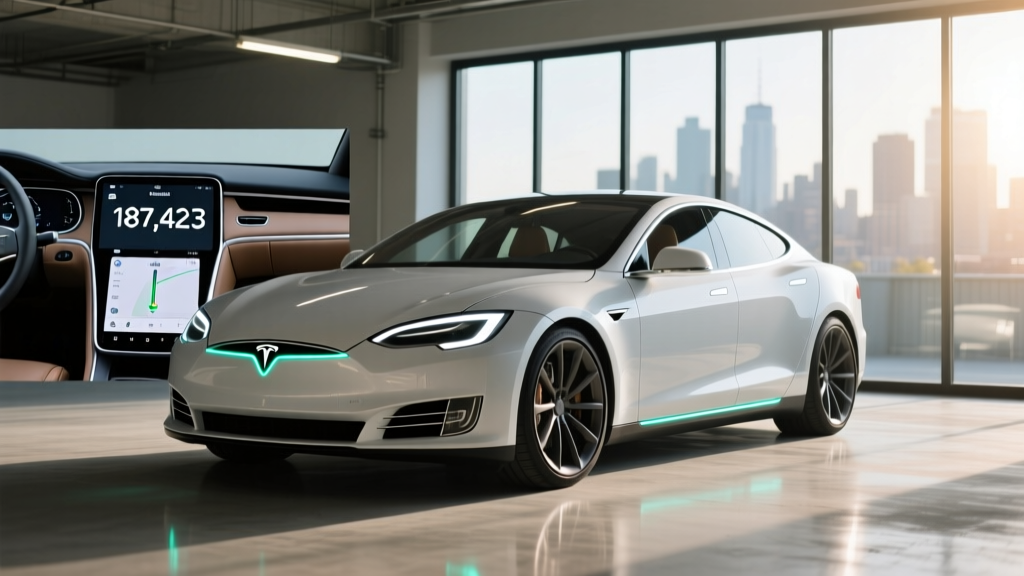
When shopping for an electric vehicle — especially a used one — the odometer reading tells a fundamentally different story than it does for a gas car. With no engine, transmission, or exhaust system to wear out, a Tesla's mileage primarily reflects two things: how much the battery has cycled and how much wear the suspension, interior, and ancillary components have absorbed. For buyers evaluating a Model 3 or Model Y with 60,000, 100,000, or even 150,000 miles on the dash, understanding what that Tesla odometer reading actually means for remaining range, charging speed, and total cost of ownership is essential before signing any paperwork.
This guide uses the current 2026 Tesla Model 3 Long Range AWD as our reference vehicle — the highest-volume Tesla on the road and the model most buyers encounter in the used market — to explain how odometer mileage correlates with battery degradation, what warranty protections remain at various mileages, and whether a high-mileage Tesla is a smart buy or a money pit.
2026 Tesla Model 3 Long Range AWD: Spec Overview
| Specification | Value |
|---|---|
| EPA Estimated Range | 341 miles |
| Battery Capacity (Usable) | ~75 kWh (NMC chemistry) |
| Drivetrain | Dual-Motor AWD |
| Horsepower | ~346 hp (combined) |
| 0-60 mph | 4.2 seconds |
| Max DC Fast Charge Rate | 250 kW peak |
| 10-80% DC Fast Charge Time | ~25 minutes (at V3 Supercharger) |
| Level 2 Home Charge Rate | 11.5 kW (~44 miles/hr) |
| Efficiency | 132 MPGe combined / 25 kWh/100 mi |
| Cargo Volume | 23 cu ft (rear trunk + frunk) |
| Rear Legroom | 35.3 inches |
| Base MSRP | $47,740 |
| Battery & Drive Unit Warranty | 8 years / 120,000 miles |
| Basic Vehicle Warranty | 4 years / 50,000 miles |
Source: fueleconomy.gov and Tesla's official specifications. Prices and specs reflect the 2026 model year and are subject to change.
Real-World Range: What the Tesla Odometer Reveals Over Time
EPA Sticker: 341 miles
Real-World Expectation (New): ~280-310 miles at highway speeds (70-80 mph), ~250-270 miles in freezing temperatures with cabin heat. City driving with regenerative braking can match or slightly exceed the EPA figure.
At 80,000 Miles: Expect approximately 5-8% battery degradation based on aggregated fleet data, reducing effective range to roughly 260-295 miles under real-world highway conditions.
At 150,000 Miles: Degradation typically plateaus between 10-15% for NMC packs that have been well-maintained (not routinely charged to 100% or left at low SoC in extreme heat). Real-world highway range: ~240-270 miles.
The Tesla odometer alone doesn't tell you the battery's State of Health (SoH). A 100,000-mile car that was predominantly charged to 80% on a Level 2 home charger and garage-kept in moderate climates may have a healthier pack than a 50,000-mile car that was DC fast-charged daily to 100% and parked in Phoenix heat. Before purchasing any used Tesla, pull up the battery health screen in the service menu or request a pre-purchase diagnostic at a Tesla Service Center to see actual capacity retention.
Tesla's NMC (nickel manganese cobalt) chemistry, used in the Long Range and Performance trims, offers higher energy density than LFP (lithium iron phosphate) but is somewhat more sensitive to high-SoC and high-temperature degradation. The base Model 3 RWD uses an LFP pack (~60 kWh), which degrades more slowly and can be routinely charged to 100% — a meaningful advantage for high-mileage commuters.
Charging at Every Mileage: Does Speed Degrade With the Odometer?
| Charging Method | Power (kW) | Speed (mi/hr added) | Notes for High-Mileage Cars |
|---|---|---|---|
| Level 1 (120V household) | ~1.4 kW | ~4-5 mi/hr | Unaffected by odometer; useful for overnight trickle |
| Level 2 (240V home/public) | 11.5 kW (max) | ~44 mi/hr | Full overnight charge; minimal degradation impact |
| DC Fast Charge (V3 Supercharger) | 250 kW peak | ~1,000+ mi/hr (peak) | Peak rate may taper slightly on degraded packs; BMS adjusts curve |
| DC Fast Charge (V4 Supercharger) | Up to 325 kW | Model 3 limited by vehicle architecture | Model 3 caps at ~250 kW regardless of charger |
One of the most common questions from used Tesla buyers: does charging slow down as the odometer climbs? The short answer is marginally, yes. As a battery ages, its internal resistance increases slightly, and the Battery Management System (BMS) becomes more conservative with peak charge rates to protect cell health. In practice, a 100,000-mile Model 3 Long Range might see its peak DC fast-charge rate drop from 250 kW to roughly 225-235 kW — a difference of perhaps 2-3 minutes on a 10-80% session. This is barely noticeable in daily use.
The more impactful variable is preconditioning. Tesla's navigation-routed battery preconditioning warms the pack before you arrive at a Supercharger, which is critical for achieving peak charge rates — especially in cold weather. A high-mileage Tesla with a well-functioning thermal management system will precondition and charge nearly identically to a new one. If the coolant system has been neglected (check service records for coolant flushes), charge speeds can suffer.
Tax Credits, Pricing, and the High-Mileage Value Proposition
For a new 2026 Model 3 Long Range AWD, the financial picture looks like this:
| Item | Amount |
|---|---|
| Base MSRP (Long Range AWD) | $47,740 |
| Destination Fee | $1,390 |
| Federal §30D Tax Credit (if eligible) | Up to $7,500 (point-of-sale transfer available) |
| Effective Price After Credit | ~$41,630 |
Eligibility is not automatic. Under current IRS §30D rules, you must meet all of the following:
- Income cap: Modified AGI ≤ $150,000 (single) / $300,000 (joint)
- MSRP cap: Vehicle MSRP ≤ $55,000 (sedans like Model 3)
- Battery sourcing: Critical minerals and battery components must meet phased-in domestic/FTEA sourcing thresholds — Tesla's US-built LFP and NMC packs have progressively met these requirements, but verify the specific VIN's eligibility at the point of sale
- Point-of-sale transfer: You can apply the credit as an immediate price reduction at the dealer rather than waiting for tax filing
Always confirm eligibility with a tax professional and verify the VIN on the IRS Energy Credits portal before purchase. Rules are subject to legislative change.
For used Teslas (the high-mileage market this article focuses on), the §25E used clean vehicle credit offers up to $4,000 or 30% of the sale price (whichever is lower) if the vehicle is purchased from a dealer for $25,000 or less, the buyer's income is ≤ $75,000 (single) / $150,000 (joint), and the vehicle is at least two model years old. A 2021-2023 Model 3 with 80,000+ miles on the odometer often falls into this sweet spot — making a high-mileage Tesla surprisingly affordable after incentives.
Warranty Coverage vs. Odometer: What's Still Protected?
Tesla's warranty structure is one of the most important factors when evaluating a high-odometer Tesla. Here's how coverage maps to mileage:
- Basic Vehicle Limited Warranty: 4 years / 50,000 miles — covers most non-powertrain components (suspension, interior, electronics, HVAC). At 60,000+ miles, you're paying out of pocket for window regulators, control arm bushings, and touchscreen failures.
- Battery and Drive Unit Warranty: 8 years / 120,000 miles (Long Range/Performance) or 8 years / 100,000 miles (RWD). Tesla guarantees the battery will retain at least 70% of its original capacity during this period. If your pack drops below that threshold, Tesla replaces or remanufactures it at no cost.
- What the 70% threshold means in practice: A Model 3 Long Range with 341 miles of EPA range would need to fall below ~239 miles of range (at equivalent new-car conditions) to trigger a warranty claim. Most NMC packs at 120,000 miles retain 85-90% capacity based on fleet data, making a warranty claim uncommon — but the protection is there.
The critical takeaway: the battery and drive unit warranty is the odometer milestone that matters most. A Tesla at 110,000 miles still has warranty runway; one at 125,000 miles is an out-of-warranty risk for a $12,000-$16,000 battery replacement if something goes wrong. Price accordingly.
Who Should Buy a High-Odometer Tesla (and Who Shouldn't)?
Pros of High-Mileage Teslas
- Significant depreciation discount — a 3-year-old Model 3 with 70,000 miles often sells for $20,000-$25,000 vs. $47,000+ new
- Electric drivetrains have far fewer wear items than ICE vehicles — no timing belts, oil changes, or transmission fluid
- Supercharger network access remains identical regardless of odometer reading
- Over-the-air updates continue for the life of the vehicle
- Used EV tax credit (§25E) can knock up to $4,000 off qualifying purchases
Cons of High-Mileage Teslas
- Basic warranty expired at 50,000 miles — suspension, interior, and electronics repairs are out-of-pocket
- Battery replacement cost ($12,000-$16,000) becomes your liability past 120,000 miles
- Older MCU1/MCU2 infotainment hardware in pre-2021 models may feel sluggish
- Insurance premiums can be higher for out-of-warranty EVs due to repair-cost uncertainty
- Cosmetic wear (seat bolsters, steering wheel, paint) accumulates visibly on Teslas
Best for: Budget-conscious commuters who can charge at home, drive 15,000-25,000 miles per year, and want access to the Supercharger network for road trips without the new-car price tag. A Model 3 with 60,000-90,000 miles and remaining battery warranty is the sweet spot.
Not ideal for: Buyers who need guaranteed long-term reliability past 150,000 miles without repair budget, those who cannot install a home charger (reliance on public DCFC accelerates battery wear), or anyone uncomfortable with Tesla's panel-gap and service-center variability.
Tesla Odometer vs. Competitors: High-Mileage Comparison
How does a high-mileage Tesla stack up against key rivals in the used EV market?
- Hyundai Ioniq 5 (2022-2024): Similar range (~303 mi EPA), 800V architecture charges faster (10-80% in ~18 min), but smaller dealer network and no Supercharger access (NACS adapter available for 2025+ models). Battery warranty: 10yr/100,000mi — longer time coverage than Tesla.
- Ford Mustang Mach-E (2021-2024): Extended Range does ~312 mi EPA. NACS port from 2025 onward; older models need adapter. Battery warranty: 8yr/100,000mi. Generally cheaper used but less efficient (more kWh/100mi).
- Chevrolet Bolt EV/EUV (2017-2023): Budget king at $12,000-$18,000 used, but limited to ~55 kW DC fast charging — a major road-trip drawback. 259 mi EPA range. Battery warranty: 8yr/100,000mi.
The Tesla's advantages at high mileage remain its efficiency (fewer kWh consumed per mile means lower charging costs), Supercharger network reliability (still the gold standard for road trips), and software longevity (OTA updates keep older models current). The trade-offs are the shorter basic warranty and the premium that even used Teslas command over comparable rivals.
Frequently Asked Questions
Can I check a Tesla's battery health before buying?
Yes. Navigate to Settings > Service > Battery Health on the touchscreen to view an estimated degradation percentage. For a more precise reading, request a Battery Health Test at a Tesla Service Center (often free during a pre-purchase inspection). Third-party tools like Tessie or TeslaFi can also log and track SoH over time using the vehicle's API.
Does a high Tesla odometer reading affect Autopilot or FSD?
No. Tesla's driver-assistance systems (Autopilot, Enhanced Autopilot, FSD Supervised — all SAE Level 2, requiring active driver supervision) are software-based and tied to the vehicle's hardware generation (HW3/HW4), not mileage. A 120,000-mile Tesla with HW4 hardware runs identical FSD software as a brand-new one. However, camera clarity can degrade if lenses are pitted or hazy — inspect them visually.
What's the most common repair on high-mileage Teslas?
Based on owner reports and service data, the most frequent out-of-warranty repairs on Teslas past 80,000 miles include: suspension components (control arms, sway bar links — Teslas are heavy and wear bushings faster than ICE cars), cabin HVAC compressor, 12V auxiliary battery replacement (every 3-4 years), and tire replacement (EVs wear tires 20-30% faster due to instant torque and weight). None of these are catastrophically expensive compared to an ICE transmission or engine rebuild.
Is a Tesla with over 100,000 miles worth buying?
It can be — if the price reflects the remaining warranty (or lack thereof) and the battery health check shows >85% capacity retention. A Model 3 Long Range at 105,000 miles with 88% SoH and 15 months of battery warranty remaining is a fundamentally different proposition than one at 130,000 miles with no warranty safety net. Always adjust your offer price by the estimated cost of a future battery replacement (~$14,000) prorated by the likelihood you'll need one during ownership.
How does cold weather affect range on a high-mileage Tesla?
All EVs lose range in freezing temperatures — typically 20-30% — due to battery chemistry limitations and cabin heating energy draw. A high-odometer Tesla with moderate degradation will experience a compounding effect: if the pack has degraded 10% and you lose another 25% to cold, your effective range might be 341 × 0.90 × 0.75 ≈ 230 miles. The Model 3's standard heat pump (introduced for the 2021 refresh) significantly mitigates this compared to older resistive heating systems. If you're buying a pre-2021 Model 3 with high mileage, budget for noticeably reduced winter range.