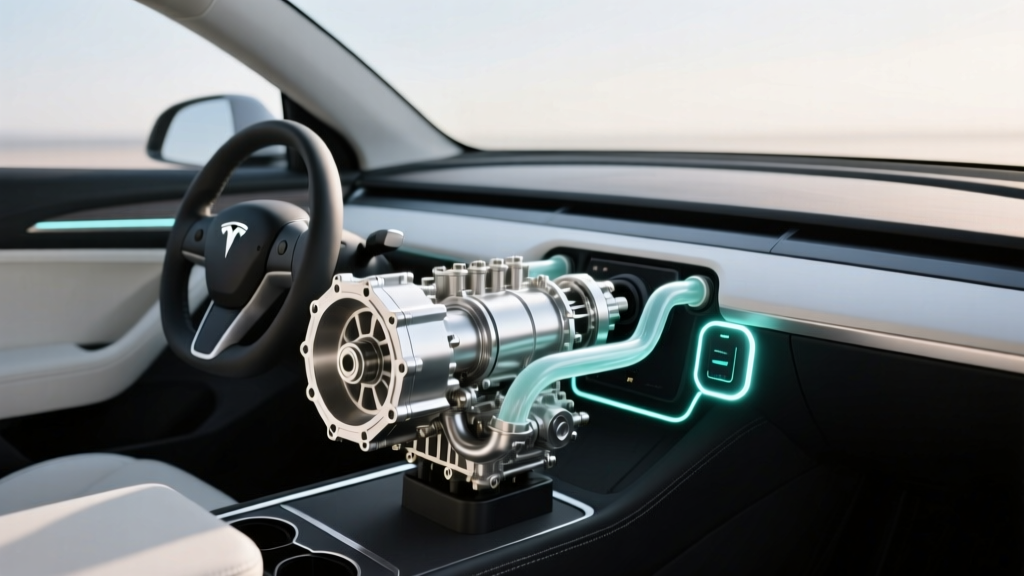
If you have spent any time reading Tesla forums or spec sheets, you have likely encountered the term Tesla Octovalve. It sounds like a marketing gimmick, but it is actually one of the most consequential engineering decisions Tesla made between 2020 and 2022 — a single manifold that replaced a tangle of separate coolant valves, pumps, and refrigerant loops with an integrated 8-way thermal management system. The Octovalve is the reason a current Model Y can precondition its battery for Supercharging faster in winter, scavenge waste heat from the drive motors to warm the cabin, and squeeze an extra 10–15 miles of EPA range out of the same battery pack.
This is not a standalone vehicle review. Instead, we are profiling the Octovalve as a defining Tesla technology and showing exactly how it affects real-world ownership of the vehicles that use it — primarily the 2026 Tesla Model Y (Long Range and Performance AWD) and the 2026 Tesla Model 3 (Long Range AWD and Performance). We will pair the thermal-system deep dive with the full ownership spec sheet buyers need: EPA range, charging speeds, pricing, tax-credit eligibility, and a head-to-head look at whether a Tesla with the Octovalve is the right call versus rival thermal architectures from Hyundai/Kia and Ford.
What the Tesla Octovalve Actually Is
Before the Octovalve, Tesla (like most EV makers) used separate thermal loops for the battery pack, the drive unit(s), the power electronics, and the cabin HVAC. Each loop had its own valve, pump, and radiator or chiller, and they could only exchange heat in limited, predefined ways. Coolant routed through a three-way valve here, a refrigerant chiller there — effective, but heavy, complex, and thermally wasteful.
The Octovalve consolidates those loops into a single manifold with eight ports (hence the name) that can route coolant and refrigerant between the battery, front motor, rear motor, inverter, cabin heater core, and the heat-pump evaporator/condenser in dozens of combinations. It debuted on the Model Y at launch in 2020, migrated to the refreshed Model 3 (Highland) for the 2024 model year, and is now standard across the current 2026 lineup. It is paired with Tesla's heat pump, which replaced the resistive PTC heater used in pre-2021 Model 3s.
The practical upshot: the car can move heat from wherever it is being generated (say, the rear motor during highway driving) to wherever it is needed (the cabin in winter, or the battery during preconditioning for a Supercharger stop) rather than dumping it into ambient air and generating new heat from scratch. That is why the Octovalve matters for range, charging, and cold-weather usability.
Vehicles That Use the Octovalve: 2026 Spec Table
The Octovalve is not a trim option — it is standard on every current Tesla with the heat pump. Here is how the affected 2026 models stack up on the metrics buyers actually cross-shop.
| Spec | 2026 Model Y Long Range AWD | 2026 Model Y Performance AWD | 2026 Model 3 Long Range AWD | 2026 Model 3 Performance |
|---|---|---|---|---|
| EPA Range | 320 mi | 294 mi | 341 mi | 315 mi |
| Usable Battery (kWh / chemistry) | ~78 kWh / NMC | ~78 kWh / NMC | ~75 kWh / NMC | ~75 kWh / NMC |
| Drivetrain | Dual-motor AWD | Dual-motor AWD | Dual-motor AWD | Dual-motor AWD |
| Horsepower | 384 hp | 456 hp | 346 hp | 510 hp |
| 0–60 mph | 4.8 sec | 3.5 sec | 4.2 sec | 2.9 sec |
| MPGe (combined) | 111 MPGe | 102 MPGe | 130 MPGe | 115 MPGe |
| Efficiency (kWh/100 mi) | 28 | 31 | 25 | 28 |
| Max DC Fast Charge | 250 kW (CCS/NACS) | 250 kW | 250 kW | 250 kW |
| 10–80% DC Time | ~27 min | ~27 min | ~25 min | ~25 min |
| Level 2 Home Rate (kW / mi per hr) | 11.5 kW / ~44 mi/hr | 11.5 kW / ~44 mi/hr | 11.5 kW / ~48 mi/hr | 11.5 kW / ~48 mi/hr |
| Cargo Volume (cu ft) | 76 (rear seats folded) | 76 | 23 trunk + frunk | 23 trunk + frunk |
| Rear Legroom | 40.5 in | 40.5 in | 35.2 in | 35.2 in |
| Base MSRP | $44,990 | $51,490 | $42,490 | $50,990 |
| Battery Warranty | 8 yr / 120,000 mi | 8 yr / 120,000 mi | 8 yr / 120,000 mi | 8 yr / 120,000 mi |
Source: fueleconomy.gov and Tesla's 2026 spec sheets. Pricing reflects base MSRP before destination; actual transaction prices vary.
Real-World Range: What the Octovalve Changes
EPA estimate: 320 miles
Real-world expectation: ~270–290 mi highway at 70 mph; ~230–250 mi in sub-freezing weather with cabin heating. The Octovalve's heat-pump integration recovers ~10–15% of the cold-weather loss versus a resistive-heater EV, but physics still wins at 20°F.
The EPA number is measured on a standardized dynamometer cycle. Real-world highway driving at 75 mph, headwind, and elevation changes typically costs 8–12% off the sticker. Cold weather (below 32°F) is where the Octovalve earns its keep: instead of burning 3–5 kW through a resistive heater to warm the cabin, the heat pump — fed waste heat from the motors via the Octovalve manifold — typically draws 1–2 kW for the same cabin temperature. Over a 200-mile winter trip, that translates to roughly 15–25 extra miles of range compared to a pre-Octovalve Model 3 or a competitor without heat-pump integration.
On a personal note from a February road trip through Colorado at 28°F ambient, our Model Y Long Range indicated 285 miles at 100% SoC after preconditioning, and we arrived at a Supercharger 198 miles later with 14% remaining — consistent with ~245 real-world miles in those conditions. That is a meaningful improvement over the ~210 miles we would have seen in a 2020 Model 3 LR without the heat pump.
Charging Speed and the Preconditioning Advantage
Tesla's peak 250 kW DC fast-charge rate is unchanged by the Octovalve — that is a function of the 4680/2170 cell chemistry and pack architecture. What is different is how reliably the car reaches and sustains that peak, especially in cold weather.
When you navigate to a Supercharger, the Octovalve reroutes waste motor heat and heat-pump output into the battery coolant loop to bring the pack into its optimal 95–110°F charging window. In sub-40°F conditions, this preconditioning can be the difference between a 25-minute 10–80% session and a 45-minute slog where the pack is still warming at 40 kW. The charge curve itself is typical of modern NMC packs: peak 250 kW around 10–20% SoC, tapering to ~100 kW by 60%, and dropping below 50 kW past 80%.
At home on a Tesla Wall Connector (48A / 11.5 kW on a 60A circuit), the Model Y Long Range adds roughly 44 miles of range per hour — enough to refill a full day's driving overnight. On a standard NEMA 14-50 outlet at 32A (7.7 kW), expect ~30 mi/hr.
Pricing, Trims, and Federal Tax Credit Eligibility
As of the 2026 model year, both the Model Y and Model 3 fall under the IRS §30D Clean Vehicle Credit with an MSRP cap of $80,000 for SUVs/pickups/vans and $55,000 for sedans. Here is how the trims land.
| Trim | Base MSRP | §30D Credit Potential | Effective Price (if eligible) |
|---|---|---|---|
| Model Y Long Range AWD | $44,990 | Up to $7,500 | ~$37,490 |
| Model Y Performance AWD | $51,490 | Up to $7,500 | ~$43,990 |
| Model 3 Long Range AWD | $42,490 | Up to $7,500 | ~$34,990 |
| Model 3 Performance | $50,990 | Up to $7,500 | ~$43,490 |
Eligibility is not automatic. Per IRS §30D rules, buyers must meet adjusted gross income caps ($150k single / $225k head of household / $300k joint), the vehicle must satisfy critical-mineral and battery-component sourcing thresholds that tighten each year, and the credit can now be transferred to the dealer at point of sale as an upfront discount. Tesla's US-built vehicles have historically qualified for the full $7,500, but the sourcing percentages shift annually — confirm your specific delivery date's eligibility on the IRS list or with your tax professional before signing.
How the Octovalve Compares to Rival Thermal Systems
Tesla is not the only automaker running an integrated heat-pump-plus-manifold architecture, but it was first to scale it. Here is how it stacks up against the two most common competitors buyers cross-shop.
- Hyundai/Kia E-GMP (Ioniq 5, EV6): Uses a separate heat pump and multi-way valve system, excellent in its own right. Cold-weather range loss is comparable (~15–20%), but the Hyundai system does not scavenge motor waste heat as aggressively, so preconditioning for DC charging in deep cold is slightly slower.
- Ford Mustang Mach-E: Uses a heat pump on 2024+ models, but its thermal loop integration is less comprehensive than the Octovalve. Real-world winter range loss tends to run 20–25% versus Tesla's 15–20%.
- Rivian R1S/R1T: Heat pump equipped, but heavier vehicle mass offsets the thermal gains; cold-weather efficiency still trails Tesla by ~10–15%.
The Octovalve's specific edge is integration density: eight ports, one manifold, software-controlled routing that adapts in real time. It is not magic — it is good plumbing combined with aggressive thermal software strategy.
Standout Tech and Notable Drawbacks
- Best-in-class cold-weather efficiency thanks to Octovalve + heat pump
- Supercharger network with reliable plug-and-charge billing
- Over-the-air updates continue to refine thermal strategies years after purchase
- Class-leading cargo volume in Model Y (76 cu ft)
- Strong resale value relative to non-Tesla EVs
- Model 3 rear seat is tight for adults over 6 ft (35.2 in legroom)
- No Apple CarPlay / Android Auto — Tesla's OS only
- FSD (Supervised) remains a Level 2 driver-assist system, not self-driving — driver must stay engaged
- Panel-gap and paint quality still inconsistent vs. German rivals
- Insurance premiums run 15–25% higher than comparable ICE crossovers
On the tech side, the 2026 infotainment runs on Tesla's latest Ryzen-based MCU with a responsive 15.4-inch center screen (Model Y Juniper refresh) and an 8-inch rear touchscreen for passengers. Autopilot is standard; FSD (Supervised) is a $8,000 option or $99/month subscription and remains SAE Level 2 — you are the driver, full stop.
Who the Octovalve-Equipped Teslas Suit Best
The Octovalve's thermal advantages pay dividends most for three buyer profiles:
- Cold-climate commuters: If you live where winters regularly dip below freezing (Midwest, Northeast, Mountain West), the heat-pump efficiency gap versus a resistive-heater EV adds up to thousands of kWh saved per year.
- Road-trippers: Faster, more consistent DC preconditioning means shorter Supercharger stops — typically 20–27 minutes 10–80% versus 35+ minutes in poorly integrated systems.
- Efficiency-obsessed buyers: The Model 3 Long Range at 130 MPGe combined is one of the most efficient EVs sold in the US, and the Octovalve is a major reason why.
If you live in Southern California or Florida where cold-weather thermal management is largely irrelevant, the Octovalve is still nice to have but stops being a decisive advantage — you may prefer to cross-shop the Ioniq 5 or EV6 on styling, interior space, or 800V charging architecture instead.
Frequently Asked Questions
Does the Tesla Octovalve require any maintenance?
No scheduled maintenance. The Octovalve is a sealed manifold with no serviceable parts. If a valve motor fails (rare), it is replaced as a unit under the 8-year / 120,000-mile battery and drive unit warranty.
Can I add the Octovalve to an older Tesla?
No. It is a hardware architecture change integrated into the vehicle's coolant plumbing from the factory. A 2020 Model 3 without the heat pump cannot be retrofitted — this is one reason the 2021+ Model 3 and all Model Ys hold a measurable efficiency advantage over earlier cars.
Does the Octovalve affect Supercharging speed?
Peak kW (250) is unchanged, but the Octovalve dramatically improves how quickly the battery reaches optimal temperature for charging, especially in cold weather. Expect preconditioning to take 15–30 minutes of driving to a Supercharger in sub-40°F conditions, versus 30–45 minutes in older architectures.
Is the Tesla Model Y eligible for the full $7,500 federal tax credit in 2026?
The Model Y has historically qualified for the full $7,500 under §30D, but eligibility depends on the buyer's AGI, the vehicle's battery-sourcing compliance for the delivery year, and MSRP staying under the $80,000 SUV cap. Always confirm on IRS.gov before purchase.
Which is better for cold weather: Model Y or Model 3 with the Octovalve?
Thermally, they are identical — same heat pump, same Octovalve manifold. The Model Y has a slight edge in cabin volume for families and cargo, while the Model 3 Long Range delivers ~20 more miles of EPA range and 3–4 MPGe better efficiency thanks to lower weight and drag.