What Tesla's October 7 Event Actually Delivered
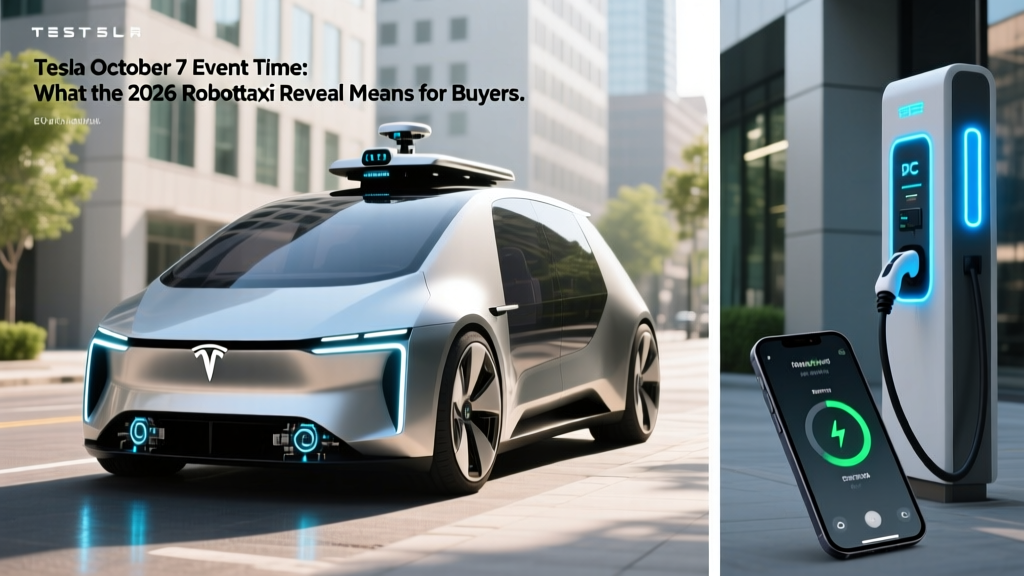
Tesla's highly anticipated October 7 showcase — originally promoted under the search term Tesla October 7 event time by thousands of eager viewers — centered on the long-awaited unveiling of the Cybercab, a purpose-built robotaxi with no steering wheel or pedals. For EV shoppers tracking the brand's trajectory, the event raised more questions than it answered about near-term purchasing decisions. Here is a data-driven breakdown of what was announced, what remains preliminary, and what current Tesla buyers should actually focus on in 2026.
Cybercab Announced Specifications (Preliminary)
Tesla shared limited hard data during the October 7 presentation. The following table compiles every confirmed or strongly implied specification. Where Tesla was vague, we note the gap.
| Attribute | Announced / Estimated |
|---|---|
| EPA Range (est.) | ~250 miles (unconfirmed by EPA) |
| Battery Capacity | Not disclosed; estimated <50 kWh based on vehicle size |
| Battery Chemistry | Likely LFP (cost-optimized for fleet use) |
| Seating | 2 passengers (no rear seats) |
| Steering / Pedals | None — Level 4 robotaxi design |
| Charging | Wireless inductive (no plug port shown) |
| Estimated Price (fleet) | <$30,000 per unit (Tesla claim, unverified) |
| Production Start | Announced 2026–2027; no firm date |
| Consumer Availability | Not confirmed — fleet/rideshare focus |
The most critical omission from the event: Tesla provided no EPA testing data, no battery kWh figure, and no DC fast-charge kW rating. The wireless-only charging claim, if accurate, would make the Cybercab incompatible with the entire existing public charging infrastructure — a significant consideration for anyone imagining personal ownership.
SAE Automation Level: What the Cybercab Claims
The Cybercab is designed as an SAE Level 4 vehicle: fully driverless within a defined operational design domain (specific cities, mapped routes, favorable weather). Unlike Tesla's current consumer vehicles — which operate at SAE Level 2 with Autopilot and FSD (Supervised) and require constant driver attention — the Cybercab has no manual controls. This is the same automation tier as Waymo's current robotaxi fleet. Level 4 does not mean the vehicle can drive anywhere in any condition; it means it can operate without a human within its approved zone.
For context, Waymo currently operates Level 4 robotaxis in Phoenix, San Francisco, and Los Angeles with a combined tens of millions of driverless miles. Tesla's FSD (Supervised), despite its branding, remains a Level 2 system per NHTSA classifications. The Cybercab's leap to Level 4 would require regulatory approval in each operating jurisdiction — a process that has taken Waymo years.
What the October 7 Event Means for Current Tesla Buyers
If you are shopping for a Tesla in 2026, the Cybercab announcement does not change your immediate options. Here is how Tesla's current purchasable lineup compares to the Cybercab concept, using verified EPA and manufacturer data.
| Spec | Model 3 LR AWD | Model Y LR AWD | Cybercab (Prelim.) |
|---|---|---|---|
| EPA Range | 363 mi | 320 mi | ~250 mi (est.) |
| Battery | ~75 kWh, NMC | ~75 kWh, NMC | <50 kWh (est.), LFP |
| 0–60 mph | 4.2 sec | 4.8 sec | Not disclosed |
| Max DC Charge | 250 kW | 250 kW | Wireless only (kW TBD) |
| 10–80% Time | ~25 min | ~27 min | Not disclosed |
| Base MSRP | $47,740 | $48,990 | <$30K (fleet, unverified) |
| §30D Credit Eligible | Up to $7,500 | Up to $7,500 | N/A (not purchasable) |
| SAE Level | Level 2 (FSD Supervised) | Level 2 (FSD Supervised) | Level 4 (planned) |
| Availability | Now | Now | 2026–2027 (announced) |
Source: fueleconomy.gov and Tesla.com, 2026 model year.
Real-World Range Reality for Today's Tesla Models
EPA Sticker: 320 miles
Real-World Highway (70 mph, 72°F): ~270–290 miles
Cold Weather (32°F, mixed driving): ~220–250 miles (20–30% reduction typical for NMC packs without heat pump pre-conditioning)
Hot Weather Highway (95°F+): ~285–305 miles (less impact than cold)
These figures reflect consistent independent testing and owner data. The EPA cycle includes low-speed city driving that inflates range vs. sustained highway use. Always plan road trips around 80% of the EPA sticker for a safety margin.
For the Cybercab's estimated ~250-mile range, real-world highway figures could drop to 190–210 miles in temperate conditions and lower in cold weather. For a fleet robotaxi operating in geofenced urban zones with predictable routes and wireless charging between trips, this may be adequate. For a personal vehicle, it would be limiting.
Charging: The Cybercab's Wireless Gamble vs. Tesla's Proven Network
Tesla's decision to omit a physical charge port from the Cybercab prototype is the most technically consequential detail from the October 7 event. Wireless inductive charging — while proven at low power levels for consumer electronics — has not been deployed at scale for EV fleet operations at the power levels needed for rapid turnaround.
| Method | Power (kW) | Miles Added per Hour | 10–80% Time |
|---|---|---|---|
| Level 1 (120V household) | 1.4 kW | ~4 mi/hr | ~40+ hours |
| Level 2 (240V, 48A) | 11.5 kW | ~35 mi/hr | ~6–7 hours |
| Tesla Supercharger V3 (DC) | 250 kW peak | ~1,000 mi/hr (peak) | ~25–27 min |
| Cybercab Wireless (claimed) | Not disclosed | Not disclosed | Not disclosed |
For current Tesla owners, the Supercharger network remains the gold standard for public DC fast charging. The 250 kW V3 stalls deliver a 10–80% charge in roughly 25 minutes for the Model 3 and Model Y, though sustained rates taper significantly above 60% state of charge. The peak rate is only maintained between approximately 10–30% SoC; above that, the charge curve ramps down to protect battery health.
Federal Tax Credit: What Applies to Current Tesla Purchases
The Cybercab, as an announced fleet vehicle not available for consumer purchase, has no §30D tax credit relevance. For Tesla models you can buy in 2026, here is the current federal credit landscape per IRS guidelines:
- Vehicle MSRP Cap: ≤$55,000 for sedans (Model 3); ≤$80,000 for SUVs/trucks (Model Y, Cybertruck)
- Buyer Income Cap: ≤$150,000 single / ≤$225,000 head of household / ≤$300,000 joint (modified AGI)
- Battery Sourcing: Critical minerals and battery components must meet phased-in domestic/free-trade-partner thresholds (increasing yearly)
- Credit Amount: Up to $7,500 — split between $3,750 for critical minerals + $3,750 for battery components; partial credit possible if only one requirement is met
- Point-of-Sale Transfer: Eligible buyers can transfer the credit to the dealer at purchase for an immediate price reduction
- Tax Liability: Credit is non-refundable — you must owe at least the credit amount in federal taxes (unless transferred at point of sale)
Always verify eligibility with a tax professional. Rules change annually and battery sourcing compliance varies by production batch. Source: IRS.gov
| Model / Trim | Base MSRP | Max §30D Credit | Effective Price (if eligible) |
|---|---|---|---|
| Model 3 RWD | $38,990 | $7,500 | $31,490 |
| Model 3 LR AWD | $47,740 | $7,500 | $40,240 |
| Model Y LR AWD | $48,990 | $7,500 | $41,490 |
| Model Y Performance | $53,490 | $7,500 | $45,990 |
Prices reflect 2026 MSRP before destination fees. Eligibility depends on buyer income, battery sourcing compliance at time of delivery, and MSRP caps. Confirm with your tax advisor.
Tesla's Current Tech: FSD (Supervised) vs. the Cybercab Promise
The October 7 event positioned the Cybercab as the endgame of Tesla's autonomous driving ambitions. But for buyers today, the relevant system is FSD (Supervised) — and its limitations must be clearly understood.
- FSD (Supervised) is an SAE Level 2 driver-assistance system — NOT self-driving
- The driver must maintain full attention, hands on or near the wheel, and be prepared to take over instantly
- NHTSA continues to investigate Tesla Autopilot/FSD-involved crashes; review current investigations before relying on the system
- FSD does not reliably handle construction zones, unmapped roads, severe weather, or complex urban scenarios without intervention
- The $8,000 one-time purchase or $99/month subscription does not guarantee future Level 4/5 capability — that remains an unfulfilled Tesla projection
The Cybercab's Level 4 ambition represents a fundamentally different engineering and regulatory challenge. Waymo, the current leader in Level 4 robotaxi deployment, uses a sensor suite including lidar, radar, and cameras — while Tesla continues to rely on a camera-only (Tesla Vision) approach. Whether camera-only perception can achieve Level 4 safety certification without lidar redundancy remains an open question in the autonomous driving industry.
Who Should Buy a Tesla in 2026 — and Who Should Wait?
Buy a Model 3 or Model Y now if:
- You need a vehicle in the next 1–6 months
- You want access to the Tesla Supercharger network (now partially open to NACS-equipped non-Teslas, but still most seamless for Tesla owners)
- You qualify for the §30D credit and want to lock in current battery-sourcing eligibility before rules tighten further
- You value over-the-air updates and an established service network
Wait if:
- You are specifically interested in a Tesla robotaxi experience (Cybercab is years from consumer availability, if ever)
- You want next-generation battery chemistry (Tesla's in-house 4680 cells are still ramping production)
- You are comparing against the refreshed Model Y or a potential lower-cost Tesla model rumored for 2027
Frequently Asked Questions
What time did the Tesla October 7 event start?
Tesla's October 7 event (commonly searched as "Tesla October 7 event time") began at approximately 7:00 PM Pacific Time / 10:00 PM Eastern Time. The event was livestreamed on Tesla's website and YouTube channel. The primary announcement was the Cybercab robotaxi concept and an update on Tesla's autonomous driving roadmap.
Can I buy the Tesla Cybercab?
No. The Cybercab is an announced concept/prototype as of the October 7 event. Tesla has not opened reservations, confirmed a production timeline, or indicated whether it will ever be available for individual consumer purchase. The vehicle is designed primarily for fleet robotaxi service.
Does the Cybercab qualify for the $7,500 federal EV tax credit?
Not applicable. The §30D credit applies to new clean vehicles purchased for personal use. The Cybercab is not available for purchase and is intended for fleet/rideshare deployment. Even if a consumer version were offered, eligibility would depend on MSRP caps, buyer income limits, and battery sourcing requirements per IRS §30D rules.
What is the real-world range of the Cybercab?
Tesla has not published an EPA range estimate for the Cybercab. Based on the vehicle's compact size and Tesla's claim of a sub-$30,000 price point, industry analysts estimate a battery under 50 kWh, suggesting roughly 200–250 miles of EPA range if and when it reaches production. Real-world highway range would likely be 15–25% lower.
How does the Cybercab charge without a plug?
Tesla showed the Cybercab using wireless inductive charging — parking over a ground pad that transfers energy without a cable. Tesla did not disclose the charging power (kW), charging time, or whether a physical charge port will be available as a backup. Wireless EV charging at high power levels remains largely unproven at commercial scale.
Is Tesla FSD the same as the Cybercab's self-driving system?
No. Tesla FSD (Supervised) is an SAE Level 2 driver-assist system requiring constant human supervision. The Cybercab is designed for SAE Level 4 driverless operation within geofenced areas. These are fundamentally different systems with different sensor requirements, software architectures, and regulatory approval pathways. Tesla has not detailed how its current FSD software bridges to Level 4 capability.
Should I wait for the Cybercab instead of buying a Model Y?
For any transportation need in the next 1–3 years, no. The Cybercab has no confirmed production date, no consumer purchase pathway, no EPA certification, and no regulatory approval for driverless operation. The Model Y Long Range AWD delivers 320 miles of EPA range, Supercharger access, available §30D credit, and immediate availability — making it the practical choice for 2026 buyers.