The Tesla October 7 event—officially dubbed "We, Robot"—was the company's most consequential reveal since the Model 3. Held on the Warner Bros. studio lot, the event showcased the Tesla Cybercab, a purpose-built two-seat robotaxi with no steering wheel or pedals, alongside the Robovan passenger/freight concept and an updated Optimus humanoid robot. For EV buyers and autonomous-vehicle watchers alike, the headline question is straightforward: when will Tesla's Level 4 robotaxi actually be available, and what are the real specs?
This profile breaks down every confirmed and estimated detail about the Cybercab, contextualizes Tesla's claims against real-world EV engineering, and explains what this means for buyers considering a Tesla vehicle today versus waiting for a driverless future.
Tesla's Cybercab is designed for SAE Level 4 operation—fully driverless within a defined operational design domain (ODD). This is fundamentally different from Tesla's current FSD (Supervised), which is SAE Level 2 and requires continuous driver attention. Level 4 means no human driver is needed in approved geofenced areas. As of 2026, Tesla has not yet received regulatory approval for driverless commercial service in any U.S. jurisdiction.
Cybercab Specifications: What Tesla Confirmed and What's Estimated
Tesla provided a mix of hard numbers and forward-looking estimates at the October 7 event. The table below separates confirmed specs from preliminary/estimated figures based on Tesla's presentation, industry analysis, and Tesla's current vehicle platform architecture.
| Specification | Tesla Cybercab (Estimated/Confirmed) |
|---|---|
| EPA Range (est.) | ~250 miles (target) |
| Battery Capacity (est.) | ~50 kWh usable, LFP chemistry |
| DC Fast Charge (peak) | ~150 kW (est.), NACS connector |
| 10–80% Charge Time (est.) | ~25–30 minutes |
| Level 2 Home Charging | N/A (fleet/depot charging model) |
| 0–60 mph | Not disclosed (est. <7 sec) |
| Drivetrain | Rear-wheel drive (single motor) |
| Seating | 2 passengers (butterfly doors) |
| Steering Wheel / Pedals | None |
| Target Price (per Tesla) | Under $30,000 (before incentives) |
| Production Start (target) | 2026 (Austin, TX) |
| Autonomy Hardware | Tesla AI5 / next-gen vision-only suite |
Range, Battery, and Real-World Efficiency
Tesla targeted approximately 250 miles of range for the Cybercab. While an official EPA figure won't be published until the vehicle enters production and undergoes certification, this target aligns with a ~50 kWh battery pack using LFP (lithium iron phosphate) cells—a chemistry Tesla already deploys in the Model 3 RWD and Model Y Standard Range for its cost advantages and cycle-life durability.
Real-World Expectation: For a robotaxi operating primarily in urban environments at moderate speeds, 250 miles is achievable in mild weather. However, sustained highway operation (70+ mph) could reduce effective range to ~200–215 miles. In cold weather (below 32°F), expect a 15–25% reduction, bringing real range to ~190–210 miles. For fleet operations, Tesla will likely target 80% daily state-of-charge (SoC) cycles, yielding ~200 usable miles per shift before recharging.
The LFP chemistry choice is strategic. LFP batteries tolerate frequent charge-discharge cycles better than NMC (nickel manganese cobalt), making them ideal for a high-utilization fleet vehicle that may charge 1–2 times daily. LFP also eliminates cobalt, reducing per-cell cost—a necessity for Tesla's sub-$30,000 target. The trade-off: LFP has lower energy density than NMC, which is why the Cybercab's range ceiling sits around 250 miles rather than 350+.
Efficiency will likely land in the 120–130 MPGe range (roughly 25–28 kWh/100 mi), comparable to the current Model 3 RWD. The Cybercab's smaller, lighter two-seat platform and absence of heavy steering hardware should offset its less-aerodynamic cab-forward profile.
Charging Speed and Fleet Depot Strategy
The Cybercab is not designed for home charging. It's a fleet vehicle, meaning it will charge at Tesla-operated depots or designated Supercharger stalls. Tesla did not confirm a peak DC fast-charge rate at the event, but based on the estimated ~50 kWh LFP pack and Tesla's current Supercharger V4 infrastructure, a peak rate of ~150 kW is a reasonable estimate.
| Charge Method | Power (kW) | Estimated Time / Miles Added |
|---|---|---|
| DC Fast Charge (Supercharger V4) | ~150 kW peak | 10–80% in ~25–30 min |
| Depot Wireless Inductive (announced) | ~11–19 kW (est.) | Full charge in 3–5 hours (overnight) |
| Level 2 (NACS, 11.5 kW) | 11.5 kW | ~44 mi/hr (if applicable) |
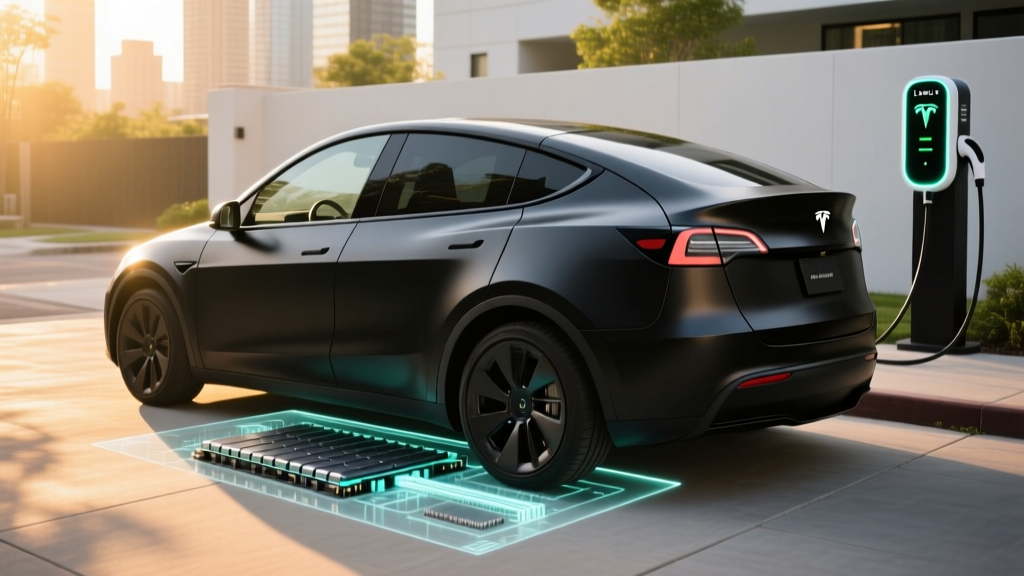
Tesla also teased wireless inductive charging pads for depot use, eliminating the need for physical plug-in. While inductive charging is slightly less efficient (~90% vs ~95% for wired), it reduces wear on connectors and enables fully automated turnaround—critical for a vehicle with no driver to plug in. The Cybercab uses the NACS (North American Charging Standard) connector for wired charging, consistent with Tesla's full lineup.
For fleet economics, the key metric is cost per mile charged. At an average commercial electricity rate of $0.12/kWh and 25 kWh/100 mi efficiency, the Cybercab's energy cost is roughly $0.03 per mile—a fraction of the $0.12–$0.15/mile fuel cost of a gas-powered rideshare vehicle.
Autonomy Hardware, FSD, and the Path to Level 4
The Cybercab will ship with Tesla's next-generation AI5 inference chip, which Tesla claims delivers roughly 5× the compute performance of the current Hardware 4 (HW4) platform. The sensor suite remains vision-only—cameras and neural networks, with no lidar or radar. This is a philosophical bet that sets Tesla apart from Waymo (Alphabet), which uses a lidar-camera-radar fusion stack for its Level 4 Waymo One service.
- It is not approved for driverless operation in any U.S. state or city as of 2026.
- Tesla's current FSD (Supervised) remains SAE Level 2—the driver must monitor the road at all times.
- Regulatory approval for Level 4 commercial service requires extensive safety validation, NHTSA engagement, and state-level permitting (as seen with Waymo and Cruise).
- Vision-only autonomy has not yet been validated for Level 4 at scale in complex urban environments, heavy rain, or construction zones.
Tesla's approach is to collect billions of miles of real-world driving data from its existing FSD-equipped fleet (millions of vehicles) to train its neural networks. If successful, this data advantage could allow faster scaling than Waymo's limited fleet approach. However, the gap between Level 2 (supervised) and Level 4 (unsupervised) is enormous—from a regulatory, engineering, and liability standpoint. Waymo has been operating Level 4 service in Phoenix and San Francisco since 2020–2023, accumulating over 20 million autonomous miles with a strong safety record. Tesla has zero Level 4 miles to date.
Pricing, Ownership Model, and Tax Credit Eligibility
Elon Musk stated a target Cybercab price of under $30,000 before incentives. However, the Cybercab is not positioned as a consumer vehicle you buy and park in your garage. The primary business model is Tesla-operated robotaxi fleet (similar to Waymo One), with a secondary possibility of individual owners adding their Cybercabs to the Tesla network—though this "Tesla Network" concept has been discussed since 2019 without materialization.
| Cost Factor | Estimated Amount |
|---|---|
| Target Base Price | Under $30,000 |
| Federal §30D Tax Credit (if eligible) | Up to $7,500 (see rules below) |
| Estimated After-Credit Price | ~$22,500 (if fully eligible) |
| Robotaxi Ride Cost (Tesla target) | ~$0.20/mile (vs. Uber/Lyft $1.50–$3.00/mi) |
Federal §30D tax credit eligibility for the Cybercab is uncertain and depends on several factors that will only be finalized when the vehicle enters production. Under current IRS rules, eligibility requires:
- MSRP cap: Vehicle must be under $55,000 (sedans) or $80,000 (SUVs/trucks) — Cybercab easily qualifies at ~$30K.
- Buyer income cap: AGI must not exceed $150,000 (single) / $300,000 (joint).
- Battery sourcing: Critical minerals and battery components must meet phased-in domestic/free-trade-partner sourcing thresholds (increasing yearly through 2032).
- Final assembly: Must occur in North America — Tesla's Austin Gigafactory qualifies.
- Point-of-sale transfer: Eligible buyers can apply the credit at purchase, reducing the upfront price.
Because the Cybercab's battery chemistry (LFP) may rely on supply chains that are still being localized, the full $7,500 credit is not guaranteed. Consult a tax professional and check the latest fueleconomy.gov listings once the vehicle is certified.
Design, Interior, and Standout Technology
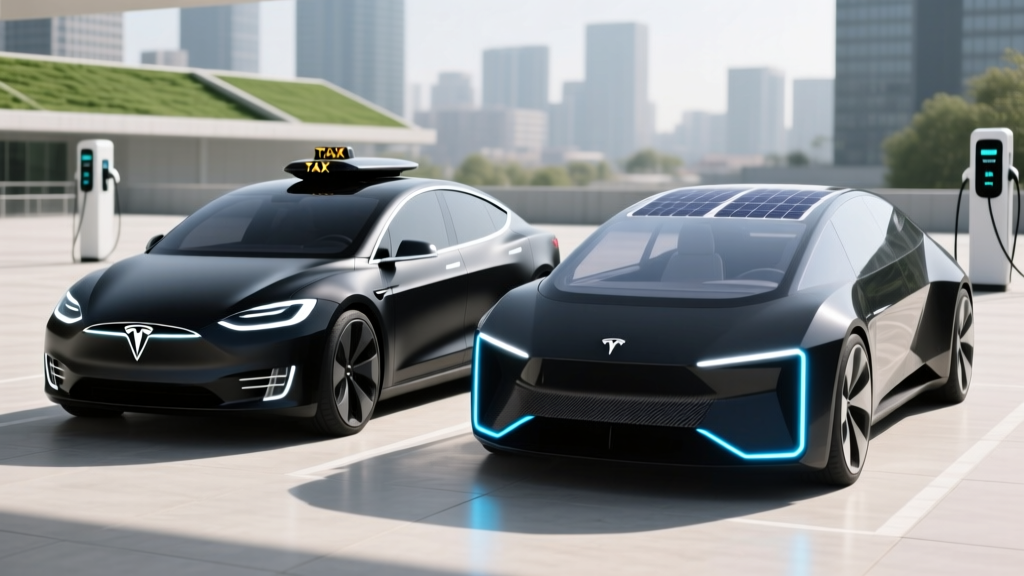
The Cybercab's design is unmistakably futuristic: a low-slung, gold-tinted two-seater with butterfly doors that open upward, a panoramic glass roof, and a minimalist interior featuring a single central touchscreen and a wraparound bench seat. With no steering wheel, pedals, or mirrors, the cabin is essentially a lounge pod.
Notable tech features include:
- Vision-only autonomous driving suite powered by AI5 chip with next-gen neural network processing
- Wireless inductive charging for hands-free depot turnaround
- Over-the-air (OTA) software updates for continuous autonomy improvement
- Central touchscreen interface for ride destination, entertainment, and climate
- Tesla Supercharger network access — the most reliable DC fast-charging network in the U.S.
Notable drawbacks:
- Only two seats — limits use for families, groups, or airport runs with luggage
- No manual driving option — if the system fails or the ODD is exceeded, there is no fallback
- Limited cargo space — no frunk, minimal rear trunk area (dimensions TBD)
- Unavailable for purchase or ride-hailing as of 2026
Pros and Cons at a Glance
- Sub-$30,000 target price could democratize robotaxi access
- LFP battery built for high-cycle fleet durability
- Wireless inductive charging eliminates plug-in friction
- Tesla Supercharger network for rapid turnaround
- Massive real-world FSD training data advantage
- Ultra-low operating cost (~$0.03/mile energy)
- Not available for purchase or ride-hailing yet
- No Level 4 regulatory approval in any jurisdiction
- Vision-only approach unproven at Level 4 scale
- Only 2 seats — limits passenger and cargo utility
- No steering wheel means zero manual fallback
- Tesla has a history of delayed production timelines
Cybercab vs. Waymo: How Tesla's Robotaxi Compares
The only operational Level 4 robotaxi service in the U.S. is Waymo One, which runs in Phoenix, San Francisco, Los Angeles, and Austin using the Jaguar I-PACE (and soon the Zeekr RT). Here's how Tesla's announced Cybercab compares to Waymo's current platform:
| Attribute | Tesla Cybercab (Announced) | Waymo (Jaguar I-PACE) |
|---|---|---|
| SAE Level | Level 4 (targeted, not approved) | Level 4 (operational) |
| Sensor Suite | Vision-only (cameras) | Lidar + cameras + radar |
| Seats | 2 | 4–5 |
| EPA Range | ~250 mi (est.) | 234 mi (EPA) |
| Service Status | Not launched | Live in 4+ cities |
| Cost Per Ride | TBD (~$0.20/mi target) | Comparable to Uber/Lyft |
Who Should Pay Attention to the Cybercab?
- You're a rideshare investor or fleet operator evaluating long-term cost structures
- You live in a city where Tesla is likely to launch robotaxi service first (Austin, San Francisco, Phoenix)
- You believe in Tesla's vision-only autonomy approach and want to track its progress
- You're considering buying a Tesla today (Model 3/Y) and want to understand how the Cybercab might affect resale values
- You need a vehicle now — the Cybercab is not available for purchase or ride-hailing
- You need more than 2 seats or significant cargo space
- You want a vehicle you can drive yourself on road trips outside a geofenced zone
Frequently Asked Questions
What is the real-world range of the Tesla Cybercab?
Tesla targets ~250 miles of range. In real-world urban robotaxi use at moderate speeds, this is achievable in mild weather. Highway operation and cold weather will reduce effective range to approximately 190–215 miles depending on conditions.
How fast does the Cybercab charge?
Estimated peak DC fast charging is ~150 kW via NACS at Tesla Superchargers, achieving a 10–80% charge in approximately 25–30 minutes. Tesla also plans wireless inductive depot charging at lower power for overnight turnaround.
How much does the Cybercab cost after tax credits?
Tesla targets a sub-$30,000 MSRP. If the vehicle qualifies for the full $7,500 federal §30D credit (dependent on battery sourcing, buyer income, and MSRP rules at time of production), the effective price could be ~$22,500. However, the primary use case is fleet operation, not individual purchase.
Is the Cybercab worth waiting for vs. buying a Tesla today?
If you need a vehicle now, no—the Cybercab is not available and has no confirmed consumer purchase timeline. The Model 3 and Model Y remain Tesla's current offerings with proven range, charging, and available FSD (Supervised). The Cybercab is a fleet robotaxi concept, not a replacement for a personal vehicle.
Does the Cybercab qualify for the federal EV tax credit?
Potentially, yes. At under $30,000 MSRP and with North American assembly, it meets the price and assembly requirements. Full eligibility depends on battery critical-mineral and component sourcing rules in effect at time of production, as well as buyer income caps. Check IRS.gov for current rules.
What are the biggest pros and cons of the Cybercab?
Pros: ultra-low operating cost, purpose-built for autonomy, sub-$30K target price, LFP battery durability, wireless charging. Cons: not yet available, no regulatory approval, vision-only approach unproven at Level 4, only 2 seats, no manual driving fallback.
When will I be able to ride in a Tesla Cybercab?
Tesla targets 2026 production at its Austin Gigafactory, but regulatory approval for driverless commercial service in any U.S. city remains uncertain. Realistic public availability is likely 2027 or later, pending NHTSA and state-level approvals.