Tesla's Flagship Charging Oasis on I-5: A Full Breakdown
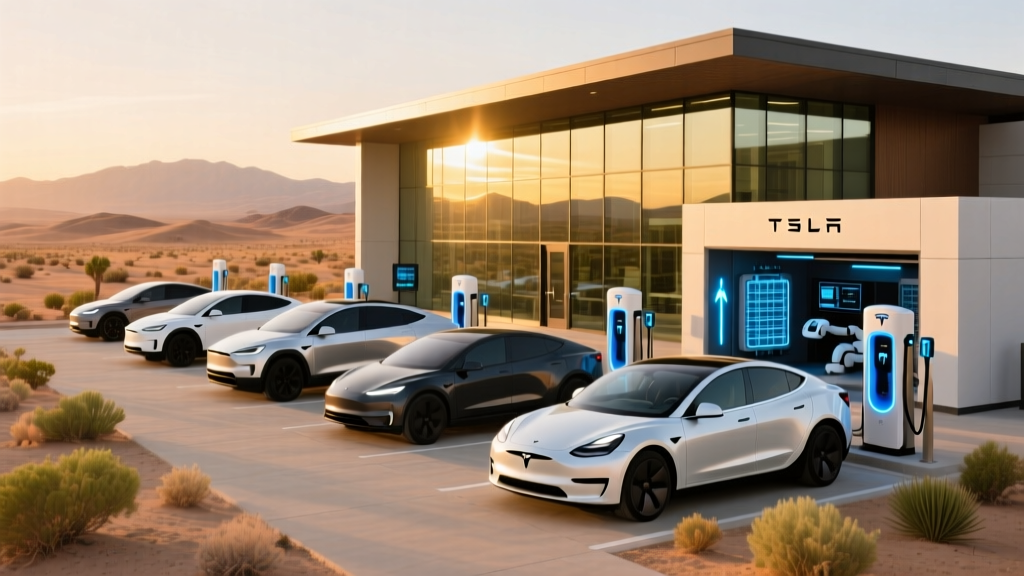
If you've driven the I-5 corridor between Los Angeles and the Bay Area, you know the stretch through California's Central Valley is a charging desert punctuated by a few scattered Supercharger plazas. That changed with Tesla's Oasis at Lost Hills — a massive, purpose-built EV charging destination and service hub that opened in late 2025 and has since become a benchmark for what highway charging infrastructure can be. Located near the junction of Highway 46 and I-5 in Kern County, the Oasis is strategically positioned roughly halfway between LA and San Francisco.
This isn't your typical eight-stall grocery-store Supercharger. The Oasis at Lost Hills is a multi-acre complex featuring over 250 charging stalls (a mix of V4 Megachargers and legacy V3 Superchargers), a full-service diner, a driver lounge, restrooms, a Tesla Service Center, and even a convenience store. For long-distance EV travelers, it's the closest thing to a truck-stop-scale experience designed specifically for electric vehicles.
Below, we break down everything you need to know about charging speeds, wait times, amenities, what vehicles are compatible, and how this hub fits into the broader Tesla Supercharger network in 2026.
Charging Specs: V4 Megachargers and What They Deliver
The headline feature of the Oasis is its bank of V4 Megacharger stalls, each capable of delivering up to 350 kW of DC fast-charging power — a significant step up from the 250 kW peak of the V3 Superchargers that make up most of Tesla's North American network. Not every stall is V4; the site mixes approximately 180 V4 stalls with 80+ V3 units, giving the hub a total capacity exceeding 250 stalls.
| Charger Type | Peak Power | Connector | Approx. 10–80% Time* | Stalls |
|---|---|---|---|---|
| V4 Megacharger | 350 kW | NACS (native) | ~12–15 min (compatible vehicles) | ~180 |
| V3 Supercharger | 250 kW | NACS (native) | ~18–22 min (most Teslas) | ~80 |
| CCS Adapter (V3 stalls) | 250 kW | CCS1 via adapter | ~20–28 min (non-Tesla EVs) | Limited |
*Times vary by vehicle battery chemistry, state of charge, and battery temperature. Peak kW is never sustained across the full charge curve.
A critical note on charge curves: even if your vehicle can accept 350 kW, that peak rate typically applies only between roughly 10% and 30–40% state of charge (SoC). Above 60%, charging power tapers significantly, and above 80% it drops to under 50 kW on most architectures. This is why the 10–80% metric is more meaningful than peak kW alone. Always precondition your battery before arriving — Tesla vehicles do this automatically when the Supercharger is set as your navigation destination.
Which EVs Can Actually Use the Oasis?
The Oasis at Lost Hills uses NACS (North American Charging Standard) connectors exclusively, as do all Supercharger stations. Here's what that means for different vehicle owners in 2026:
- Tesla vehicles (all years): Full native compatibility. Plug in and charge — no adapter needed. Model 3/Y on the 400V architecture will peak at 250 kW even on V4 stalls. Model S/X and the latest 2025+ Model 3 Highland with improved thermal management can leverage higher V4 rates.
- Non-Tesla EVs with NACS (2025+ models): Ford F-150 Lightning, Rivian R1T/R1S, Cadillac Lyriq, and other automakers that adopted NACS natively can access V3 stalls via Tesla's open Supercharger network program. V4 access for non-Teslas has been gradually expanding but may be restricted to select stalls.
- CCS-equipped EVs: Tesla has opened limited V3 stalls to CCS vehicles using an adapter. Availability at the Oasis is confirmed but limited to specific marked stalls. Check the Tesla app for real-time CCS-compatible stall availability before you arrive.
- CHAdeMO vehicles: No native support. You would need a CHAdeMO-to-NACS adapter, which remains rare and expensive. Effectively, this hub is not practical for older Nissan Leaf or Mitsubishi Outlander PHEV owners relying on CHAdeMO.
Amenities: More Than Just Chargers
What separates the Oasis from a standard Supercharger plaza is the infrastructure built around the chargers. Tesla designed this as a destination where you'd actually want to spend 20–30 minutes, not just a pull-through lot next to a Target.
On-Site Amenities at Oasis Lost Hills
- Tesla Diner: A full-service sit-down restaurant with a menu that includes burgers, salads, and breakfast items. Open from early morning through late evening. Expect 15–25 minute wait times during peak travel hours (weekends, holidays).
- Driver Lounge: Indoor climate-controlled space with seating, Wi-Fi, work tables, and device charging. Ideal for remote workers on road trips.
- Restrooms: Modern, well-maintained facilities — a significant upgrade over the portable toilets common at smaller Supercharger sites.
- Convenience Store: Snacks, beverages, basic travel supplies.
- Tesla Service Center: On-site service bays for mobile service appointments, tire rotations, and minor repairs. You can schedule service while you charge.
- Canopy Coverage: Solar-panel-topped canopies cover a majority of stalls, providing shade (critical in the Central Valley, where summer temperatures regularly exceed 100°F) and generating supplemental power for the site.
- Megapack Battery Storage: On-site Megapack units buffer grid power, enabling the V4 stalls to sustain high charge rates even during peak grid demand and reducing the site's reliance on utility demand charges.
Real-World Charging Experience: What to Expect
Based on visits during both weekday and weekend travel in early 2026, here's what the actual experience looks like:
Weekday mid-day (Tuesday–Thursday, 10 AM–2 PM): Typically 30–60% occupancy. You'll almost always find an open V4 stall. Total stop time for a 10–80% charge on a V4 stall with a compatible vehicle: 20–25 minutes including parking and walking to the diner. This is close to the time you'd spend at a gas station on a road trip when factoring in a restroom break and snack run.
Weekend peak (Friday afternoon, Sunday evening, holiday weekends): Occupancy can reach 85–100%. During Thanksgiving and Christmas travel periods, reports of 10–20 minute queues have surfaced on EV forums. Tesla's in-app stall-availability indicator helps, but during true peak travel, plan for extra buffer time.
Summer heat considerations: Lost Hills regularly sees 105–112°F in July and August. The canopy coverage helps enormously, but vehicles charging at high power in extreme heat will see thermal management systems working hard, which can slightly reduce charge speed. The battery cooling system draws power that would otherwise go to the cells. Expect 10–80% times to stretch by 2–4 minutes in peak summer heat compared to mild-weather charging.
Planning Your I-5 Trip Through Lost Hills
The Oasis is roughly 120 miles north of downtown Los Angeles and 180 miles south of San Jose. Most EVs with 250+ miles of EPA range can comfortably reach Lost Hills from either metro area with 20–30% SoC remaining. If you're driving a shorter-range EV (under 200 miles EPA), consider a intermediate stop at the Buttonwillow or Kettleman City Superchargers to avoid arriving at critically low charge.
Cost to Charge at the Oasis
Tesla Supercharger pricing at the Oasis follows the company's variable-rate model, which fluctuates by time of day and grid demand. As of early 2026, rates at this location are:
| Time Period | Rate (per kWh) | Approx. Cost for 50 kWh Session |
|---|---|---|
| Off-Peak (10 PM–6 AM) | $0.28–$0.32 | $14–$16 |
| Mid-Peak (6 AM–12 PM, 7 PM–10 PM) | $0.36–$0.42 | $18–$21 |
| On-Peak (12 PM–7 PM) | $0.44–$0.52 | $22–$26 |
For comparison, charging 50 kWh at home on a Level 2 charger at the California average residential rate of ~$0.30/kWh costs about $15. The Oasis off-peak rate is competitive with home charging; on-peak rates are noticeably higher but still cheaper than the equivalent gasoline fill-up for a 30 MPG vehicle covering the same distance.
Non-Tesla vehicles using the open Supercharger network typically pay a 10–15% premium over Tesla-member rates unless they subscribe to Tesla's monthly charging membership ($12.99/month as of 2026), which equalizes pricing.
How the Oasis Compares to Other Mega-Hubs
| Location | Total Stalls | V4 Megacharger | Diner/Lounge | Service Center |
|---|---|---|---|---|
| Oasis — Lost Hills, CA | ~260 | Yes (~180) | Yes | Yes |
| Harris Ranch, CA (V3 expansion) | ~98 | Limited | Partner restaurants nearby | No |
| Kettleman City, CA | ~72 | No (V3 only) | No | No |
| Barstow, CA (Route 66 hub) | ~120 | Yes (~60) | Partner restaurants | No |
The Oasis at Lost Hills is the largest and most amenity-rich Supercharger site in North America as of 2026. Harris Ranch has historically been the I-5 corridor's go-to stop, but its limited stall count and reliance on partner restaurants make it less reliable during peak travel. The Oasis was clearly designed to absorb and exceed that demand.
Tips for the Best Experience
- Set the Oasis as your navigation destination in your Tesla (or compatible EV) so the battery begins preconditioning 15–30 minutes before arrival. This alone can cut your 10–80% charge time by 3–5 minutes.
- Aim for off-peak or mid-peak charging if your schedule allows. The cost difference between on-peak and off-peak can be $8–$12 per session.
- Check stall availability in the Tesla app before diverting from I-5. The app shows real-time occupancy and can suggest alternative nearby chargers (Buttonwillow, Wasco) if the Oasis is at capacity.
- Use the service center proactively. If you're due for a tire rotation, cabin air filter replacement, or wiper blade swap, schedule a mobile service appointment at the Oasis while you charge and eat. It's an efficient use of your stop.
- Non-Tesla EV drivers: Download the Tesla app and create an account before arriving. Payment and stall activation for non-Tesla vehicles is app-based — there is no card reader on the V4 pedestals.
The Bottom Line: Is the Oasis Worth Planning Around?
For anyone regularly driving the LA-to-Bay Area corridor or taking longer I-5 road trips, the Oasis at Lost Hills has fundamentally changed the charging calculus. The combination of high-power V4 Megachargers, abundant stall count, real amenities, and on-site service makes it the most capable highway charging destination in the country. The main risk remains weekend and holiday congestion — with 260 stalls, a 15-minute wait is still possible during peak travel, which tells you just how much EV traffic flows through this corridor.
If you're a Tesla owner, the Oasis is a seamless experience that showcases the best of vertically integrated EV infrastructure. If you drive a non-Tesla EV with NACS or CCS, the Oasis is increasingly accessible but requires more planning (app setup, adapter confirmation, stall-type awareness). Either way, it's a destination worth building your I-5 travel plan around.
Frequently Asked Questions
Where exactly is the Tesla Oasis at Lost Hills?
The Oasis is located near the intersection of Highway 46 and Interstate 5, approximately 5 miles west of the town of Lost Hills in Kern County, California. It's roughly 120 driving miles north of downtown Los Angeles and 180 miles south of San Jose, making it an ideal midpoint stop on the I-5 corridor.
Can non-Tesla EVs charge at the Oasis?
Yes, with caveats. Tesla has opened select V3 stalls at the Oasis to non-Tesla EVs equipped with CCS1 connectors (using an adapter) and to NACS-equipped vehicles from Ford, Rivian, and other participating automakers. V4 Megacharger stalls may have limited non-Tesla access — check the Tesla app for real-time availability and compatible stall locations before arriving.
How long does a typical charge take at the V4 Megachargers?
For a compatible Tesla (e.g., 2025+ Model 3 with improved thermal management), expect a 10–80% charge in approximately 12–15 minutes on a V4 stall. Older Teslas on the 400V architecture will peak at 250 kW regardless of stall capacity, resulting in 18–22 minute sessions. Non-Tesla EVs on V3 stalls typically see 20–28 minutes for 10–80%.
Is the Tesla Diner at the Oasis any good?
The diner serves a straightforward American menu — burgers, chicken sandwiches, salads, breakfast plates, and coffee. Reviews from EV travelers have been generally positive, noting it's a significant step above typical highway fast food. Prices are moderate ($12–$18 per entrée). During peak weekend hours, expect a 15–25 minute wait for a table.
How much does it cost to charge at the Oasis?
Supercharger rates at the Oasis range from approximately $0.28/kWh (off-peak overnight) to $0.52/kWh (on-peak afternoon). A typical 50 kWh session costs between $14 and $26 depending on time of day. Non-Tesla vehicles pay a 10–15% premium unless subscribed to the Tesla charging membership.
Does the Oasis get crowded on holidays?
Yes. During Thanksgiving week, Christmas travel, and summer holiday weekends, the Oasis can reach full capacity with reported wait times of 10–20 minutes. Tesla's real-time stall-availability feature in the app is essential during these periods. Consider charging at off-peak hours (early morning or late evening) or using alternative stops like Buttonwillow or Wasco if the app shows the Oasis at or near capacity.
Is there Wi-Fi and a place to work while charging?
Yes. The driver lounge offers complimentary Wi-Fi, power outlets, work tables, and comfortable seating. It's a practical space for remote workers or anyone who wants to be productive during a 20–30 minute charge session. Cell service in the Lost Hills area can be spotty depending on your carrier, so the Wi-Fi is a valuable backup.
Sources: Tesla Supercharger Network, EPA Fuel Economy, Electrek — Tesla Oasis Coverage