Tesla No-Interest Deals and the 2026 Model Y: What You Need to Know
When Tesla periodically rolls out promotional financing — often advertised as 0% APR or "no-interest" offers on select models — it catches the attention of EV shoppers comparing monthly payments against rivals like the Hyundai Ioniq 5, Ford Mustang Mach-E, and Chevrolet Equinox EV. But a low-interest rate only matters if the underlying vehicle delivers. In this review, we break down the 2026 Tesla Model Y Long Range AWD — the variant most commonly featured in Tesla's financing promotions — with exact specs on range, charging speed, pricing, and federal tax credit eligibility, so you can determine whether a Tesla no-interest deal actually saves you money over the life of the loan.
Real-World Expectation: ~265–285 miles on sustained highway driving at 70+ mph; ~220–240 miles in sub-freezing winter conditions. City driving with regenerative braking recovers closer to the EPA sticker.
Full 2026 Model Y Spec Sheet
| Spec | Model Y Long Range AWD |
|---|---|
| EPA Range | 320 miles |
| Battery Capacity (usable) | ~75 kWh (NMC lithium-ion) |
| Drivetrain | Dual-motor AWD |
| Horsepower | 384 hp combined |
| 0–60 mph | 4.8 seconds |
| MPGe (combined) | 122 MPGe |
| Efficiency | 28 kWh/100 mi |
| Max DC Fast Charge | 250 kW peak |
| 10–80% DC Charge Time | ~25 minutes |
| Level 2 Home Charging | 11.5 kW (~44 mi/hr) |
| Cargo Volume (rear seats up) | 30.2 cu ft |
| Cargo Volume (rear seats folded) | 72.1 cu ft |
| Rear Legroom | 38.2 inches |
| Battery Warranty | 8 years / 120,000 miles (min 70% retention) |
| Base MSRP | $44,990 |
Sources: fueleconomy.gov, Tesla.com Model Y specs
Range and Efficiency: The Real-World Picture
The 2026 Model Y Long Range AWD carries an EPA-estimated 320 miles of range, placing it near the top of the compact electric SUV segment. Tesla's energy management remains among the most efficient in the industry — at 28 kWh per 100 miles, the Model Y sips electrons more frugally than the Ford Mustang Mach-E Extended Range (31 kWh/100 mi) and the Hyundai Ioniq 5 AWD (30 kWh/100 mi).
However, real-world range depends heavily on your driving pattern. On a flat highway at 65–70 mph in moderate temperatures, expect to extract roughly 265–285 miles before needing a charge. Push speeds to 80 mph or encounter sustained headwinds and mountain grades, and that figure drops to 240–255 miles. Cold weather (below 32°F) compounds the loss — battery chemistry and cabin heating demands can cut range by 20–30%, yielding an effective 220–240 miles. Tesla's standard heat pump mitigates some of this loss compared to resistive heating, but physics is physics.
For daily commuters driving 40–60 miles round trip, the Model Y easily covers a full work week on a single charge. Road trippers will need to plan stops roughly every 200–220 miles to maintain a comfortable buffer and stay within the fast-charge sweet spot (10–80% SoC).
Charging Speed: DC Fast and Home Level 2
Charging speed is where Tesla's Supercharger network advantage becomes tangible. The Model Y Long Range supports a peak DC fast-charge rate of 250 kW at V3 Superchargers. In practice, this means:
| Charging Method | Power (kW) | Speed (mi/hr added) | Notes |
|---|---|---|---|
| Tesla V3 Supercharger (DC) | 250 kW peak | ~1,000 mi/hr at peak | 10–80% in ~25 min; tapers sharply above 80% |
| Non-Tesla DC Fast (CCS via adapter) | 150–175 kW typical | ~600–700 mi/hr at peak | Varies by station; NACS-to-CCS adapter included |
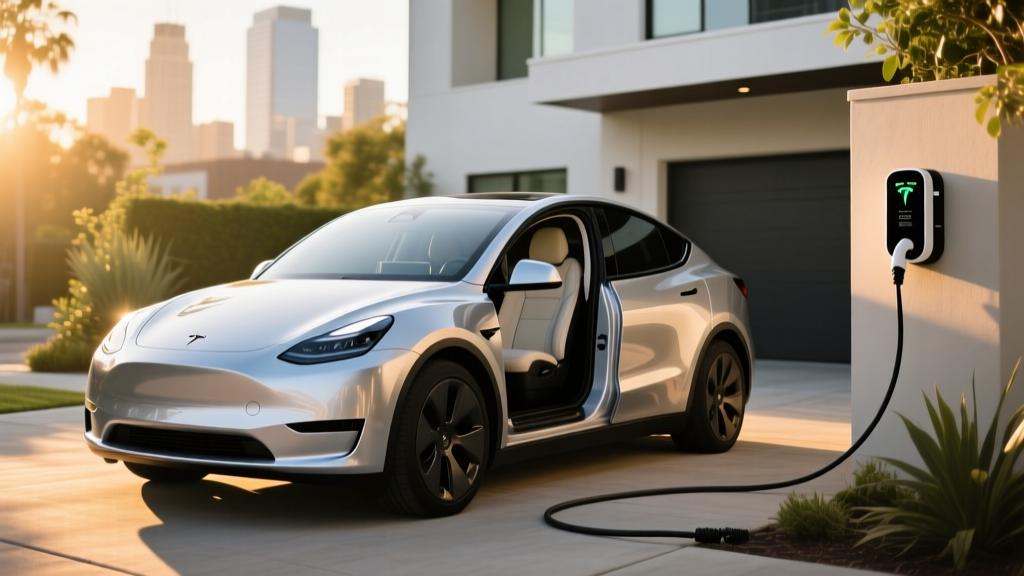
| Level 2 Home (Tesla Wall Connector) | 11.5 kW | ~44 mi/hr | Full charge in ~7 hours; requires 60A circuit |
| Level 2 Home (standard 240V/40A) | 9.6 kW | ~37 mi/hr | Common NEMA 14-50 outlet; full charge in ~8.5 hours |
| Level 1 (120V household) | ~1.4 kW | ~4–5 mi/hr | Emergency/trickle only |
The critical nuance: peak 250 kW is not sustained. The charge curve tapers significantly past 50% SoC, and above 80% the rate drops to under 50 kW. Tesla's navigation system will precondition the battery when you route to a Supercharger, which is essential for achieving advertised speeds — arriving at a Supercharger without preconditioning can add 5–10 minutes to your session, especially in cold weather.
For home charging, a Tesla Wall Connector on a dedicated 60-amp circuit delivers the fastest Level 2 experience. Most owners find overnight charging fully replenishes daily driving. Installation typically runs $800–$2,000 depending on panel proximity and local permitting.
Pricing, Tax Credits, and the No-Interest Advantage
The 2026 Model Y Long Range AWD starts at $44,990 (before destination). Here's where the "Tesla no-interest" conversation gets interesting. When Tesla offers 0% APR financing — typically for 36 to 60 months through their captive lending partners — the monthly savings versus a standard auto loan at 6–7% APR can be substantial.
| Scenario | Vehicle Price | Fed. Tax Credit | Effective Price | 60-Mo Payment (0% APR) | 60-Mo Payment (6.5% APR) |
|---|---|---|---|---|---|
| Full credit eligible | $44,990 | –$3,750* | $41,240 | $687/mo | $807/mo |
| No credit (income/MSRP/sourcing) | $44,990 | $0 | $44,990 | $750/mo | $880/mo |
*The federal EV tax credit under IRS §30D for the 2026 Model Y is subject to battery critical-mineral and component sourcing requirements, which have progressively tightened. The credit amount may be $3,750 or $7,500 depending on current-year sourcing compliance. Income caps apply: $300,000 joint / $225,000 head of household / $150,000 single. The Model Y qualifies under the $80,000 SUV MSRP cap. Always verify eligibility with a tax professional and consult the IRS Clean Vehicle Credit page for the latest rules. Point-of-sale transfer is available at participating dealers.
Over a 60-month term, the difference between 0% and 6.5% APR on a ~$42,000 loan is roughly $7,200 in interest savings. That's real money that offsets the Model Y's higher base price versus competitors like the Equinox EV (starting ~$33,000) or Ioniq 5 (~$42,000 for comparable AWD trim).
- MSRP must be ≤ $80,000 (SUV classification) — Model Y qualifies ✓
- Buyer AGI must not exceed $300K joint / $225K HOH / $150K single
- Battery critical minerals must meet escalating percentage thresholds (check IRS for current-year %)
- Battery components must meet escalating domestic-content thresholds
- Vehicle must undergo final assembly in North America ✓
- Credit can be transferred at point of sale to reduce purchase price directly
Performance, Interior, and Tech
The dual-motor AWD Model Y delivers 384 combined horsepower and a 4.8-second 0–60 mph time — quick for a family crossover and meaningfully faster than the Ioniq 5 AWD (5.1 sec) and Mach-E Extended Range AWD (5.5 sec). The instant torque and low center of gravity give it confident passing power and composed handling, though the ride quality is firm by segment standards.
Inside, the minimalist cabin centers on a 15.4-inch touchscreen running Tesla's proprietary infotainment. There are no physical buttons — climate, mirrors, and glovebox are all screen-controlled. This polarizes buyers: some love the clean aesthetic, others find it distracting while driving. The 2026 refresh ("Juniper") brought improved materials, ventilated front seats, ambient lighting, and a rear-seat entertainment screen.
Cargo space is generous at 30.2 cu ft behind the second row and 72.1 cu ft with seats folded — competitive with the Mach-E and slightly behind the Ioniq 5's boxier profile. The front trunk (frunk) adds useful storage for charging cables and small bags.
Tesla's Autopilot comes standard and includes adaptive cruise control, lane centering, and automatic emergency braking. Full Self-Driving (Supervised) remains a $8,000 add-on or $99/month subscription. Important clarification: FSD is an SAE Level 2 driver-assistance system — the driver must remain fully engaged and hands-on at all times. It is not autonomous driving.
Pros, Cons, and Who Should Buy
- Class-leading efficiency at 28 kWh/100 mi
- Access to Tesla Supercharger network (17,000+ stalls in North America)
- Strong real-world range of 265–285 highway miles
- 250 kW peak DC charging with battery preconditioning
- Spacious cargo area and practical hatchback design
- Over-the-air updates continuously add features
- 0% APR promotions save $5,000–$7,500 vs market-rate loans
- Screen-only controls require a learning curve
- Firm ride quality on rough pavement
- FSD remains Level 2 — not self-driving despite the name
- Insurance premiums tend to run 15–25% higher than comparable ICE SUVs
- Tax credit amount uncertain due to battery sourcing rules
- No Apple CarPlay or Android Auto support
- Panel gaps and paint quality still lag some competitors
Best suited for: Daily commuters with home charging access, tech-forward buyers who value OTA updates and Supercharger convenience, and families needing cargo flexibility. Road trippers benefit enormously from the Supercharger network's reliability. Less ideal for: Buyers who prefer traditional controls, those in extreme-cold climates without a garage (range loss compounds), and budget-conscious shoppers who might save $8,000–$12,000 with a Chevrolet Equinox EV or base Hyundai Ioniq 5.
How It Stacks Up Against Key Competitors
Is the Model Y worth buying versus the competition when a no-interest deal is on the table? The 0% APR offer narrows the total-cost gap considerably. A $7,200 interest savings effectively brings the Model Y's out-of-pocket cost within striking distance of a market-rate-financed Ioniq 5 or Mach-E, while delivering superior efficiency and charging infrastructure access.
The Hyundai Ioniq 5 offers faster 10–80% charging (18 minutes on 350 kW chargers) and CarPlay support, but its public charging network experience is less seamless. The Ford Mach-E provides a more conventional interior with physical controls and strong dealer support, but trails in efficiency. The Chevrolet Equinox EV undercuts on price dramatically but offers slower DC charging and less refined driving dynamics.
Frequently Asked Questions
What is the real-world range of the 2026 Tesla Model Y?
The EPA rates the Model Y Long Range AWD at 320 miles. Real-world highway driving at 70 mph yields approximately 265–285 miles. In cold weather below freezing, expect 220–240 miles due to battery chemistry limitations and cabin heating demand.
How fast does the Model Y charge at home and on DC fast chargers?
At a Tesla V3 Supercharger, the Model Y peaks at 250 kW and charges from 10–80% in about 25 minutes. At home on a Level 2 Wall Connector (11.5 kW), it adds roughly 44 miles per hour, achieving a full charge overnight in about 7 hours.
Does the 2026 Model Y qualify for the federal EV tax credit?
The Model Y qualifies under the §30D SUV MSRP cap ($80,000) and is assembled in North America. However, the credit amount ($3,750 or $7,500) depends on battery sourcing compliance with critical-mineral and component requirements that tighten annually. Buyer income caps also apply. Verify current eligibility at IRS.gov.
Is Tesla's no-interest financing better than competitor cash-back incentives?
It depends on your loan term and credit profile. A 0% APR over 60 months saves approximately $7,200 versus a 6.5% loan on a ~$42K balance. Compare this to competitor cash rebates (often $2,000–$5,000) — the interest savings can exceed the rebate, but only if you finance rather than pay cash or use a low-rate credit union loan.
Is FSD self-driving?
No. Tesla's Full Self-Driving (Supervised) is an SAE Level 2 driver-assist system. It can manage steering and speed on highways and some city streets, but the driver must remain fully attentive and ready to intervene at all times. It does not make the car autonomous.
What is the battery warranty on the Model Y?
Tesla covers the battery and drive unit for 8 years or 120,000 miles, whichever comes first, with a minimum 70% capacity retention guarantee. If the battery degrades below 70% within the warranty period, Tesla will repair or replace it.