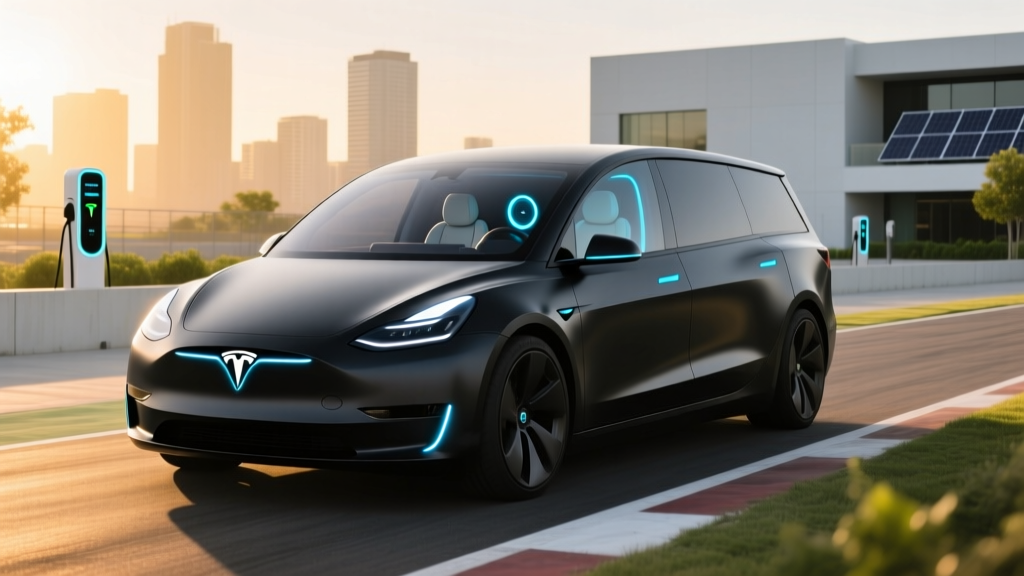
Tesla's "new van" — officially teased as the Robovan — has generated enormous curiosity since Elon Musk first mentioned the concept alongside the Cybercab robotaxi reveal in October 2024. As of early 2026, Tesla has not yet opened orders, released final EPA-certified specifications, or confirmed a production timeline for a consumer van or people-mover. What follows is a synthesis of every confirmed detail, reasonable estimate based on Tesla's existing platform architecture, and the practical buying context you need before committing to wait — or pivoting to a competitor.
If you've been searching for a "tesla new van" and expecting a Model Y with more seats, the reality is more complex. Tesla's van ambitions appear to straddle two distinct vehicles: a potential consumer multi-passenger van and a Level 4 autonomous people-mover (the true Robovan). Neither has reached production. Here's what we know, what's estimated, and what remains pure speculation.
What Tesla Has Actually Confirmed About the Robovan
During the "We, Robot" event on October 10, 2024, Musk showed a rendering of a large, futuristic van alongside the Cybercab and an Optimus robot update. He described it as capable of carrying up to 20 passengers and positioned it primarily as a fleet/robotaxi vehicle rather than a consumer product. Key confirmed statements:
- Capacity: Up to 20 passengers (Musk's stated figure)
- Primary use case: Autonomous fleet service (Level 4 target), similar to Cybercab
- Production timeline: No date given; Musk suggested it would follow Cybercab production, which itself was targeted for 2026 but has faced typical Tesla timeline slippage
- Consumer availability: Not explicitly confirmed — Tesla has not stated whether a non-autonomous, owner-operated version will be offered
Estimated Specifications: What a Tesla Van Would Likely Offer
While final specs don't exist, we can build a credible estimate using Tesla's current battery, motor, and platform technology. The table below represents our analyst estimates for a hypothetical consumer-oriented Tesla van built on an extended version of Tesla's next-generation platform (the same unboxed architecture underpinning the upcoming affordable models).
| Attribute | Estimated Spec | Basis / Notes |
|---|---|---|
| EPA Range (est.) | ~280–350 miles | Based on 100–120 kWh pack, heavy vehicle penalty |
| Battery Capacity | ~100–120 kWh (usable) | Likely NMC chemistry for energy density; LFP possible for base trim |
| Battery Chemistry | NMC (est. Long Range); LFP (est. Standard) | Tesla uses both across current lineup |
| Max DC Fast Charge | ~250–350 kW (peak) | V4 Supercharger capable; large pack sustains rate longer |
| 10–80% Charge Time (est.) | ~25–35 minutes | Larger pack = longer absolute time despite high peak kW |
| Level 2 Home Charging | ~11.5 kW / ~30–35 mi/hr | 48A onboard charger (Tesla Wall Connector) |
| 0–60 mph | ~5.0–7.0 seconds | Dual-motor AWD likely; heavy curb weight limits acceleration |
| Horsepower | ~400–500 hp (dual-motor) | Comparable to Model X dual-motor |
| Drivetrain | AWD (dual-motor) likely standard | Weight and passenger load favor AWD |
| Seating | 7–8 (consumer); up to 20 (fleet Robovan) | Per Musk's event statements |
| Cargo Volume (est.) | ~80–120 cu ft (behind 2nd row) | Van form factor advantage |
| Battery/Powertrain Warranty | 8 yr / 150,000 mi (est.) | Tesla's current highest-tier warranty (Model S/X) |
| Connector | NACS (native) | Tesla's standard; now the North American industry standard |
Range Reality: What to Expect Beyond the EPA Sticker
Even if Tesla achieves an EPA-rated 320+ miles, real-world range in a large, heavy van will diverge meaningfully from the sticker — just as it does with every EV on the road today.
EPA Estimated: ~300–350 miles (unconfirmed, preliminary)
Highway (75 mph, moderate climate): ~250–290 miles — large frontal area increases aero drag significantly
Cold Weather (20°F, cabin heat): ~200–250 miles — expect 25–35% range loss without a heat pump; Tesla likely includes one
Full Passenger Load (7–8 occupants + cargo): Subtract ~10–15% from baseline range due to increased rolling resistance and mass
For context, Tesla's own Model X (the closest current analog in size and weight) is EPA-rated at 311–335 miles depending on wheel size, but independent testing consistently shows highway range in the 250–280 mile band at 70–75 mph. A van with a larger frontal area and potentially heavier curb weight should be expected to follow a similar pattern, not exceed it.
Range anxiety is a legitimate concern for van buyers planning road trips with family or passengers. If your typical route exceeds 250 miles between charging stops, you'll need to plan around Supercharger locations — which Tesla's network covers well, but which remain sparse in some rural corridors.
Charging Speed: DC Fast Charging and Home Level 2
Charging a 100+ kWh battery pack is a different proposition than topping off a Model 3's 60 kWh unit. The physics are straightforward: even at a strong peak rate, more energy takes more time.
| Charging Level | Power / Rate | Time / Miles Added |
|---|---|---|
| Level 1 (120V household) | ~1.4 kW | ~3–4 mi/hr — impractical for daily use |
| Level 2 (240V, 48A Wall Connector) | ~11.5 kW | ~30–35 mi/hr; full charge in ~9–11 hours |
| DC Fast (V4 Supercharger, peak) | ~250–350 kW | 10–80% in ~25–35 min (est.) |
| DC Fast (sustained avg, 10–80%) | ~150–200 kW avg | Charge curve tapers above 60% SoC |
Key insight on the charge curve: Peak kW numbers are misleading on their own. A 350 kW peak might only sustain for the 10–40% state-of-charge window before the battery management system tapers current to protect cell health. The average rate across the 10–80% session is what determines your actual stop duration. Tesla's large packs historically sustain strong rates longer than smaller packs, but the absolute time will still exceed that of a Model 3 or Model Y due to sheer energy volume.
For home charging, a Level 2 installation on a dedicated 60A circuit (supporting 48A continuous) is essentially mandatory for a van this size. Expect installation costs of $800–$2,500 depending on panel proximity and whether your electrical panel needs an upgrade to 200A service. Tesla's Wall Connector retails for approximately $475 and remains one of the most reliable Level 2 units available.
Technology, Driver Assistance, and the Autonomy Question
Any consumer Tesla van would almost certainly ship with Tesla's current technology stack:
- Infotainment: 15.4" center touchscreen (or larger), Tesla OS, streaming media, gaming, over-the-air updates
- Driver Assistance: Tesla Autopilot standard; Full Self-Driving (Supervised) available as a paid add-on or subscription
- Hardware: HW4 (or successor) vision-only system — no radar or ultrasonic sensors
- Unique features: Sentry Mode, Dog Mode, camp mode, Tesla app integration, potential V2L (vehicle-to-load) capability for powering devices
Tesla Autopilot and FSD (Supervised) are SAE Level 2 driver-assistance systems. The driver must remain fully engaged, hands on or near the wheel, eyes on the road, and ready to take over at any moment. These systems do NOT make the vehicle self-driving. The Robovan fleet concept targets Level 4 (no driver required in defined operational domains), but that capability is not yet available in any Tesla consumer vehicle and remains subject to regulatory approval. For more on automation levels, see SAE International's J3016 standard.
The Robovan's stated ambition — fully autonomous fleet operation without a steering wheel — would require Level 4 certification, which as of 2026 has only been granted to a handful of operators (Waymo, Cruise in limited markets) under strict geographic and operational constraints. Tesla has not submitted any vehicle for Level 4 certification with NHTSA. Consumer buyers should plan for a Level 2 vehicle with an attentive-driver requirement, regardless of Tesla's long-term autonomy roadmap.
Pricing, Tax Credits, and the Cost Question
Tesla has not announced pricing for any van product. However, we can estimate based on current Tesla positioning and the competitive landscape:
| Trim (Hypothetical) | Est. Base MSRP | Federal Tax Credit (§30D) | Est. Net Price |
|---|---|---|---|
| Standard Range (LFP, RWD) | ~$60,000–$70,000 | Up to $7,500* | ~$52,500–$62,500 |
| Long Range (NMC, AWD) | ~$75,000–$85,000 | Up to $7,500* | ~$67,500–$77,500 |
| Performance / Plaid | ~$90,000–$100,000+ | Likely $0 (MSRP cap exceeded) | ~$90,000–$100,000+ |
* Federal tax credit eligibility under IRS §30D is subject to multiple requirements that change frequently:
- MSRP Cap: Vans fall under the SUV/van classification, which currently carries an $80,000 MSRP cap for credit eligibility. Any trim priced above $80,000 would be ineligible.
- Buyer Income Cap: Adjusted gross income must not exceed $300,000 (married filing jointly), $225,000 (head of household), or $150,000 (single). Verify with your tax professional.
- Battery Sourcing: The $7,500 credit splits into $3,750 for critical minerals and $3,750 for battery component sourcing — both with escalating domestic-content requirements that may affect eligibility depending on the model year and Tesla's supply chain at time of delivery.
- Point-of-Sale Transfer: As of 2024+, eligible buyers can transfer the credit to the dealer at purchase, reducing the upfront price rather than waiting for a tax return. This requires dealer participation and proper IRS registration.
Bottom line on pricing: A consumer Tesla van, if it arrives, will likely compete in the $60,000–$85,000 range before incentives. The $7,500 federal credit could apply to lower trims if sourcing requirements are met, but buyers should not assume eligibility without verifying their personal tax situation and the specific vehicle's battery supply chain compliance at time of purchase.
How It Compares: Tesla Van vs. Existing Electric Vans and Large EVs
While waiting for Tesla's van, buyers have real alternatives available today. Here's how the competitive landscape shapes up:
| Vehicle | EPA Range | Seating | Base MSRP (2025/2026) | Status |
|---|---|---|---|---|
| Tesla Robovan (est.) | ~300–350 mi | 7–8 (consumer) | ~$60,000–$85,000 | Announced / Not on sale |
| Tesla Model X | 311–335 mi | 5–7 | ~$79,990 | Available now |
| Mercedes EQV / eSprinter | ~200–240 mi (est.) | 7–8 (EQV) / varies | ~$70,000–$80,000+ | Limited US availability |
| Rivian R1S (3-row SUV) | ~316–410 mi | 7 | ~$79,900 | Available now |
| Kia EV9 (3-row SUV) | 230–304 mi | 6–7 | ~$54,900 | Available now; §30D eligible |
| VW ID. Buzz (US spec) | ~230–234 mi | 6–7 | ~$59,995 | Available now |
The closest currently purchasable vehicle to a "Tesla new van" concept is arguably the VW ID. Buzz (true van form factor, 3-row seating) or the Kia EV9 (3-row electric SUV with strong value and tax-credit eligibility). Neither matches Tesla's projected Supercharger network advantage or potential performance, but both are real products you can drive today.
Who Should Wait — and Who Should Buy Now
- You need 7–8 seats AND Tesla's Supercharger network is critical for your road-trip patterns
- You're willing to wait 1–3+ years with no guaranteed delivery date or final pricing
- Tesla's tech ecosystem (OTA updates, app, FSD subscription) is a must-have
- You're a fleet operator evaluating autonomous people-mover options for future deployment
- You need a 3-row electric family hauler within the next 6 months
- Federal tax credit eligibility is a budget factor (Kia EV9 qualifies; Tesla vehicles have limited eligibility depending on sourcing)
- You want proven reliability data and IIHS/NHTSA safety ratings before committing $60K+
- You prefer a traditional dealer experience with service infrastructure nearby
Pros and Cons: Tesla New Van (Projected)
✅ Projected Pros
- Access to Tesla Supercharger network (most reliable DC fast-charging infrastructure in North America)
- Over-the-air software updates continuously improving the vehicle post-purchase
- Potential best-in-class range if 120 kWh pack materializes
- Strong performance (Tesla rarely sacrifices acceleration even in large vehicles)
- Minimalist interior with large screen and integrated entertainment
- Low running costs vs. gas-powered large vans (electricity at $0.13/kWh ≈ $0.04/mi vs. $0.18/mi for gas at 20 MPG)
❌ Projected Cons
- Not available for purchase — no timeline, no preorder, no specs confirmed
- Likely high MSRP ($60K–$85K+) may push above the $80K tax-credit cap on desirable trims
- Tesla's panel gaps, service center wait times, and lack of traditional dealer support remain pain points
- Vision-only Autopilot system has drawn NHTSA scrutiny; no radar backup
- Large battery = long home-charge times; may require electrical panel upgrade ($1,500–$3,000+)
- No confirmed towing capacity — Tesla's track record with towing range reduction is steep (~30–40%)
- Insurance premiums for Tesla vehicles tend to run 20–40% above comparable non-Tesla EVs
Frequently Asked Questions
Can I order the Tesla new van right now?
No. As of early 2026, Tesla has not opened preorders or confirmed a production start date for any van product. The Robovan was shown as a concept/rendering at the October 2024 "We, Robot" event. Check Tesla.com for any updates to their vehicle lineup.
What is the real-world range of the Tesla van?
There is no EPA-certified range because the vehicle does not yet exist in production form. Our analyst estimate, based on a ~100–120 kWh pack and the aerodynamic profile of a large van, is approximately 250–290 miles in real-world highway driving and potentially 200–250 miles in cold weather, even if the EPA sticker eventually reads 300–350 miles.
How fast will it charge at home and on the road?
Estimated DC fast charging at a V4 Supercharger: 250–350 kW peak, with a 10–80% session taking approximately 25–35 minutes. Home Level 2 charging via a Tesla Wall Connector at 48A/11.5 kW would add roughly 30–35 miles per hour, requiring 9–11 hours for a full charge from empty.
Will the Tesla van qualify for the $7,500 federal EV tax credit?
Possibly on lower trims, but it's not guaranteed. Under current IRS §30D rules, vans/SUVs must have an MSRP at or below $80,000, the buyer must fall under income caps ($300K joint / $150K single), and the battery must meet critical-mineral and component-sourcing thresholds. Higher trims will likely exceed the MSRP cap. Always consult a tax professional before relying on credit eligibility.
Is it worth waiting for vs. buying a VW ID. Buzz or Kia EV9?
If you need a vehicle now and tax-credit savings matter, the Kia EV9 (starting ~$54,900, eligible for the full $7,500 credit on qualifying trims) or the VW ID. Buzz (~$59,995, true van form factor) are rational choices. Wait for Tesla only if the Supercharger network, Tesla's software ecosystem, and potential range superiority outweigh the uncertainty of an undefined timeline and unconfirmed pricing.
Will the Robovan be self-driving?
Tesla's stated goal is Level 4 autonomous operation for the fleet Robovan — but Level 4 certification from NHTSA and state regulators has not been achieved by Tesla for any vehicle. Any consumer version would ship as a Level 2 driver-assist vehicle requiring full driver attention, identical to current Tesla products. Fully driverless operation in a Tesla product does not exist as of 2026.
What's the expected warranty on a Tesla van?
Based on Tesla's current warranty structure, expect 8 years / 150,000 miles on the battery and drive unit (matching Model S/X terms), with a minimum 70% battery capacity retention threshold over the warranty period. The basic vehicle limited warranty would likely be 4 years / 50,000 miles.