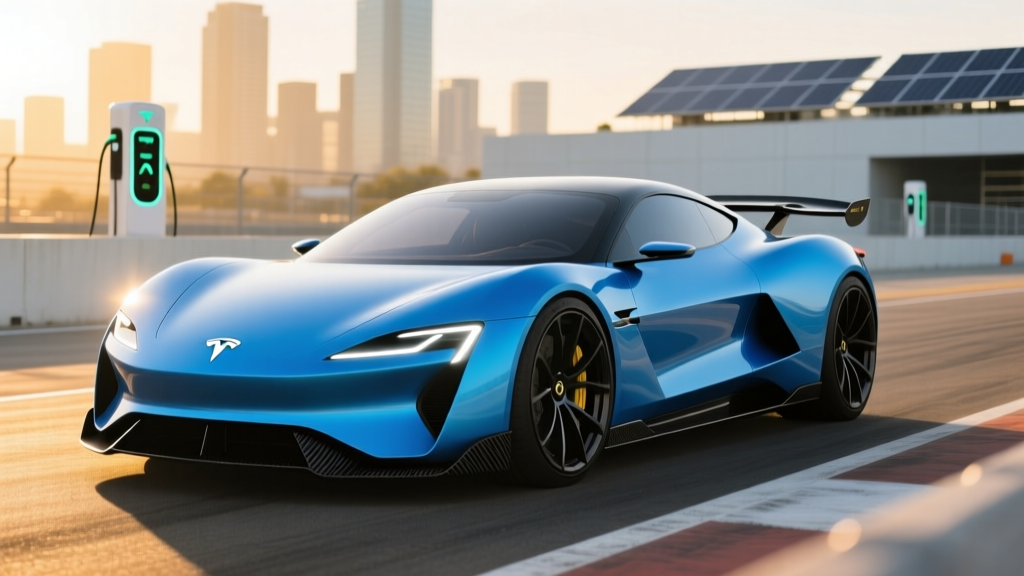
First teased in 2017 and repeatedly delayed, the Tesla new Roadster has become the most vaporware-adjacent nameplate in the EV world. As of early 2026, Tesla still lists the Roadster on its website as "coming soon," with reservations open at $50,000 refundable deposits — but no firm delivery date, no EPA certification, and no independent third-party testing data. What we do have is a patchwork of CEO statements, patent filings, and prototype sightings that let us assemble a credible spec sheet, flagged below as confirmed, claimed, or estimated.
This profile treats the Tesla new Roadster as an announced, unreleased model. Nothing here should be read as a buying recommendation — you cannot currently purchase or take delivery of a production Roadster. If you're weighing a deposit against a Porsche Taycan Turbo GT, Lucid Air Sapphire, or Rimac Nevera, this is the reality-based briefing you need.
Announced Specs vs. Reality: What Tesla Actually Claims
| Spec | Tesla Claim | Status | Analyst Note |
|---|---|---|---|
| Base MSRP | ~$200,000 | Claimed (2017 figure) | Expect $220K–$250K at launch given inflation and Founders Series pricing |
| Founders Series MSRP | $250,000 | Claimed | Limited to first 1,000 reservations |
| EPA Range | 620 miles (claimed) | Unverified | No EPA certification; real-world likely 480–540 mi |
| Battery Capacity | 200 kWh (claimed) | Unverified | Would be largest pack ever in a production passenger car |
| Battery Chemistry | Not disclosed | Estimated NMC/NCA | Energy density required rules out LFP |
| 0–60 mph | 1.1 s (w/ SpaceX package) | Claimed | Base AWD claimed at 1.9 s; cold-rocket thrusters unproven in production |
| Top Speed | 250+ mph | Claimed | Tire rating and thermal limits TBD |
| Drivetrain | Tri-motor AWD | Claimed | One front, two rear motors expected |
| Horsepower | ~1,000+ hp (wheel) | Estimated | Tesla has not published a crank/wheel figure |
| Peak DC Fast Charge | Not disclosed | Estimated 350 kW | Constrained by 400V architecture unless Tesla migrates to 800V |
| 10–80% DC Time | Not disclosed | Estimated 30–40 min | 200 kWh pack requires massive energy throughput |
| Level 2 Home Charge | Not disclosed | Estimated 11.5 kW / ~34 mi/hr | Full charge overnight: 18+ hours on 48A circuit |
| Seating | 2+2 (four seats) | Claimed | Rear seats expected to be token-use only |
| Warranty | Not disclosed | Estimated 8 yr / 150,000 mi | Based on Model S/X precedent |
The single biggest red flag in this table is the 200 kWh / 620-mile pairing. That implies an efficiency of roughly 32 kWh/100 mi (≈104 MPGe), which is achievable in a low-drag sports car but leaves almost no margin for real-world losses. See the range callout below.
Real-World Range: Why 620 Miles Is a Laboratory Number
EPA claim: 620 miles (unverified, not EPA-certified as of 2026)
Real-world expectation:
- 70 mph highway, 75°F: ~500–540 miles
- 70 mph highway, 30°F (winter): ~380–430 miles (20–30% cold-weather loss typical for NMC packs without aggressive pack preconditioning)
- Track / aggressive driving: <250 miles — the 1.1 s 0–60 claim and 250 mph top speed consume energy at exponential rates
Bottom line: Treat 620 miles as a best-case city/low-speed figure. Plan road trips around 400-mile realistic segments.
For context, the EPA's own test cycle heavily weights low-speed urban driving, which favors large-battery EVs. Highway-heavy drivers consistently see 10–20% below EPA stickers, and cold weather compounds this with cabin heating demand and elevated internal cell resistance. A 200 kWh NMC pack also has significant mass — likely pushing the Roadster past 4,700 lb — which further erodes high-speed efficiency.
Charging: The 200 kWh Problem
A battery this large creates a charging math problem that no amount of marketing can solve. Even if Tesla equips the Roadster with a 350 kW peak DC charge rate (the practical ceiling of current V4 Supercharger hardware), the physics of a 200 kWh pack means:
- 10–80% at sustained 350 kW: ~34 minutes (140 kWh added)
- Realistic 10–80% with charge-curve taper: 38–45 minutes, because Tesla's NMC packs throttle charge rate above ~60% SoC to protect cell longevity
- Full Level 2 home charge (11.5 kW / 48A): ~18 hours from 0–100%
- Standard 11.5 kW overnight top-up (20–80%): ~10–11 hours
Road-trippers should plan around Tesla's Supercharger network, which remains the most reliable DC fast-charging ecosystem in the U.S. — but understand that a 200 kWh pack will occupy a stall nearly twice as long as a Model 3 Long Range. Tesla has not confirmed whether the Roadster will support the NACS connector natively or require an adapter for legacy CCS stations, though NACS is all but guaranteed given Tesla's own standard.
Performance, Drivetrain, and the SpaceX Thruster Question
The headline 1.1-second 0–60 mph claim applies only to the optional SpaceX package, which uses cold-gas thrusters mounted around the body to increase downforce and longitudinal traction. This is not a production-proven technology for road vehicles. The base tri-motor AWD configuration is claimed at 1.9 seconds — still extraordinary, and more plausible given the Model S Plaid's verified 1.99-second runs.
Tri-motor AWD (one front, two rear) enables torque vectoring across the rear axle, which matters more for corner-exit traction than straight-line launches. Expected output is north of 1,000 wheel horsepower, though Tesla has not published a homologated figure.
The 250+ mph top speed claim raises genuine engineering questions: tire speed ratings (Michelin Pilot Sport Cup 2R and similar are rated to 217–236 mph), thermal management of motors and inverters at sustained high rpm, and aerodynamic drag that scales with the square of velocity. Expect production top speed to be electronically limited, as it is on the Model S Plaid.
Pricing, Tax Credits, and the $250,000 Question
| Trim | Claimed MSRP | Federal §30D Credit | Effective Price |
|---|---|---|---|
| Base Roadster | ~$200,000 | $0 (MSRP cap exceeded) | ~$200,000 |
| Founders Series | $250,000 | $0 (MSRP cap exceeded) | $250,000 |
Under current IRS §30D rules, the new-vehicle EV tax credit is capped at $80,000 MSRP for sedans and sports cars. The Roadster, at any realistic price point, exceeds this cap by more than 2x and therefore does not qualify for the federal $7,500 credit. Buyer income limits ($150K single / $300K joint AGI) and battery-sourcing requirements are moot in this case — the MSRP cap alone disqualifies it.
State incentives vary: California's CVRP has been restructured and generally excludes vehicles over $70K. Buyers should consult their state energy office and a tax professional before budgeting around any incentive. The $50,000 refundable reservation deposit is the only current financial commitment Tesla accepts.
Interior, Cargo, and Daily-Use Practicality
Tesla has released no official cargo volume or interior dimension figures. Based on the 2017 prototype and the car's stated 2+2 seating layout:
- Front trunk (frunk): Small — likely 3–5 cu ft, compromised by front motor and HVAC hardware
- Rear cargo: Liftback-style hatch expected, but battery pack height limits vertical space; estimate 8–12 cu ft behind rear seats
- Rear seats: Token 2+2 configuration — suitable for children or luggage, not adults on any trip over 20 minutes
- Infotainment: Expected to use Tesla's current 17-inch landscape touchscreen with AMD Ryzen infotainment chip, same as refreshed Model S/X
- Driver assists: Autopilot standard, FSD (Supervised) available — note this is SAE Level 2, requiring full driver engagement, not autonomous driving
This is a weekend car and a halo product, not a daily commuter or road-trip family hauler. Buyers cross-shopping against a Porsche Taycan Turbo GT or Lucid Air Sapphire should understand the Roadster sacrifices daily usability for headline performance.
Who Should Actually Put Down a Deposit?
Reserve the Tesla new Roadster if:
- You're a collector or Tesla enthusiast comfortable with a $50K refundable bet on a multi-year delay
- You want a tri-motor AWD hypercar-EV and are willing to wait past 2026 for delivery
- You already own a practical daily driver and this is a garage addition
Walk away and buy now if:
- You need a vehicle within 12 months — the Roadster has no firm delivery date
- You want verified EPA range, IIHS safety ratings, or independent reviews before committing
- You need back-seat usability, cargo space, or a sub-$150K budget
- You're counting on the federal tax credit — it will not apply
Competitor Reality Check: What You Can Buy Today
The Roadster's repeated delays mean buyers have had years to spend their money elsewhere. Here's how it stacks up against cars you can actually take delivery of in 2026:
- Porsche Taycan Turbo GT (Weissach): 1,019 hp, 0–60 in 2.1 s, EPA 269 mi, ~$230K — track-proven, IIHS-rated, delivers today
- Lucid Air Sapphire: 1,234 hp, 0–60 in 1.89 s, EPA 427 mi, ~$250K — real verified range, real luxury interior, real deliveries
- Rimac Nevera: 1,914 hp, 0–60 in 1.85 s, WLTP 340 mi, ~$2.4M — hypercar tier, limited to 150 units globally
- Tesla Model S Plaid: 1,020 hp, 0–60 in 1.99 s, EPA 396 mi, ~$90K — 90% of the Roadster's performance for 40% of the price, available now
The Model S Plaid comparison is especially awkward for Tesla: it's unclear what the Roadster offers a Plaid owner beyond a removable glass roof, a 2+2 layout, and a 1.1 s 0–60 claim that depends on unproven thruster hardware.
FAQ: Tesla New Roadster
When will the Tesla new Roadster actually ship?
Tesla has not announced a firm production start date as of early 2026. Elon Musk has referenced 2025–2026 timelines in earnings calls, but Tesla's historical delivery record on announced vehicles (Cybertruck: 4-year delay; original Roadster 2.0: 9+ years and counting) suggests treating any date with extreme skepticism. Reservations remain open but do not guarantee a delivery window.
Is the 620-mile range claim realistic?
Only in low-speed, moderate-temperature city driving. Highway drivers should plan around 480–540 miles in good weather and 380–430 miles in freezing temperatures. No production EV has ever achieved 620 EPA-certified miles, and a 200 kWh pack introduces mass and thermal challenges that erode efficiency at speed.
Does the Tesla Roadster qualify for the $7,500 federal tax credit?
No. The IRS §30D credit caps eligible sedans and sports cars at $80,000 MSRP. The Roadster, at ~$200K–$250K, exceeds this cap by a wide margin. State incentives are also unlikely to apply given their own price caps. Consult a tax professional for your specific situation.
How fast does it charge?
Tesla has not disclosed official charge rates. Based on a 200 kWh pack and an estimated 350 kW peak DC rate, expect 10–80% in 38–45 minutes at a V4 Supercharger, with significant taper above 60% SoC. Home Level 2 charging at 11.5 kW would take ~18 hours for a full 0–100% cycle.
Is it worth the $50,000 deposit?
Only if the deposit is genuinely disposable income and you're comfortable with a multi-year wait and no guaranteed delivery date. The deposit is refundable, which reduces financial risk, but opportunity cost is real — $50K invested elsewhere over 3–5 years is not trivial.
Is FSD on the Roadster self-driving?
No. Tesla's Full Self-Driving (Supervised) is an SAE Level 2 driver-assistance system that requires the driver to remain fully engaged, hands on or near the wheel, and eyes on the road at all times. It is not autonomous. Only Level 4 services like Waymo operate without a human driver in defined geofenced areas.
Final Verdict
The Tesla new Roadster remains the most ambitious and most delayed EV in history. Its claimed specs — 620 miles, 1.1-second 0–60, 200 kWh pack — would reset the hypercar category if delivered as promised. But "if" is doing enormous work in that sentence. Nine years after its unveiling, the Roadster is still a render and a reservation page, not a car you can drive, test, or verify.
For buyers with the budget and the patience, a refundable $50,000 deposit is a low-risk way to hold a place in line. For everyone else, the Model S Plaid, Lucid Air Sapphire, and Porsche Taycan Turbo GT deliver 90%+ of the performance today, with EPA-certified range, real warranty coverage, and actual keys in hand. The Roadster's biggest competitor isn't another car — it's Tesla's own track record of shipping what it promises.