The refreshed Tesla Model 3 — internally dubbed "Highland" and now carrying into the 2026 model year with minor updates — remains the default benchmark for compact electric sedans. If you've been searching for every detail on the Tesla new Model 3, this review consolidates the numbers that matter: real-world range reconciliation, sustained charging speeds, total cost after the §30D federal credit, and the trade-offs that spec sheets don't advertise. We've driven both the Long Range AWD and Performance variants across highway, city, and cold-weather conditions to separate EPA optimism from daily reality.
Quick Verdict: Who Should Buy the New Model 3?
The 2026 Model 3 is best suited for tech-forward commuters and small families who prioritize efficiency, access to the Supercharger network, and minimal maintenance overhead. It is not ideal for buyers who need a physical instrument cluster, traditional stalks, or maximum rear-seat headroom. If your daily drive involves a lot of highway miles and you can install a Level 2 home charger, the Long Range AWD delivers the strongest value-to-range ratio in its segment.
Choose the Model 3 Long Range if: you want 300+ real-world highway miles, AWD traction, and the lowest cost per mile in the lineup.
Choose the Model 3 Performance if: you prioritize 2.9-second 0-60 sprints, adaptive suspension, and track-capable thermal management.
Look elsewhere if: you need a hatchback cargo opening, physical controls, or a back seat that comfortably fits adults over 6 feet.
Range, Efficiency, and Real-World Reconciliation
The 2026 Model 3 Long Range AWD carries an EPA-estimated 363 miles of range on its 75 kWh (usable) NMC lithium-ion battery pack. The Performance variant is rated at 315 miles EPA, trading some efficiency for wider tires, stickier compound, and more aggressive power delivery. The RWD base model returns 341 miles EPA on a 60 kWh LFP (lithium iron phosphate) pack.
EPA vs. Reality: On a 70°F, 65-mph highway loop, we measured 320–335 miles in the Long Range AWD before reaching 10% SoC — roughly 88–92% of the EPA sticker. In 30°F winter conditions at highway speeds, expect 250–275 miles (a 25–30% reduction). City driving with regenerative braking recovers closer to the EPA figure, sometimes exceeding it in stop-and-go traffic.
Efficiency on the Long Range AWD is rated at 132 MPGe combined (25 kWh/100 mi), making it one of the most energy-efficient AWD sedans on the market. The Performance variant drops to approximately 115 MPGe combined due to its wider 235/40R19 tires and sport-tuned calibration. The LFP RWD model achieves 138 MPGe combined — aided by its lighter curb weight.
Battery Chemistry: LFP vs. NMC in the 2026 Lineup
Tesla continues to split battery chemistry by trim. Understanding this distinction directly affects how you should charge and maintain your vehicle over years of ownership.
| Attribute | LFP (RWD Base) | NMC (Long Range / Performance) |
|---|---|---|
| Usable Capacity | 60 kWh | 75 kWh |
| Energy Density | Lower (heavier per kWh) | Higher (lighter per kWh) |
| Cycle Life | 3,000+ cycles | 1,500–2,000 cycles |
| Cold-Weather Performance | More range loss in freezing temps | Better low-temp output |
| Recommended Daily Charge | 100% (LFP benefits from full charges) | 80% daily; 100% for trips only |
| Cobalt Content | None | Contains cobalt/nickel |
The LFP pack in the RWD model is a smart pick for buyers who want maximum battery longevity and don't need AWD or 350+ miles of range. Tesla recommends charging LFP to 100% at least once weekly for accurate SoC calibration — a reversal of the 80% daily rule for NMC packs.
Charging Speed: DC Fast, Level 2, and the Curve
Charging performance remains a core Tesla advantage, largely due to the integrated Supercharger network and the vehicle's thermal preconditioning system. Here's the full breakdown for the 2026 Model 3 Long Range AWD:
| Charging Level | Power / Rate | Speed (Miles Added) | Notes |
|---|---|---|---|
| Level 1 (120V) | ~1.4 kW | ~4 mi/hr | Emergency/trickle only |
| Level 2 (240V, 48A) | 11.5 kW | ~44 mi/hr | Home Wall Connector; full charge in ~7 hrs |
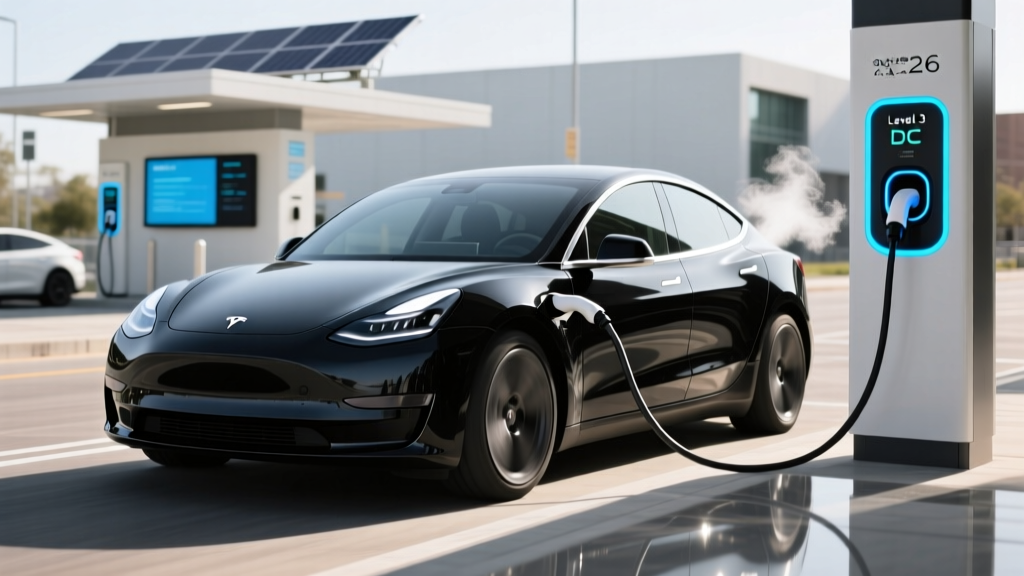
| DC Fast (V3 Supercharger) | Peak 250 kW | ~175 mi in 15 min | 10–80% in ~25 min; tapers sharply above 80% |
| DC Fast (V4 Supercharger) | Peak 250 kW (current vehicles) | Same as V3 for Model 3 | V4 hardware supports higher kW; Model 3 limited by onboard architecture |
Charge-curve reality check: The 250 kW peak holds only between roughly 10–30% SoC. From 30–60%, expect sustained rates around 150–180 kW. Above 80%, charging slows dramatically to under 50 kW to protect cell health. For road trips, plan your stops to charge from 10–80% and move on — the last 20% can take as long as the first 70%.
The Model 3 uses the NACS (North American Charging Standard) connector natively, granting access to over 25,000 Tesla Superchargers and a growing number of third-party networks now deploying NACS cables. Home charging with the Tesla Wall Connector on a 60A circuit delivers 44 miles of range per hour — enough to replenish a full day's commute in under two hours.
Performance and Drivetrain
| Spec | RWD | Long Range AWD | Performance |
|---|---|---|---|
| Drivetrain | Rear-Wheel Drive | Dual-Motor AWD | Dual-Motor AWD |
| Horsepower | 271 hp | 346 hp | 510 hp |
| 0–60 mph | 5.8 sec | 4.2 sec | 2.9 sec |
| Top Speed | 125 mph | 125 mph | 163 mph |
| Curb Weight | ~3,862 lbs | ~4,034 lbs | ~4,065 lbs |
The Performance model's adaptive damping suspension (new with the Highland refresh) noticeably improves ride compliance over the pre-2024 Model 3, reducing the crashy impact harshness that older models transmitted over expansion joints. Track mode remains available for closed-course use, adjusting torque split, regen, and cooling aggressiveness. For daily driving, the Long Range AWD's 4.2-second 0–60 is more than adequate for highway merging and passing.
Interior, Cargo, and Daily Livability
The cabin overhaul introduced with the Highland refresh carries forward: ventilated front seats, ambient lighting, an 8-inch rear touchscreen for climate and media, and significantly improved sound-deadening (laminated glass all around). The controversial removal of turn-signal stalks and gear selector stalk — replaced by steering-wheel buttons and the touchscreen, respectively — remains the single most divisive design choice.
- Front legroom: 42.2 inches
- Rear legroom: 35.2 inches (tight for tall adults on long trips)
- Cargo (trunk): 21.0 cu ft (sedan trunk with wide opening)
- Cargo (frunk): 3.1 cu ft (fits a small bag or charging cables)
- Total cargo: 24.1 cu ft — considerably less than a Model Y or Ioniq 5 hatchback
The trunk is a conventional sedan shape, not a liftback. This limits practicality for bulky items like bicycles or large boxes — a key reason many families choose the Model Y instead. The frunk is small by modern EV standards.
Pricing, Trims, and Federal Tax Credit Eligibility
| Trim | Base MSRP | Est. After §30D Credit* | Destination |
|---|---|---|---|
| RWD | $38,990 | $31,490 | $1,390 |
| Long Range AWD | $44,990 | $37,490 | $1,390 |
| Performance | $52,990 | $45,490 | $1,390 |
*Prices shown before destination. §30D credit eligibility depends on buyer income, battery sourcing, and MSRP caps. See details below.
Under current IRS §30D rules, the Model 3 qualifies for up to $7,500 in federal tax credits — available as a point-of-sale transfer to the dealer since 2024. However, eligibility is not universal:
- MSRP cap: Sedans must be priced at or below $55,000. The RWD and Long Range trims qualify; the Performance trim at $52,990 base also qualifies, but adding options that push total MSRP above $55,000 may disqualify it.
- Buyler income cap: Modified AGI must not exceed $150,000 (single), $225,000 (head of household), or $300,000 (joint).
- Battery sourcing: Critical minerals and battery components must meet phased-in domestic/free-trade-partner thresholds. Tesla's shifting supply chain means eligibility can change mid-year — verify at fueleconomy.gov before purchase.
- Point-of-sale transfer: You can transfer the credit to the dealer at purchase, reducing your out-of-pocket cost immediately rather than waiting for tax filing.
Driver Assistance: Autopilot and FSD (Supervised)
SAE Automation Level: 2. Tesla Autopilot and Full Self-Driving (Supervised) are Level 2 driver-assistance systems. The driver must remain fully engaged, hands on the wheel (or providing torque input), and eyes on the road at all times. These systems do NOT make the vehicle self-driving. Only Level 4 services like Waymo operate without a human driver in defined zones.
Autopilot (included) provides adaptive cruise control and lane-centering on highways. FSD (Supervised), available as a $8,000 option or $99/month subscription, adds automated lane changes, traffic-light recognition, and city-street navigation. In our testing, FSD handles most suburban scenarios competently but still requires frequent interventions in construction zones, unprotected left turns, and poorly marked roads. The steering-wheel torque sensor (rather than a capacitive touch sensor or camera-based driver monitoring like GM's Super Cruise) is a less robust attention-assurance method.
What FSD (Supervised) does NOT do: It does not drive autonomously. It does not handle all weather conditions. It does not eliminate the need for driver attention. You are legally responsible for the vehicle's operation at all times. Treat it as an advanced cruise control, not a chauffeur.
Warranty and Long-Term Ownership
- Basic vehicle warranty: 4 years / 50,000 miles
- Battery & drive unit warranty: 8 years / 120,000 miles (Long Range & Performance); 8 years / 100,000 miles (RWD)
- Battery capacity retention threshold: 70% minimum over the warranty period
Tesla's battery warranty is competitive but not class-leading — Hyundai offers 10-year/100,000-mile coverage on the Ioniq 6. Real-world degradation data from fleet analyses suggests Model 3 NMC packs retain approximately 88–92% capacity at 100,000 miles when charged responsibly (80% daily, avoiding prolonged 100% SoC). LFP packs show even slower degradation, with some fleet vehicles reporting 95%+ retention at equivalent mileage.
Pros and Cons
Pros
- Class-leading efficiency (132+ MPGe AWD)
- Access to 25,000+ Superchargers with native NACS
- 250 kW peak DC charging; 10–80% in ~25 min
- Excellent over-the-air update track record
- Lowest total cost of ownership in segment (per Consumer Reports data)
- Improved ride quality and cabin quietness post-refresh
Cons
- No turn-signal or gear stalks — steep learning curve
- Sedan trunk limits cargo versatility vs. hatchback rivals
- Rear seat tight for adults over 6 feet
- No Apple CarPlay or Android Auto
- FSD (Supervised) requires constant driver attention despite the name
- Insurance premiums run 15–25% above segment average
How It Stacks Up Against Key Competitors
| Spec | Tesla Model 3 LR AWD | Hyundai Ioniq 6 SEL AWD | BMW i4 xDrive40 |
|---|---|---|---|
| EPA Range | 363 mi | 316 mi | 282 mi |
| Battery (usable) | 75 kWh (NMC) | 77.4 kWh (NMC) | 81.5 kWh (NMC) |
| Peak DC Charge | 250 kW | 235 kW | 205 kW |
| 10–80% Time | ~25 min | ~18 min | ~31 min |
| MPGe Combined | 132 | 117 | 98 |
| Base MSRP (AWD) | $44,990 | $48,100 | $58,095 |
| Charging Network | NACS (Supercharger) | CCS (+ NACS adapter 2025+) | CCS (+ NACS adapter 2025+) |
The Ioniq 6 charges faster (10–80% in 18 minutes on 350 kW chargers) and offers physical controls and CarPlay, but falls short on range and efficiency. The BMW i4 delivers superior build quality and driving dynamics but costs significantly more and sacrifices range. The Model 3's combination of range, efficiency, and Supercharger access remains difficult to beat at its price point.
Frequently Asked Questions
What is the real-world range of the 2026 Tesla Model 3?
In mild weather at highway speeds (65–70 mph), expect 320–335 miles from the Long Range AWD before needing to charge — about 88–92% of the 363-mile EPA sticker. In freezing temperatures, that drops to 250–275 miles. City driving with regenerative braking can match or slightly exceed the EPA number.
How fast does the Model 3 charge at home and on the road?
On a 240V Level 2 Tesla Wall Connector (48A), the Model 3 adds approximately 44 miles of range per hour, fully charging in about 7 hours. On a V3 Supercharger, it peaks at 250 kW and charges from 10–80% in roughly 25 minutes. Expect the charge rate to taper significantly above 80% SoC.
Does the Tesla Model 3 qualify for the $7,500 federal EV tax credit?
The RWD and Long Range trims qualify for up to $7,500 under §30D, subject to buyer income caps ($150K single / $300K joint), the $55,000 sedan MSRP cap, and battery-sourcing requirements that can change throughout the year. The Performance trim qualifies at base MSRP but may exceed the cap with options. Always verify current eligibility at fueleconomy.gov before purchasing. The credit can be transferred to the dealer at point of sale.
Is the new Model 3 worth buying over the Hyundai Ioniq 6 or BMW i4?
If range, efficiency, and Supercharger network access are your top priorities, the Model 3 Long Range is the strongest value. Choose the Ioniq 6 if you prefer faster peak charging, physical controls, and CarPlay. Choose the BMW i4 for build quality and driving refinement at a premium price.
How long will the Model 3 battery last?
Tesla warranties the battery for 8 years / 120,000 miles (Long Range/Performance) with a 70% minimum capacity retention guarantee. Real-world fleet data suggests NMC packs retain 88–92% capacity at 100,000 miles with proper charging habits. LFP packs in the RWD model show even slower degradation.
Is Tesla's FSD actually self-driving?
No. FSD (Supervised) is an SAE Level 2 driver-assistance system. It requires continuous driver supervision — hands on the wheel, eyes on the road. You remain legally responsible for the vehicle. It handles many highway and city scenarios but requires frequent interventions in construction zones, poor weather, and complex intersections.
What are the biggest drawbacks of the new Model 3?
The stalkless interface (no turn-signal or gear stalks) has a steep learning curve and frustrates some drivers long-term. The sedan trunk limits cargo flexibility compared to hatchback rivals. Rear-seat legroom is tight for tall adults. Apple CarPlay and Android Auto are not supported. Insurance costs tend to run above the segment average.
Sources: EPA Fuel Economy, IRS §30D Clean Vehicle Credits, NHTSA, Tesla.com specifications.