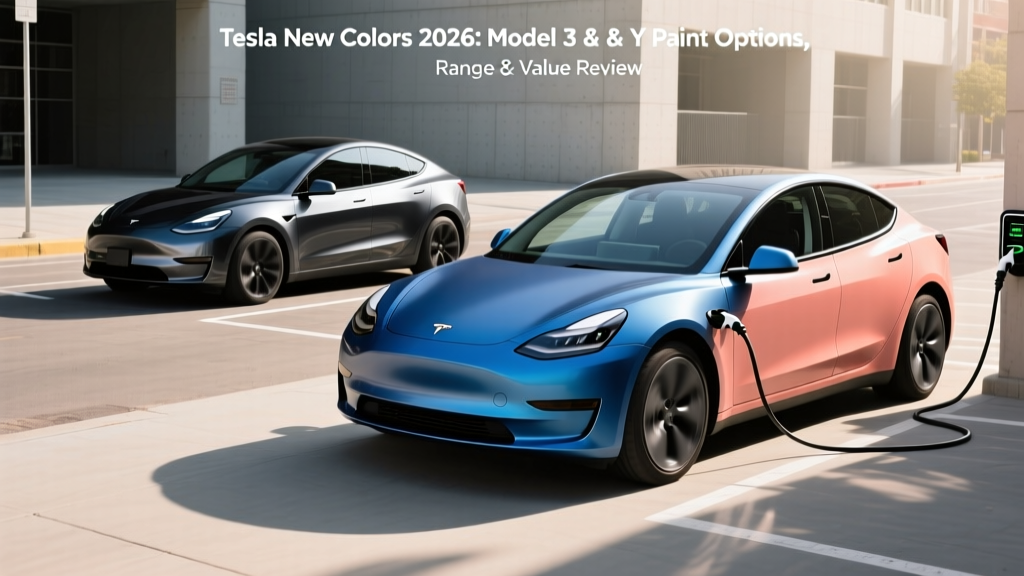
For years, Tesla's paint palette was the automotive equivalent of a Henry Ford quote: you could have any color as long as it was white, black, silver, blue, or red. That changed with the Highland Model 3 refresh and the Juniper Model Y update, and for 2026 Tesla has once again reshuffled its exterior color lineup across both vehicles. If you're researching Tesla new colors and wondering whether the latest hues affect resale, pricing, or the underlying engineering, this review covers everything — paint options, real-world range, charging speeds, tax credit eligibility, and how the 2026 Model 3 and Model Y stack up against rivals.
2026 Tesla Color Lineup: What's New and What It Costs
Tesla's current color menu for the U.S. market includes five standard and premium options across Model 3 and Model Y, though availability varies by trim and factory (Fremont vs. Austin vs. Shanghai imports for certain markets). Here's the 2026 breakdown:
| Color | Finish Type | Surcharge | Model 3 | Model Y |
|---|---|---|---|---|
| Pearl White Multi-Coat | Standard tri-coat | $0 | ✓ | ✓ |
| Solid Black | Standard | $0 (was $1,500) | ✓ | ✓ |
| Deep Blue Metallic | Metallic | $1,000 | ✓ | ✓ |
| Ultra Red | Multi-coat metallic | $2,000 | ✓ | ✓ |
| Quicksilver | Premium metallic | $2,500 | ✓ | ✓ |
| Starlight Green (NEW) | Multi-coat metallic | $2,500 | ✓ | ✓ |
The headline addition for 2026 is Starlight Green, a deep, multi-coat metallic that shifts between forest green and teal depending on lighting. It replaces the previous Stealth Grey in the premium tier. Quicksilver, introduced with the Model S/X Plaid, has trickled down to Model 3 and Model Y as of mid-2025 and continues into 2026. Ultra Red remains Tesla's flagship red — a complex multi-coat that requires more paint layers than the discontinued Red Multi-Coat, yielding deeper saturation.
Notably, Tesla made Solid Black a no-cost option starting with the Juniper Model Y refresh, removing a longstanding $1,500 surcharge. This matters for total cost calculations and tax credit threshold math, which we'll address below.
2026 Model 3: Range, Battery, and Efficiency
The 2026 Tesla Model 3 continues with three primary trims. The Highland redesign (introduced for 2024) carries forward with minor software and efficiency tweaks for 2026, including improved thermal management that reduces cold-weather range loss by roughly 5-8% compared to the pre-Highland platform.
| Spec | Model 3 RWD | Model 3 Long Range AWD | Model 3 Performance |
|---|---|---|---|
| EPA Range | 272 mi | 341 mi | 315 mi |
| Battery (usable) | ~57.5 kWh (LFP) | ~75 kWh (NMC) | ~75 kWh (NMC) |
| Drivetrain | RWD, single motor | AWD, dual motor | AWD, dual motor |
| Horsepower | 271 hp | 346 hp | 510 hp |
| 0-60 mph | 5.8 sec | 4.2 sec | 2.9 sec |
| MPGe (combined) | 132 MPGe | 125 MPGe | 118 MPGe |
| Efficiency | 25 kWh/100mi | 27 kWh/100mi | 29 kWh/100mi |
| Base MSRP | $38,990 | $45,990 | $52,990 |
LFP vs. NMC: What the Battery Chemistry Means for You
The base Model 3 RWD uses a lithium iron phosphate (LFP) battery, while Long Range and Performance trims use nickel-manganese-cobalt (NMC) chemistry. The trade-offs are significant:
| Factor | LFP (RWD) | NMC (Long Range / Perf) |
|---|---|---|
| Energy density | Lower (heavier per kWh) | Higher (lighter per kWh) |
| Recommended daily charge | 100% (Tesla recommends weekly full charge) | 80% daily, 100% for trips |
| Cycle life | 3,000+ cycles | 1,500-2,000 cycles |
| Cold-weather performance | Slightly worse range in cold | Better cold-weather efficiency |
| Long-term degradation | Slower degradation curve | Moderate degradation |
| Cobalt/nickel sourcing | Cobalt-free | Contains cobalt and nickel |
If you're a daily commuter who can charge to 100% every night and doesn't need 341 miles of range, the LFP battery in the RWD trim is arguably the more durable long-term choice. If you road-trip frequently or live in a cold climate, the NMC Long Range offers more usable buffer.
Charging Speed: DC Fast Charge and Home Level 2
Charging speed is where Tesla continues to hold a real advantage, thanks to the Supercharger network and the Model 3/Y's capable thermal management system. Here are the 2026 numbers:
| Charging Level | Model 3 RWD (LFP) | Model 3 Long Range / Perf (NMC) |
|---|---|---|
| Level 1 (120V, standard outlet) | ~3-4 mi/hr | ~3-4 mi/hr |
| Level 2 (240V, 48A home charger) | ~30 mi/hr (11.5 kW) | ~44 mi/hr (11.5 kW) |
| DC Fast Charge (peak) | 170 kW | 250 kW |
| DC 10-80% time | ~30 min | ~25 min |
| Connector | NACS (native) | NACS (native) |
A critical nuance: the 250 kW peak on Long Range and Performance models is not sustained. The charge curve peaks around 250 kW between roughly 10-30% state of charge, then tapers progressively. From 50-80%, you'll see approximately 100-130 kW. This is why the 10-80% time is 25 minutes rather than the ~15 minutes a sustained 250 kW rate would theoretically deliver.
The LFP RWD model peaks lower at 170 kW because LFP chemistry accepts charge at a lower C-rate. This means road-trip charging stops take about 5 minutes longer on average compared to the Long Range.
For home charging, Tesla's Wall Connector ($420) at 48 amps on a 60-amp circuit delivers up to 11.5 kW. A typical overnight charge (10 hours) adds 300-440 miles of range depending on trim — more than enough to replenish a full day's driving. Installation costs for a 240V/60A circuit typically range from $800-$2,500 depending on panel proximity and local permit requirements, per licensed electrician estimates.
2026 Model Y: The Juniper Update in New Colors
The Model Y received its Juniper refresh for the 2025 model year, and the 2026 version carries forward with the same updated exterior, interior, and suspension tuning. All 2026 Tesla new colors — including Starlight Green and Quicksilver — are available on Model Y.
| Spec | Model Y Long Range AWD | Model Y Performance |
|---|---|---|
| EPA Range | 320 mi | 293 mi |
| Battery (usable) | ~75 kWh (NMC) | ~75 kWh (NMC) |
| Drivetrain | AWD, dual motor | AWD, dual motor |
| Horsepower | 384 hp | 510 hp |
| 0-60 mph | 4.8 sec | 3.5 sec |
| MPGe (combined) | 118 MPGe | 111 MPGe |
| Cargo (rear seats up) | 30.2 cu ft | 30.2 cu ft |
| Cargo (rear seats folded) | 72.1 cu ft | 72.1 cu ft |
| Rear legroom | 40.5 in | 40.5 in |
| Base MSRP | $46,990 | $52,490 |
Model Y DC Fast Charging
The Juniper Model Y Long Range peaks at 250 kW on a V3/V4 Supercharger, with a 10-80% time of approximately 27 minutes. The Performance trim achieves similar peak rates. Both use the native NACS connector — no adapter needed at Tesla Superchargers, and a NACS-to-CCS adapter (included with recent vehicles) enables use of Electrify America and other CCS networks.
Pricing, Tax Credits, and Total Cost
Tesla's 2026 pricing has shifted slightly from prior years, and the federal tax credit landscape remains complex. Here's what you need to know:
| Trim | Base MSRP | Federal Tax Credit (§30D) | Effective Price (if eligible) |
|---|---|---|---|
| Model 3 RWD | $38,990 | Up to $7,500 | ~$31,490 |
| Model 3 Long Range AWD | $45,990 | Up to $7,500 | ~$38,490 |
| Model 3 Performance | $52,990 | Up to $7,500 | ~$45,490 |
| Model Y Long Range AWD | $46,990 | Up to $7,500 | ~$39,490 |
| Model Y Performance | $52,490 | Up to $7,500 | ~$44,990 |
Federal Tax Credit Eligibility (§30D) — Key Requirements
Not every buyer qualifies for the full $7,500. Per IRS §30D rules, eligibility depends on multiple factors:
- Income caps: Modified adjusted gross income (MAGI) must not exceed $150,000 (single), $225,000 (head of household), or $300,000 (joint filers).
- MSRP caps: The vehicle's MSRP must not exceed $55,000 for sedans (Model 3) or $80,000 for SUVs/trucks (Model Y). All 2026 Model 3 and Model Y trims fall under these caps.
- Battery sourcing: A percentage of critical minerals and battery components must be sourced from the U.S. or free-trade-agreement countries. Tesla's U.S.-built vehicles have largely met these thresholds for 2026, but the exact credit amount ($3,750 vs. $7,500) can shift based on annual sourcing requirements. Check fueleconomy.gov for the current determination on your specific VIN.
- Point-of-sale transfer: As of 2024, you can transfer the credit to the dealer at purchase, reducing your out-of-pocket cost immediately rather than waiting to claim it on your tax return.
Important: Adding a $2,500 premium color (Quicksilver or Starlight Green) to a Model 3 Performance pushes the as-tested price to $55,490 — right at the sedan MSRP cap. Tesla typically structures paint as a separate line item, and the MSRP cap applies to the base vehicle MSRP, but confirm with your tax professional before relying on credit eligibility for a heavily optioned build.
Technology, Driver Assistance, and Interior
The 2026 Model 3 Highland and Model Y Juniper share Tesla's latest interior architecture: a 15.4-inch center touchscreen, ambient lighting, ventilated front seats (a first for Tesla on Model 3), and a rear 8-inch touchscreen for passengers on Model 3. The Model Y Juniper adds a power-folding second row and improved acoustic glass.
Autopilot and Full Self-Driving (Supervised)
Tesla's Autopilot comes standard and includes Traffic-Aware Cruise Control and Autosteer. Full Self-Driving (Supervised) remains an $8,000 option (or $99/month subscription as of 2026). FSD (Supervised) adds automatic lane changes, Navigate on Autopilot, traffic light and stop sign recognition, and Autopark.
Notable Tech Drawbacks
The Highland Model 3 eliminated physical turn signal stalks and the gear selector stalk — both are now controlled via steering wheel buttons and the touchscreen, respectively. This remains polarizing among owners and reviewers. The Model Y Juniper retains a similar minimalist approach. Additionally, Tesla's removal of ultrasonic sensors in favor of Tesla Vision (camera-only) means parking proximity alerts are software-estimated rather than sensor-precise, which some drivers find less reliable in tight spaces.
Warranty Coverage
| Coverage | Model 3 RWD | Model 3 LR / Perf & Model Y |
|---|---|---|
| Basic vehicle | 4 years / 50,000 mi | 4 years / 50,000 mi |
| Battery & drive unit | 8 years / 100,000 mi | 8 years / 120,000 mi |
| Battery capacity retention threshold | 70% minimum | 70% minimum |
Tesla's battery warranty guarantees that the pack will retain at least 70% of its original capacity during the warranty period. If degradation drops below that threshold, Tesla will replace or refurbish the battery at no cost. In practice, Tesla's own fleet data shows average degradation of approximately 12-15% at 200,000 miles for NMC packs, well within the warranty buffer. LFP packs show even less measurable degradation at equivalent mileage.
Tesla Model 3 vs. Key Competitors
| Attribute | 2026 Tesla Model 3 LR | 2026 Hyundai Ioniq 6 SEL | 2026 BMW i4 eDrive40 |
|---|---|---|---|
| EPA Range | 341 mi | 361 mi | 307 mi |
| Base MSRP | $45,990 | $42,750 | $57,900 |
| Peak DC Charge | 250 kW | 233 kW | 205 kW |
| 10-80% DCFC | ~25 min | ~18 min | ~31 min |
| Charging Network | NACS (Supercharger native) | NACS (adapter or 2026 native) | NACS (adapter) |
| 0-60 mph | 4.2 sec | 5.1 sec | 5.5 sec |
| Tax Credit | Up to $7,500 | Up to $7,500 (varies) | Not eligible (German-built) |
The Model 3 Long Range's key advantages are Supercharger network access (no adapter needed), strong performance, and the best software/OTA update ecosystem in the industry. The Ioniq 6 offers more range and faster peak charging at a lower price, but its public charging experience depends on CCS-to-NACS adapter reliability. The BMW i4 is more luxurious and quieter but significantly pricier and ineligible for the federal credit due to overseas manufacturing.
Who Should Buy a 2026 Tesla Model 3 or Model Y?
- Commuters with home charging: The Model 3 RWD at ~$31,490 after the tax credit is one of the cheapest ways into a new EV with 272 miles of range. Plug in nightly to an LFP-friendly 100% charge and wake up to a full battery every morning.
- Families needing cargo space: The Model Y's 72.1 cu ft of cargo room with seats folded beats most compact SUVs, gas or electric. The Juniper suspension update also improved ride comfort significantly over the pre-2025 Model Y.
- Road trippers: Tesla's Supercharger network remains the most reliable and widespread DC fast-charging network in the U.S., with over 6,500 V3/V4 stalls nationwide. If you take frequent long trips, this ecosystem advantage is tangible.
- You prefer traditional controls — the stalkless steering wheel and touchscreen-only gear selector are dealbreakers for some drivers.
- You need a luxury-grade interior — Tesla's minimalist cabin uses decent materials but doesn't match BMW, Mercedes, or Genesis on fit and finish.
- You want the absolute longest EPA range — the Hyundai Ioniq 6 (361 mi) and Lucid Air Pure (419 mi) exceed the Model 3's 341 miles.
Frequently Asked Questions
What is the real-world range of the 2026 Tesla Model 3?
The EPA rates the Model 3 Long Range AWD at 341 miles, but real-world highway driving at 70-75 mph typically yields 285-305 miles. In cold weather below freezing, expect 255-290 miles. The RWD model's 272-mile EPA rating translates to approximately 230-250 miles on the highway in mild conditions.
How fast does the 2026 Model 3 and Model Y charge?
On a Tesla V3/V4 Supercharger, the Long Range and Performance trims peak at 250 kW, reaching 10-80% in roughly 25-27 minutes. The RWD (LFP) model peaks at 170 kW with a 10-80% time of about 30 minutes. At home on a 48-amp Level 2 charger, expect 30-44 miles of range per hour depending on trim.
How much does a 2026 Tesla cost after the federal tax credit?
If you meet all IRS §30D requirements (income caps, MSRP caps, battery sourcing), the Model 3 RWD can effectively cost as low as ~$31,490 and the Model Y Long Range as low as ~$39,490. The credit can be transferred at the point of sale, reducing your upfront payment. Always confirm eligibility with a tax professional and check fueleconomy.gov for the latest VIN-specific credit determination.
Do Tesla's new colors affect resale value?
Historically, Pearl White and Solid Black have the strongest resale demand in the Tesla used market. Premium colors like Ultra Red and Quicksilver appeal to enthusiasts but don't consistently recoup their $2,000-$2,500 surcharge at trade-in. Starlight Green is too new to have resale data, but unique colors on limited-production vehicles tend to hold value better in the first 2-3 years before normalizing.
Is the 2026 Tesla Model 3 or Model Y worth buying vs. competitors?
For buyers who prioritize charging infrastructure, software updates, and performance-per-dollar, Tesla remains the benchmark. The Model 3 Long Range at $45,990 with 341 miles of range, 250 kW charging, and Supercharger access is hard to beat. However, the Hyundai Ioniq 5/6, Chevrolet Equinox EV, and Ford Mustang Mach-E offer compelling alternatives with more traditional controls, competitive range, and improving charging access via NACS adapters.
Does the 2026 Model Y qualify for the full $7,500 federal tax credit?
As of early 2026, the U.S.-built Model Y qualifies for the full $7,500 credit for eligible buyers, based on its MSRP (under the $80,000 SUV cap), buyer income thresholds, and Tesla's battery sourcing compliance. However, sourcing requirements tighten annually, so verify current eligibility on irs.gov before purchasing.