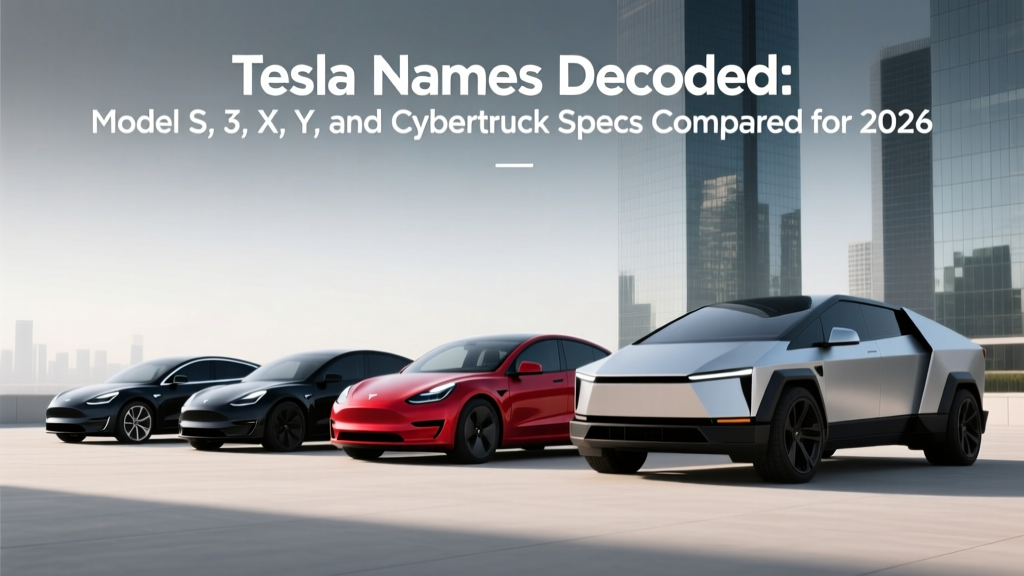
Why Tesla Names Its Cars the Way It Does
If you've ever wondered why Tesla's vehicle lineup seems to spell out a word, you're not alone. The Tesla names — Model S, Model 3, Model X, and Model Y — were chosen to spell "S3XY" (a playful stand-in for "sexy"), a fact Elon Musk confirmed years ago. The Cybertruck and Tesla Semi broke from that convention, but the core passenger lineup still carries the original DNA. Understanding what each Tesla name represents isn't just trivia; each badge maps to a distinct vehicle class, battery architecture, and use case. This guide decodes every current Tesla model with the exact numbers buyers need: EPA range, battery kWh and chemistry, DC fast-charge speeds, pricing, and federal tax credit eligibility under current IRS §30D rules.
Tesla Model Lineup at a Glance: 2026 Specs
| Spec | Model 3 | Model Y | Model S | Model X | Cybertruck |
|---|---|---|---|---|---|
| Class | Sedan | Crossover SUV | Luxury Sedan | Luxury SUV | Pickup Truck |
| EPA Range (max) | 363 mi (LR RWD) | 320 mi (LR AWD) | 402 mi (LR) | 335 mi (LR) | 340 mi (AWD) |
| Battery (usable, est.) | ~75 kWh (LFP) / ~82 kWh (NMC) | ~75 kWh (LFP) / ~82 kWh (NMC) | ~95 kWh (NMC) | ~95 kWh (NMC) | ~123 kWh (NMC) |
| Peak DC Charge | 250 kW | 250 kW | 250 kW | 250 kW | 350 kW |
| 10–80% DC Time | ~25 min | ~25 min | ~27 min | ~30 min | ~15 min |
| 0–60 mph (quickest) | 3.1s (Perf) | 3.5s (Perf) | 1.99s (Plaid) | 2.5s (Plaid) | 2.6s (Beast) |
| Horsepower (max) | 510 hp | 456 hp | 1,020 hp | 1,020 hp | 845 hp |
| Base MSRP | $38,990 | $44,990 | $79,990 | $84,990 | $79,990 |
| Federal Tax Credit | Up to $7,500 (varies) | Up to $7,500 (varies) | $0 (over MSRP cap) | $0 (over MSRP cap) | $0 (over MSRP cap) |
Sources: fueleconomy.gov, Tesla.com specifications pages. Figures reflect latest available model-year data and may vary by trim and production batch.
Tesla Model 3: The Entry Point
The Model 3 is Tesla's volume sedan and the most affordable way into the Supercharger network. The "3" was originally meant to be "E" (to complete S-E-X-Y), but Ford's trademark on "Model E" forced the numeric pivot. Today, the Model 3 (refreshed as "Highland" for the 2024–2026 model years) offers a dramatically improved interior over the pre-refresh versions, with ventilated seats, ambient lighting, rear-seat touchscreen, and substantially reduced cabin noise.
Real-World Expectation: Expect ~300–320 miles on mixed highway driving in mild weather for the LR RWD. In sub-30°F winter conditions, plan for 220–260 miles depending on cabin heat usage and preconditioning habits. The LFP battery in the Standard RWD variant is more tolerant of daily 100% charging, which partially offsets its shorter sticker range.
Charging & Battery
The Standard Range RWD uses a ~60 kWh LFP (lithium iron phosphate) battery supplied by CATL. LFP chemistry trades energy density for longevity — Tesla recommends charging LFP packs to 100% at least weekly to maintain accurate state-of-charge calibration. Long Range trims use an ~82 kWh NMC (nickel manganese cobalt) pack from Panasonic, best kept between 20–80% for daily use.
| Charging Level | Power | Speed |
|---|---|---|
| Level 1 (120V) | ~1.4 kW | ~4 mi/hr |
| Level 2 (240V, 48A) | 11.5 kW | ~33 mi/hr |
| DC Fast Charge | Peak 250 kW | 10–80% in ~25 min (LR) |
The 250 kW peak is not sustained across the full curve. Expect peak rates between 10–30% SoC, tapering to ~120 kW by 60%, and ~50 kW above 80%. This is why Tesla's navigation system preconditions the battery when a Supercharger is set as your destination — arriving with a warm pack unlocks the full charge curve.
Pricing & Tax Credit
Base MSRP for the Model 3 Standard Range starts at $38,990. The Long Range RWD sits at $42,490, and the Performance AWD tops out around $52,990. Under current IRS §30D rules, the Model 3 may qualify for up to $7,500 in federal tax credit — but eligibility hinges on battery component sourcing and critical mineral requirements that shift annually. Buyer income caps apply ($150K single / $300K joint AGI), and the vehicle MSRP must not exceed $55,000 for sedans. The point-of-sale transfer option allows buyers to apply the credit as a down-payment reduction at the dealer. Always verify current eligibility on the IRS source list before purchasing.
Tesla Model Y: The Best-Seller
The "Y" completes the S-3-X-Y quartet and represents Tesla's compact crossover SUV — mechanically related to the Model 3 but riding higher with more cargo space and available third-row seating (for small children). The Model Y received its "Juniper" refresh for the 2025–2026 model years, adding a front light bar, revised suspension, ventilated front seats, and power-folding second row.
Real-World Expectation: Highway cruising at 75 mph yields approximately 265–285 miles in the LR AWD. Cold-weather highway range drops to roughly 210–240 miles. The Model Y's taller, less aerodynamic profile costs it roughly 10–15% range versus the Model 3 on the highway.
Charging mirrors the Model 3: 250 kW peak DC, ~25 minutes 10–80%, and 11.5 kW Level 2 at home. The Juniper refresh improved thermal management, yielding marginally faster sustained charge rates in colder ambient temperatures compared to the pre-refresh platform.
Starting at $44,990 for the Long Range AWD, the Model Y qualifies for the §30D credit under the SUV MSRP cap of $80,000 — giving it more pricing headroom than the Model 3 sedan cap of $55,000. Cargo volume stands at 76.2 cu ft with the rear seats folded, and 30.2 cu ft behind the second row. The optional third row adds two seats but reduces cargo to 12.8 cu ft and is best suited for children under 5'0".
Tesla Model S: The Flagship Sedan
The Model S — the "S" standing for "sedan" — is Tesla's original mass-market vehicle (the Roadster preceded it but was low-volume). Now in its second major interior refresh, the Model S offers the longest EPA range in the lineup at 402 miles (Long Range) and the most extreme performance variant in the Plaid, which hits 60 mph in 1.99 seconds with 1,020 horsepower from its tri-motor setup.
The Model S uses a ~95 kWh NMC battery pack and charges at up to 250 kW on DC — a rate that feels modest given the larger battery, translating to roughly 27 minutes from 10–80%. Level 2 charging at 11.5 kW adds approximately 34 miles per hour. The 0–60 time for the Long Range dual-motor variant is 3.1 seconds, which is already supercar territory without stepping up to Plaid.
At a base MSRP of $79,990, the Model S exceeds the $55,000 sedan MSRP cap for the §30D federal tax credit. Buyers will not receive the federal credit on any Model S variant. State-level incentives may still apply — check your local energy office for details. Interior space includes 28.0 cu ft of cargo behind the rear seats (plus a 5.3 cu ft frunk) and 40.9 inches of rear legroom.
Tesla Model X: The Falcon-Wing SUV
The Model X ("X" for crossover) is Tesla's largest passenger SUV, distinguished by its rear falcon-wing doors — a design choice that aids third-row access in tight parking spots but adds mechanical complexity. The current Model X shares its ~95 kWh NMC platform with the Model S and offers 335 miles of EPA range in Long Range trim or a 2.5-second 0–60 in Plaid guise.
Real-world range in the Model X suffers more than in the sedan counterparts due to its 5,185-lb curb weight and boxier aerodynamics. Expect roughly 275–295 miles on a highway road trip in fair weather, dropping to 220–250 miles in freezing temperatures with heat running. DC fast charging peaks at 250 kW with a 10–80% time of approximately 30 minutes — the larger pack takes slightly longer to fill proportionally.
Starting at $84,990, the Model X exceeds the $80,000 SUV MSRP cap, disqualifying it from the §30D federal credit. Cargo volume reaches 88.1 cu ft with both rear rows folded (five-seat config), and the frunk adds 6.6 cu ft. Towing capacity is rated at 5,000 lbs, though expect a 30–40% range reduction when towing near max weight at highway speeds.
Tesla Cybertruck: The Outlier
The Cybertruck breaks from the Tesla naming convention entirely — no "Model" prefix, no letter in the S3XY puzzle. Tesla positioned it as a futuristic stainless-steel pickup, and it launched in late 2023 with AWD and Cyberbeast trims. The 2026 lineup continues with the AWD at $79,990 and the tri-motor Cyberbeast at $99,990. A promised RWD variant at a lower price point has been repeatedly delayed and remains unreleased as of this writing.
Real-World Expectation: Highway driving at 70–75 mph yields roughly 270–300 miles. The Cybertruck's angular stainless-steel exoskeleton creates substantial aerodynamic drag, making it range-sensitive at speed. Towing cuts range dramatically — plan for 150–180 miles when pulling 8,000+ lbs.
The Cybertruck uses a ~123 kWh NMC pack — the largest in Tesla's consumer lineup. Its standout charging advantage is 800V architecture supporting up to 350 kW DC fast charging, achieving a 10–80% fill in approximately 15 minutes at compatible chargers. This makes it Tesla's fastest-charging vehicle by a significant margin. Home Level 2 charging at 11.5 kW adds roughly 25 miles per hour, meaning a full overnight charge from near-empty takes roughly 10–12 hours.
The Cybertruck exceeds the §30D truck MSRP cap of $80,000 on most trims. The base AWD at $79,990 technically qualifies on price but must still meet battery sourcing and buyer income requirements — check the IRS qualified vehicles list for current status.
Tesla Model Names: Pricing, Credits, and Total Cost
| Model & Trim | MSRP | Est. §30D Credit | Effective Price | MSRP Cap Status |
|---|---|---|---|---|
| Model 3 Standard RWD | $38,990 | Up to $7,500 | ~$31,490 | Under $55K cap |
| Model 3 Long Range RWD | $42,490 | Up to $7,500 | ~$34,990 | Under $55K cap |
| Model 3 Performance AWD | $52,990 | Up to $7,500 | ~$45,490 | Under $55K cap |
| Model Y Long Range AWD | $44,990 | Up to $7,500 | ~$37,490 | Under $80K cap |
| Model Y Performance AWD | $49,990 | Up to $7,500 | ~$42,490 | Under $80K cap |
| Model S Long Range | $79,990 | $0 | $79,990 | Over $55K sedan cap |
| Model X Long Range | $84,990 | $0 | $84,990 | Over $80K SUV cap |
| Cybertruck AWD | $79,990 | Varies* | ~$72,490* | At $80K truck cap |
*Cybertruck §30D eligibility depends on current battery-sourcing compliance and the truck classification cap. Verify on IRS.gov before purchase. Income caps: $150K single / $225K head-of-household / $300K joint. Point-of-sale transfer available at time of delivery.
Driver Assistance: Autopilot and FSD Supervised
Every Tesla ships with Basic Autopilot (traffic-aware cruise control and lane-keeping). The optional Full Self-Driving (Supervised) package adds automatic lane changes, traffic light and stop sign recognition, and navigate-on-autopilot highway ramp-to-ramp capability. FSD Supervised currently costs $8,000 as a one-time purchase or $99/month.
Tesla's Autopilot and FSD Supervised are Level 2 driver-assistance systems per SAE classification. This means the driver must remain fully engaged, hands on or near the wheel, and eyes on the road at all times. The vehicle does not drive itself. Tesla's cabin camera monitors attention and will issue escalating warnings if the driver appears disengaged. Only fully driverless robotaxi services (Waymo, Zoox) operate at Level 4.
- Does not eliminate the need for driver attention or liability
- Does not guarantee stopping at every construction zone or temporary signal
- Does not perform reliably in heavy rain, fog, or poorly marked roads
- Does not transfer liability from the driver to Tesla in the event of a collision
Warranty Coverage Across the Lineup
Tesla structures its warranty in two tiers depending on the battery chemistry and model:
- Model 3 / Model Y (Standard Range, LFP): 8 years / 100,000 miles battery & drive unit warranty, with a minimum 70% capacity retention threshold.
- Model 3 / Model Y (Long Range/Performance, NMC): 8 years / 120,000 miles battery & drive unit warranty, 70% retention.
- Model S / Model X: 8 years / 150,000 miles battery & drive unit warranty, 70% retention.
- Cybertruck: 8 years / 120,000 miles battery & drive unit warranty, 70% retention.
- Basic Vehicle Limited Warranty: 4 years / 50,000 miles on all models.
The 70% retention threshold means Tesla will replace or repair the battery if it degrades below 70% of original capacity within the warranty period. Real-world data from fleet analytics sources suggests most Tesla NMC packs retain 85–90% capacity at 100,000 miles, with degradation curving asymptotically — the steepest loss occurs in the first 10,000–20,000 miles, then flattens significantly.
Which Tesla Name Fits You?
Choose Model Y if: You need a family vehicle with cargo flexibility, occasional third-row capability, and SUV ride height. The best-selling Tesla for a reason — it balances space, range, and price.
Choose Model S if: You want executive sedan comfort, the longest range in the lineup (402 mi EPA), or Plaid-level performance. Budget is secondary, and you accept no federal tax credit.
Choose Model X if: You need three adult-sized rows (or two rows plus cargo), falcon-wing door novelty, and luxury SUV space. You tow occasionally (5,000 lbs rated) and accept the efficiency penalty of a large, heavy vehicle.
Choose Cybertruck if: You need a truck bed, tow regularly (11,000 lbs rated), value the 350 kW charging speed, and accept the range compromises of an aerodynamically challenged stainless-steel wedge. It's a statement vehicle that also works.
Pros (Tesla Lineup)
- Access to the Supercharger network — 6,000+ stalls in North America, consistently the most reliable DC fast-charging network
- Over-the-air updates continuously add features and improve efficiency
- Best-in-class software integration — navigation, preconditioning, and charging routing are seamless
- Strong resale value relative to non-Tesla EVs (though depreciation has accelerated since 2023)
- LFP battery option in Model 3/Y offers longer cycle life and daily 100% charging tolerance
Cons (Tesla Lineup)
- Panel gap quality and paint consistency remain below German/Japanese luxury standards
- No Apple CarPlay or Android Auto — Tesla's proprietary infotainment is the only option
- FSD Supervised is expensive ($8,000 or $99/mo) and remains Level 2 despite the "self-driving" name
- Service center wait times can stretch weeks in growing markets
- Model S/X pricing excludes them from the federal tax credit entirely
Frequently Asked Questions
What is the real-world range of Tesla vehicles?
Real-world range varies significantly by model, driving style, and temperature. As a rule of thumb, expect 80–90% of EPA range in mixed mild-weather driving, 65–75% on sustained highway trips above 70 mph, and 60–70% in sub-freezing winter conditions. The Model 3 Long Range RWD (363 mi EPA) typically delivers 300–320 miles in real-world mixed use, while the Cybertruck AWD (340 mi EPA) delivers closer to 270–300 miles due to its poor aerodynamics.
How fast do Teslas charge at home and on the road?
At home on a Level 2 (240V, 48A) Tesla Wall Connector, all models charge at 11.5 kW, adding roughly 25–44 miles per hour depending on the model's efficiency. A full overnight charge from 20% takes 6–9 hours. On DC fast chargers, most Teslas peak at 250 kW (Supercharger V3/V4), filling 10–80% in 25–30 minutes. The Cybertruck is the exception, supporting 350 kW for a 10–80% time of roughly 15 minutes at compatible chargers.
Does my Tesla qualify for the $7,500 federal tax credit?
It depends on three factors: (1) the vehicle's MSRP must be under the §30D cap ($55,000 for sedans like Model 3, $80,000 for SUVs/trucks like Model Y and Cybertruck), (2) your adjusted gross income must be under $150K single / $300K joint, and (3) the battery must meet current-year critical mineral and component sourcing thresholds set by the IRS. The Model 3 and Model Y frequently qualify for the full or partial credit. The Model S and Model X never qualify due to MSRP caps. Always check the IRS qualified clean vehicle list before finalizing your purchase.
Is Tesla's FSD actually self-driving?
No. Tesla's Full Self-Driving (Supervised) is an SAE Level 2 driver-assistance system. The driver must remain fully engaged, monitor the road, and be prepared to take over at any moment. The "Full Self-Driving" name is a product branding choice, not a technical classification. True self-driving at Level 4 is currently offered only by robotaxi services like Waymo in select geofenced cities.
Are Tesla Teslas worth buying versus competitors?
Tesla's advantages are the Supercharger network, software maturity, and efficiency (kWh/100mi). Competitors like the Hyundai Ioniq 5, BMW i4, Ford Mustang Mach-E, and Rivian R1S offer compelling alternatives — often with better build quality, Apple CarPlay, or more distinctive interiors. If Supercharger access and over-the-air updates are priorities, Tesla remains the default. If build quality, dealer service infrastructure, or CarPlay matter more, cross-shop aggressively. The Model 3 and Model Y with the §30D credit are exceptionally difficult to beat on price-per-mile-of-range.
What does LFP vs NMC mean for Tesla batteries?
LFP (lithium iron phosphate) batteries, used in Standard Range Model 3 and Model Y variants, offer longer cycle life, better thermal stability, and tolerance for daily 100% charging — but lower energy density, meaning shorter range per kWh. NMC (nickel manganese cobalt) batteries in Long Range and Performance trims pack more energy into the same volume, enabling longer range, but Tesla recommends limiting daily charge to 80% to preserve longevity. For high-mileage commuters who charge nightly, LFP is arguably the more practical chemistry despite its shorter EPA number.