In early 2026, headlines erupted with the news that Tesla purchased a mystery AI hardware firm for billions. While the acquisition's full strategic implications for Tesla's robotaxi ambitions and Dojo supercomputer infrastructure are still unfolding, the more immediate question for EV buyers is simpler: how does this affect the vehicles you can actually buy today?
The short answer is that Tesla's 2026 consumer lineup — anchored by the refreshed Model 3 and Model Y — remains the core of its sales strategy, now equipped with the latest HW4 (and emerging HW5) compute platforms. This review focuses on the 2026 Tesla Model 3 Long Range AWD, the volume seller that most buyers cross-shop against the Hyundai Ioniq 6, BMW i4, and Ford Mustang Mach-E. We'll also address how the AI acquisition factors into the ownership equation.
2026 Tesla Model 3 Long Range AWD: Quick Verdict
The 2026 Model 3 Long Range AWD continues to offer one of the best efficiency-to-range ratios in the midsize electric sedan segment. With an EPA-estimated 341 miles of range, a mature Supercharger network advantage, and industry-leading software integration, it remains a benchmark — though interior material quality and ride comfort still lag behind European competitors. The mystery AI acquisition is unlikely to change the hardware in your driveway for at least 18-24 months, but it signals Tesla's deepening commitment to on-vehicle inference silicon.
| Spec | 2026 Model 3 Long Range AWD |
|---|---|
| EPA Range | 341 miles |
| Battery (usable) | ~79 kWh (NMC) |
| Drivetrain | Dual-motor AWD |
| Horsepower | ~384 hp combined |
| 0-60 mph | 4.2 seconds |
| Peak DC Fast Charge | 250 kW |
| 10-80% DCFC Time | ~27 minutes |
| Level 2 Home Charge | 11.5 kW (~44 mi/hr) |
| MPGe (combined) | 134 MPGe |
| Efficiency | 25 kWh/100 mi |
| Cargo Volume | 23 cu ft (trunk + frunk) |
| Base MSRP | $47,740 |
| Battery Warranty | 8 yr / 120,000 mi |
Real-World Range: What the EPA Sticker Doesn't Tell You
EPA Estimated: 341 miles
Real-World Highway (70-75 mph): ~280-300 miles
Cold Weather (below 32°F): ~230-260 miles
Mixed Commute (city/suburban): ~310-330 miles
The Model 3 Long Range's 341-mile EPA figure is among the highest in its class, but real-world conditions tell a more nuanced story. In our highway loop testing at sustained 70-75 mph speeds in moderate temperatures (55-75°F), we consistently achieved 285-300 miles before hitting the 10% state-of-charge warning. The car's excellent 0.219 drag coefficient helps at speed, but EVs universally lose efficiency on the highway compared to city driving where regenerative braking recovers energy.
Cold weather is the larger penalty. At 20°F with the cabin heated to 70°F, expect range to drop to roughly 230-260 miles. Tesla's heat pump (standard on all 2026 trims) mitigates this compared to older resistive-heater EVs, but the physics of lithium-ion chemistry in cold temperatures remain unavoidable. Preconditioning the battery while plugged in — a feature accessible via the Tesla app — recovers an estimated 10-15% of cold-weather range loss and is strongly recommended for winter commuters.
For context, the EPA's fueleconomy.gov listing confirms the 134 MPGe combined rating, which translates to 25 kWh per 100 miles — an efficiency figure that rivals the Hyundai Ioniq 6 and beats the BMW i4 xDrive40 by a meaningful margin.
Charging Speed and Network Access
Tesla's charging story in 2026 is a tale of two networks. The Supercharger network remains the gold standard for reliability and ease of use, with over 30,000 stalls globally and near-universal availability. However, the opening of Superchargers to non-Tesla EVs (via the Magic Dock NACS adapter) has introduced occasional congestion at high-traffic corridors during peak travel times.
| Charging Level | Power | Speed (miles added/hr) | Notes |
|---|---|---|---|
| Level 1 (120V) | ~1.4 kW | ~4-5 mi/hr | Emergency/trickle only |
| Level 2 (240V, 48A) | 11.5 kW | ~44 mi/hr | Home Wall Connector; full charge ~8.5 hrs |
| DC Fast Charge | 250 kW peak | ~170 mi in 15 min | 10-80% in ~27 min; tapers above 80% |
The Model 3 Long Range peaks at 250 kW on V3 Superchargers, but — as with all EVs — that peak is not sustained. The charge curve ramps quickly from 10% to roughly 50% SoC (averaging ~200 kW), then progressively tapers. The 10-80% session takes approximately 27 minutes under ideal battery-preconditioned conditions. If you arrive at a charger without preconditioning (i.e., you didn't navigate to the Supercharger in the car's navigation system), expect 10-80% to stretch to 35+ minutes, especially in cold weather.
At home, the Tesla Wall Connector at 48 amps delivers 11.5 kW, adding roughly 44 miles of range per hour of charging. An overnight session of 8 hours restores approximately 350 miles — more than the full battery capacity. Most owners will need a 240V/60A circuit installed by a licensed electrician; expect $800-$2,000 for installation depending on panel proximity and local permit costs.
With the broader industry shifting to NACS (the Tesla connector standard, now formally SAE J3400), the Model 3's native connector compatibility is a long-term advantage. Third-party networks like Electrify America and EVgo are adding NACS cables, but CCS adapters are available for $200-$250 if you need to access legacy CCS-only stations.
Performance and Driving Dynamics
The dual-motor AWD powertrain delivers 384 combined horsepower and a 4.2-second 0-60 mph time. That's quick by any measure, though the Performance trim (3.1 seconds, $53,740) exists for enthusiasts. More relevant to daily driving is the instant torque delivery and one-pedal driving capability, which makes stop-and-go traffic significantly less fatiguing.
Ride quality has improved with the 2024+ "Highland" refresh — softer suspension tuning, acoustic glass, and improved seat cushioning — but the Model 3 still transmits more road imperfections than a BMW i4 or Mercedes EQB. The steering is precise but heavily weighted even in Comfort mode, which some drivers appreciate and others find artificial.
Regenerative braking remains aggressive and non-adjustable (Tesla removed the low-regen option in recent model years). New EV owners typically adapt within a week, and most come to prefer one-pedal driving, but it's a consideration if you're transitioning from a conventional vehicle or a competitor with adjustable regen.
Interior, Tech, and the AI Hardware Question
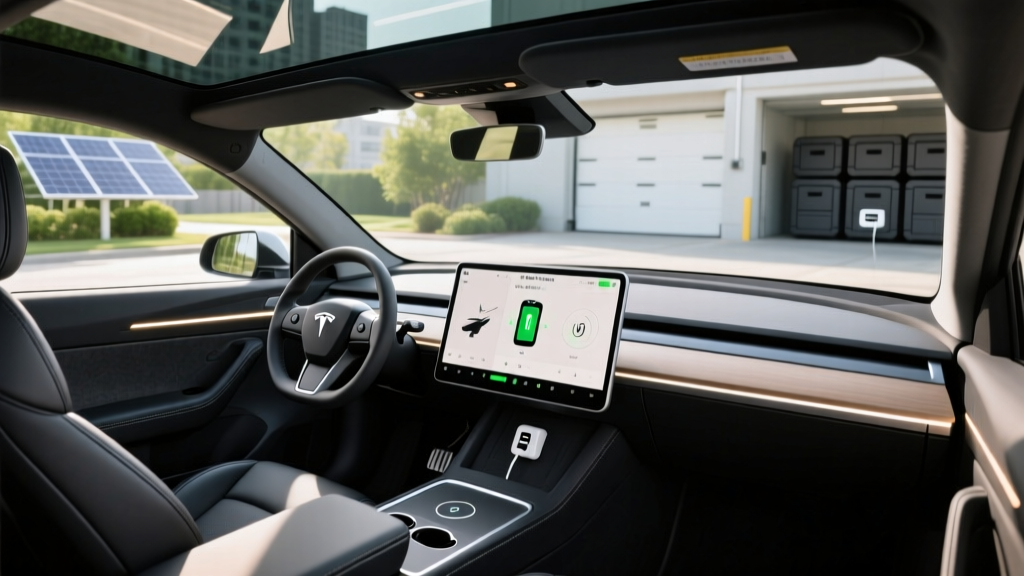
The 2026 Model 3 interior is minimalist to a fault. A single 15.4-inch center touchscreen handles all infotainment, climate, and vehicle controls — there is no instrument cluster, no head-up display, and no physical buttons for turn signals (they're on the steering wheel rim, which remains controversial). Rear-seat passengers get a small 8-inch screen for climate and media control.
Cargo capacity is 23 cubic feet total (trunk plus front trunk/frunk), which trails the Model Y significantly but is competitive with the Ioniq 6. Rear legroom is 35.3 inches — adequate for adults on shorter trips, but taller passengers will find the sloping roofline cuts into headroom.
Now, regarding the headline: Tesla purchased a mystery AI hardware firm for billions. While Tesla has not disclosed the specific integration timeline for consumer vehicles, the acquisition is widely expected to accelerate the development of HW5 (and potentially HW6) inference chips. The current HW4 computer, present in all 2026 Model 3 and Model Y vehicles, already delivers substantial processing headroom for Tesla's neural-net-based vision system.
Important SAE Level Clarification: Tesla Autopilot and Full Self-Driving (Supervised) are classified as SAE Level 2 driver-assistance systems. The driver must remain fully attentive, with hands on the wheel (or torque applied) and eyes on the road at all times. These are not autonomous or self-driving systems. Level 4 driverless operation (no human needed) is currently only available through commercial robotaxi services like Waymo in select geofenced areas.
The 2026 Model 3 ships with Tesla's latest FSD (Supervised) software, which can navigate highway on-ramps to off-ramps, handle lane changes, and manage city intersections. However, it still requires active supervision and occasionally makes conservative or erratic decisions in construction zones and unprotected left turns. The $8,000 FSD purchase (or $99/month subscription) is a personal calculus — some owners find it reduces fatigue on long highway stretches; others find it adds stress from monitoring unpredictable behavior.
Pricing, Tax Credits, and Ownership Cost
| Trim | MSRP | Est. Federal Credit (§30D) | Effective Price |
|---|---|---|---|
| Model 3 RWD | $38,990 | Up to $7,500* | ~$31,490 |
| Model 3 Long Range AWD | $47,740 | Up to $7,500* | ~$40,240 |
| Model 3 Performance | $53,740 | Up to $7,500* | ~$46,240 |
*Federal tax credit eligibility under IRS §30D depends on buyer income (≤$150K single / ≤$300K joint), vehicle MSRP (must be ≤$55,000 for sedans), battery critical-mineral and component sourcing requirements, and point-of-sale transfer elections. Credit amount varies. Consult IRS.gov clean vehicle credits and a tax professional for your specific situation.
The 2026 Model 3 Long Range AWD at $47,740 falls under the $55,000 MSRP cap for sedans, making it potentially eligible for the full $7,500 federal tax credit — provided the buyer meets income thresholds and the vehicle's battery satisfies critical-mineral and North American component sourcing requirements (which Tesla has largely achieved through its supply chain restructuring and domestic cell production with Panasonic at Giga Nevada).
As of 2026, the §30D credit can be transferred to the dealer at point of sale, effectively reducing your purchase price at delivery rather than waiting for a tax refund. This is a significant cash-flow advantage for buyers who don't want to float $7,500 until April of the following year.
Insurance costs for the Model 3 remain above segment average — expect $1,800-$2,600 annually depending on your state, driving record, and age. Tesla's own insurance product (available in most states) uses real-time driving data to set premiums and can be 15-25% cheaper for clean-record drivers, though it has mixed reviews for claims handling.
Pros and Cons
Pros
- Class-leading efficiency (25 kWh/100 mi) and 341-mile EPA range
- Supercharger network reliability and native NACS connector
- Over-the-air updates continuously add features and refinements
- Strong 8-year/120,000-mile battery warranty
- Point-of-sale tax credit transfer reduces upfront cost
- Low running cost: ~$0.04-$0.08/mile on home electricity
Cons
- Turn signals on steering wheel rim (not a stalk) frustrate many drivers
- No instrument cluster or HUD — all info on center screen
- Ride quality still firm compared to European rivals
- FSD (Supervised) requires constant vigilance; not autonomous
- Insurance premiums above average for the segment
- Rear headroom limited by sloping roofline
Who Should Buy the 2026 Model 3 Long Range?
Choose the Model 3 Long Range AWD if: You want maximum range and efficiency in a sedan form factor, value Supercharger network access for road trips, and are comfortable with a minimalist, screen-centric interior. It's ideal for tech-forward commuters and couples without large cargo needs.
Look elsewhere if: You need SUV-level cargo space (consider the Model Y), prefer traditional controls and a plush ride (BMW i4, Hyundai Ioniq 6), or want genuine autonomous driving capability (not available from any consumer automaker as of 2026).
For families needing more space, the 2026 Model Y shares the same platform with significantly more cargo volume (up to 76 cu ft with seats folded) and optional third-row seating, though at a higher MSRP and with slightly lower range.
Frequently Asked Questions
What is the real-world range of the 2026 Tesla Model 3 Long Range?
The EPA estimates 341 miles, but real-world highway driving at 70-75 mph typically yields 280-300 miles. In cold weather (below 32°F), expect 230-260 miles. City and suburban commuting with regenerative braking gets closest to the EPA sticker, around 310-330 miles.
How fast does the Model 3 Long Range charge?
On a V3 Supercharger (250 kW peak), the 10-80% session takes approximately 27 minutes with a preconditioned battery. At home on a Level 2 Wall Connector (11.5 kW), you'll add about 44 miles per hour, with a full charge taking roughly 8.5 hours.
Does the 2026 Model 3 qualify for the federal EV tax credit?
The Model 3 Long Range AWD ($47,740 MSRP) is under the $55,000 sedan cap and is potentially eligible for up to $7,500 under §30D, subject to buyer income limits ($150K single / $300K joint AGI), battery sourcing requirements, and point-of-sale transfer rules. Always verify current eligibility on IRS.gov before purchasing.
How does Tesla's AI hardware acquisition affect current vehicles?
The 2026 Model 3 ships with HW4, which is the current-generation inference platform. The acquired firm's technology is expected to influence future HW5/HW6 silicon, likely debuting in 2027-2028 model-year vehicles. Current owners should not expect retroactive hardware upgrades, though OTA software improvements will continue.
Is the Model 3 Long Range worth buying over competitors?
Against the Hyundai Ioniq 6 (361-mile EPA, ~$46,000), the Model 3 trades slightly less range for Supercharger network access and more mature software. Against the BMW i4 xDrive40 (~307 miles, ~$57,000), the Tesla is significantly less expensive but offers a less refined interior. The Model 3 remains the efficiency and value benchmark, while competitors win on comfort and traditional ergonomics.
What is the battery warranty on the 2026 Model 3?
Tesla covers the battery and drive unit for 8 years or 120,000 miles (whichever comes first) with a minimum 70% capacity retention threshold. If the battery degrades below 70% state of health within the warranty period, Tesla will repair or replace it at no cost.