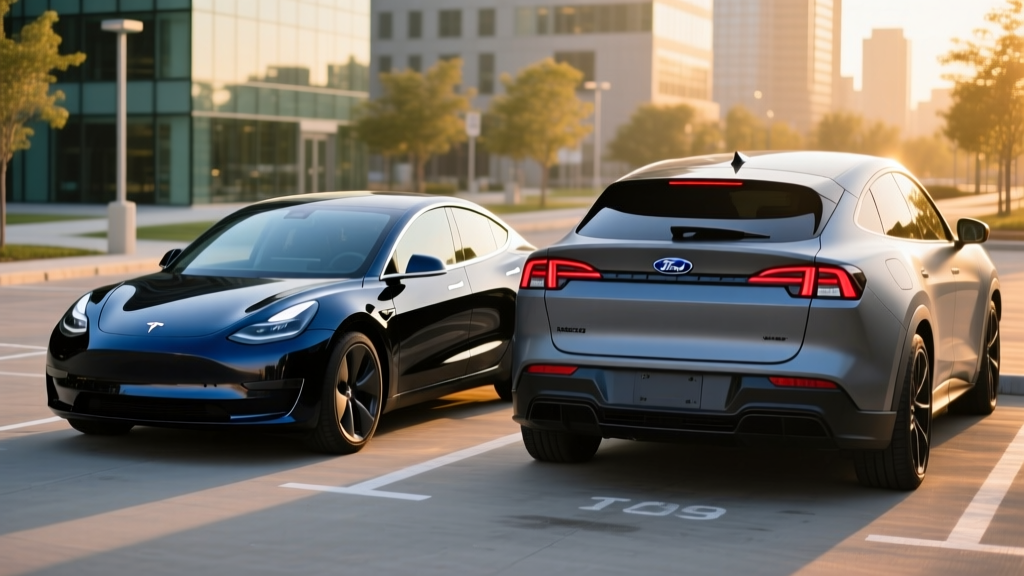
If your EV search history includes the phrase "tesla mustang", you're almost certainly weighing two of the most popular electric sedans/crossovers on the market: the Tesla Model 3 and the Ford Mustang Mach-E. Both have been refined heavily through the 2025 and 2026 model years, both compete in the $40,000–$55,000 bracket, and both offer compelling but distinctly different ownership experiences.
This head-to-head comparison cuts through marketing to give you exact EPA range figures, real-world charging curves, tax-credit eligibility under current IRS §30D rules, and the ownership practicalities that spec sheets leave out. Whether you're drawn to Tesla's Supercharger network or Ford's more traditional dealer-and-build quality approach, the numbers below will clarify which EV actually fits your life.
Side-by-Side Specs: Model 3 vs Mustang Mach-E at a Glance
| Specification | 2026 Tesla Model 3 Long Range AWD | 2026 Ford Mustang Mach-E Premium AWD (Extended Range) |
|---|---|---|
| EPA Range | 341 miles | 320 miles |
| Battery Capacity (usable) | 79 kWh (NMC) | 91 kWh (NMC) |
| Efficiency | 132 MPGe / 25 kWh/100mi | 101 MPGe / 33 kWh/100mi |
| Max DC Fast Charge | 250 kW (peak) | 150 kW (peak) |
| 10–80% DC Charge Time | ~25 minutes | ~36 minutes |
| Level 2 Home Charge Rate | 11.5 kW (~44 mi/hr) | 10.5 kW (~32 mi/hr) |
| 0–60 mph | 4.2 seconds | 5.1 seconds |
| Horsepower | 346 hp (dual motor) | 312 hp (dual motor) |
| Drivetrain | AWD (dual motor) | AWD (dual motor) |
| Cargo Volume | 23 cu ft (rear) + 3 cu ft (frunk) | 29.7 cu ft (rear) + 4.7 cu ft (frunk) |
| Rear Legroom | 35.3 inches | 38.1 inches |
| Base MSRP | $47,740 | $51,875 |
| Battery/Powertrain Warranty | 8 yr / 120,000 mi | 8 yr / 100,000 mi |
Sources: fueleconomy.gov, Tesla and Ford manufacturer spec sheets for 2026 model year.
Real-World Range: What the EPA Sticker Doesn't Tell You
Tesla Model 3 LR AWD: EPA 341 mi → Expect ~285–310 mi on sustained highway driving at 70–75 mph; ~240–260 mi in sub-30°F winter conditions.
Mustang Mach-E Premium AWD ER: EPA 320 mi → Expect ~265–290 mi highway; ~220–245 mi in freezing weather.
The Model 3's efficiency advantage is substantial: it extracts roughly 25% more miles from each kilowatt-hour than the Mach-E. That means even with a smaller 79 kWh battery versus Ford's 91 kWh pack, the Tesla delivers more range. On a 300-mile road trip in mild weather, the Model 3 arrives with cushion to spare. The Mach-E can do the same trip but with less margin, particularly if you're driving into headwinds or climbing elevation.
Cold weather hits both vehicles, but the Mach-E's larger battery provides a slightly bigger absolute buffer. Tesla's heat pump (standard on all 2026 Model 3 trims) is more efficient at cabin heating than Ford's system, which translates to less range sacrificed to keeping you warm in winter. If you live in Minnesota or Maine, preconditioning while plugged in is non-negotiable for both vehicles — but the Model 3's thermal management system has a longer track record of reliability.
Charging Speed: Where the Gap Widens
| Charging Level | Tesla Model 3 LR | Ford Mustang Mach-E Premium ER |
|---|---|---|
| Level 1 (120V / 12A) | ~1.4 kW (~4 mi/hr) | ~1.4 kW (~3 mi/hr) |
| Level 2 (240V / 48A) | 11.5 kW (~44 mi/hr) | 10.5 kW (~32 mi/hr) |
| DC Fast Charge (peak) | 250 kW | 150 kW |
| DC 10–80% Time | ~25 min | ~36 min |
| DC Sustained Rate (10–50%) | ~200 kW avg | ~130 kW avg |
| Connector (2026) | NACS (native) | NACS (native, 2025+) |
This is where the Tesla vs Mustang comparison becomes most consequential for road-trippers. The Model 3's 250 kW peak charge rate isn't just a spec-sheet number — it reflects a sustained charging curve that holds above 200 kW through roughly 50% State of Charge before tapering. In practical terms, you'll add 175+ miles of range in 15 minutes at a V3 or V4 Supercharger.
The Mach-E peaks at 150 kW and tapers more aggressively above 60% SoC. That 36-minute 10–80% charge means longer stops on road trips. Over a 1,000-mile journey with three charging stops, you're looking at roughly 30 extra minutes total in the Ford. For daily driving and overnight Level 2 home charging, this gap matters far less — both vehicles fully replenish overnight on a 48-amp home charger.
Starting with the 2025 model year, Ford equipped the Mach-E with a native NACS charge port, giving it direct access to Tesla's Supercharger network without an adapter. This eliminated one of Tesla's biggest historical advantages. However, Supercharger reliability and availability remain denser in most corridors, and Tesla's integrated navigation-to-charger preconditioning still works more seamlessly than Ford's system.
Pricing, Trims, and Federal Tax Credit Eligibility
| Cost Factor | 2026 Tesla Model 3 LR AWD | 2026 Ford Mustang Mach-E Premium AWD ER |
|---|---|---|
| Base MSRP | $47,740 | $51,875 |
| As-Tested (typical options) | $49,240 (w/ FSD transfer, paint) | $54,500 (w/ BlueCruise, panoramic roof) |
| Federal §30D Credit Eligibility | Up to $7,500 | Up to $7,500 |
| Estimated Price After Credit | ~$40,240 | ~$44,375 |
| MSRP Cap Compliance | Under $55,000 sedan cap ✓ | Under $80,000 SUV/truck cap ✓ |
Both vehicles can qualify for the full $7,500 federal EV tax credit under IRS §30D rules — but eligibility is not automatic. Here's the checklist:
- Income caps: Modified AGI must not exceed $150,000 (single), $225,000 (head of household), or $300,000 (joint filing).
- MSRP caps: The Model 3 qualifies under the $55,000 sedan cap. The Mach-E qualifies under the $80,000 SUV/truck cap (it's classified as an SUV by the IRS).
- Battery sourcing: Both vehicles have met critical mineral and battery component requirements for the full credit as of the 2026 model year, but supply-chain shifts can alter eligibility mid-year. Always verify on fueleconomy.gov before purchasing.
- Point-of-sale transfer: You can now transfer the credit to the dealer at purchase, reducing your out-of-pocket cost immediately rather than waiting for tax filing.
The Model 3's lower base price combined with comparable credit eligibility gives it a roughly $4,000 cost advantage after incentives. However, Ford frequently offers lease deals and loyalty incentives that can narrow or close this gap.
Driving Experience, Tech, and Interior Quality
The Model 3's "Highland" refresh (introduced for 2024, carried forward to 2026) addressed many historical complaints: cabin noise is dramatically reduced, the suspension is more compliant, ventilated front seats are standard, and rear passengers now have an 8-inch touchscreen. The minimalist interior is polarizing — there are no physical stalks (turn signals are on the steering wheel rim) and no instrument cluster. Everything routes through the 15.4-inch center display.
The Mach-E takes a more traditional approach: a 10.2-inch digital instrument cluster behind the wheel, a large 15.5-inch vertical center touchscreen with SYNC 4A, physical buttons for climate and drive modes, and available Ford BlueCruise hands-free driving on pre-mapped highways. The cabin materials feel more substantial — soft-touch surfaces, real stitching, and a more conventional SUV seating position that appeals to crossover buyers transitioning from ICE vehicles.
Tesla Autopilot / FSD (Supervised) and Ford BlueCruise are both SAE Level 2 driver-assistance systems. Neither is self-driving. Both require continuous driver supervision, hands-on-wheel (or eyes-on-road for BlueCruise) engagement, and immediate takeover readiness. Only Level 4 services like Waymo operate without a driver in the loop.
Tesla's FSD (Supervised) remains a $8,000 option (or $99/month subscription as of 2026) and offers impressive point-to-point capability on mapped roads, but still requires active monitoring and occasional intervention. Ford's BlueCruise is more geofenced (limited to ~130,000 miles of pre-mapped divided highways) but offers genuinely hands-free operation within those zones, with a driver-facing camera confirming attention.
Practicality: Cargo, Passenger Space, and Daily Use
The Mach-E wins the practicality contest for families. Its 29.7 cu ft of rear cargo space (expandable to 59.7 cu ft with seats folded) and 38.1 inches of rear legroom make it a genuine compact SUV competitor. The 4.7 cu ft frunk includes a drain plug — useful for tailgating or storing wet gear.
The Model 3 is a sedan, and it shows. Rear legroom at 35.3 inches is adequate for adults on shorter trips but tight for taller passengers on long journeys. The 23 cu ft trunk is deep but narrow, and the 3 cu ft frunk is small. For couples or small families who don't regularly haul cargo, it's fine. For those who do, the Mach-E's hatchback versatility is a clear advantage.
Both vehicles offer a full glass roof (Model 3 standard, Mach-E available as a panoramic option), wireless phone charging, and multiple USB-C ports. The Mach-E's available power liftgate and hands-free foot-activation are practical touches the Model 3 lacks.
Pros and Cons: The Honest Summary
- Best-in-class efficiency (132 MPGe)
- 250 kW fast charging with excellent sustained curve
- Supercharger network reliability (native NACS)
- Lower base price; strong resale value
- Over-the-air updates continuously add features
- 8-year/120,000-mile battery warranty
- Minimalist interior not for everyone
- No physical turn-signal stalks
- Tighter rear seat and cargo space
- FSD costs extra and isn't truly autonomous
- Service center availability varies by region
- No Apple CarPlay / Android Auto
- SUV versatility: 29.7 cu ft cargo, roomy rear seat
- Conventional controls ease the EV transition
- BlueCruise hands-free on mapped highways
- Apple CarPlay / Android Auto standard
- Ford dealer network for service nationwide
- Native NACS port (2025+) for Supercharger access
- Higher base price ($4,135 more than Model 3)
- Slower DC fast charging (150 kW vs 250 kW)
- Lower efficiency (101 MPGe vs 132 MPGe)
- Shorter battery warranty (100K vs 120K miles)
- Higher electricity cost per mile over ownership
- Depreciation steeper than Tesla historically
Who Should Buy Which?
Choose the Tesla Model 3 if:
- You prioritize range efficiency and lowest cost-per-mile
- You take regular road trips and value fast DC charging
- You prefer a sedan driving position and sporty handling
- You're comfortable with a screen-centric interface
- You want the lowest total cost of ownership over 5 years
- You need SUV cargo space and rear-seat room for family
- You prefer traditional controls and a digital instrument cluster
- You want Apple CarPlay or Android Auto integration
- You value hands-free BlueCruise on highway commutes
- You want Ford dealer service access in your area
Frequently Asked Questions
What is the real-world range of the Tesla Model 3 vs Mustang Mach-E?
The Model 3 Long Range AWD delivers an EPA-estimated 341 miles, but expect 285–310 miles in real-world highway driving and 240–260 miles in freezing weather. The Mach-E Premium AWD Extended Range is EPA-rated at 320 miles, with real-world highway driving yielding 265–290 miles and winter conditions reducing that to 220–245 miles. The Tesla's superior efficiency gives it a consistent advantage.
How fast does each EV charge at home and on the road?
At home on a 48-amp Level 2 charger, the Model 3 adds about 44 miles of range per hour (11.5 kW), while the Mach-E adds about 32 miles per hour (10.5 kW). On DC fast chargers, the Model 3 peaks at 250 kW and charges from 10–80% in roughly 25 minutes. The Mach-E peaks at 150 kW and takes about 36 minutes for the same session — an 11-minute gap that compounds on long road trips.
How much do these EVs cost after the federal tax credit?
The Model 3 Long Range AWD starts at $47,740 and can drop to approximately $40,240 with the full $7,500 §30D credit. The Mach-E Premium AWD Extended Range starts at $51,875 and falls to roughly $44,375 with the credit. Eligibility depends on your income (caps at $150K single / $300K joint), the vehicle's MSRP classification, and battery-sourcing compliance — always verify current status at fueleconomy.gov and consult a tax professional.
Is the Tesla Model 3 or Mustang Mach-E worth buying over the other?
It depends on your priorities. If efficiency, charging speed, and lower total cost of ownership matter most, the Model 3 is the stronger pick. If you need SUV practicality, prefer conventional controls, and want Apple CarPlay, the Mach-E is the better fit. Neither is a wrong choice — they serve different use cases well.
Does the Mustang Mach-E qualify for the same federal tax credit as Tesla?
Yes, both vehicles are eligible for up to $7,500 under the §30D credit as of the 2026 model year, provided you meet income limits and the vehicle's battery-sourcing requirements are satisfied. The Mach-E benefits from the higher $80,000 SUV MSRP cap, while the Model 3 must stay under the $55,000 sedan cap. Both currently qualify, but sourcing rules can shift — check before you buy.
Which EV has better long-term battery reliability?
Tesla's battery warranty covers 8 years or 120,000 miles (whichever comes first) with a 70% minimum capacity retention guarantee. Ford covers 8 years or 100,000 miles at the same 70% threshold. Tesla has more high-mileage fleet data publicly available, and its NMC chemistry has demonstrated strong longevity. Ford's larger battery means it may show less noticeable degradation in absolute range over time, since you're cycling through a smaller percentage of total capacity for the same daily mileage.