Why Tesla Music Streaming Matters to EV Owners
For many Tesla owners, the infotainment system is as important as the powertrain. Unlike legacy automakers that rely on Apple CarPlay and Android Auto, Tesla built its media ecosystem from scratch — integrating streaming services directly into the vehicle's central touchscreen. If you're considering a Tesla in 2026 or already own one, understanding how Tesla music streaming works — what services are supported, what connectivity you need, and how it compares to phone-mirroring systems — is essential for daily satisfaction behind the wheel.
This guide covers the full Tesla music streaming landscape for the 2026 Model 3 and Model Y (Tesla's highest-volume vehicles), while also grounding you in the real-world ownership specs that matter: range, charging, pricing, and tax credit eligibility.
Supported Music Services in Tesla Vehicles (2026)
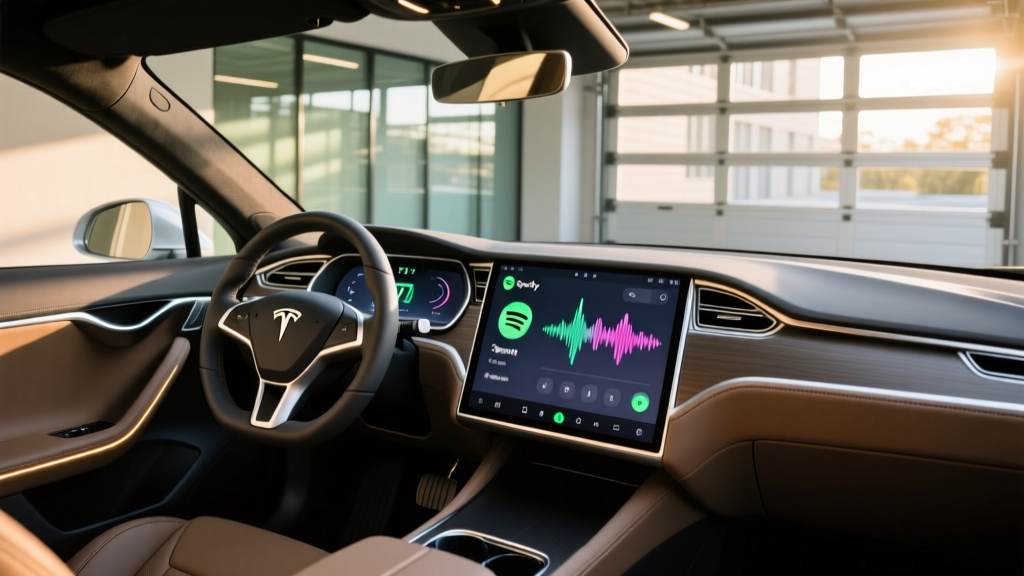
Tesla's infotainment system supports several streaming platforms natively — no phone required. Here's the current lineup:
- Spotify — Full integration with Premium Connectivity. Browse playlists, search artists, and control playback directly from the touchscreen. Free Spotify accounts work over Bluetooth from a phone.
- Tidal — Added in recent software updates, Tidal offers lossless and hi-res audio streaming natively in Tesla vehicles with Premium Connectivity.
- TuneIn — Internet radio with thousands of stations, available with Premium Connectivity.
- Tesla Toybox / Media Player — USB drive playback for FLAC, MP3, and other local audio files.
- Bluetooth Audio — Any service on your phone (Apple Music, YouTube Music, Amazon Music, podcasts) can stream via Bluetooth to the car's speakers.
What's missing: Apple Music does not have native Tesla integration in 2026. Apple Music users must rely on Bluetooth streaming from an iPhone, which means no steering-wheel or touchscreen control of playlists — only play/pause and skip. This remains one of the most common complaints among iPhone-carrying Tesla owners.
Premium Connectivity: The Key to In-Car Streaming
Tesla music streaming over cellular requires Premium Connectivity, a subscription service priced at $9.99/month or $99/year (2026 pricing). Without it, streaming services only work when the vehicle is connected to Wi-Fi (e.g., your home network or a mobile hotspot).
Premium Connectivity also enables:
- Live traffic visualization and satellite maps
- Video streaming (Netflix, YouTube, Disney+) while parked
- Arcade gaming while parked
- Sentry Mode live camera access via the Tesla app
- Dashcam clip viewing remotely
New Tesla vehicles typically include a 30-day trial of Premium Connectivity. After that, it's up to you whether the music streaming and data features justify the cost. For most owners who stream music daily during commutes, the $10/month is a worthwhile convenience upgrade over managing Bluetooth pairing every trip.
Tesla Audio Hardware: What You're Listening Through
Sound quality is a meaningful part of the music streaming experience. Tesla offers two audio configurations depending on trim:
| Feature | Standard Audio | Premium Audio |
|---|---|---|
| Speakers | 9 speakers | 15 speakers (Model 3) / 14 speakers (Model Y) |
| Subwoofer | None | Dual subwoofers |
| Amplifier | Standard | Dedicated multi-channel amplifier |
| Immersive Sound | No | Yes (customizable) |
| Availability | Base RWD trims | Long Range, Performance trims |
The Premium Audio system is one of the best factory-installed audio setups in any vehicle under $60,000. If music quality matters to you — especially for lossless Tidal streams or high-bitrate Spotify — spec a Long Range or Performance trim to get it. The base RWD audio is adequate for podcasts and casual listening but lacks the depth and staging audiophiles expect.
2026 Tesla Model 3 & Model Y: Core EV Specs
Music streaming is just one part of ownership. Here are the numbers that define daily life with a 2026 Model 3 or Model Y:
| Spec | Model 3 Long Range AWD | Model Y Long Range AWD |
|---|---|---|
| EPA Range | 341 miles | 320 miles |
| Battery Capacity (usable) | ~79 kWh (NMC) | ~79 kWh (NMC) |
| Drivetrain | Dual-Motor AWD | Dual-Motor AWD |
| Horsepower | ~384 hp | ~384 hp |
| 0-60 mph | 4.2 seconds | 4.8 seconds |
| MPGe (combined) | 132 MPGe | 122 MPGe |
| Efficiency | 25 kWh/100 mi | 28 kWh/100 mi |
| Max DC Fast Charge | 250 kW (CCS/NACS) | 250 kW (CCS/NACS) |
| 10-80% DC Charge Time | ~27 minutes | ~27 minutes |
| Level 2 Home Charging | 11.5 kW (~44 mi/hr) | 11.5 kW (~44 mi/hr) |
| Cargo Volume | 23 cu ft (rear) + frunk | 76 cu ft (rear folded) + frunk |
| Rear Legroom | 35.2 inches | 40.5 inches |
| Battery Warranty | 8 yr / 120,000 mi | 8 yr / 120,000 mi |
Charging Speed: DC Fast Charging & Home Setup
Both the Model 3 and Model Y use the NACS (North American Charging Standard) connector natively — no adapter needed at Tesla Superchargers. Both also support CCS1 via the included adapter for Electrify America, EVgo, and other networks.
| Level | Power | Speed | Typical Use |
|---|---|---|---|
| Level 1 (120V) | ~1.4 kW | ~3-4 miles/hour | Emergency / overnight trickle |
| Level 2 (240V, 48A) | 11.5 kW | ~44 miles/hour | Home daily charging (Wall Connector) |
| DC Fast (Supercharger V3) | Up to 250 kW peak | 10-80% in ~27 min | Road trips |
| DC Fast (V4 Supercharger) | Up to 250 kW (current vehicles) | Similar to V3 | Newer Supercharger stations |
Charging curve reality: The 250 kW peak only applies between roughly 10-30% State of Charge. Above 50%, the rate tapers significantly, and above 80% it slows to under 40 kW. This is why Tesla's navigation system recommends charging to 80% on road trips — the time penalty from 80-100% is substantial. For daily use, Tesla recommends setting the charge limit to 80% to preserve long-term battery health with NMC chemistry.
Autopilot & Driver Assistance: What You Get
Every 2026 Tesla includes Basic Autopilot as standard equipment:
- Traffic-Aware Cruise Control
- Autosteer (lane-centering on marked highways)
- Automatic Emergency Braking
- Blind-spot monitoring and lane-departure warning
Pricing, Trims & Federal Tax Credit (2026)
Here's what you'll actually pay for a 2026 Model 3 or Model Y:
| Trim | Base MSRP | Federal §30D Credit | Effective Price |
|---|---|---|---|
| Model 3 RWD | $38,990 | $3,750 (partial)* | ~$35,240 |
| Model 3 Long Range AWD | $45,740 | $3,750 (partial)* | ~$41,990 |
| Model 3 Performance | $52,990 | $3,750 (partial)* | ~$49,240 |
| Model Y Long Range AWD | $44,990 | $3,750 (partial)* | ~$41,240 |
| Model Y Performance | $48,990 | $3,750 (partial)* | ~$45,240 |
*Critical tax credit note: Under IRS §30D rules, the federal EV tax credit for 2026 is split into two components: $3,750 for critical minerals and $3,750 for battery component sourcing. Tesla vehicles currently qualify for the $3,750 critical minerals half but have not met the battery component sourcing threshold for the full $7,500. Additionally:
- Income caps: Modified AGI must not exceed $150,000 (single), $225,000 (head of household), or $300,000 (joint).
- MSRP caps: Sedans (Model 3) must be under $55,000; SUVs/trucks/vans (Model Y) must be under $80,000.
- Point-of-sale transfer: You can transfer the credit to the dealer at purchase, reducing your out-of-pocket cost immediately rather than waiting for a tax refund.
Always verify current eligibility on fueleconomy.gov before purchasing, as sourcing requirements and eligible amounts change periodically.
Pros, Cons & Who Should Buy
- Best-in-class Supercharger network — 65,000+ stalls globally
- NACS connector natively — no adapters for the largest fast-charging network
- Over-the-air updates continuously add features
- Class-leading efficiency (kWh/100 mi)
- Native Spotify, Tidal, and TuneIn streaming
- Premium Audio system is exceptional for the price
- Strong resale value relative to most EVs
- No Apple CarPlay or Android Auto — ever
- No native Apple Music integration (Bluetooth only)
- FSD (Supervised) is expensive and still Level 2
- Minimalist interior lacks physical buttons for climate/media
- Panel gaps and build consistency still lag German/Japanese rivals
- Only $3,750 federal credit (not the full $7,500)
- Insurance premiums often higher than comparable EVs
- Choose Model 3 if you prioritize efficiency, lower price, and sporty driving dynamics. Ideal for solo commuters and couples without large cargo needs.
- Choose Model Y if you need rear seat space (40.5" legroom), cargo volume (76 cu ft), or plan family road trips. The higher seating position and hatchback utility make it the pragmatic choice.
- Look elsewhere if you depend on Apple CarPlay, want native Apple Music, prefer physical dashboard controls, or need the full $7,500 tax credit to justify the purchase.
How Tesla Music Streaming Compares to CarPlay/Android Auto
The absence of Apple CarPlay and Android Auto is Tesla's most polarizing decision. Here's a practical comparison:
| Factor | Tesla Native | CarPlay / Android Auto |
|---|---|---|
| Service variety | Spotify, Tidal, TuneIn, USB | Any app on your phone |
| Apple Music | Bluetooth only (no touchscreen control) | Full native integration |
| Phone dependency | None (streams over cellular) | Phone must be connected |
| Touchscreen control | Full browse, search, playlist management | Limited to CarPlay-safe interface |
| Audio quality | High (Tidal lossless supported) | Varies by phone Bluetooth codec |
| Steering wheel controls | Full play/pause/skip/voice | Full (when connected) |
If you're a Spotify or Tidal subscriber, Tesla's native system is arguably better than CarPlay — you get full touchscreen browsing without phone dependency. But if you're deeply invested in Apple Music or YouTube Music, the Bluetooth-only workaround is a genuine daily frustration. Many Apple Music users report keeping a dedicated Android phone in the car purely for USB-based streaming — a workaround that shouldn't be necessary in a $45,000+ vehicle.
Frequently Asked Questions
Can I use Apple Music in a Tesla?
Not natively. Apple Music does not have a Tesla app as of 2026. You can stream Apple Music via Bluetooth from your iPhone, but you won't get touchscreen playlist browsing or steering-wheel track control beyond play/pause and skip. This is the single biggest infotainment gap for iPhone users.
Does Tesla music streaming use my phone's data?
No — if you have Premium Connectivity ($9.99/month), music streams over the car's built-in cellular connection. Without Premium Connectivity, you need to connect the car to Wi-Fi (home network or phone hotspot) to use native streaming apps.
Is Tidal on Tesla worth it for audio quality?
If you have the Premium Audio system (Long Range or Performance trims), yes. Tidal's lossless streams sound noticeably better through Tesla's 15-speaker setup with dual subwoofers. Through the base 9-speaker system, the difference is less perceptible.
How much does it cost to charge a Tesla at home vs. Supercharging?
At the US average residential electricity rate of ~$0.17/kWh, fully charging a Model 3 Long Range (~79 kWh) costs roughly $13.40 for 341 miles of range. Supercharger pricing varies by location and time of day but averages $0.28-$0.35/kWh, making a full charge roughly $22-$28. Home charging is significantly cheaper and more convenient for daily use.
What is the real-world range of the 2026 Model 3 Long Range?
EPA-rated at 341 miles. In real-world highway driving at 70-75 mph, expect 280-300 miles. In cold weather (under 30°F), plan for 230-260 miles. City driving with regenerative braking can sometimes exceed the EPA estimate.
Does the 2026 Tesla Model Y qualify for the full $7,500 federal tax credit?
No. As of 2026, Tesla vehicles qualify for the $3,750 critical minerals portion of the §30D credit but not the battery component portion. The Model Y's MSRP (under $80,000 for all trims) and buyer income caps still apply. Verify current eligibility at irs.gov before purchasing.
Is a Tesla worth buying vs. a Hyundai Ioniq 5 or Ford Mustang Mach-E?
Tesla wins on charging network access (Superchargers are the most reliable DC network in the US), efficiency, and software. The Ioniq 5 offers faster 10-80% charging (18 min on 350 kW chargers), CarPlay/Android Auto, and a more comfortable ride. The Mach-E provides more traditional SUV styling and Ford dealer service access. If road-trip charging reliability is your top priority, Tesla still leads. If infotainment flexibility (CarPlay) and ride comfort matter more, the Ioniq 5 is a strong alternative.
Sources: fueleconomy.gov (EPA range and MPGe data), IRS §30D Clean Vehicle Credit rules, Tesla official specifications. All pricing and credit eligibility reflects 2026 model year and current IRS guidance — verify before purchase.