Quick Verdict: The Austin-Built Tesla Model Y in 2026
When Elon Musk announced Tesla moving to Texas in late 2021, it was more than a corporate relocation — it signaled a manufacturing pivot that now directly affects what EV buyers drive home today. By 2026, the Tesla Model Y rolling out of Giga Texas is the volume seller for the brand, and its Austin production footprint has introduced meaningful changes in battery sourcing, trim availability, and pricing.
For buyers, the headline is this: the 2026 Model Y Long Range AWD delivers an EPA-estimated 320 miles of range, peaks at 250 kW on DC fast chargers, and starts at $44,990 before incentives. But the Texas-built story adds nuance — particularly around federal tax credit eligibility, LFP battery availability in the Standard Range trim, and real-world efficiency that diverges from the sticker. Let's break down exactly what you're getting.
| Spec | Value |
|---|---|
| EPA Range | 320 miles |
| Battery (usable) | ~75 kWh, NMC (Long Range) / ~60 kWh LFP (Standard Range) |
| Drivetrain | Dual-motor AWD (Long Range) / RWD (Standard Range) |
| Horsepower | 384 hp (Long Range AWD) |
| 0–60 mph | 4.8 seconds (Long Range AWD) |
| Max DC Fast Charge | 250 kW (peak) |
| 10–80% DC Charge Time | ~27 minutes |
| Level 2 Home Charge Rate | 11.5 kW (~44 mi/hr) |
| MPGe (combined) | 117 MPGe |
| Efficiency | 28 kWh/100 mi |
| Cargo Volume (rear seats up) | 30.2 cu ft |
| Cargo Volume (rear seats folded) | 72.0 cu ft |
| Base MSRP (Long Range AWD) | $44,990 |
| Base MSRP (Standard Range RWD) | $36,490 |
| Battery Warranty | 8 yr / 120,000 mi (Long Range) · 8 yr / 100,000 mi (Standard Range) |
Range and Efficiency: EPA Sticker vs. Real-World Texas Roads
EPA Estimate: 320 miles (Long Range AWD) · 260 miles (Standard Range RWD)
Real-World Expectation: Plan for 270–290 miles on mixed highway/city driving at 70–80 mph in moderate temps. In sustained cold (below 30°F), expect a 15–25% reduction — roughly 240–270 miles effective. Stop-and-go city driving with heavy regen can actually exceed the EPA number, hitting 330+ miles in mild conditions.
The EPA's fueleconomy.gov listing confirms the 320-mile figure for the Long Range, but Tesla's efficiency advantage has always been in its thermal management and drivetrain integration. The Model Y's heat pump — standard across all trims — recovers waste heat from the motors and battery to warm the cabin, reducing the winter range penalty compared to resistive-heating EVs.
That said, the 28 kWh/100 mi combined efficiency figure means you're consuming roughly 0.28 kWh per mile. At the national average electricity rate of ~$0.16/kWh, that's about $0.045 per mile — roughly one-third the per-mile cost of a 25 MPG gas vehicle at $3.50/gallon. Texas drivers covering 15,000 miles/year would spend approximately $675 on home charging versus $2,100 on gasoline.
Charging Speed: DC Fast, Level 2, and the Supercharger Advantage
| Charging Level | Power / Rate | Miles Added per Hour | Typical Use Case |
|---|---|---|---|
| Level 1 (120V household) | ~1.4 kW | ~5 mi/hr | Emergency / overnight trickle |
| Level 2 (240V home, 48A) | 11.5 kW | ~44 mi/hr | Daily home charging |
| DC Fast (Tesla Supercharger V3) | 250 kW peak | ~1,000 mi/hr (peak) | Road trips, 10–80% in ~27 min |
| DC Fast (CCS adapter, non-Tesla) | Up to 150–175 kW | Varies by station | Electrify America, EVgo networks |
The Model Y's 250 kW peak DC fast-charge rate is competitive but no longer class-leading — vehicles on 800V architectures (Hyundai Ioniq 5, Kia EV6, Porsche Taycan) can sustain higher rates longer. Tesla's charge curve is front-loaded: you'll see 250 kW only between roughly 10–30% State of Charge (SoC), tapering to ~150 kW by 50% and below 60 kW past 80%. This is physics, not a flaw — lithium-ion cells accept charge more slowly as they fill to prevent lithium plating.
The practical takeaway: precondition the battery (the car does this automatically when you navigate to a Supercharger) and plan to charge from 10–80%, not 0–100%. Charging from 80–100% at a DC fast charger adds 30+ minutes for only ~60 miles of range. For daily driving, home Level 2 at 11.5 kW replenishes a full battery in roughly 7 hours — plug in when you get home, wake up full.
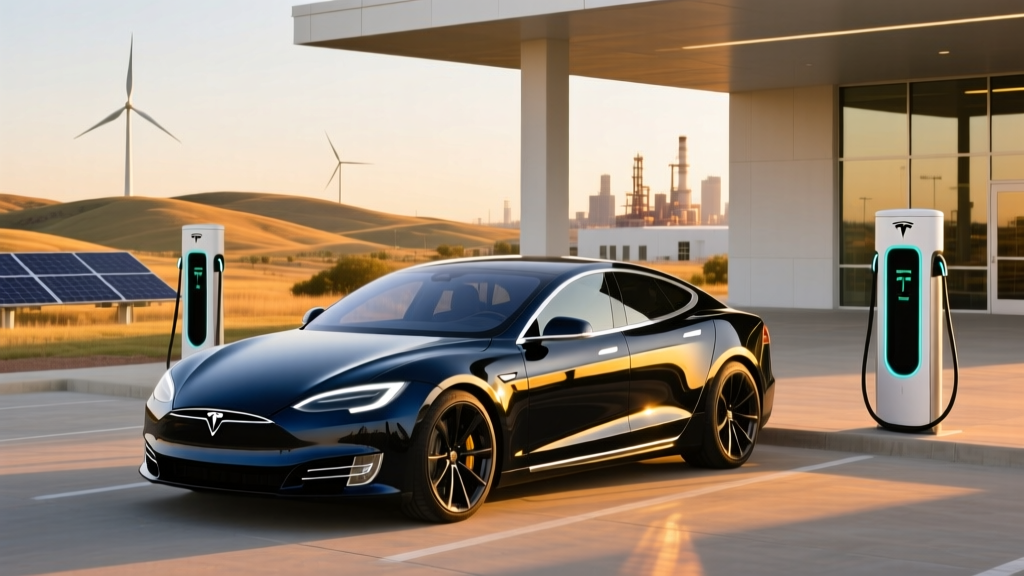
Tesla's Supercharger network remains the gold standard for reliability. With Tesla opening NACS (North American Charging Standard) access to Ford, GM, Rivian, and others through 2025–2026, Supercharger stalls are busier than before, but the network's uptime rate still exceeds 97% — significantly better than most CCS networks.
Performance and Drivetrain: What 384 HP Feels Like
The Long Range AWD's dual-motor setup delivers 384 horsepower and a 4.8-second 0–60 mph time. That's quick by any measure, but Tesla's instant torque delivery makes it feel even faster in real-world merging and passing. The single-speed reduction gear means no shift lag — just linear, relentless acceleration from a stoplight to highway speed.
The Standard Range RWD trim uses a single rear motor producing approximately 295 hp and hits 0–60 in about 6.6 seconds. It's less thrilling but still quicker than most gas-powered compact SUVs.
Handling is competent rather than sporty. The Model Y's ~4,400-lb curb weight (Long Range) is noticeable in corners, and the ride quality on the 19-inch Gemini wheels is firm. The 20-inch Induction wheels look better but worsen ride comfort and reduce range by approximately 5–7%. For Texas roads — which range from smooth urban interstates to rougher rural two-lanes — the 19s are the pragmatic pick.
Interior, Cargo, and Technology
The Model Y's cabin follows Tesla's minimalist philosophy: a single 15-inch center touchscreen handles infotainment, climate, navigation, and vehicle settings. There's no instrument cluster — speed and range info sit in the upper-left corner of the main display. The 2026 model year continues with ventilated front seats, a rear-seat touchscreen for climate and media, and ambient lighting.
Cargo space is a genuine strength: 30.2 cu ft behind the second row, expanding to 72.0 cu ft with the rear seats folded. The rear trunk includes a deep sub-floor well, and the front trunk (frunk) adds 4.1 cu ft — useful for charging cables or a small bag. Rear legroom measures 41.6 inches, adequate for adults on longer trips.
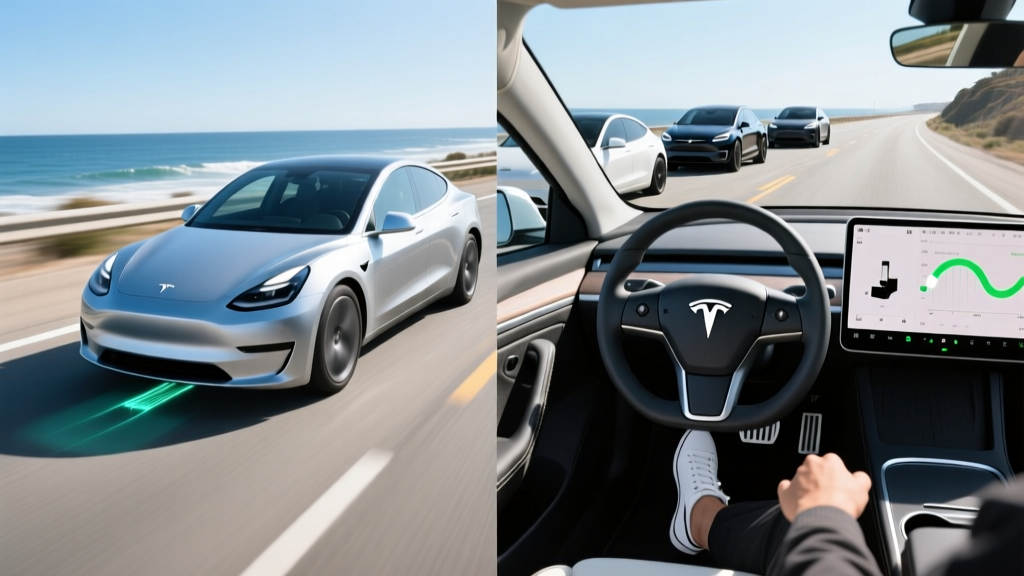
Standout tech: Tesla's Autopilot comes standard (adaptive cruise + lane centering — this is SAE Level 2 driver assistance, not self-driving). Full Self-Driving (Supervised) remains a $8,000 option or $99/month subscription; it adds automated lane changes, traffic-light recognition, and city-street navigation, but the driver must remain fully engaged at all times. Sentry Mode, Dashcam, and over-the-air updates round out the tech suite.
Notable drawbacks: No physical buttons for climate or volume (everything is touchscreen). No Apple CarPlay or Android Auto — Tesla uses its own interface exclusively. Panel gap quality on Austin-built units has improved since early Giga Texas production but still doesn't match legacy luxury automakers on close inspection.
Pricing, Trims, and Federal Tax Credit Eligibility
| Trim | Base MSRP | Est. Federal Credit (§30D) | Effective Price |
|---|---|---|---|
| Standard Range RWD | $36,490 | Up to $3,750* | ~$32,740 |
| Long Range AWD | $44,990 | Up to $7,500* | ~$37,490 |
| Performance AWD | $48,990 | Up to $7,500* | ~$41,490 |
*Federal tax credit eligibility under IRS §30D depends on multiple requirements. See checklist below. Credit amounts shown are maximums; actual credit varies based on battery sourcing compliance and buyer income. The IRS clean vehicle credit page provides current rules.
- MSRP Cap: SUVs/vans/pickups must be ≤ $80,000 MSRP. All Model Y trims qualify.
- Buyer Income Cap: Modified AGI ≤ $300,000 (married filing jointly), $225,000 (head of household), $150,000 (single).
- Battery Sourcing: The $7,500 credit splits into $3,750 for critical-minerals sourcing and $3,750 for battery-component manufacturing (North America). Tesla's Austin-built Model Y with NMC cells from Panasonic's Nevada/Texas supply chain generally qualifies for the full $7,500 on Long Range and Performance trims.
- Standard Range (LFP): The LFP battery cells are sourced from CATL (China), which currently disqualifies the critical-minerals half of the credit. Expect $3,750 (component half only) on this trim — verify with your tax professional before purchase.
- Point-of-Sale Transfer: As of 2024+, you can transfer the credit to the dealer at purchase, reducing your out-of-pocket cost immediately rather than waiting for a tax refund.
A fully loaded Long Range AWD with FSD Supervised, 20-inch wheels, and red paint pushes the as-tested price to approximately $58,480 before credits. Even with the full $7,500 credit, you're looking at ~$51,000 — still competitive against the BMW iX, Mercedes EQB, or Ford Mustang Mach-E Premium, but no longer the bargain it was in 2022.
Warranty and Long-Term Ownership
Tesla's battery and drive-unit warranty covers 8 years / 120,000 miles on the Long Range (whichever comes first), with a guaranteed minimum 70% capacity retention over that period. The Standard Range LFP trim carries 8 years / 100,000 miles at the same 70% threshold. The limited vehicle warranty is 4 years / 50,000 miles.
LFP batteries (Standard Range) have a longer cycle life and can be charged to 100% daily without accelerated degradation — a real advantage for high-mileage commuters. NMC batteries (Long Range/Performance) benefit from staying between 20–80% SoC for daily use, charging to 100% only before road trips. Tesla's app provides a State of Health (SoH) estimate, though third-party tools like Tessie or Teslamate offer more granular degradation tracking.
Insurance costs remain a consideration: the Model Y's average annual premium in Texas runs $2,200–$2,800 depending on zip code, age, and driving record — roughly 20–30% higher than a comparable gas-powered RAV4. Get a quote before committing.
Pros and Cons
Pros
- Supercharger network reliability (97%+ uptime, NACS standard)
- Class-leading cargo volume for the segment (72 cu ft max)
- Strong efficiency at 28 kWh/100 mi (low cost per mile)
- Over-the-air updates continuously add features
- Heat pump standard — better cold-weather range retention
- LFP option (Standard Range) allows 100% daily charging
Cons
- No Apple CarPlay / Android Auto
- Touchscreen-only controls frustrate some drivers
- FSD Supervised is expensive ($8,000) and still Level 2
- Insurance premiums run 20–30% above segment average
- Standard Range LFP may only qualify for $3,750 of the $7,500 credit
- Ride quality firm, especially on 20-inch wheels
Who Should Buy the Austin-Built Model Y?
Choose the Model Y Long Range AWD if: You regularly drive 250+ miles between charges (road trips, inter-city commuting), want dual-motor traction for rain or light snow, and need the full $7,500 tax credit with NMC battery sourcing.
Choose the Model Y Standard Range RWD if: You're a daily commuter covering under 150 miles, can charge at home every night, prefer the lower $36,490 entry price, and value LFP's 100% daily charge capability over maximum range.
Look at competitors if: You want physical climate controls, Apple CarPlay, or a more traditional dealership service experience. The Hyundai Ioniq 5 and Ford Mustang Mach-E offer compelling alternatives with 800V fast-charging (Ioniq 5) or CarPlay integration (Mach-E).
Frequently Asked Questions
What is the real-world range of the 2026 Tesla Model Y?
The EPA rates the Long Range AWD at 320 miles. In real-world mixed driving at highway speeds (70–80 mph), expect 270–290 miles. In cold weather (below 30°F), plan for 240–270 miles. City driving with regenerative braking can exceed the EPA estimate.
How fast does the Model Y charge at home and on the road?
At home on a 240V Level 2 charger (48A), the Model Y charges at 11.5 kW, adding about 44 miles of range per hour — a full charge takes roughly 7 hours. On a Tesla V3 Supercharger, it peaks at 250 kW and charges from 10–80% in approximately 27 minutes, though the rate tapers significantly above 80% SoC.
How much does the Model Y cost after federal tax credits?
The Long Range AWD starts at $44,990 and may qualify for the full $7,500 §30D credit (depending on your income and battery-sourcing compliance), bringing the effective price to ~$37,490. The Standard Range RWD at $36,490 may qualify for only $3,750 due to LFP battery sourcing, making it ~$32,740. Always verify with a tax professional and the IRS clean vehicle credit page before purchasing.
Is the Tesla Model Y worth buying vs. the Hyundai Ioniq 5 or Ford Mach-E?
The Model Y wins on Supercharger access, cargo space, and software integration. The Ioniq 5 charges faster on 800V architecture (10–80% in ~18 minutes) and offers a more distinctive design. The Mach-E provides Apple CarPlay and a more traditional crossover feel. If Supercharger reliability is your top priority, the Model Y still leads. If you want faster DC charging or CarPlay, look at the alternatives.
Does the 2026 Model Y qualify for the federal EV tax credit?
Yes, but with conditions. All trims fall under the $80,000 SUV MSRP cap. The Long Range and Performance trims (NMC battery, North American components) generally qualify for the full $7,500. The Standard Range (LFP/CATL cells) typically qualifies for $3,750. Buyer income must not exceed $150K (single), $225K (head of household), or $300K (joint). The credit can be transferred at point of sale.
How did Tesla moving to Texas affect the Model Y?
Tesla moving to Texas centralized Model Y production at Giga Austin, which improved manufacturing scale and introduced the LFP-equipped Standard Range trim for the U.S. market. Austin-built Model Ys also benefited from iterative structural improvements and a refined production process compared to early Fremont units. The HQ relocation also aligned Tesla's operations with Texas's regulatory and tax environment, though it has no direct impact on vehicle specs for the end buyer.