Why Tesla's Corporate Structure Matters for Model Y Buyers
When shoppers search for Tesla Motors subsidiaries, they are usually trying to understand the ecosystem behind the badge on the crossover they're considering. Tesla, Inc. operates through several key subsidiaries that directly impact what you drive, how you charge, and what you pay. Tesla Energy (solar and Powerwall), Tesla Insurance Services, and the Supercharger network (now open to non-Tesla EVs via NACS) all feed into the ownership experience of the 2026 Tesla Model Y — the company's highest-volume vehicle and one of the best-selling EVs in the U.S.
This review breaks down the 2026 Model Y across the metrics that matter: real-world range, charging speed, pricing after federal incentives, and how Tesla's vertically integrated subsidiaries give it advantages — and limitations — versus rivals like the Hyundai Ioniq 5, Ford Mustang Mach-E, and Chevrolet Equinox EV.
2026 Tesla Model Y: Core Specifications at a Glance
| Spec | Long Range RWD | Long Range AWD | Performance |
|---|---|---|---|
| EPA Range | 320 mi | 308 mi | 285 mi |
| Battery (usable) | ~75 kWh (NMC) | ~75 kWh (NMC) | ~75 kWh (NMC) |
| Drivetrain | Rear-Wheel Drive | Dual-Motor AWD | Dual-Motor AWD |
| Horsepower | 346 hp | 384 hp | 510 hp |
| 0–60 mph | 5.8 sec | 4.8 sec | 3.5 sec |
| Max DC Fast Charge | 250 kW | 250 kW | 250 kW |
| 10–80% DC Time | ~25 min | ~25 min | ~25 min |
| Level 2 Home Rate | 11.5 kW (~44 mi/hr) | 11.5 kW (~44 mi/hr) | 11.5 kW (~44 mi/hr) |
| MPGe (combined) | 123 MPGe | 117 MPGe | 111 MPGe |
| Efficiency | 27 kWh/100 mi | 29 kWh/100 mi | 30 kWh/100 mi |
| Cargo (rear seats up) | 30.2 cu ft (76 cu ft max with seats folded) | ||
| Base MSRP | $44,990 | $47,990 | $52,490 |
Source: fueleconomy.gov and Tesla's official 2026 order configurator. Specs reflect the refreshed "Juniper" generation introduced for the 2025 model year and carried into 2026.
Range & Efficiency: EPA vs. Real-World Expectations
Real-World Expectation: ~265–290 mi on mixed highway driving; ~230–250 mi in freezing temperatures with cabin heat; ~300+ mi in mild city/regen-heavy commuting.
The Model Y Long Range RWD's 320-mile EPA rating is competitive but not class-leading — the Hyundai Ioniq 5 (Long Range RWD) posts 318 miles on a larger 84 kWh battery, while the Chevrolet Equinox EV 3LT hits 319 miles. What sets the Model Y apart is efficiency: at 27 kWh per 100 miles, it extracts more distance per electron than nearly every rival. That efficiency comes from Tesla's heat pump (standard on all trims), aggressive regenerative braking, and a low drag coefficient (~0.23 Cd post-refresh).
For road-trippers, plan conservatively. On a 70 mph interstate run in 35°F weather with the heat on, expect roughly 230 usable miles before you'll want to stop at 10–15% State of Charge. The Model Y's navigation system is excellent at predicting arrival SoC and routing through Superchargers, which reduces range-anxiety guesswork substantially.
Charging Speed: Supercharger Network & Home Setup
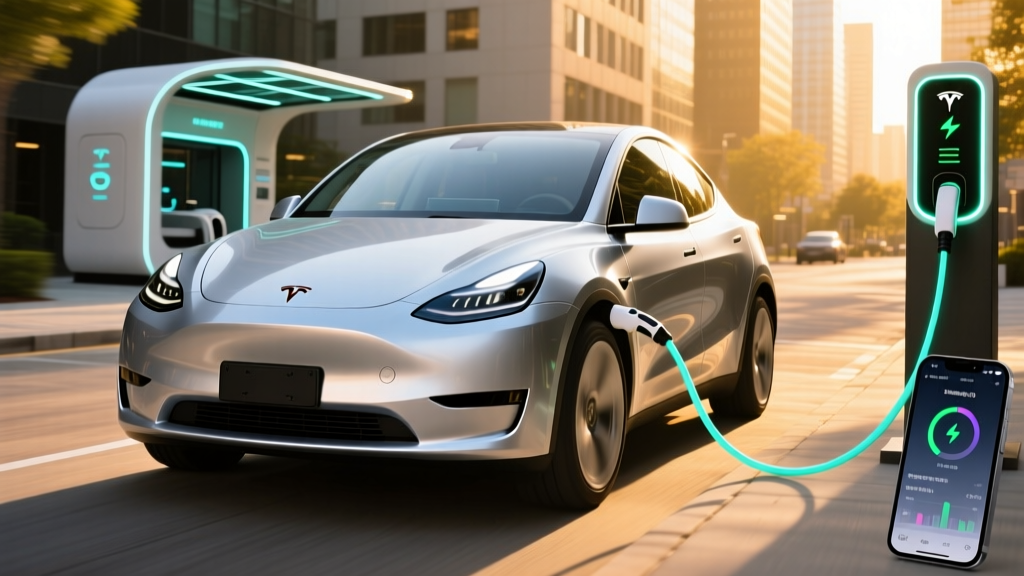
Tesla's Supercharger subsidiary — now branded as the broader Tesla Charging network — remains the single largest competitive moat for Model Y owners. As of 2026, there are over 6,500 Supercharger stalls in North America, and Tesla has opened many to non-Tesla NACS-equipped vehicles. But Model Y owners still get the most seamless experience: plug-and-charge with no app or RFID card required, real-time stall availability in the nav, and automatic battery preconditioning when you route to a charger.
| Charging Level | Power | Miles Added per Hour | Notes |
|---|---|---|---|
| Level 1 (120V) | ~1.4 kW | ~3–4 mi/hr | Emergency/top-up only |
| Level 2 (240V, 48A) | 11.5 kW | ~44 mi/hr | Tesla Wall Connector or equivalent; full charge in ~7–8 hrs |
| DC Fast (V3 Supercharger) | 250 kW peak | ~1,000 mi/hr (peak) | 10–80% in ~25 min; tapers significantly above 80% |
| DC Fast (V4 Supercharger) | Up to 350 kW (cabinet) | Varies by vehicle | Model Y caps at ~250 kW due to 400V architecture |
A critical nuance: the Model Y uses a 400-volt battery architecture, which caps its peak DC intake at roughly 250 kW even at V4 Supercharger stalls capable of 350 kW. Competitors on 800V platforms (Hyundai Ioniq 5, Kia EV6, Porsche Macan EV) can sustain higher charge rates longer. In practice, the Model Y's charge curve peaks at 250 kW up to roughly 35% SoC, then steps down to ~175 kW through 50%, and further to ~100 kW by 70%. The 10–80% time of approximately 25 minutes is good but no longer best-in-class.
For home charging, Tesla's Wall Connector ($420) on a 60-amp circuit delivers the full 11.5 kW / 48 amps the Model Y can accept. Expect roughly 44 miles of range per hour of charging — enough to replenish a full day's driving in 30–45 minutes of plug-in time.
Performance, Ride Quality & Interior
The 2026 Model Y carries over the Juniper refresh's improvements: a quieter cabin (acoustic glass all around), ventilated front seats, ambient lighting, a rear touchscreen for passengers, and a slightly retuned suspension that absorbs small bumps more gracefully than pre-2025 models. The Performance trim's 3.5-second 0–60 time remains thrilling, though the Long Range AWD at 4.8 seconds is more than adequate for merging and passing.
Interior space is a strong suit. With 30.2 cubic feet behind the second row and 76 cubic feet with seats folded, the Model Y beats the Mach-E (29.7 / 59.7 cu ft) and rivals the Ioniq 5 for practicality. Rear legroom measures 41.6 inches — generous for adults on longer trips. The front trunk (frunk) adds 4.1 cubic feet for charging cables or a small bag.
Tech remains Tesla's hallmark. The 15.4-inch center touchscreen handles everything — no physical instrument cluster, no stalks (turn signals are steering-wheel buttons in the refreshed model, which remains polarizing). The infotainment system is fast and intuitive, with native Spotify, Netflix (while parked), and a solid navigation system. Autopilot comes standard and includes adaptive cruise, lane centering, and automatic emergency braking. Full Self-Driving (Supervised) is an $8,000 add-on or $99/month subscription.
Pricing, Trims & Federal Tax Credit Eligibility
| Trim | Base MSRP | Est. After §30D Credit* | Destination |
|---|---|---|---|
| Long Range RWD | $44,990 | $37,490 | $1,390 |
| Long Range AWD | $47,990 | $40,490 | $1,390 |
| Performance AWD | $52,490 | $44,990 | $1,390 |
*Tax credit figures assume full $7,500 eligibility under IRS §30D. The credit can now be transferred to the dealer at point of sale as an instant discount per IRS rules. Eligibility depends on buyer income, vehicle MSRP caps, and battery-component/critical-mineral sourcing requirements.
- MSRP cap: SUVs/crossovers must be ≤$80,000 — all Model Y trims qualify.
- Buyer income cap: Modified AGI ≤$150,000 (single), ≤$225,000 (head of household), ≤$300,000 (joint).
- Battery sourcing: Required percentages of critical minerals and battery components must be sourced from the U.S. or FTA partners. Tesla's U.S.-built LFP and NMC packs have generally met these thresholds, but rules tighten annually. Verify current eligibility on the IRS qualified vehicle list before purchasing.
- Point-of-sale transfer: You can elect to transfer the credit to Tesla at delivery for an instant price reduction — no need to wait for tax filing.
Always confirm eligibility with a tax professional and check the latest IRS guidance before ordering.
How Tesla's Subsidiaries Shape the Ownership Experience
Understanding Tesla Motors subsidiaries helps explain why the Model Y ownership loop feels different from legacy automakers:
- Tesla Supercharger Network: Operated as an internal division (not a separate legal subsidiary in the traditional sense, but functionally autonomous), it gives Model Y owners the most reliable DC fast-charging network in North America. Uptime consistently exceeds 95%, per third-party tracking.
- Tesla Insurance: Available in over 30 states as of 2026, Tesla's in-house insurance product uses real-time driving data from the vehicle to set premiums. Safe drivers can see rates 15–25% below market average, though aggressive drivers may pay more. It's administered through Tesla's insurance subsidiaries and partners.
- Tesla Energy: While not directly part of the car purchase, Tesla's Powerwall and solar divisions create a home-energy ecosystem. Model Y owners with Powerwall can integrate with Tesla's app for a unified energy view, and future V2H (vehicle-to-home) capabilities could let the Model Y's 75 kWh battery serve as backup power — though this feature is not yet enabled on the Model Y as of early 2026.
- Tesla Service & Mobile Rangers: Tesla operates its service network directly (no franchised dealers). Mobile service vans handle ~80% of routine issues at your home or office, though body repair and major drivetrain work still require a service center visit. Wait times vary by metro area.
Warranty, Reliability & Long-Term Battery Outlook
Tesla provides the following coverage on the 2026 Model Y:
- Basic Vehicle Warranty: 4 years / 50,000 miles
- Battery & Drive Unit Warranty: 8 years / 120,000 miles (Long Range RWD); 8 years / 120,000 miles (Long Range AWD & Performance)
- Warranty Threshold: Tesla guarantees the battery will retain at least 70% of its original capacity during the warranty period. If it drops below 70%, Tesla will repair or replace it.
The NMC battery in the Model Y has a proven track record. Real-world fleet data (aggregated by sources like Recurrent Auto) shows Tesla NMC packs losing roughly 5–8% capacity over the first 100,000 miles, with degradation flattening significantly after the initial break-in period. For a 320-mile EPA vehicle, that means ~295–305 miles of real-world range at 100,000 miles — a manageable decline.
If you prioritize maximum battery longevity over range and performance, note that Tesla offers LFP (lithium iron phosphate) batteries in the Standard Range Model Y in some markets. LFP chemistry tolerates regular 100% charging and offers longer cycle life, though with lower energy density (meaning less range in the same pack size). Check Tesla's configurator for LFP availability in your region.
Pros, Cons & Verdict: Is the 2026 Model Y Worth It?
Pros
- Best-in-class efficiency (27 kWh/100 mi)
- Supercharger network access — still the gold standard
- Strong cargo space (76 cu ft max)
- Over-the-air updates keep the car improving post-purchase
- Competitive pricing after §30D credit
- Tesla Insurance can save safe drivers 15–25%
Cons
- 400V architecture limits peak DC charging vs. 800V rivals
- Turn-signal buttons on steering wheel (no stalk) remain divisive
- FSD (Supervised) is expensive and still Level 2 — not autonomous
- No Apple CarPlay or Android Auto
- Ride quality improved but still firm on rough pavement
- Service center availability varies by region
Who Should Buy the 2026 Tesla Model Y?
Choose the Model Y if: You want the most reliable public charging network, value OTA software updates, commute 30–60 miles daily and can charge at home, and prefer a minimalist tech-forward cabin.
Consider competitors if: You need 800V ultra-fast charging (Ioniq 5/EV6), want Apple CarPlay (Mach-E, Equinox EV), prefer physical controls and a traditional instrument cluster, or need a third-row seat (Kia EV9).
Frequently Asked Questions
What is the real-world range of the 2026 Tesla Model Y?
The Long Range RWD has a 320-mile EPA rating. In real-world mixed driving, expect 265–290 miles. In freezing weather with cabin heat, plan for 230–250 miles. City driving with regenerative braking can push past 300 miles in mild conditions.
How fast does the Model Y charge at home and on the road?
At home on a Level 2 (240V, 48A) Tesla Wall Connector, the Model Y charges at 11.5 kW — adding about 44 miles of range per hour, or a full charge in 7–8 hours. On DC fast charging, it peaks at 250 kW at a V3 or V4 Supercharger, achieving 10–80% in approximately 25 minutes. Note that charging slows significantly above 80% SoC to protect battery health.
How much does the 2026 Model Y cost after the federal tax credit?
The Long Range RWD starts at $44,990 and drops to approximately $37,490 after the full $7,500 §30D credit (if eligible). The Long Range AWD falls to ~$40,490, and the Performance to ~$44,990. Eligibility requires meeting IRS income caps ($150K single / $300K joint) and battery-sourcing rules. The credit can be applied as a point-of-sale discount at delivery.
Does the 2026 Model Y qualify for the federal EV tax credit?
Yes, all 2026 Model Y trims fall under the $80,000 SUV MSRP cap. However, buyer eligibility depends on your modified adjusted gross income and the battery's critical-mineral and component sourcing compliance for the 2026 tax year. Tesla's U.S.-manufactured packs have generally qualified, but always verify on the IRS qualified vehicles list before ordering.
Is the Model Y worth buying vs. the Ioniq 5 or Mach-E?
The Model Y wins on efficiency, Supercharger network access, and cargo volume. The Hyundai Ioniq 5 counters with 800V ultra-fast charging (10–80% in ~18 min at 350 kW), a more distinctive design, and slightly more rear legroom. The Ford Mustang Mach-E offers a more engaging driving feel and Apple CarPlay. If public charging reliability is your top concern, the Model Y's Supercharger advantage is hard to beat. If you mostly charge at home and want the fastest road-trip charging, the Ioniq 5's 800V architecture is compelling.
What are Tesla's key subsidiaries and how do they affect me?
Tesla operates through subsidiaries and divisions including its Supercharger network (charging infrastructure), Tesla Insurance (usage-based insurance in 30+ states), Tesla Energy (Powerwall and solar), and its direct-to-consumer service model. These create a vertically integrated ownership experience — from charging to insurance to energy management — that no legacy automaker currently matches end-to-end.