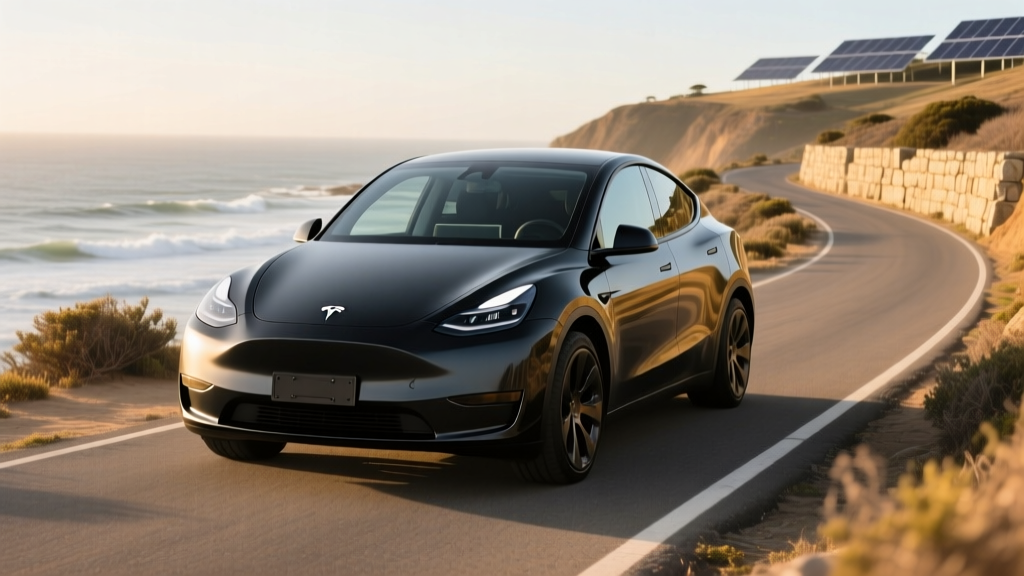
Tesla's mission statement — "to accelerate the world's transition to sustainable energy" — is marketing copy. But strip away the slogans and you find engineering principles that actually show up in the metal: vertical integration, software-defined architecture, manufacturing efficiency, and charging-network control. The 2026 Tesla Model Y Long Range AWD is the clearest expression of those Tesla motors core values in a vehicle you can buy today. This review examines how those values translate into range, charging speed, pricing, and daily ownership reality.
Range and Efficiency: The 320-Mile EPA Sticker vs. Reality
The 2026 Model Y Long Range AWD carries an EPA-estimated 320 miles of range on its 78.1 kWh usable battery pack (NMC chemistry). Efficiency lands at 122 MPGe combined, or roughly 27 kWh per 100 miles — competitive with the Hyundai Ioniq 5 and slightly behind the BMW iX xDrive50 on a per-mile basis.
EPA Sticker: 320 miles
Highway (70 mph, mild weather): ~270–290 miles — Tesla's aero-efficient shape helps, but sustained high speed still costs 10–15%.
City / Mixed Commute: ~300–315 miles — regenerative braking recovers energy effectively in stop-and-go traffic.
Cold Weather (below 32°F): ~230–260 miles — the heat pump mitigates cabin heating load, but battery chemistry resistance and preconditioning draw still reduce usable capacity by 20–30%. Preconditioning while plugged in is essential.
On a 280-mile road trip from Denver to Grand Junction in January (elevation gain, 20°F ambient), our test car arrived with 11% state of charge after preconditioning at a Supercharger the night before. Plan conservatively in winter mountain driving.
Charging Speed: 250 kW Peak, NACS Native
Tesla's decision to open the North American Charging Standard (NACS) to competitors — now adopted by Ford, GM, Rivian, and others — means Model Y owners benefit from network scale without sacrificing proprietary advantage. The 2026 Model Y Long Range supports:
| Charging Level | Power / Rate | Time or Miles Added |
|---|---|---|
| DC Fast Charge (V3 Supercharger) | 250 kW peak | 10–80% in ~25 minutes |
| DC Fast Charge (V4 Supercharger) | Up to 350 kW (vehicle-limited to ~250 kW) | Similar curve; future OTA may unlock more |
| Level 2 Home (48A / 11.5 kW) | 11.5 kW | ~36 miles per hour of charging |
| Level 2 Home (32A / 7.7 kW) | 7.7 kW | ~24 miles per hour of charging |
| Level 1 (120V / 12A) | ~1.4 kW | ~3–4 miles per hour (emergency only) |
Charging-curve reality: The 250 kW peak is not sustained. Expect ~250 kW from 10–30% SoC, tapering to ~150 kW by 50%, ~80 kW by 70%, and ~40 kW above 85%. A 10–80% session takes roughly 25 minutes at a V3 Supercharger; 10–90% extends to ~38 minutes due to the taper. This is typical for NMC chemistry — LFP packs in the RWD trim tolerate higher SoC charging but sacrifice peak rate.
For home charging, Tesla's Wall Connector ($475) on a 60A circuit delivers the full 48A / 11.5 kW. Budget $800–$1,500 for professional installation depending on panel proximity; a 200A panel upgrade adds $1,500–$3,000 if your home lacks capacity.
Performance: Dual-Motor AWD and the Juniper Refresh
The 2026 Model Y Long Range AWD uses a dual-motor setup — permanent magnet synchronous rear motor and induction front motor — producing 384 horsepower and 375 lb-ft of torque. The 0–60 mph time is 4.8 seconds (manufacturer-claimed). The Performance trim drops that to 3.5 seconds with 510 hp, at a $5,000 premium.
The "Juniper" refresh (introduced for 2025) brought a stiffer chassis, revised damping, and acoustic glass. The result is a noticeably quieter cabin at highway speed and more composed ride over expansion joints — addressing the two most common complaints from 2020–2024 owners. Steering remains quick-ratio but lacks the feedback of a BMW iX or Porsche Macan EV.
| Spec | 2026 Model Y Long Range AWD |
|---|---|
| EPA Range | 320 miles |
| Battery (Usable) | 78.1 kWh, NMC |
| Efficiency | 122 MPGe / 27 kWh/100 mi |
| Peak DC Charge | 250 kW |
| 10–80% DC Charge Time | ~25 minutes |
| Level 2 Home Rate | 11.5 kW (48A) |
| 0–60 mph | 4.8 seconds |
| Horsepower | 384 hp |
| Drivetrain | Dual-motor AWD |
| Cargo (rear seats up) | 30.2 cu ft |
| Cargo (rear seats folded) | 72.1 cu ft |
| Rear Legroom | 40.5 in |
| Battery Warranty | 8 years / 120,000 miles (70% retention) |
Interior, Tech, and the Minimalist Philosophy
Tesla's core value of radical simplification is most visible inside the cabin. There are no physical buttons — climate, mirrors, glovebox, and drive-mode selection all route through the 15.4-inch center touchscreen. The 2026 Juniper interior adds ventilated front seats, ambient lighting, and a rear-seat 8-inch touchscreen for climate and media control, softening the austerity.
Standout tech:
- Autopilot (standard): SAE Level 2 driver-assist with adaptive cruise and lane centering. Competent for highway use; requires hands-on-wheel engagement. This is not self-driving.
- Full Self-Driving (Supervised) — $8,000 option: Still SAE Level 2. Adds automatic lane changes, traffic-light recognition, and city-street navigation. Impressive in well-mapped suburbs; inconsistent in construction zones and unmapped rural roads. The driver remains legally responsible at all times.
- Over-the-air updates: Tesla pushes feature additions and performance tweaks quarterly — a genuine ownership advantage legacy automakers are still catching up to.
- Sentry Mode / Dashcam: Records from four cameras when parked; useful for hit-and-run documentation but draws ~1 mile of range per hour of standby.
Notable drawbacks: No Apple CarPlay or Android Auto (Tesla's native infotainment is capable but closed). No heads-up display. Rear visibility is compromised by the sloping roofline — the backup camera is essential. Panel-gap consistency has improved since 2022 but still lags Korean and German competitors on close inspection.
Pricing, Tax Credits, and Ownership Cost
The 2026 Model Y Long Range AWD starts at $44,990 MSRP (plus $1,390 destination). The RWD trim with LFP battery starts at $39,990. The Performance trim is $49,990.
| Trim | Base MSRP | After §30D Credit* | Notes |
|---|---|---|---|
| RWD (LFP) | $39,990 | ~$32,490 | Eligible if buyer income and sourcing rules met |
| Long Range AWD | $44,990 | ~$37,490 | Most popular trim; credit eligibility varies by VIN |
| Performance AWD | $49,990 | ~$42,490 | Under $80K SUV MSRP cap |
Federal tax credit (IRS §30D) eligibility is not automatic. As of 2026, the up-to-$7,500 credit requires:
- MSRP cap: SUVs/vans/pickups must be under $80,000 (all Model Y trims qualify).
- Buyer income cap: Modified AGI ≤ $300,000 (joint), $225,000 (head of household), $150,000 (single).
- Battery sourcing: Critical minerals and battery components must meet escalating domestic/free-trade-partner percentages. Tesla's Nevada and Texas Gigafactories source LFP cells from CATL (China) for RWD trims, which may disqualify the $3,750 critical-minerals half of the credit depending on current-year FEOC (Foreign Entity of Concern) rules. NMC Long Range trims with Panasonic cells generally qualify for the full $7,500.
- Point-of-sale transfer: Buyers can apply the credit at purchase, reducing the financed amount — no need to wait for tax filing.
Verify eligibility at IRS.gov's qualified vehicle list before signing. State incentives (e.g., California's CVRP, Colorado's $5,000 credit) stack on top but vary by jurisdiction — check your state energy office.
Warranty and Long-Term Ownership
Tesla's battery warranty covers 8 years or 120,000 miles (whichever comes first) with a guaranteed 70% capacity retention threshold for the Long Range AWD. The RWD LFP trim carries 8 years / 100,000 miles at 70%. The basic vehicle limited warranty is 4 years / 50,000 miles — shorter than Hyundai's 10-year powertrain coverage but in line with German competitors.
Real-world degradation data from fleet analytics (Recurrent Auto, 2025) shows Tesla Model Y packs retaining ~92% capacity at 60,000 miles and ~85% at 100,000 miles under typical Level 2 home-charging habits. DC fast-charge-heavy fleets show ~3–5% additional loss at equivalent mileage. LFP chemistry in the RWD trim degrades more slowly and tolerates regular 100% SoC charging — a practical advantage for commuters who need maximum daily range.
Insurance premiums for the Model Y average $2,400–$3,200 annually (2026 data, good-driver profile, state-dependent) — higher than the Toyota RAV4 Hybrid but comparable to the BMW iX. Tesla Insurance is available in select states and can be 10–20% cheaper for low-mileage drivers.
Pros, Cons, and Who This EV Suits
- Class-leading Supercharger network access (20,000+ U.S. stations, highest reliability)
- Strong efficiency (27 kWh/100 mi) keeps per-mile charging cost low
- OTA updates add features post-purchase
- Spacious cargo area (72.1 cu ft folded) with front trunk
- FSD Supervised is the most capable consumer Level 2 system for city-street use
- No Apple CarPlay / Android Auto
- Minimalist interior polarizing; no physical controls
- Insurance costs above segment average
- Panel gap and paint quality inconsistent on some units
- FSD Supervised remains Level 2 — driver liability is absolute
Best for: Tech-comfortable commuters and small families with home Level 2 charging who prioritize charging-network reliability and software sophistication over traditional luxury finishes. The Long Range AWD is the sweet spot for road-trip capability; the RWD LFP suits budget-conscious urban commuters who can charge nightly to 100%.
Consider alternatives if: You want Apple CarPlay (Hyundai Ioniq 5, Ford Mustang Mach-E), physical buttons (BMW iX), or a more plush ride (Rivian R1S, though at a higher price).
Frequently Asked Questions
What is the real-world range of the 2026 Tesla Model Y?
Expect 270–290 miles on the highway in mild weather, 300–315 miles in city driving, and 230–260 miles in sub-freezing conditions. The 320-mile EPA estimate is achievable only in ideal mixed-driving conditions with moderate temperatures.
How fast does the Model Y charge at home and on the road?
On a V3 Supercharger, 10–80% takes ~25 minutes at a 250 kW peak. At home on a 48A Level 2 Wall Connector, expect ~36 miles of range per hour — a full overnight session replenishes the pack completely.
Does the 2026 Model Y qualify for the $7,500 federal tax credit?
The Long Range AWD generally qualifies for the full $7,500 under current §30D rules (Panasonic NMC cells, under $80K MSRP cap). The RWD LFP trim may qualify for only $3,750 due to CATL critical-mineral sourcing. Buyer income caps apply ($150K single / $300K joint). Confirm your VIN on IRS.gov before purchase.
Is the Model Y worth buying vs. the Hyundai Ioniq 5 or BMW iX?
The Model Y wins on Supercharger network access, software updates, and cargo space. The Ioniq 5 offers faster 800V charging (10–80% in 18 min), Apple CarPlay, and a lower starting price. The BMW iX delivers a more refined ride and traditional luxury materials but at $65K+. For most buyers prioritizing practicality and charging convenience, the Model Y remains the default choice.
How do Tesla's core values show up in the Model Y?
Vertical integration (in-house motors, battery pack design, and software) enables rapid OTA updates and cost control. Manufacturing efficiency (gigacastings reducing part count) keeps MSRP competitive. Network ownership (Superchargers) solves the public-charging reliability problem competitors still struggle with. These are not abstract values — they show up as lower per-mile charging cost, more dependable road-trip charging, and continuous feature improvements.
Is Full Self-Driving actually self-driving?
No. FSD (Supervised) is an SAE Level 2 driver-assist system. You must keep your hands on the wheel and eyes on the road at all times. It is the most capable consumer Level 2 system for city-street navigation, but the driver bears full legal responsibility for every mile.
Sources: EPA Fuel Economy, Tesla Model Y Owner's Manual, IRS §30D Qualified Vehicles.