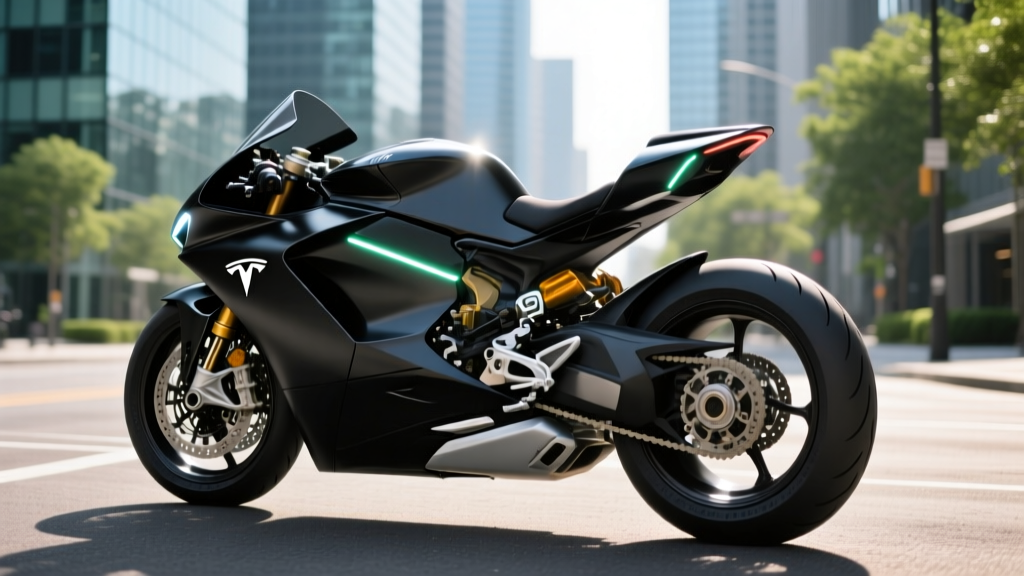
If you've typed "Tesla motorbike" into a search bar, you're not alone. The idea of Tesla building an electric motorcycle has circulated in forums, YouTube speculation videos, and social media threads for years. Elon Musk himself has teased the concept at various points, and Tesla's brand cachet in the EV space naturally makes riders wonder: when will a Tesla electric motorcycle hit the road?
The short answer, as of early 2026, is that Tesla does not manufacture or sell a motorbike. There is no Tesla Model M, no Tesla electric motorcycle in showrooms, and no official production timeline. What Tesla does offer is the Cyberquad for Kids — a battery-powered ATV sold through the Tesla Shop — and a history of hints that a full-size two-wheeler could be in the company's long-range vision.
This guide cuts through the rumors, examines what Tesla has actually said and built, and profiles the real electric motorcycles you can buy today if you're looking for a silent, zero-tailpipe-emissions ride.
Has Tesla Ever Announced an Electric Motorcycle?
Tesla's master plans have focused squarely on four-wheeled vehicles: the Roadster, Model S, Model 3, Model X, Model Y, Cybertruck, and the upcoming next-generation platform vehicle. Motorcycles have never appeared in a Tesla shareholder deck, earnings call, or official press release as a production commitment.
That said, the speculation isn't baseless. In 2019, during the Cybertruck unveiling, Tesla revealed the Cyberquad — an electric ATV designed to load into the Cybertruck bed. While initially shown as a concept and later released only as a kids' version (priced around $1,900), the Cyberquad demonstrated Tesla's willingness to explore electric vehicles beyond cars and trucks.
Elon Musk has also stated in interviews that he personally owned and rode a dirt bike and has expressed interest in electric two-wheelers. However, interest from a CEO is not a product roadmap. Tesla's engineering resources remain heavily committed to scaling vehicle production, expanding the Supercharger network (now with NACS adoption across the industry), developing the Optimus humanoid robot, and advancing FSD (Supervised) software.
Why Tesla Hasn't Built a Motorbike (Yet)
Building a production electric motorcycle presents challenges that differ fundamentally from building electric cars:
- Market size: The U.S. motorcycle market sells roughly 500,000–600,000 units per year (per the Motorcycle Industry Council), compared to ~15–16 million light-duty vehicles. Tesla's factory capacity and capital allocation prioritize the largest addressable markets.
- Battery packaging: A motorcycle's frame offers far less volume for battery cells. Achieving 100+ miles of range requires dense, heavy packs that compromise handling — a problem Tesla's engineers would need to solve without the skateboard platform that underpins their cars.
- Safety and regulation: Motorcycles carry inherently higher fatality rates per vehicle mile traveled (NHTSA data consistently shows motorcyclists are ~28x more likely to die in a crash than car occupants). Tesla's brand is heavily tied to safety ratings and ADAS features that are far harder to implement on two wheels.
- Charging infrastructure: Tesla's Supercharger network is designed for four-wheeled vehicles. A motorbike would need either an adapter solution or a separate charging ecosystem.
None of these obstacles are insurmountable — companies like Zero Motorcycles, Energica, and LiveWire (Harley-Davidson's electric spinoff) have navigated them — but they explain why Tesla has kept its focus elsewhere.
Electric Motorcycles You Can Actually Buy in 2026
If the Tesla motorbike search stems from genuine interest in an electric motorcycle, several proven options exist today. Here's how the leading models compare:
| Model | Battery (kWh) | City Range (mi) | Highway Range (mi) | 0-60 mph | Top Speed | Base MSRP |
|---|---|---|---|---|---|---|
| Zero SR/S | 17.3 kWh (Z-Force Li-Ion) | ~161 | ~82 | 3.3 sec | 124 mph | ~$21,795 |
| LiveWire ONE | 15.5 kWh (RESS) | ~146 | ~70 | 3.0 sec | 115 mph | ~$21,999 |
| Energica Ego+ | 21.5 kWh (NMC) | ~160 | ~90 | 2.6 sec | 150 mph | ~$27,000 |
| Zero S (Standard) | 14.4 kWh (Z-Force) | ~156 | ~78 | 4.0 sec | 102 mph | ~$15,995 |
Range figures reflect manufacturer estimates for combined city/highway use; real-world results vary significantly based on speed, temperature, and riding style. Unlike EPA automotive testing, motorcycle range claims are less standardized — treat these as ballpark figures.
Zero SR/S — The Benchmark Electric Sportbike
Zero Motorcycles, based in Scotts Valley, California, has been building electric motorcycles since 2006. The SR/S is their faired sport-touring model, built on the Z-Force powertrain platform with a 17.3 kWh battery pack. It delivers 110 hp and 140 lb-ft of torque — available instantly from zero RPM, as with all electric motors. Level 1 charging (120V) adds roughly 13 miles per hour; an optional Charge Tank accessory enables Level 2 (240V) charging at up to 6 kW, cutting a full charge to about 2.5 hours. There is no DC fast-charging capability on current Zero models.
LiveWire ONE — Harley's Electric Spinoff
LiveWire, spun off from Harley-Davidson as a standalone brand, offers the LiveWire ONE with a 15.5 kWh battery and DC fast-charging capability via CCS — a rarity in the electric motorcycle segment. It can charge from 0-80% in approximately 40 minutes at a compatible DC station. The twist: LiveWire's dealer network remains limited, and parts/service availability varies by region.
Energica Ego+ — Italian Performance
Energica, based in Modena, Italy, targets the premium superbike segment. The Ego+ packs a 21.5 kWh NMC battery — the largest in production electric motorcycles — and supports DC fast charging (Mode 4 / CCS), reaching 0-80% in roughly 40 minutes. Top speed is electronically limited to 150 mph. Pricing starts around $27,000, placing it in exotic-bike territory.
Charging an Electric Motorcycle vs. an EV
One reason a Tesla motorbike would be compelling is access to the Supercharger network. Today's electric motorcycle owners face a different reality:
| Charging Level | Power (kW) | Typical Miles Added/Hour | Motorcycle Compatibility |
|---|---|---|---|
| Level 1 (120V household) | ~1.0–1.4 kW | 8–15 mi/hr | All models (standard cord) |
| Level 2 (240V) | ~3.3–7.2 kW | 25–60 mi/hr | Most models (J1772 adapter or proprietary) |
| DC Fast Charge | ~20–50 kW | 0-80% in 30–45 min | Limited (LiveWire, Energica; most Zero models lack DCFC) |
Motorcycle battery packs (14–22 kWh) are far smaller than EV packs (60–100+ kWh), so even modest kW rates fill them quickly. A Zero SR/S on Level 2 at 6 kW can fully charge in under 3 hours. The trade-off: fewer public DC fast-charging stations accommodate motorcycles, and adapter compatibility varies.
Tax Credits and Incentives for Electric Motorcycles
Here's where electric motorcycle buyers face a significant disadvantage compared to EV car buyers: the federal §30D Clean Vehicle Credit does not apply to motorcycles.
The IRS §30D credit (up to $7,500 for new qualifying vehicles) applies to four-wheeled vehicles with a gross vehicle weight rating (GVWR) under 14,000 lbs that meet battery-sourcing, MSRP, and buyer-income requirements. Motorcycles, three-wheeled vehicles, and low-speed vehicles are excluded.
However, some state and local incentives may apply:
- California: The Clean Vehicle Rebate Project (CVRP) and various air-district incentives have historically included electric motorcycles, though funding and eligibility change frequently. Check energy.ca.gov for current programs.
- Utility rebates: Some electric utilities (e.g., PG&E, SCE) offer $300–$500 rebates for purchasing an electric motorcycle. Contact your local utility for details.
- Federal alternative: The §30D credit's companion, the commercial clean vehicle credit (§45W), applies differently and may be relevant for fleet purchases — consult a tax professional.
Without the federal credit, a $20,000+ electric motorcycle carries its full sticker price — making the total cost of ownership equation different from a Tesla Model 3 or Chevrolet Equinox EV that may qualify for $7,500 at point of sale.
Could Tesla Build a Motorbike in the Future?
It's not impossible. Tesla has expanded from sports cars (Roadster) to sedans (Model S/3) to SUVs (Model X/Y) to trucks (Cybertruck) to semis (Tesla Semi). The company's battery technology, motor design expertise, and software capabilities would translate to a compelling electric motorcycle.
A hypothetical Tesla motorcycle could leverage:
- 4680 battery cells: Tesla's structural battery pack technology could be adapted for a compact, energy-dense motorcycle frame.
- Supercharger access: A NACS-equipped Tesla motorcycle would instantly tap the most reliable DC fast-charging network in North America.
- Software integration: Tesla's app ecosystem, over-the-air updates, and navigation could set a new standard for motorcycle connectivity.
But Tesla's current priorities — scaling Cybertruck production, launching the next-gen $25,000-class vehicle, expanding energy storage (Megapack), and advancing autonomous driving — suggest a motorbike is not imminent. If it arrives, expect an announcement at a major Tesla event, not a quiet website update.
Pros and Cons of Buying an Electric Motorcycle Today
✅ Pros
- Instant torque — no clutch, no shifting, seamless acceleration
- Near-silent operation — reduced noise pollution, more neighbor-friendly
- Minimal maintenance — no oil changes, spark plugs, or exhaust systems
- Home charging — plug into a standard 120V outlet overnight
- Lower fuel cost — electricity at $0.15/kWh ≈ $0.02–0.04/mile vs. $0.08–0.12/mile for gas
❌ Cons
- Highway range drops sharply — expect 50–70 miles at 70+ mph
- No federal tax credit (§30D excludes motorcycles)
- Limited DC fast-charging support on most models
- Higher upfront cost than comparable gas motorcycles
- Dealer/service network thinner than legacy brands
- Cold weather reduces range by 20–30%
Frequently Asked Questions
Does Tesla make an electric motorcycle?
No. As of 2026, Tesla does not manufacture or sell any motorcycle or motorbike. The only Tesla-branded two-wheeled/ATV product is the Cyberquad for Kids, a battery-powered youth ATV sold through the Tesla Shop.
What is the best electric motorcycle to buy in 2026?
The Zero SR/S and LiveWire ONE are the most widely recommended electric motorcycles for street riders. The Zero SR/S offers the broadest dealer network and proven reliability; the LiveWire ONE is one of the few electric motorcycles with DC fast-charging capability. For maximum performance, the Energica Ego+ leads the pack with a 21.5 kWh battery and 150 mph top speed.
Do electric motorcycles qualify for the $7,500 federal tax credit?
No. The IRS §30D Clean Vehicle Credit applies only to four-wheeled vehicles meeting specific MSRP, income, and battery-sourcing requirements. Motorcycles are excluded. Some state incentives and utility rebates may partially offset the purchase price — check your state energy office and local utility.
How far can an electric motorcycle go on a charge?
Real-world range depends heavily on speed and conditions. At city speeds (30–45 mph), expect 100–160 miles from models like the Zero SR/S or LiveWire ONE. At sustained highway speeds (70+ mph), that range drops to roughly 50–80 miles due to aerodynamic drag and the absence of regenerative braking opportunities. Cold weather (below 40°F) can reduce range by an additional 20–30%.
How long does it take to charge an electric motorcycle?
On a standard 120V outlet (Level 1), expect 8–15 miles of range added per hour — a full charge can take 10–15 hours. On a 240V Level 2 charger (where supported), a full charge takes 2–4 hours. DC fast-charging (available on select models like the LiveWire ONE and Energica Ego+) can reach 0-80% in roughly 30–45 minutes.
Will Tesla ever release a motorcycle?
There is no official announcement or timeline. Elon Musk has expressed personal interest in electric motorcycles, and Tesla's battery and motor technology could support one, but the company's current roadmap focuses on cars, trucks, energy storage, and robotics. If a Tesla motorcycle is ever announced, expect it at a major product event with detailed specifications.
The Bottom Line
The "Tesla motorbike" remains one of the EV world's most persistent what-ifs. Tesla has the technology, the brand, and the charging infrastructure to build a category-defining electric motorcycle — but the company has chosen to focus its resources on four-wheeled vehicles, energy products, and AI/robotics.
If you're ready to ride electric today, Zero Motorcycles, LiveWire, and Energica offer proven, production-ready options with real-world range of 70–160 miles depending on riding conditions. Just be prepared for the full sticker price — no federal tax credit applies — and plan your charging around Level 1/Level 2 access at home, with DC fast charging available only on select models.
Sources: IRS §30D Clean Vehicle Credit, NHTSA Motorcycle Safety, manufacturer specification pages for Zero Motorcycles, LiveWire, and Energica.