If you've been searching for Tesla motor homes, you've probably noticed a confusing mix of concept renders, camper conversion kits, and outright misinformation. Here's the reality: Tesla does not manufacture a motorhome, Class A/B/C RV, or any dedicated recreational vehicle as of 2026. What does exist is a growing ecosystem of third-party camper conversions, tow-behind trailer setups, and Tesla models that serve double-duty as camping platforms — particularly the Model X, Cybertruck, and the refreshed Model Y.
This guide cuts through the hype. We'll cover what's actually buyable, what's vaporware, the real-world range and charging logistics of using a Tesla for extended camping, and which Tesla model makes the most practical base for a motor-home-style lifestyle. If you're weighing an electrified road-trip rig, this is the data you need.
Why There Is No Factory Tesla Motor Home
Tesla's vehicle lineup in 2026 includes the Model 3, Model Y, Model S, Model X, and Cybertruck. None are built as motor homes. The company has never announced a Class B camper van, Sprinter-style RV, or integrated motorhome product. Elon Musk has occasionally mentioned the idea of a "Tesla Van" in passing, but no production timeline, prototype, or filing has materialized.
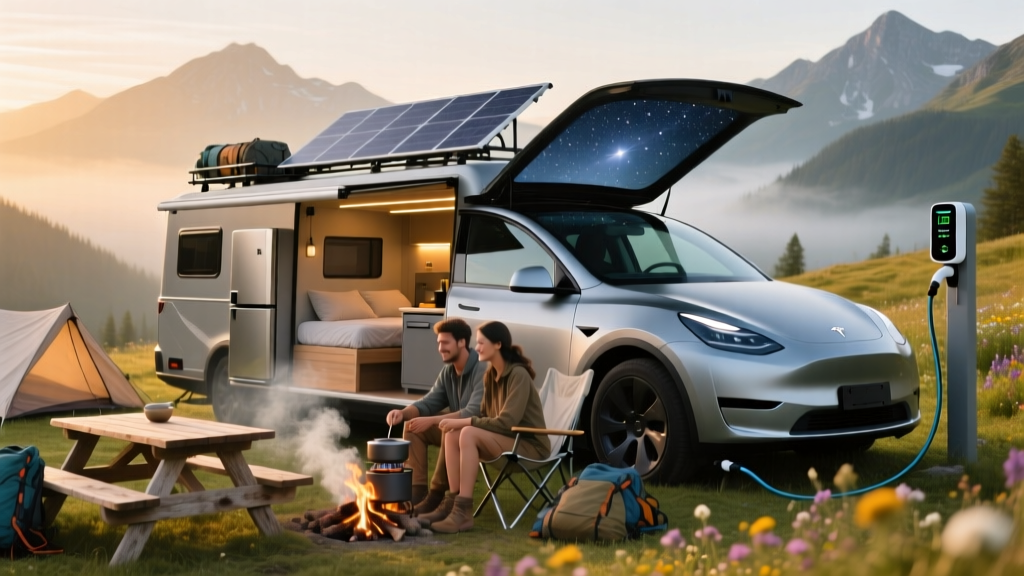
What does exist is a robust aftermarket. Companies like Lightship (an all-electric tow-behind travel trailer), Colorado Teardrops, and various van-conversion outfitters have built camper solutions designed specifically to pair with Tesla tow vehicles and battery systems. Additionally, Tesla's own Camp Mode — available across all current models — turns any Tesla into an overnight shelter with climate control, airflow, and power management optimized for stationary use.
The Best Tesla Models for Motor-Home-Style Camping
Not all Teslas are equal when it comes to living, sleeping, or towing a camper. Here's how the lineup stacks up for RV-adjacent use cases.
| Model | EPA Range | Towing Capacity | Cargo (rear seats folded) | Camp Mode | Best For |
|---|---|---|---|---|---|
| Model X | 335 mi | 5,000 lbs | 88.1 cu ft | Yes | Trailer camping, family road trips |
| Cybertruck (AWD) | 340 mi | 11,000 lbs | 67 cu ft (bed) | Yes | Heavy trailers, off-grid camping |
| Model Y (Long Range) | 320 mi | 3,500 lbs | 72.1 cu ft | Yes | Light teardrop trailers, car camping |
| Model 3 (Long Range) | 363 mi | Not rated | 23 cu ft (trunk) | Yes | Solo minimalist car camping |
Tesla Model X: The Closest Thing to a Tesla Motor Home
If you want a single Tesla that approximates the motor-home experience — sleeping inside, towing a trailer, carrying gear — the 2026 Model X Long Range is the strongest candidate. Its falcon-wing rear doors open the cabin wide, the available 6- or 7-seat layout folds flat, and its 5,000-pound tow rating handles most travel trailers under 28 feet.
| EPA Range: | 335 miles |
| Real-World Range: | ~265–290 mi highway; ~230–250 mi cold weather (below 32°F) |
| Battery: | ~100 kWh usable, NMC chemistry |
| Max DC Fast Charge: | 250 kW (V3 Supercharger), 10–80% in ~30 min |
| Level 2 Home Charge: | 11.5 kW / ~34 mi/hr on a 48A Wall Connector |
| 0–60 mph: | 3.8 seconds (LR AWD) |
| Horsepower: | 670 hp (dual motor) |
| Efficiency: | 102 MPGe combined / 33 kWh/100mi |
| Cargo (seats folded): | 88.1 cu ft |
| Towing: | 5,000 lbs |
| Base MSRP: | $79,990 (before destination) |
| Battery Warranty: | 8 years / 150,000 miles (min 70% retention) |
Sources: EPA Fuel Economy, Tesla Model X Specs
Real-World Range When Towing
This is where the motor-home dream meets physics. Towing a 4,000-lb travel trailer with the Model X reduces range by roughly 40–55% depending on speed, terrain, and temperature. On a flat interstate at 65 mph, expect about 150–180 miles of real range before you need to stop. That means Supercharger stops every 2 to 2.5 hours on a road trip — manageable, but it requires planning. Use Tesla's built-in trip planner or apps like A Better Routeplanner (ABRP) to model towing range with specific trailer weights.
Charging Logistics with a Trailer
One of the biggest pain points for Tesla-as-motor-home users: most Supercharger stalls are not pull-through. You'll need to unhitch your trailer at many stations or seek out locations with designated pull-through EV + trailer spots. Tesla has been expanding pull-through stalls at high-traffic corridors, but coverage remains inconsistent. Electrify America and some ChargePoint stations offer more pull-through-friendly layouts for tow vehicles.
Cybertruck: The Electric Truck Camper Platform
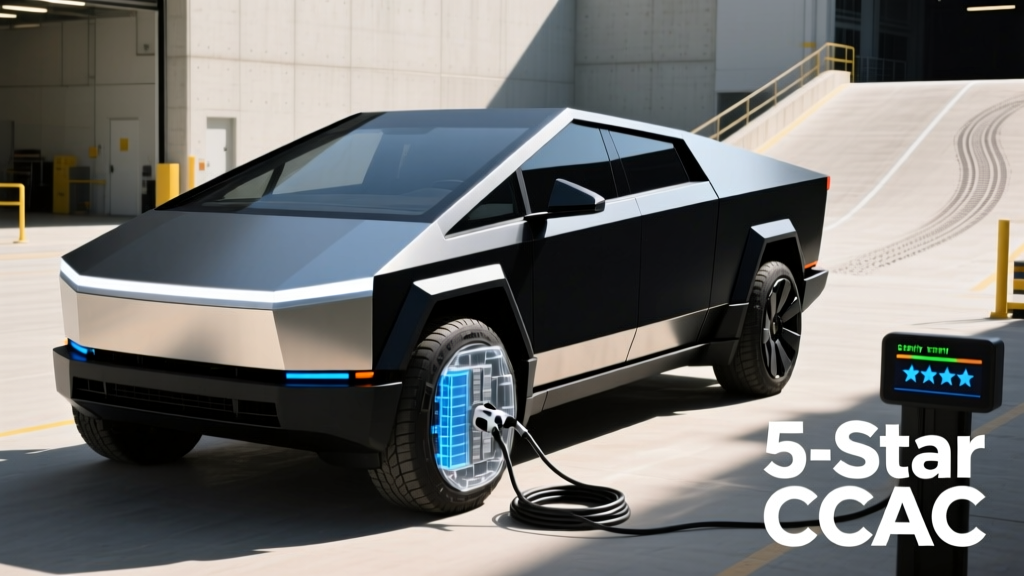
The 2026 Cybertruck AWD offers the most utility for serious camper builds. Its 11,000-lb tow rating handles large fifth-wheel and travel trailers that the Model X cannot. The 6-foot bed accommodates slide-in truck campers from companies like Scout Campers and Four Wheeler, and the stainless-steel exoskeleton doesn't need a garage — it's built for outdoor storage.
| EPA Range: | 340 miles (no trailer) |
| Real-World Towing Range: | ~140–170 mi with a 7,000-lb trailer at highway speed |
| Battery: | ~123 kWh usable, NMC (4680 cells) |
| Max DC Fast Charge: | 350+ kW (V4 Supercharger), 10–80% in ~20 min (unloaded) |
| Level 2 Home Charge: | 11.5 kW / ~30 mi/hr |
| 0–60 mph: | 4.1 seconds |
| Horsepower: | 600 hp (dual motor AWD) |
| Bed Length: | 6 ft (lockable tonneau) |
| Base MSRP: | $79,990 (AWD) |
| Battery Warranty: | 8 years / 120,000 miles |
The Cybertruck also features Powershare — Tesla's vehicle-to-load (V2L) system — which provides up to 11.5 kW of 120V/240V AC output from the bed and cabin outlets. That's enough to run a camper's air conditioning, microwave, induction cooktop, and lights simultaneously without a generator. For boondocking (off-grid camping), this is a genuine advantage over gas trucks.
Cybertruck Camper Builds: What's Available
Several upfitters now offer slide-in and pop-top campers designed for the Cybertruck's bed dimensions:
- Scout Campers Kenai — lightweight aluminum slide-in (~1,200 lbs), solar-ready, fits the 6-ft bed
- AT Overland Summit — pop-top camper with rooftop tent integration
- Basecamp-style DIY builds — the flat bed and integrated tie-downs make custom platform builds straightforward
Model Y: The Budget-Friendly Tesla Camping Option
For those who don't need to tow and simply want a Tesla they can sleep in on weekends, the 2026 Model Y Long Range is the most popular choice. With the rear seats folded, you get a roughly 6'2" flat load floor — enough for a memory-foam mattress. Camp Mode maintains cabin temperature, runs the HEPA air filtration, and limits battery drain to roughly 1–2% per hour for climate control in moderate temperatures.
| Spec | Value |
|---|---|
| EPA Range | 320 miles |
| Real-World Highway | ~265–285 mi at 70 mph |
| Cold Weather (20°F) | ~220–245 mi |
| Battery | ~75 kWh usable, NMC |
| Max DC Fast Charge | 250 kW, 10–80% in ~25 min |
| Level 2 Home Charge | 11.5 kW / ~44 mi/hr |
| Cargo (seats folded) | 72.1 cu ft |
| Towing | 3,500 lbs |
| Base MSRP | $44,990 |
| Battery Warranty | 8 years / 120,000 miles |
The Model Y's 3,500-lb tow rating limits you to lightweight teardrop trailers (think nuCamp Tab 320 or Scamp 13'), but for weekend warriors who want a car that commutes Monday through Friday and camps on Saturday, it's the sweet spot.
Electric Travel Trailers Designed for Tesla Tow Vehicles
The most exciting development in the "Tesla motor home" space isn't from Tesla at all. A new generation of electric travel trailers features their own battery packs, reducing range loss on the tow vehicle and even providing self-propelled maneuverability at the campsite.
- Lightship L1 — an all-electric, aerodynamic travel trailer with an ~80 kWh battery, solar roof, and self-propulsion capability that reduces tow-vehicle range loss to under 15%. Expected MSRP: ~$75,000+. Currently in limited production.
- Grounded e-RV (concept stage) — an electric RV platform with integrated battery and solar, designed to pair with EVs.
These trailers essentially turn any Tesla into a hybrid motor-home system: the car provides propulsion and Supercharger access, while the trailer provides living space and its own power reserves for off-grid camping.
Tesla Camp Mode: What It Actually Does
Before investing in a conversion or trailer, understand what Tesla's built-in Camp Mode offers. Activated from the climate menu, it:
- Maintains your set cabin temperature indefinitely (using the heat pump on newer models)
- Keeps USB ports and the 12V accessory outlet powered
- Runs the touchscreen for media playback (Netflix, YouTube, Spotify)
- Disables walk-away auto-lock and the charging-port auto-close
- Suppresses exterior chimes and Sentry Mode alerts
- Draws approximately 1.5–3 kWh overnight (8 hours) in moderate weather — roughly 2–4% of battery
Camp Mode does not provide AC power outlets for external appliances (except on Cybertruck via Powershare). For cooking, you'll need a portable induction cooktop plugged into a 120V adapter (where available) or a standalone camp stove.
Pricing, Tax Credits & Total Cost
| Model | Base MSRP | Under $80K MSRP Cap? | §30D Credit Eligible? | Est. After Max Credit |
|---|---|---|---|---|
| Model Y LR AWD | $44,990 | Yes (SUV cap: $80K) | Up to $7,500* | ~$37,490 |
| Model 3 LR AWD | $42,490 | Yes (sedan cap: $55K) | Up to $7,500* | ~$34,990 |
| Model X LR | $79,990 | Yes (SUV cap: $80K) | Up to $7,500* | ~$72,490 |
| Cybertruck AWD | $79,990 | Yes (truck cap: $80K) | Up to $7,500* | ~$72,490 |
*The IRS §30D federal tax credit has strict eligibility requirements: buyer AGI must not exceed $150K (single) / $300K (joint), the vehicle must meet critical-mineral and battery-component sourcing thresholds, and MSRP must be under the applicable cap. Credit amount varies — $3,750 if only one sourcing requirement is met, $7,500 if both are met. As of 2026, Tesla's US-built vehicles with North American battery sourcing generally qualify for the full $7,500. The credit is available as a point-of-sale transfer to the dealer. Consult a tax professional for your specific situation.
Pros and Cons: Tesla as a Motor-Home Replacement
✅ Pros
- Supercharger network — 6,000+ V3/V4 stalls nationwide makes road-trip charging viable
- Camp Mode provides climate-controlled overnight sleeping without idling emissions
- Cybertruck Powershare (11.5 kW V2L) eliminates the need for a gas generator
- Instant torque for trailer merging and mountain-grade pulling
- Low "fuel" cost — ~$0.13/kWh national average vs. $3.50+/gal gasoline
- Over-the-air updates continuously improve trip planning and battery management
❌ Cons
- No factory Tesla motor home exists — all solutions require aftermarket work or trailers
- Towing cuts range 40–55%, requiring frequent charging stops
- Most Supercharger stalls are not pull-through — unhitching is often required
- Model X and Cybertruck MSRP near $80K — expensive base for a camping rig
- Cold-weather camping compounds range loss (battery + cabin heating)
- No integrated gray/black water, propane, or full kitchen — you're building, not buying
- Insurance costs for towing with an EV can be higher than ICE equivalents
Who Should (and Shouldn't) Build a Tesla Motor Home
Choose a Tesla camping setup if:
- You already own or plan to buy a Model X, Model Y, or Cybertruck and want dual-purpose use
- Your camping trips are within 200–300 miles of home or along well-served Supercharger corridors
- You value quiet, emission-free campsites with climate control and power
- You want V2L capability (Cybertruck) to replace a gas generator
- You're comfortable planning charging stops and unhitching at some stations
Look elsewhere if:
- You need a full motor home with bathroom, kitchen, and self-contained living for weeks at a time
- You regularly camp in areas with zero charging infrastructure (remote BLM land, Alaskan highways)
- You tow a trailer over 5,000 lbs and need 300+ miles of range while loaded
- You want a turnkey, buy-and-drive RV with no DIY or aftermarket work required
Frequently Asked Questions
Does Tesla make a motor home or RV?
No. As of 2026, Tesla does not manufacture any motor home, RV, camper van, or Class B/C recreational vehicle. All "Tesla motor home" solutions involve third-party camper conversions, tow-behind trailers, or using a Tesla vehicle's Camp Mode for overnight stays.
How much range do I lose towing a trailer with a Tesla?
Expect a 40–55% range reduction when towing at highway speeds. A Model X rated for 335 miles EPA will deliver roughly 150–180 real-world miles with a 4,000-lb trailer. A Cybertruck with 340 miles EPA drops to roughly 140–170 miles with a 7,000-lb load. Terrain, speed, wind, and temperature all affect the outcome.
Can I sleep in a Tesla overnight?
Yes. All current Tesla models support Camp Mode, which maintains cabin temperature, powers USB/screen, and runs air filtration overnight. Battery consumption is roughly 1.5–3 kWh over 8 hours in moderate weather. With a Model Y's 72 cu ft of flat cargo space, a full-size mattress fits with seats folded.
Which Tesla is best for towing a camper trailer?
The Cybertruck AWD (11,000-lb tow rating) handles the largest trailers. The Model X (5,000 lbs) is best for mid-size travel trailers. The Model Y (3,500 lbs) suits lightweight teardrops. The Model 3 is not rated for towing.
Do Tesla vehicles qualify for the $7,500 federal tax credit?
Most 2026 Tesla models built in the US with North American battery sourcing qualify for up to $7,500 under IRS §30D, subject to buyer income caps ($150K single / $300K joint AGI) and MSRP caps ($55K sedans, $80K SUVs/trucks/vans). The credit can be transferred at point of sale. Eligibility varies — verify current rules with your tax advisor and the IRS clean vehicle credit page.
What is the Lightship L1 electric trailer?
The Lightship L1 is an all-electric, aerodynamic travel trailer with its own ~80 kWh battery and solar roof. Its self-propulsion system reduces tow-vehicle range loss to under 15% — a major improvement over conventional trailers. It's designed to pair with EVs including Teslas. Production began in limited volumes; check the manufacturer for current availability.
Can I run appliances from my Tesla while camping?
Only the Cybertruck with Powershare provides 120V/240V AC outlets capable of running appliances (up to 11.5 kW continuous). Other Tesla models provide USB power and 12V accessory power in Camp Mode, but no standard AC outlets for external devices. Aftermarket 12V-to-120V inverters exist but are limited by the 12V system's capacity.