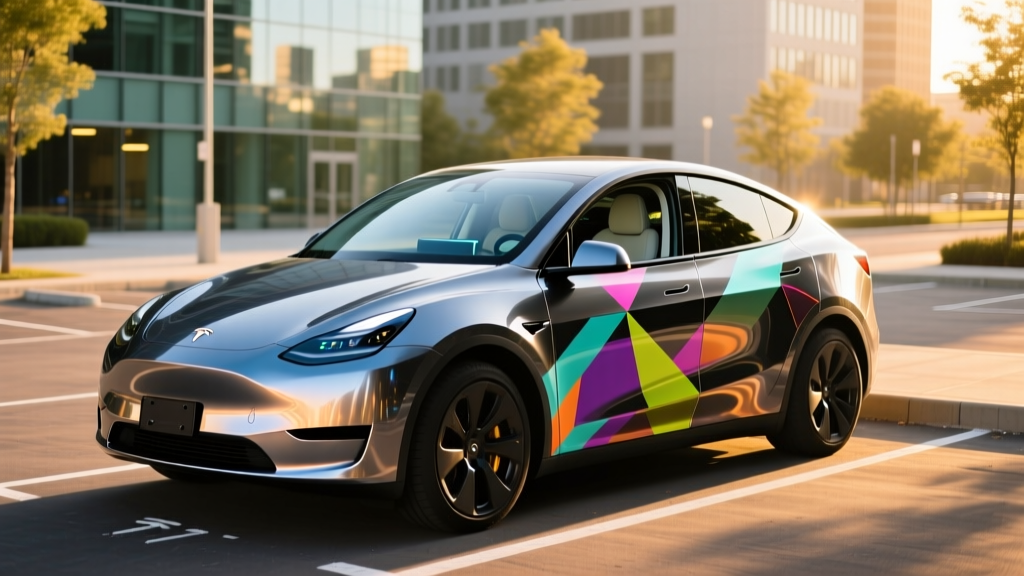
If you've just ordered a Tesla Model Y—or are deep into researching one—you've probably noticed the limited color palette. That reality pushes many owners toward vinyl wraps, which protect the factory paint while offering near-limitless customization. But what does a Model Y wrap actually cost, and how does it factor into the total ownership picture of one of America's best-selling electric vehicles?
This guide breaks down Tesla Model Y wrap pricing in detail, then delivers the full EV review: real-world range, charging speeds, battery chemistry, tax-credit math, and whether the 2026 Model Y still holds its crown against the Hyundai Ioniq 5, Ford Mustang Mach-E, and a wave of new Chinese-market competitors now entering global markets.
How Much Does a Tesla Model Y Wrap Cost?
A full exterior vinyl wrap on a Tesla Model Y typically costs between $2,500 and $6,000 installed, depending on material quality, shop reputation, and your local market. Here's how the pricing tiers break down:
| Tier | Material | Average Cost | Expected Lifespan | Notes |
|---|---|---|---|---|
| Budget | Cast vinyl (economy grade) | $2,500 – $3,200 | 2 – 3 years | Prone to edge lifting; limited color options; may leave residue |
| Mid-Range | 3M 2080 / Avery Dennison SWF | $3,500 – $4,500 | 5 – 7 years | Industry standard; wide finish selection (matte, satin, gloss, metallic) |
| Premium | Color-shift / textured / PPF hybrid | $5,000 – $7,500+ | 7 – 10 years | Chameleon, brushed-metal, or paint-protection-film combos |
Why the Model Y costs more to wrap than smaller cars: The Model Y's surface area is substantial—roughly 225–250 square feet of exterior panels including bumpers, mirrors, and door jambs. Its curved fenders, large liftgate, and panoramic glass roof edge all require skilled panel-by-panel application. Most reputable shops charge $10–$18 per square foot for mid-grade materials with labor included.
Partial wraps and accents run $500–$1,500 for roof-only jobs (popular for the blacked-out look), $300–$600 for mirror caps, and $800–$1,200 for chrome-delete packages that cover the window trim and badges.
Pro tip: If your primary goal is paint protection rather than color change, consider paint protection film (PPF) instead. A full-body PPF installation runs $5,000–$8,000 but offers self-healing properties and rock-chip resistance that vinyl wraps don't provide. Many owners combine a PPF base layer with a color-change wrap on top.
2026 Tesla Model Y: Range, Battery, and Efficiency
The 2026 Tesla Model Y Long Range AWD carries an EPA-estimated 320 miles of range, while the rear-wheel-drive base model achieves approximately 310 miles. The Performance variant drops to around 285 miles due to its sportier tuning and stickier tires.
The EPA's 320-mile sticker assumes a mix of city and highway driving at moderate temperatures. In our experience and aggregated owner data, expect ~270–290 miles on sustained highway trips at 70–75 mph. In cold weather (below 30°F), range drops 15–25%, putting realistic winter range at ~240–270 miles for the Long Range AWD. The Model Y's heat pump (standard since 2021) mitigates cabin-heating energy draw, but battery chemistry still loses efficiency in the cold. Preconditioning the battery while plugged in is essential for preserving range and enabling peak DC charging speeds.
| Spec | Long Range AWD | RWD (Base) | Performance |
|---|---|---|---|
| EPA Range | 320 mi | 310 mi | 285 mi |
| Battery (usable) | ~75 kWh (NMC) | ~60 kWh (LFP) | ~75 kWh (NMC) |
| Drivetrain | Dual-motor AWD | Single-motor RWD | Dual-motor AWD |
| Horsepower | ~384 hp | ~295 hp | ~456 hp |
| 0–60 mph | 4.8 sec | 6.6 sec | 3.5 sec |
| MPGe (combined) | 117 MPGe | 123 MPGe | 111 MPGe |
| Efficiency | 29 kWh/100mi | 27 kWh/100mi | 30 kWh/100mi |
| Base MSRP | $48,990 | $44,990 | $53,990 |
Battery chemistry matters: The base RWD Model Y uses an LFP (lithium iron phosphate) battery, which sacrifices some energy density for superior longevity and thermal stability. Tesla recommends charging LFP packs to 100% regularly. The Long Range and Performance trims use NMC (nickel manganese cobalt) chemistry for higher energy density; Tesla recommends an 80% daily charge limit, reserving 100% for long trips.
Charging Speed: DC Fast, Level 2, and Home Setup
Charging speed remains one of the Model Y's strongest advantages, thanks to Tesla's Supercharger network—now increasingly open to non-Tesla EVs via the NACS standard, which Tesla pioneered and which has become the de facto North American charging connector.
| Level | Power | Speed / Notes |
|---|---|---|
| Level 1 (120V household) | ~1.4 kW | ~3–4 miles per hour |
| Level 2 (240V home / public) | Up to 11.5 kW (48A) | ~37 miles per hour; full charge in ~7–8 hours |
| DC Fast Charge (V3 Supercharger) | Peak 250 kW | 10–80% in ~22 minutes |
| DC Fast Charge (V4 Supercharger) | Peak 250 kW* | Similar to V3; V4 cabinet supports higher future rates |
Charging curve reality: The Model Y's peak 250 kW draw occurs only between roughly 10–30% state of charge. Above 50%, the rate tapers significantly, dropping to ~100 kW by 70% and ~40 kW above 90%. This is standard lithium-ion behavior, not a flaw—but it means the advertised "15 minutes to 200 miles" applies only to the bottom portion of the battery. Plan your road-trip stops around 10–80% sessions for optimal time efficiency.
Home charging: A Tesla Wall Connector ($475) on a 60-amp circuit delivers the Model Y's maximum 11.5 kW AC charge rate. Most owners installing a 240V/50A outlet (NEMA 14-50) will see ~9.6 kW, adding roughly 30 miles per hour—enough to fully replenish overnight. Installation costs vary widely: $500–$1,500 if your electrical panel has capacity, but $2,000–$4,500 if a panel upgrade (to 200A service) is needed. Always get a quote from a licensed electrician before committing.
Pricing, Trims, and Federal Tax Credit Eligibility
The 2026 Model Y lineup has been streamlined compared to prior years. Here's the current pricing and tax-credit picture:
| Trim | Base MSRP | §30D Credit | Effective Price | Eligibility Notes |
|---|---|---|---|---|
| RWD | $44,990 | Up to $7,500 | ~$37,490 | MSRP under $80K cap ✓; income & sourcing rules apply |
| Long Range AWD | $48,990 | Up to $7,500 | ~$41,490 | MSRP under $80K cap ✓; income & sourcing rules apply |
| Performance | $53,990 | Up to $7,500 | ~$46,490 | MSRP under $80K cap ✓; income & sourcing rules apply |
The federal §30D tax credit is not automatic. Under current IRS rules, eligibility depends on:
- Buyer income caps: Modified AGI ≤ $150,000 (single), $225,000 (head of household), $300,000 (joint)
- MSRP cap: SUVs/vans/pickups must be ≤ $80,000 (all Model Y trims qualify)
- Battery sourcing: Critical minerals and battery components must meet escalating percentage thresholds from US or free-trade-agreement countries. These thresholds tighten annually—verify current-year compliance on the IRS clean vehicle credit page before purchasing
- Point-of-sale transfer: As of 2024, buyers can transfer the credit to the dealer at purchase, reducing the out-of-pocket price immediately rather than waiting for a tax refund
Consult a tax professional to confirm your personal eligibility. State and utility incentives may stack on top but vary by jurisdiction—check AFDC's state incentive database for local programs.
Interior, Cargo, and Technology
The Model Y's cabin remains minimalist and screen-centric. A single 15.4-inch touchscreen handles infotainment, climate, navigation, and vehicle settings—no physical instrument cluster, no heads-up display. The 2025 refresh (carried into 2026) added ventilated front seats, ambient lighting, power-folding second-row seats, and improved sound insulation that noticeably reduces road noise at highway speeds.
Cargo capacity: 30.2 cubic feet behind the second row, expanding to 72.1 cubic feet with the rear seats folded. The front trunk (frunk) adds 4.1 cubic feet—useful for charging cables, groceries, or a small carry-on. Rear legroom measures 41.6 inches, adequate for adults on longer trips.
Driver assistance: Basic Autopilot (lane centering + adaptive cruise) is standard. Full Self-Driving (Supervised) remains a $8,000 add-on or $99/month subscription. FSD is an SAE Level 2 system—it does not make the Model Y self-driving. You must remain attentive, keep your hands available, and monitor the road at all times. True Level 4 autonomy (no driver required) exists only in geofenced robotaxi services like Waymo, not in any consumer vehicle.
Tesla Autopilot and FSD (Supervised) are Level 2 driver-assist systems. They can steer, accelerate, and brake within their operational domain, but they cannot handle all driving scenarios. Construction zones, faded lane markings, adverse weather, and unexpected obstacles require immediate human takeover. NHTSA continues to investigate Autopilot-related incidents. Never treat these systems as a substitute for an engaged driver.
Pros, Cons, and Who Should Buy
- Class-leading Supercharger network access (17,000+ US stalls)
- Excellent efficiency: 27–30 kWh/100mi is best-in-segment
- Strong real-world range (270–290 mi highway)
- Spacious cargo area with versatile frunk + hatchback layout
- Over-the-air updates continuously add features
- Strong resale value relative to EV segment average
- LFP option on RWD for buyers prioritizing battery longevity
- Minimalist interior isn't for everyone—no physical buttons or stalks (turn signals on steering wheel)
- Ride quality still firm on rough pavement despite 2025 suspension updates
- FSD (Supervised) costs $8,000 and remains Level 2
- Insurance premiums 20–40% higher than comparable gas SUVs
- Limited color options push owners toward wraps ($2,500–$6,000+)
- No Apple CarPlay or Android Auto
- Increasing competition from Ioniq 5, Mach-E, and others with 800V charging
Who the Model Y suits best: This is the default recommendation for families and commuters who want one vehicle that does everything adequately to exceptionally. The combination of range, cargo space, Supercharger access, and efficiency makes it ideal for daily commuting, school runs, and 300-mile road trips alike. If you tow (up to 3,500 lbs), camp with V2L needs, or want a more engaging driving experience, competitors like the Ford Mustang Mach-E or Hyundai Ioniq 5 may better fit specific priorities—but none match the Model Y's overall package breadth.
Warranty and Long-Term Ownership
Tesla's warranty coverage for the 2026 Model Y:
- Basic vehicle: 4 years / 50,000 miles
- Battery & drive unit (Long Range/Performance): 8 years / 120,000 miles, with minimum 70% capacity retention
- Battery & drive unit (RWD/LFP): 8 years / 100,000 miles, with minimum 70% capacity retention
The 70% retention threshold is standard across the industry. In practice, Tesla's battery degradation data (aggregated from fleet telemetry) shows most Model Y packs retaining ~90% capacity at 100,000 miles, with LFP packs showing particularly flat degradation curves. A full battery replacement outside warranty currently runs $12,000–$16,000 depending on the pack, though this cost continues to decline as battery manufacturing scales.
Frequently Asked Questions
Does wrapping a Tesla Model Y void the warranty?
A professionally installed vinyl wrap does not void Tesla's vehicle warranty. However, if wrap removal damages paint or trim, those repairs won't be covered. Use a reputable installer who documents their work and uses quality adhesives (3M or Avery Dennison). Notify your insurance company, as some carriers require disclosure of aftermarket modifications.
Can I wrap a leased Tesla Model Y?
Yes, and many lessees do. Vinyl wraps are fully removable and can protect the factory paint during the lease term. Just ensure removal before lease return to avoid potential disposition-fee disputes over modified appearance.
How does the Model Y compare to the Hyundai Ioniq 5?
The Ioniq 5 offers 800V architecture (10–80% in ~18 minutes on a 350 kW charger), a more distinctive interior with physical controls, and competitive range (~305 mi). However, it lacks Tesla's Supercharger network (though Hyundai has partnered with Electrify America) and offers slightly less cargo space. If fast-charging speed and interior design matter most, the Ioniq 5 is compelling. If network reliability and overall efficiency are your priorities, the Model Y still leads.
Is the Tesla Model Y still worth buying in 2026?
With the Juniper refresh fully integrated, improved NVH, and continued Supercharger dominance, the Model Y remains the segment benchmark. Competition has narrowed the gap—particularly on charging speed and interior quality—but no rival yet matches the combination of efficiency, range, network access, and cargo versatility. For most buyers cross-shopping electric SUVs, it remains the safest recommendation.
What's the cheapest way to change my Model Y's color?
A partial wrap (roof + mirror caps + chrome delete) runs $1,000–$2,000 and dramatically transforms the car's appearance. For a full color change, budget at minimum $3,500 for quality mid-grade material. Avoid sub-$2,000 full-wrap quotes—these typically use calendared vinyl that shrinks, cracks, and leaves adhesive residue within 18 months.