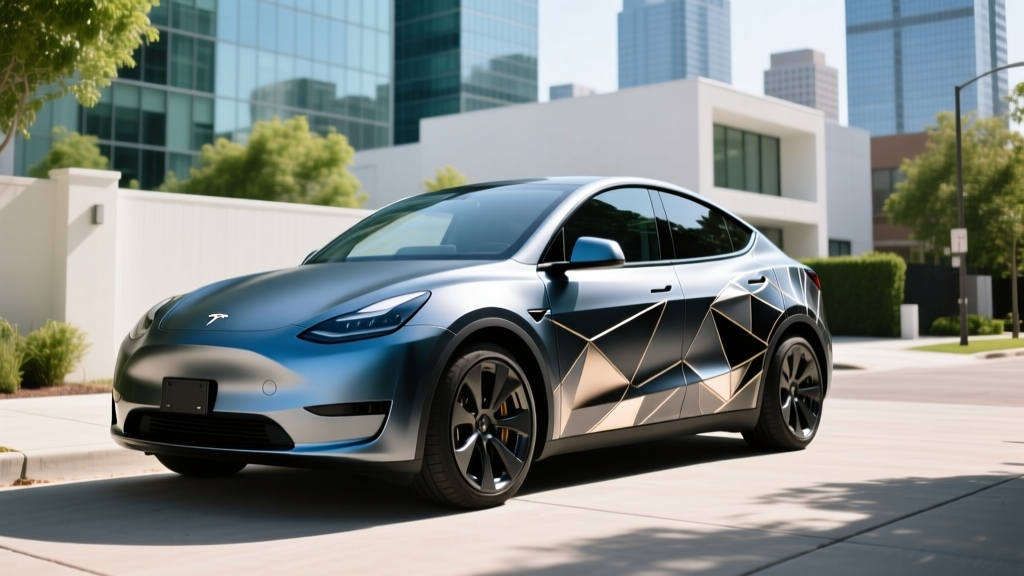
If you've searched how much is it to wrap a Tesla Model Y, you're likely weighing paint protection, color customization, or both against the backdrop of one of America's best-selling electric vehicles. A professional vinyl wrap on a Model Y typically runs $2,500 to $6,000 depending on film quality, coverage, and shop location — but the real question is whether that investment makes sense given the vehicle's total cost of ownership, efficiency, and long-term value.
This guide answers the wrap-cost question in detail, then delivers the full 2026 Tesla Model Y review you need: EPA range, charging speeds, battery chemistry, tax credit eligibility, and how it stacks up against rivals like the Hyundai Ioniq 5 and Ford Mustang Mach-E.
Vinyl Wrap Cost for the Tesla Model Y: What You'll Actually Pay
The Model Y's crossover proportions — roughly 187 inches long with sweeping roof and hatch contours — require more material and labor than a sedan like the Model 3. Here's what shops are charging in 2026:
| Wrap Type | Material | Estimated Cost | Longevity |
|---|---|---|---|
| Partial (roof/hood/mirrors) | Standard cast vinyl | $800 – $1,500 | 3–5 years |
| Full body — gloss/matte color change | 3M 2080 / Avery Dennison SWF | $2,800 – $4,200 | 5–7 years |
| Full body — premium (satin chrome, color-shift) | 3M 2080 premium / KPMF | $4,000 – $5,500 | 5–7 years |
| Full body + door jambs + wheel faces | Premium cast + extra labor | $5,500 – $7,500+ | 5–7 years |
| Paint Protection Film (PPF) — full | Self-healing urethane (XPEL, SunTek) | $5,000 – $8,000 | 7–10 years |
Key cost drivers: Tesla's factory paint is notoriously thin, making PPF popular among owners who want rock-chip protection rather than a color change. Matte and satin finishes cost 15–25% more than gloss due to installation difficulty. Expect to pay $300–$600 extra if you want chrome-delete trim wrapped to match. Always choose a shop that removes door handles, mirrors, and emblems rather than cutting around them — knifeless tape is a minimum standard.
2026 Tesla Model Y: EPA Range, Battery, and Real-World Efficiency
For the 2026 model year, the Model Y continues on the refreshed "Juniper" platform introduced for 2025, with minor battery and software refinements. Here are the numbers that matter:
| Spec | Long Range AWD | Performance AWD | RWD (Standard Range) |
|---|---|---|---|
| EPA Range | 320 miles | 298 miles | 279 miles |
| Battery Capacity (usable) | ~78 kWh (NMC) | ~78 kWh (NMC) | ~60 kWh (LFP) |
| Drivetrain | Dual Motor AWD | Dual Motor AWD | Single Motor RWD |
| Horsepower | 384 hp | 456 hp | 295 hp |
| 0–60 mph | 4.8 sec | 3.5 sec | 6.6 sec |
| Efficiency (combined) | 122 MPGe / 27 kWh/100mi | 111 MPGe / 30 kWh/100mi | 128 MPGe / 26 kWh/100mi |
| Top Speed | 125 mph | 155 mph | 135 mph |
Charging Speed: DC Fast Charge, Level 2, and the NACS Advantage
The 2026 Model Y uses Tesla's North American Charging Standard (NACS) connector natively — the same plug now adopted by Ford, GM, Rivian, Hyundai, and most major automakers. This means full, unrestricted access to the Tesla Supercharger network, which remains the most reliable DC fast-charging infrastructure in the U.S.
| Charging Level | Power / Rate | Speed (Miles Added) | Notes |
|---|---|---|---|
| Level 1 (120V household) | ~1.4 kW | ~4–5 miles/hour | Emergency/top-up only |
| Level 2 (240V home, 48A) | 11.5 kW | ~37 miles/hour | Full charge overnight (~8 hrs) |
| Level 2 (240V, 32A Mobile Connector) | 7.7 kW | ~25 miles/hour | Included Mobile Connector |
| DC Fast Charge (Supercharger V3/V4) | Peak 250 kW | ~1,000 mi/hr peak | 10–80% in ~25 minutes |
Charging curve reality: The Model Y Long Range peaks at 250 kW only between roughly 10–30% State of Charge (SoC). By 50% SoC, speed tapers to ~150 kW; above 80%, it drops below 50 kW. This is normal lithium-ion behavior. For road trips, plan 10–80% stops (~25 min) rather than filling to 100% — the last 20% can add another 25–30 minutes.
kW vs. kWh reminder: kW (kilowatts) measures charge speed — how fast energy flows into the car. kWh (kilowatt-hours) measures battery capacity — how much energy the battery holds. A 78 kWh battery charging at 250 kW will not fill in 18 minutes; the taper curve means real 10–80% time is ~25 minutes.
Pricing, Trims, and Federal Tax Credit Eligibility
Tesla adjusted Model Y pricing several times over the past two years. As of early 2026, here's where the lineup stands before destination fees and options:
| Trim | Base MSRP | §30D Federal Credit | Effective Price |
|---|---|---|---|
| Long Range AWD | $44,990 | Up to $7,500* | ~$37,490* |
| Performance AWD | $48,990 | Up to $7,500* | ~$41,490* |
| RWD (Standard Range) | $39,990 | Up to $7,500* | ~$32,490* |
*Critical tax credit caveats (IRS §30D, 2026 rules): The full $7,500 credit requires meeting all of the following, per IRS guidelines:
- MSRP cap: SUVs/crossovers must be ≤ $80,000 (all Model Y trims qualify)
- Buyer income cap: AGI ≤ $150,000 single / $225,000 head of household / $300,000 joint
- Battery sourcing: Critical minerals and battery components must meet escalating domestic/free-trade-agreement thresholds — Tesla has largely localized supply, but verify the specific VIN at the point of sale
- Point-of-sale transfer: You can apply the credit as an instant rebate at purchase rather than waiting for tax filing
The RWD trim's LFP battery uses iron phosphate chemistry, which has historically relied more heavily on Chinese-sourced minerals. Verify current §30D eligibility for the RWD specifically — the Long Range (NMC) has consistently qualified. Consult a tax professional for your individual situation.
Interior, Cargo, Tech, and Daily Livability
The Juniper refresh brought a quieter cabin, ventilated front seats, ambient lighting, and a rear touchscreen for passengers — addressing many complaints from pre-2025 owners. The minimalist interior remains polarizing but functional.
Cargo & passenger dimensions:
- Cargo behind rear seats: 30.2 cu ft
- Cargo with rear seats folded: 72.1 cu ft
- Front trunk (frunk): 4.1 cu ft
- Rear legroom: 41.6 inches
- Front headroom: 41.0 inches
Standout tech:
- 15.4-inch center touchscreen with Tesla's latest UI
- 8-camera Tesla Vision suite (no radar or ultrasonic sensors)
- Autopilot standard (SAE Level 2 — requires hands-on-wheel supervision at all times)
- Full Self-Driving (Supervised) available as a $8,000 option or $99/month subscription — still SAE Level 2, not autonomous
- Over-the-air updates, Sentry Mode, Dog Mode, theater-grade audio (14 speakers on Long Range/Performance)
Notable drawbacks:
- No physical buttons or stalks for turn signals (steering-wheel capacitive controls — an adjustment period)
- Rear visibility is limited; relies heavily on cameras
- No Apple CarPlay or Android Auto — Tesla's ecosystem is closed
- Ride quality on 20-inch Performance wheels can be firm on rough pavement
Pros, Cons, and Who the Model Y Suits Best
Pros
- Best-in-class Supercharger network access (NACS native)
- Class-leading efficiency (~27 kWh/100mi on Long Range)
- Spacious cargo area with flat-fold rear seats
- Strong resale value relative to EV peers
- Continuous OTA improvements post-purchase
- Qualifies for $7,500 federal credit (verify by VIN)
Cons
- Minimalist controls require adaptation (no stalks, no buttons)
- No CarPlay/Android Auto
- Insurance premiums run 15–25% higher than comparable ICE crossovers
- LFP RWD battery loses more range in extreme cold
- Build quality improving but still inconsistent panel gaps reported
Who this EV suits best:
- Commuters and road-trippers: 320-mile range + Supercharger access makes the Long Range ideal for both daily driving and cross-country travel
- Small families: Ample cargo, good rear legroom, excellent safety ratings (NHTSA 5-Star)
- Tech-forward buyers: If you want OTA updates and a software-defined vehicle, Tesla still leads
- Not ideal for: Heavy towing (3,500-lb max, real-world range drops sharply), buyers who prefer physical controls, or those in remote areas far from Superchargers
Model Y vs. Key Competitors: Is It Still the Default Choice?
| Spec | Tesla Model Y LR | Hyundai Ioniq 5 LR AWD | Ford Mustang Mach-E ER AWD |
|---|---|---|---|
| EPA Range | 320 mi | 305 mi | 312 mi |
| Battery (usable) | 78 kWh NMC | 84 kWh NMC | 91 kWh NMC |
| Peak DC Charge | 250 kW | 240 kW | 150 kW |
| 10–80% Time | ~25 min | ~18 min | ~45 min |
| 0–60 mph | 4.8 sec | 5.1 sec | 5.6 sec |
| Cargo (rear seats up) | 30.2 cu ft | 27.2 cu ft | 29.7 cu ft |
| Base MSRP | $44,990 | $49,850 | $48,995 |
| Connector | NACS (native) | NACS (2025+) | NACS (adapter/2025+) |
Decision Framework
- Choose the Model Y if: You prioritize Supercharger network reliability, class-leading efficiency, cargo space, and the strongest software ecosystem
- Choose the Ioniq 5 if: You want faster 10–80% charging (800V architecture), physical buttons, CarPlay, and a more conventional cockpit
- Choose the Mach-E if: You prefer a car-like driving feel, Ford dealer service network, and don't mind slower DC charging
Battery Warranty, Degradation, and Long-Term Ownership
Tesla covers the Model Y battery and drive unit with an 8-year / 120,000-mile warranty (Long Range/Performance) or 8-year / 100,000-mile warranty (RWD), guaranteeing a minimum of 70% capacity retention over that period.
Real-world degradation data: Analysis of Tesla fleet telemetry shows the average Model Y battery retains approximately 90% capacity after 100,000 miles and roughly 85% after 200,000 miles. NMC batteries (Long Range/Performance) degrade slightly faster in the first 20,000 miles before stabilizing. LFP batteries (RWD) show a more linear degradation curve but tolerate frequent 100% charging, which simplifies daily use.
Battery replacement cost: Out of warranty, a Model Y battery replacement runs approximately $12,000–$16,000 at a Tesla Service Center. Third-party EV battery shops are emerging as a lower-cost option ($8,000–$12,000), but availability varies by region.
Ownership economics: According to fueleconomy.gov, charging a Model Y Long Range at the U.S. average electricity rate of ~$0.17/kWh costs roughly $4.60 per 100 miles — compared to ~$12–$14 for a 25-MPG gas crossover at $3.20/gallon. Over 5 years and 75,000 miles, that's approximately $5,500–$7,000 in fuel savings, partially offset by higher insurance and tire costs (EVs wear tires ~20% faster due to weight and instant torque).
Frequently Asked Questions
Does a vinyl wrap affect Tesla Model Y range or efficiency?
No. A vinyl wrap adds negligible weight (roughly 15–25 lbs for a full wrap) and has no measurable impact on range or MPGe. PPF is similarly lightweight. The only consideration: dark matte wraps may slightly increase cabin heat in direct sun, marginally increasing A/C load in summer.
Will wrapping my Model Y void the Tesla warranty?
A professionally installed vinyl wrap does not void the battery, drive unit, or vehicle warranty. However, if wrap removal damages factory paint, Tesla will not cover the repaint. PPF is generally safer for warranty preservation since it's designed for removal without paint damage.
Does the 2026 Tesla Model Y qualify for the $7,500 federal tax credit?
The Long Range AWD and Performance trims have consistently qualified for the full $7,500 under IRS §30D rules, subject to buyer income caps ($150K single / $300K joint) and battery-sourcing requirements. The RWD trim's LFP battery sourcing has been less consistent — verify the specific VIN's eligibility at the point of sale. Tesla dealers and the IRS Clean Vehicle report can confirm per-VIN eligibility.
What's the real-world highway range of the Model Y Long Range?
EPA rates it at 320 miles combined. On a sustained 70–75 mph highway drive in moderate temperatures, expect 260–280 miles. In winter (below 32°F), plan for 220–240 miles between charges. Preconditioning the battery via the Tesla app before departure recovers some of this loss.
How much does home charging installation cost for a Model Y?
A dedicated 240V / 60A circuit with a Tesla Wall Connector typically costs $800–$2,500 installed, depending on panel proximity and local permit fees. If your electrical panel needs an upgrade to 200A service, add $1,500–$3,500. This is a one-time cost that pays for itself within 1–2 years versus public DC fast charging.
Is the Tesla Model Y still worth buying in 2026 vs. newer competitors?
The Model Y remains the default choice for buyers who prioritize charging infrastructure (Supercharger network), software maturity, and strong resale value. Competitors like the Ioniq 5 offer faster peak charging and CarPlay, but Tesla's integrated ecosystem, efficiency, and cargo space keep it competitive. If you road-trip frequently, the Supercharger advantage is still significant.