The Tesla Model Y remains one of the best-selling electric vehicles in the United States for good reason: it packages long range, fast charging, and practical cargo space into a crossover footprint that fits most American garages and parking spots. But buyers frequently search for specific physical dimensions — particularly the Tesla Model Y width — to confirm it will work for their garage, carport, or tight urban parking. This review answers that question precisely and then goes deeper into everything else you need to know before buying: real-world range, DC fast-charging curves, battery chemistry, tax-credit eligibility under IRS §30D, and how the 2026 Model Y stacks up against rivals like the Hyundai Ioniq 5 and Ford Mustang Mach-E.
Tesla Model Y Width and Exterior Dimensions Explained
The Tesla Model Y measures 75.6 inches wide (1,921 mm) with the side mirrors folded, and approximately 83.8 inches wide (2,129 mm) with mirrors extended. That places it squarely in the midsize crossover segment — narrower than a full-size SUV but wider than compact crossovers like the Chevrolet Equinox EV.
| Dimension | Measurement |
|---|---|
| Width (mirrors folded) | 75.6 in (1,921 mm) |
| Width (mirrors extended) | 83.8 in (2,129 mm) |
| Length (overall) | 187.0 in (4,751 mm) |
| Height | 63.9 in (1,624 mm) |
| Wheelbase | 113.8 in (2,890 mm) |
| Ground clearance | 6.6 in (167 mm) |
| Curb weight (Long Range AWD) | ~4,398 lbs |
Garage fit note: The minimum recommended single-car garage width is 10 feet (120 inches). The Model Y at 75.6 inches (mirrors folded) leaves roughly 22 inches of clearance per side — enough for door opening in most standard garages, but tight if you have shelving or storage racks on the walls. If your garage opening is under 96 inches wide, measure carefully before committing.
Interior Space: Passenger Room and Cargo Volume
The Model Y's 75.6-inch width translates into generous shoulder room up front and a flat floor that makes the rear middle seat genuinely usable — a rarity in EVs with large battery packs.
| Measurement | Front | Rear |
|---|---|---|
| Headroom | 41.0 in | 37.7 in |
| Legroom | 41.8 in | 37.3 in |
| Shoulder room | 58.4 in | 54.4 in |
| Hip room | 53.1 in | 51.3 in |
Cargo volume: 30.2 cubic feet behind the second row, expanding to 72.1 cubic feet with the rear seats folded. The front trunk (frunk) adds approximately 4.1 cubic feet — enough for a charging cable bag and a small duffel. For comparison, the Hyundai Ioniq 5 offers 27.2 cu ft behind the rear seats (56.2 cu ft folded), giving the Model Y a meaningful cargo advantage for family hauling.
Battery, Range, and Efficiency: Real-World Numbers
The 2026 Tesla Model Y Long Range AWD is equipped with an ~78 kWh usable battery pack using NMC (nickel manganese cobalt) chemistry, which offers higher energy density than LFP and is standard on Long Range and Performance trims. The base Rear-Wheel-Drive model has historically used LFP (lithium iron phosphate) chemistry in a smaller pack (~60 kWh usable) — LFP is heavier but supports regular 100% charging without degradation concerns and has a longer cycle life.
EPA estimated range (Long Range AWD): 320 miles
Real-world highway (70-75 mph, moderate temps): ~270-290 miles
Real-world cold weather (below 30°F, highway): ~220-250 miles
Real-world city/mixed (temperate): ~300-320 miles
EVs lose efficiency at sustained highway speeds due to aerodynamic drag, and lithium-ion batteries lose capacity in cold temperatures because internal resistance increases. The Model Y's standard heat pump mitigates cold-weather cabin-heating energy draw, but expect a 15-25% range reduction in sub-freezing conditions compared to the EPA sticker. Source: fueleconomy.gov.
| Trim | EPA Range | MPGe (Combined) | kWh/100 mi |
|---|---|---|---|
| Long Range AWD | 320 mi | 117 MPGe | 29 kWh |
| Performance AWD | 285 mi | 111 MPGe | 30 kWh |
| Rear-Wheel-Drive | ~295 mi | ~122 MPGe | ~28 kWh |
The Model Y's efficiency is among the best in its class. At 28-30 kWh per 100 miles, it converts battery energy to distance more effectively than heavier competitors like the Ford Mustang Mach-E (which averages ~32-34 kWh/100 mi in AWD trims), directly translating into more miles per charging session.
Charging Speed: DC Fast Charging and Home Level 2
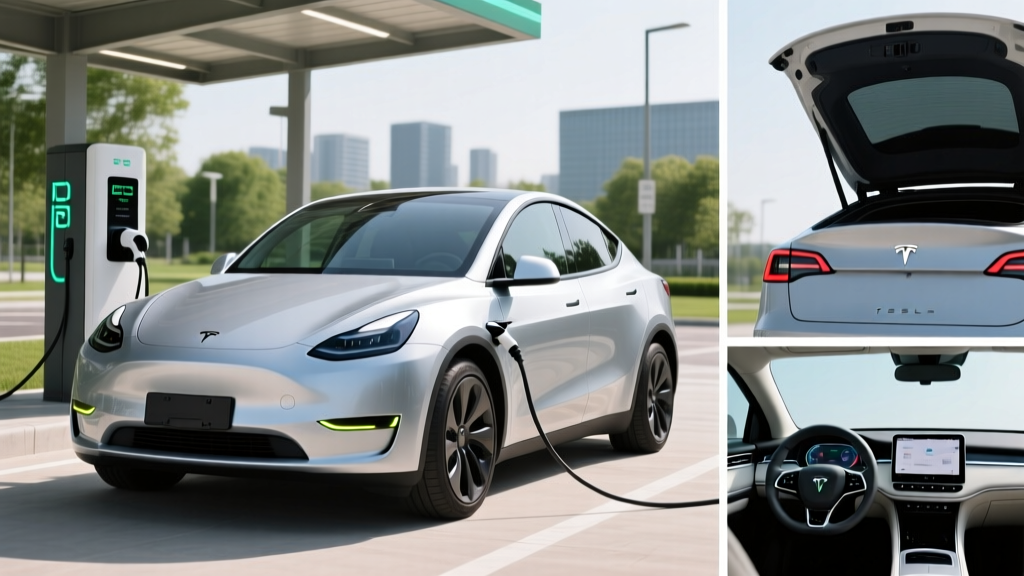
Charging speed is where the Model Y continues to lead the pack. Tesla's NACS connector and Supercharger network integration provide a seamless plug-and-charge experience, and the vehicle's thermal preconditioning — which warms the battery before you arrive at a charger — enables the pack to accept peak charge rates faster and sustain them longer.
| Charging Level | Power / Rate | Speed / Time |
|---|---|---|
| Level 1 (120V household) | ~1.4 kW | ~4-5 miles per hour |
| Level 2 (240V home, 48A) | 11.5 kW | ~37 miles per hour / full in ~8 hrs |
| DC Fast Charge (V3 Supercharger) | Peak 250 kW | 10-80% in ~25 min |
| DC Fast Charge (V4 Supercharger) | Peak 250+ kW | 10-80% in ~22 min (est.) |
Charging curve reality: The Model Y does not sustain 250 kW for the entire session. Peak rate applies roughly between 10-30% State of Charge (SoC), then tapers progressively: ~180 kW around 40%, ~120 kW around 60%, and below 50 kW past 85%. This is why 10-80% time (~25 min) is the meaningful metric — charging from 80-100% can add another 20+ minutes at very low power. Always plan road-trip stops around 10-80% sessions to minimize total charging time.
For home charging, a 48-amp Level 2 wall connector on a 60-amp circuit delivers 11.5 kW, adding roughly 37 miles of range per hour. Most owners who drive 30-40 miles per day recover their daily usage in about one hour of overnight charging. Installation cost for a Level 2 home setup typically ranges from $500 (simple outlet near the panel) to $2,500+ (long wire runs, panel upgrades). Always consult a licensed electrician for final specifications.
Performance: 0-60, Horsepower, and Drivetrain
| Trim | Drivetrain | Horsepower | 0-60 mph |
|---|---|---|---|
| Rear-Wheel-Drive | RWD (single motor) | ~346 hp | 5.0 sec |
| Long Range AWD | Dual-motor AWD | ~384 hp | 4.8 sec |
| Performance AWD | Dual-motor AWD | ~456 hp | 3.5 sec |
Even the base RWD Model Y is quick by any standard, but the dual-motor AWD trims add all-weather traction and a lower center of gravity feel thanks to the torque-vectoring rear motor. The Performance trim's 3.5-second 0-60 time puts it in sports-car territory, and Tesla's instant torque delivery makes it feel even quicker in real-world stoplight-to-stoplight driving. Regenerative braking is strong enough to enable one-pedal driving in most scenarios, reducing brake pad wear significantly over the vehicle's life.
Pricing, Trims, and Federal Tax Credit Eligibility
| Trim | Base MSRP | Est. After §30D Credit |
|---|---|---|
| Rear-Wheel-Drive | ~$44,990 | ~$37,490* |
| Long Range AWD | ~$48,990 | ~$41,490* |
| Performance AWD | ~$53,990 | ~$46,490* |
*Estimated after $7,500 federal tax credit, assuming full eligibility. Actual credit varies.
- Maximum credit: $7,500 (split: $3,750 for critical minerals + $3,750 for battery component sourcing)
- Vehicle MSRP cap: $80,000 for SUVs/crossovers/vans — the Model Y qualifies under this cap at all trims
- Buyer income cap: AGI must not exceed $150,000 (single), $225,000 (head of household), or $300,000 (married filing jointly)
- Battery sourcing: Critical minerals and battery components must meet phased-in domestic/free-trade sourcing thresholds — Tesla's US production generally meets current requirements, but verify at IRS.gov
- Point-of-sale transfer: Eligible buyers can transfer the credit to the dealer at purchase for an immediate price reduction (effective Jan 2024 onward)
- Tax liability: The credit is non-refundable — you must owe at least $7,500 in federal tax to claim the full amount (or use the point-of-sale transfer option)
Consult a tax professional to confirm your personal eligibility. Rules are subject to change. Source: IRS.gov
Tech, Safety, and Driver Assistance
The Model Y's cabin is minimalist by design: a single 15.4-inch touchscreen handles infotainment, climate, navigation, and vehicle settings. There is no traditional instrument cluster — speed and driving data appear in the upper-left corner of the main display. Standard features include:
- Over-the-air (OTA) software updates that add features post-purchase
- Tesla navigation with real-time Supercharger routing and preconditioning
- Sentry Mode dashcam recording and remote monitoring
- Phone-as-key via Bluetooth
- HEPA air filtration system (Bioweapon Defense Mode)
Tesla Autopilot (standard) and Full Self-Driving Supervised (FSD, ~$8,000 add-on or subscription) are SAE Level 2 driver-assist systems. This means the vehicle can manage steering, acceleration, and braking under certain conditions, but the driver must remain fully engaged, eyes on the road, hands available to take over at any time. FSD is not Level 4 autonomous driving. It does not replace the driver. You are legally responsible for the vehicle at all times. Source: NHTSA.
Safety ratings are strong: the Model Y has earned a 5-Star Overall Safety Rating from NHTSA and Top Safety Pick+ recognition from IIHS in prior model years. The rigid battery skateboard structure contributes to excellent crash-energy management.
Warranty Coverage
| Coverage | Term |
|---|---|
| Basic vehicle | 4 years / 50,000 miles |
| Battery & drive unit (Long Range/Performance) | 8 years / 120,000 miles |
| Battery & drive unit (RWD) | 8 years / 100,000 miles |
| Battery capacity retention threshold | 70% minimum over warranty period |
The 8-year battery warranty guarantees that the pack will retain at least 70% of its original capacity. In practice, Tesla NMC packs have shown approximately 5-8% degradation over the first 100,000 miles based on fleet data, meaning most owners will never approach the warranty threshold. LFP packs in the RWD trim tend to degrade even more slowly, though they start with less total capacity.
Who the Tesla Model Y Suits Best
- Families: 72 cu ft cargo space, rear-seat room for two car seats, and Supercharger routing make it a top family EV.
- Comuters: 320-mile EPA range covers even long commutes with days between charges; home Level 2 makes fueling effortless.
- Road trippers: Tesla's Supercharger network remains the most reliable and widespread DC fast-charging network in the US, with V3/V4 stations along major highways.
- Tech-forward buyers: OTA updates, app integration, and the Tesla ecosystem (Powerwall, solar) offer unmatched connectivity.
- You need a third row — look at the Kia EV9 or Tesla Model X.
- You prefer physical buttons and a traditional instrument cluster — the Hyundai Ioniq 5 or VW ID.4 offer more conventional interiors.
- You want CCS charging without an adapter — though Tesla's NACS is becoming the industry standard for 2025+.
Pros and Cons at a Glance
- Class-leading efficiency (~28-29 kWh/100 mi)
- 250 kW DC fast charging with 10-80% in ~25 min
- 72 cu ft cargo with seats folded + usable frunk
- Supercharger network reliability
- Strong safety ratings (5-star NHTSA)
- OTA updates continuously improve the vehicle
- Qualifies for full $7,500 federal tax credit (subject to eligibility)
- No physical buttons — all controls through touchscreen
- FSD add-on is expensive and still Level 2 (not autonomous)
- Rear visibility is limited by the sloping roofline
- Ride quality can be firm on rough pavement
- No third-row option
- Insurance premiums tend to be higher than segment average
Frequently Asked Questions
What is the exact width of the Tesla Model Y?
The Tesla Model Y is 75.6 inches (1,921 mm) wide with mirrors folded and approximately 83.8 inches (2,129 mm) wide with mirrors extended. For garage clearance planning, use the mirrors-folded measurement of 75.6 inches.
What is the real-world range of the Tesla Model Y?
The Long Range AWD carries an EPA estimate of 320 miles. In real-world highway driving at 70-75 mph in moderate temperatures, expect approximately 270-290 miles. In cold weather below 30°F, range drops to roughly 220-250 miles due to increased battery resistance and cabin heating demand. City driving in temperate conditions can match or slightly exceed the EPA estimate thanks to regenerative braking.
How fast does the Tesla Model Y charge?
On a Tesla V3 Supercharger, the Model Y peaks at 250 kW and charges from 10-80% in approximately 25 minutes. At home on a 48-amp Level 2 charger (11.5 kW), it adds about 37 miles of range per hour, fully recharging overnight. A standard 120V Level 1 outlet adds only 4-5 miles per hour — suitable only for emergency or very low-mileage use.
Does the Tesla Model Y qualify for the federal EV tax credit?
Yes, the Model Y qualifies for the IRS §30D clean vehicle credit of up to $7,500, as it is assembled in the US, falls under the $80,000 SUV MSRP cap, and meets current battery-sourcing requirements. However, buyer income must not exceed $150,000 (single) / $300,000 (married filing jointly). The credit can be transferred to the dealer at the point of sale for an immediate price reduction. Always verify current eligibility at IRS.gov and consult a tax professional.
Is the Tesla Model Y worth buying vs. competitors?
The Model Y's combination of 320-mile range, 250 kW charging, 72 cu ft cargo space, and Supercharger network access makes it the default choice in the segment. The Hyundai Ioniq 5 offers faster 10-80% charging (~18 min on 350 kW chargers) and a more conventional interior, but less cargo space and a smaller charging network. The Ford Mustang Mach-E provides engaging driving dynamics but trails in efficiency and range. If you prioritize charging convenience and cargo versatility, the Model Y is still the benchmark.
What battery chemistry does the Model Y use?
Long Range and Performance trims use NMC (nickel manganese cobalt) chemistry for maximum energy density and range. The Rear-Wheel-Drive trim has used LFP (lithium iron phosphate) chemistry, which is heavier but supports daily 100% charging without accelerated degradation and offers a longer overall cycle life. LFP is recommended for buyers who primarily charge at home and want a low-maintenance ownership experience.
How much does it cost to charge a Tesla Model Y at home?
At the US average electricity rate of ~$0.16/kWh, fully charging the Long Range's ~78 kWh battery costs approximately $12.50 — equivalent to about $0.04 per mile. Compare that to a 25 MPG gas vehicle at $3.50/gallon ($0.14 per mile). Over 15,000 miles per year, home charging saves roughly $1,500 vs. gasoline. Source: fueleconomy.gov.