The Reality Behind "Tesla Wheelchairs"
Search for "Tesla wheelchairs" and you'll find a confusing mix of concept renders, third-party conversion shops, and hopeful forum posts. Here's the unvarnished truth: Tesla does not manufacture or sell wheelchair-accessible vehicles (WAVs), nor does it offer a factory wheelchair ramp or lift system for any model in its lineup — not the Model Y, Model X, Cybertruck, or any other vehicle as of the 2026 model year.
That said, the question driving those searches is legitimate and important: Can an electric vehicle — specifically a Tesla — serve a wheelchair user or a family that needs wheelchair accessibility? The answer is nuanced. The Tesla Model Y, with its crossover ride height and hatchback cargo area, is the most commonly adapted Tesla for wheelchair-related use cases, but significant limitations remain. This review examines the Model Y's specs, space, and practical suitability as a platform for wheelchair users or caregivers who transport someone using a wheelchair — alongside the real options that exist today.
2026 Tesla Model Y: Spec Snapshot
| Specification | Model Y Long Range AWD | Model Y Performance |
|---|---|---|
| EPA Range | 320 miles | 280 miles |
| Battery Capacity | ~78 kWh usable (NMC) | ~78 kWh usable (NMC) |
| Drivetrain | Dual-Motor AWD | Dual-Motor AWD |
| Horsepower | 384 hp | 456 hp |
| 0–60 mph | 4.8 seconds | 3.5 seconds |
| Max DC Fast Charge | 250 kW (peak) | 250 kW (peak) |
| 10–80% DC Charge Time | ~25 minutes | ~25 minutes |
| Level 2 Home Charge Rate | 11.5 kW (~44 mi/hr) | 11.5 kW (~44 mi/hr) |
| MPGe (Combined) | 111 MPGe | 103 MPGe |
| Efficiency | 27 kWh/100 mi | 29 kWh/100 mi |
| Cargo Volume (rear seats up) | 30.2 cu ft | 30.2 cu ft |
| Cargo Volume (rear seats folded) | 72.1 cu ft | 72.1 cu ft |
| Front Trunk (Frunk) | 4.1 cu ft | 4.1 cu ft |
| Rear Legroom | 39.5 inches | 39.5 inches |
| Base MSRP | $47,990 | $52,490 |
| Battery Warranty | 8 years / 120,000 miles | 8 years / 120,000 miles |
Source: fueleconomy.gov, Tesla.com 2026 specs. Pricing before destination fees and incentives.
Real-World Range: What Wheelchair Users Should Expect
EPA Estimate: 320 miles (Long Range AWD)
Real-World Highway (70–80 mph): ~250–270 miles
Cold Weather (below 32°F): ~210–240 miles (25–30% reduction typical for NMC chemistry)
Mixed Commute (city + highway): ~280–300 miles
For wheelchair users or caregivers planning medical appointments, therapy sessions, or paratransit-style driving routines, range matters differently than for a typical commuter. You may be making multiple short trips with significant idle time for loading and unloading a wheelchair, which means cabin conditioning (heating or AC) draws from the battery even while stationary.
The Model Y's 78 kWh battery pack uses NMC (nickel manganese cobalt) chemistry, which offers strong energy density but is more sensitive to cold-weather range loss than LFP (lithium iron phosphate). Tesla's heat pump — standard on all 2026 Model Y variants — helps mitigate winter losses, but expect a real-world 25–30% reduction in freezing temperatures. If your typical day involves 60–80 miles of local driving with wheelchair loading stops, a single overnight Level 2 charge will easily cover it, even in winter.
For longer trips — say, a 200-mile drive to a specialist — the Model Y Long Range can handle it without a charging stop in mild weather. In winter or at sustained highway speeds above 75 mph, plan for one 15–20 minute Supercharger stop.
Charging Speed: DC Fast, Home, and Accessibility Considerations
| Charging Level | Power (kW) | Miles Added per Hour | Typical Use Case |
|---|---|---|---|
| Level 1 (120V standard outlet) | ~1.4 kW | ~5 mi/hr | Emergency / overnight trickle |
| Level 2 (240V home wall connector) | 11.5 kW | ~44 mi/hr | Primary daily charging |
| DC Fast Charge (Supercharger V3) | 250 kW (peak) | Up to ~1,000 mi/hr | Road trips; 10–80% in ~25 min |
| DC Fast Charge (CCS adapter, non-Tesla) | ~150–170 kW (typical sustained) | Varies | Electrify America, EVgo, etc. |
Charging curve reality: The 250 kW peak rate on Tesla's V3 Superchargers only holds up to roughly 40–50% State of Charge (SoC). Above 60%, the rate tapers significantly — expect ~100 kW around 70% SoC and ~50 kW approaching 80%. The advertised 10–80% time of ~25 minutes reflects this taper. Charging from 80–100% adds another 20+ minutes, which is why Tesla's navigation system typically recommends charging to 80% on road trips.
Accessibility note for wheelchair users at public chargers: This is a critical and often overlooked issue. Many public DC fast-charging stations — including some Supercharger locations — have charging cables that are short, heavy, and mounted at heights that may be difficult to reach from a seated position in a wheelchair. The ADA (Americans with Disabilities Act) does not yet have specific federal standards for EV charger accessibility, though the U.S. Access Board has issued guidance. Before relying on a specific public charging network, check PlugShare or ChargePoint listings for user-submitted accessibility notes. Tesla's Supercharger stalls are generally more standardized, but cable reach remains a challenge for drivers who remain seated in a wheelchair while charging.
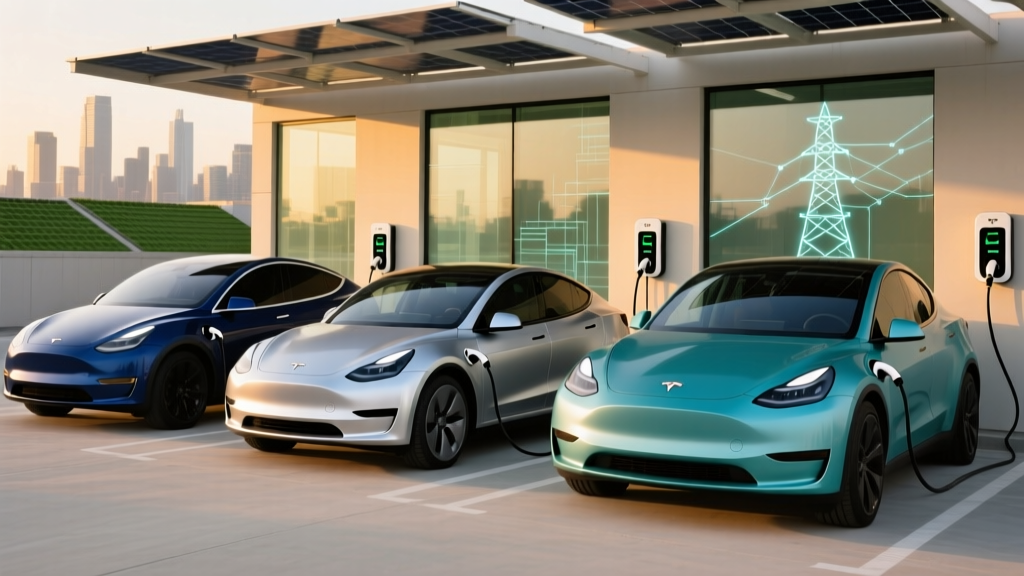
Home charging is the equalizer. A Tesla Wall Connector installed in your garage at 240V/48A delivers 11.5 kW, adding ~44 miles of range per hour — more than enough for overnight replenishment. For wheelchair users, home charging eliminates the public charger accessibility problem entirely. Budget $500–$1,500 for a professional Level 2 installation, depending on whether your electrical panel needs an upgrade (a 200-amp panel is typically required). Always get a quote from a licensed electrician before purchasing equipment.
Cargo Space and Wheelchair Fit: The Critical Question
Here's where the "Tesla wheelchair" conversation gets practical. The Model Y offers 30.2 cubic feet of cargo space behind the second row and 72.1 cubic feet with the rear seats folded flat. The load floor sits at approximately 29 inches from the ground — lower than most SUVs, which helps when lifting a folded manual wheelchair into the rear cargo area.
Folded manual wheelchair: Most standard folding manual wheelchairs (roughly 36"L × 12"W × 32"H when folded) will fit in the Model Y's cargo area with the rear seats up, though it will be a snug fit width-wise between the wheel wells. With one or both rear seats folded, a folded manual wheelchair fits easily with room to spare for groceries or medical equipment.
Power wheelchair or scooter: This is where the Model Y hits its limit. Most power wheelchairs weigh 150–300+ lbs and have dimensions that exceed the Model Y's cargo opening and load capacity. You cannot drive a power wheelchair into a Model Y, and lifting one manually is impractical. A hitch-mounted wheelchair carrier (rated for the Model Y's 350-lb tongue weight limit with the optional tow package) or a small trailer are the only realistic options for transporting a power chair — and neither is a factory Tesla offering.
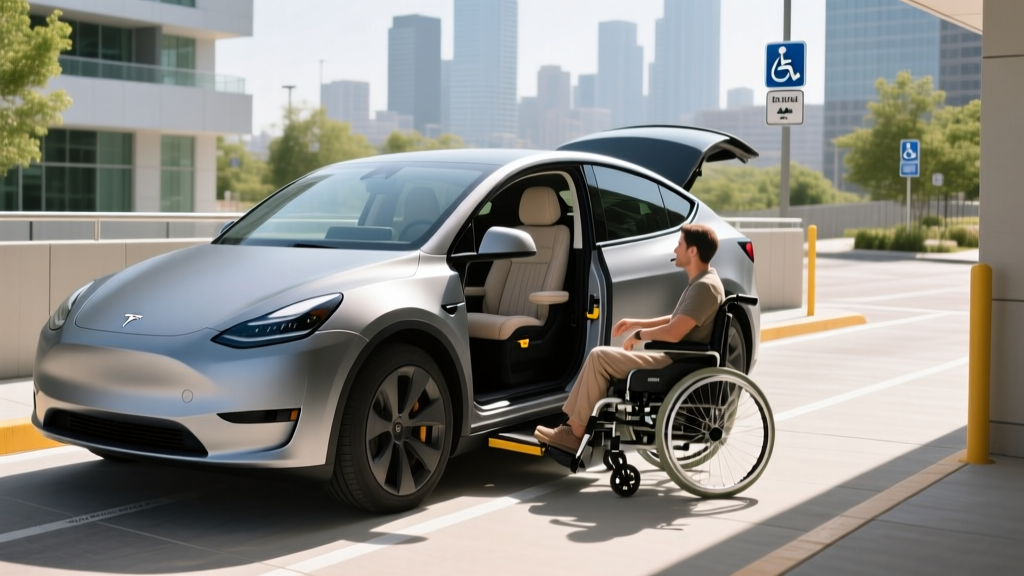
Wheelchair user as a passenger or driver (seated in wheelchair): The Model Y cannot accommodate a wheelchair user remaining seated in their chair inside the vehicle. There is no ramp system, no lowered floor, and no wheelchair tie-down points. Third-party conversion companies (such as BraunAbility, VMI, and Rollx Vans) build wheelchair-accessible vehicles exclusively on minivan and full-size van platforms — the Chrysler Pacifica, Honda Odyssey, Toyota Sienna, and Ram ProMaster. No Tesla model has been certified for a wheelchair-accessible conversion as of 2026.
The Tesla Model Y is not a wheelchair-accessible vehicle (WAV). It cannot be converted with a ramp or lowered floor. Wheelchair users who need to remain seated in their chair while inside the vehicle must look at minivan-based WAV conversions from companies like BraunAbility or VMI. The Model Y can, however, transport a folded manual wheelchair in its cargo area, making it suitable for wheelchair users who can transfer to the vehicle seat.
Driver Assistance, Tech, and Safety
The 2026 Model Y comes standard with Tesla's Basic Autopilot suite, which includes Traffic-Aware Cruise Control and Autosteer (lane-centering). This is a SAE Level 2 driver-assistance system — meaning the driver must remain fully engaged, hands on the wheel, and eyes on the road at all times. It is not self-driving.
Tesla Autopilot and FSD (Supervised) are SAE Level 2 systems. The driver is responsible for all driving decisions and must maintain continuous supervision. Full Self-Driving (Supervised) adds features like automatic lane changes and traffic light/stop sign recognition, but it still requires active driver oversight. Level 4 (true driverless operation) is currently only available in limited robotaxi services like Waymo.
Tesla's optional FSD (Supervised) package ($8,000 as of 2026) adds Navigate on Autopilot, Auto Lane Change, Smart Summon (which can pull the car forward in a parking lot — potentially useful for wheelchair users loading in tight spaces), and traffic light recognition. Smart Summon is the one feature with genuine wheelchair-user utility: you can summon the vehicle to your location in a parking lot, reducing the distance you need to travel on foot or in a wheelchair to reach the car.
Safety: The Model Y earned a 5-star overall rating from NHTSA and a Top Safety Pick+ designation from IIHS. Standard safety features include automatic emergency braking, blind-spot monitoring, lane departure warning, and eight airbags.
Infotainment: The Model Y runs Tesla's proprietary 15.4-inch touchscreen system with navigation, streaming, gaming, and over-the-air updates. There is no Apple CarPlay or Android Auto — a dealbreaker for some buyers who rely on phone-based accessibility features (voice control, screen readers). Tesla's built-in voice commands cover navigation and basic controls but are not as robust as Apple or Google's accessibility ecosystems.
Pricing, Tax Credits, and Total Cost
| Trim | Base MSRP | Est. Federal Credit (§30D) | Est. Effective Price |
|---|---|---|---|
| Model Y Long Range AWD | $47,990 | Up to $7,500* | ~$40,490* |
| Model Y Performance | $52,490 | Up to $7,500* | ~$44,990* |
*Federal tax credit eligibility under IRS §30D depends on buyer income caps ($150K single / $300K joint AGI), vehicle MSRP caps ($80K for SUVs — both trims qualify), and battery critical-mineral/battery-component sourcing requirements that change annually. The credit can be transferred to the dealer as a point-of-sale discount. Consult a tax professional for your specific eligibility.
5-Year Ownership Cost Context: Electricity costs for the Model Y average roughly $0.04–$0.06 per mile (at $0.15/kWh national average), compared to $0.12–$0.16/mile for a comparable gas-powered SUV at $3.50/gallon. Over 5 years and 75,000 miles, that's approximately $6,000–$9,000 in fuel savings. Insurance for the Model Y runs 15–30% higher than comparable non-Tesla crossovers, per industry data — budget $2,000–$3,000/year depending on your state and driving record.
Who Should (and Shouldn't) Consider the Model Y for Wheelchair Use
- You are a wheelchair user who can transfer to the driver or passenger seat
- You use a foldable manual wheelchair that fits in the cargo area
- You want low running costs, home charging convenience, and Supercharger access for road trips
- You value Smart Summon for bringing the car to you in parking lots
- You don't need to remain seated in your wheelchair inside the vehicle
- You need to remain seated in your wheelchair while inside the vehicle (you need a WAV minivan conversion)
- You use a power wheelchair or mobility scooter (too heavy/large for the Model Y cargo area)
- You require Apple CarPlay/Android Auto for accessibility tools
- You need a vehicle with a ramp or lift system (no Tesla supports this)
- Public charging accessibility in your area is poor and you lack home charging access
The Honest Alternatives for Wheelchair Accessibility
If your use case requires a true wheelchair-accessible vehicle — one with a ramp or lift, a lowered floor, and wheelchair tie-downs — the EV landscape in 2026 offers limited but improving options:
- Chrysler Pacifica PHEV (WAV conversion): The plug-in hybrid Pacifica offers ~32 miles of electric-only range and can be converted by BraunAbility and VMI with side-entry or rear-entry ramp systems. It's the closest thing to an electrified WAV currently available.
- Fully electric WAVs: As of 2026, no mass-market fully electric minivan is available in the U.S. with a certified wheelchair-accessible conversion. The Kia EV9 (3-row electric SUV) has been discussed as a future WAV platform, but no conversion exists yet.
- Paratransit and ride services: Many metro areas offer ADA-compliant paratransit services. Waymo's robotaxi fleet in Phoenix and San Francisco has begun testing accessible vehicle options, but availability remains extremely limited.
Frequently Asked Questions
Does Tesla make a wheelchair-accessible vehicle?
No. Tesla does not manufacture, sell, or certify any wheelchair-accessible vehicle (WAV) with a ramp, lift, or lowered floor. No Tesla model — including the Model Y, Model X, or Cybertruck — is available as a WAV from the factory or through a certified third-party converter as of 2026.
Can a folded wheelchair fit in the Tesla Model Y?
Yes, most standard folding manual wheelchairs will fit in the Model Y's cargo area (30.2 cu ft with seats up, 72.1 cu ft folded). Power wheelchairs and mobility scooters are generally too large and heavy to fit.
What is the real-world range of the Model Y for daily wheelchair-related trips?
The EPA rates the Long Range AWD at 320 miles. For daily local driving with frequent stops (common for medical and therapy appointments), expect 280–300 miles in mild weather and 210–240 miles in freezing temperatures.
How much does a Model Y cost after the federal tax credit?
The Long Range AWD starts at $47,990. If you qualify for the full $7,500 §30D credit (subject to income caps, MSRP limits, and battery sourcing rules), the effective price drops to approximately $40,490. The credit can be applied as a point-of-sale discount at the dealer.
Is Tesla's Smart Summon useful for wheelchair users?
Smart Summon (included with FSD Supervised) can move the car short distances in a parking lot via the Tesla app. This can reduce the distance a wheelchair user needs to travel to reach the vehicle, though it requires a flat, paved surface and has limited range (~40 feet).
Are there any electric wheelchair-accessible vehicles available in 2026?
True fully electric WAVs are not yet available in the U.S. market. The Chrysler Pacifica PHEV is the closest electrified option and can be converted with ramp systems by BraunAbility or VMI. Fully electric minivans with WAV certifications are expected later this decade.
For the latest federal tax credit rules, consult the IRS Clean Vehicle Credit page. For EV range and efficiency data, visit fueleconomy.gov.