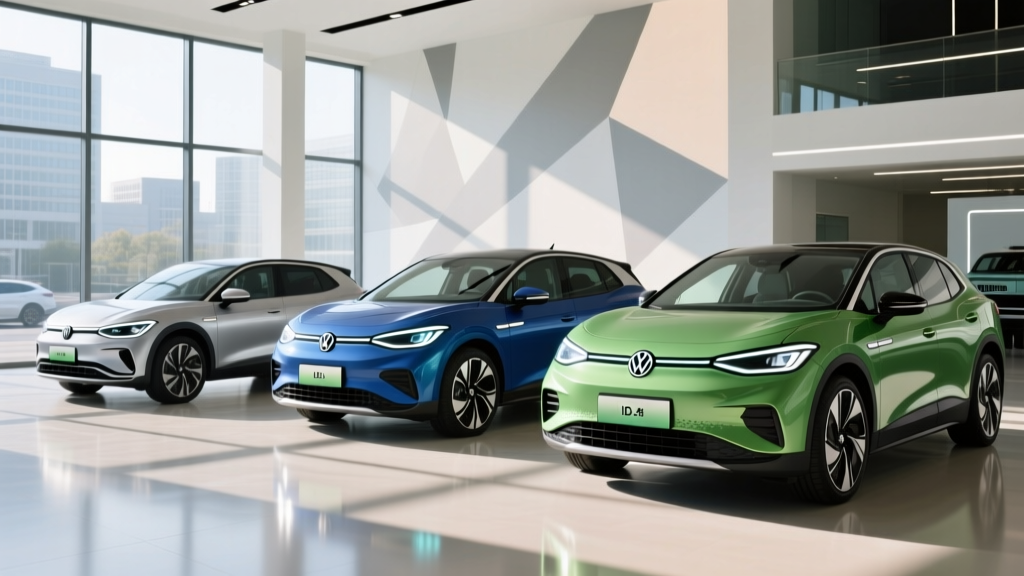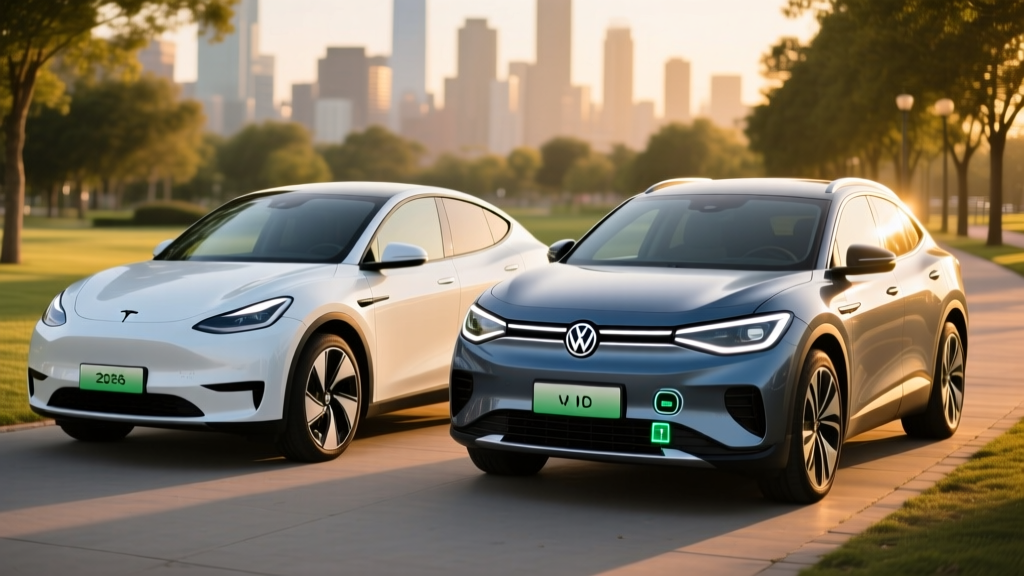
When EV shoppers search for Tesla Volkswagen, they're usually weighing the segment's two most visible electric SUVs: the Tesla Model Y and the Volkswagen ID.4. Both seat five, both offer 250+ miles of range, and both compete for the same buyer. But their approaches to efficiency, charging, and ownership are fundamentally different. This review breaks down the 2026 Tesla Model Y and 2026 Volkswagen ID.4 across every metric that matters — from real-world highway range to DC fast-charge taper curves — so you can decide which electric SUV fits your driving life.
2026 Tesla Model Y: Quick Verdict
The refreshed Model Y (internally dubbed "Juniper") arrives for 2026 with a redesigned interior, ventilated front seats, a rear touchscreen for passengers, ambient lighting, and improved ride quality thanks to revised suspension tuning. It remains the efficiency king of the compact electric SUV segment. The Long Range AWD variant delivers an EPA-estimated 320 miles on a single charge, while the Performance trim trades a small amount of range for a 3.5-second 0-60 sprint. Tesla's Supercharger network — now open to other brands via NACS adoption — remains a significant road-trip advantage, though the gap is narrowing as competitors gain access.
EPA Estimate: 320 miles (Long Range AWD) / 277 miles (Performance)
Real-World Expectation: ~270–290 mi highway at 70 mph; ~230–250 mi in sub-30°F winter conditions. Tesla's heat pump helps, but cold still cuts range 15–25%. City driving with regen braking gets closest to the EPA sticker.
2026 Volkswagen ID.4: Quick Verdict
Volkswagen's ID.4 enters 2026 with the larger 82 kWh (usable) battery now standard on most trims, replacing the older 77 kWh pack. The GTX trim adds dual-motor AWD and 295 hp, while the base Pro S with rear-wheel drive prioritizes range at 291 miles EPA. The ID.4's strengths are its car-like ride comfort, generous rear legroom, and conventional control layout that doesn't require a learning curve. Its weakness remains DC charging speed: even with VW's latest software updates, the ID.4 peaks at 175 kW and sustains that rate for a shorter window than the Model Y.
EPA Estimate: 291 miles (Pro S RWD) / 263 miles (GTX AWD)
Real-World Expectation: ~245–265 mi highway at 70 mph; ~200–225 mi in sub-30°F conditions. The ID.4's larger battery buffer helps, but its less efficient drivetrain and higher curb weight mean it loses range faster than the Model Y at sustained highway speeds.
Spec-by-Spec Comparison Table
| Spec | 2026 Tesla Model Y Long Range AWD | 2026 Volkswagen ID.4 Pro S (RWD) |
|---|---|---|
| EPA Range | 320 mi | 291 mi |
| Battery (usable) | 75 kWh, NMC | 82 kWh, NMC |
| Efficiency | 122 MPGe / 28 kWh/100mi | 107 MPGe / 32 kWh/100mi |
| Drivetrain | Dual-motor AWD | Single-motor RWD (AWD avail.) |
| Horsepower | 384 hp | 282 hp |
| 0-60 mph | 4.8 sec | 7.7 sec |
| Max DC Fast Charge | 250 kW (peak) | 175 kW (peak) |
| 10-80% DCFC Time | ~22 min | ~30 min |
| Level 2 Home Charge | 11.5 kW (~44 mi/hr) | 11 kW (~37 mi/hr) |
| Connector | NACS (native) | CCS1 (NACS adapter avail.) |
| Cargo (rear seats up) | 30.2 cu ft + 4.1 cu ft frunk | 30.3 cu ft (no frunk) |
| Rear Legroom | 38.9 in | 37.6 in |
| Towing Capacity | 3,500 lb | 2,700 lb |
| Battery Warranty | 8 yr / 120,000 mi | 8 yr / 100,000 mi |
| Base MSRP | $46,630 (Long Range AWD) | $43,545 (Pro S RWD) |
Sources: EPA fueleconomy.gov, Tesla Model Y specs, Volkswagen ID.4.
Charging Deep Dive: kW, Charge Curves, and Road-Trip Reality
Charging speed separates these two SUVs more than any other spec. The Model Y peaks at 250 kW at a V3 Supercharger, but that peak only holds from roughly 10% to 35% State of Charge (SoC). From 35% to 60%, it tapers to ~170 kW, and from 60% to 80% it drops further to ~100 kW. The result is a 10–80% session of about 22 minutes — fast, but not the flat-line 250 kW that marketing implies.
The ID.4 peaks at 175 kW (up from 135 kW on earlier models), and its curve is flatter: it holds near 170 kW from 10% to about 50% SoC, then tapers more gradually. The 10–80% session takes roughly 30 minutes. On a road trip, that's about 8 extra minutes per stop — noticeable but not a dealbreaker if you're pairing charging with meal breaks.
| Charging Level | Model Y Long Range | ID.4 Pro S |
|---|---|---|
| Level 1 (120V / 12A) | ~1.4 kW — ~5 mi/hr | ~1.4 kW — ~4 mi/hr |
| Level 2 (240V / 48A) | 11.5 kW — ~44 mi/hr | 11 kW — ~37 mi/hr |
| DC Fast Charge (peak) | 250 kW — ~185 mi in 15 min* | 175 kW — ~115 mi in 15 min* |
*Miles added in 15 minutes is an estimate based on average charge-curve taper, not peak rate sustained. Actual results vary by SoC, temperature, and charger capability.
Connector note: The Model Y ships with a native NACS port, giving it seamless access to the full Tesla Supercharger network (17,000+ stalls in North America). The ID.4 uses CCS1 but Volkswagen offers a NACS adapter, and VW has committed to Supercharger access for ID.4 owners. However, adapter-based charging can add minor friction — you need to carry the adapter and some Electrify America stalls may not accommodate the geometry of adapter-plus-cable cleanly.
Pricing, Trims, and Federal Tax Credit Eligibility
Both SUVs compete in the $40,000–$55,000 range, but the tax credit picture differs.
| Trim | MSRP | Est. After §30D Credit |
|---|---|---|
| Model Y Long Range AWD | $46,630 | ~$39,130* |
| Model Y Performance | $52,130 | ~$44,630* |
| ID.4 Pro S (RWD) | $43,545 | ~$36,045* |
| ID.4 GTX (AWD) | $49,795 | ~$42,295* |
*Tax credit estimates assume full $7,500 eligibility under IRS §30D. Eligibility depends on:
- MSRP cap: SUVs must be under $80,000 — both vehicles qualify.
- Buyer income cap: Modified AGI must not exceed $150,000 (single) / $300,000 (joint). Verify with your tax professional.
- Battery sourcing: Critical minerals and battery components must meet escalating domestic-content thresholds. Tesla's US-built battery cells give the Model Y a sourcing advantage. The ID.4 is assembled in Chattanooga, TN, but some battery components may still face partial credit reduction depending on the model year's sourcing rules.
- Point-of-sale transfer: As of 2024+, you can transfer the credit to the dealer for an immediate price reduction at purchase, rather than waiting to claim it on your tax return.
Bottom line: Always verify current-year eligibility on IRS.gov before purchase. Battery-sourcing rules tighten annually, and a vehicle that qualifies in January may face reduced credit by December.
Interior, Tech, and Driver Assistance
Tesla Model Y: The Juniper refresh adds a 15.4-inch front touchscreen, an 8-inch rear touchscreen for passengers, ventilated front seats, power-folding second row, and significantly improved cabin materials. The steering-wheel-mounted turn signals and gear selector remain polarizing. Tesla's Autopilot (SAE Level 2) is standard; Full Self-Driving (Supervised) is an $8,000 add-on that adds automated lane changes and city-street navigation but still requires active driver supervision at all times.
Volkswagen ID.4: VW's ID.4 interior is more conventional — physical climate controls (finally restored for 2025+), a 12.9-inch infotainment screen, wireless Apple CarPlay and Android Auto, and a capacitive-touch steering wheel that most drivers find easier to adapt to than Tesla's yoke-style minimalism. The IQ.DRIVE suite includes adaptive cruise, lane centering, and emergency braking (SAE Level 2). It's less ambitious than Autopilot but also less prone to phantom-braking complaints. Rear legroom at 37.6 inches trails the Model Y's 38.9 inches, but both comfortably seat adults on long trips.
Pros and Cons at a Glance
Tesla Model Y Pros
- Best-in-class efficiency (122 MPGe)
- Fastest DC charging in segment (250 kW peak)
- Native NACS / Supercharger access
- 3,500-lb towing capacity
- Strong over-the-air update pipeline
- Frunk adds 4.1 cu ft cargo
Tesla Model Y Cons
- Minimalist controls require adaptation
- Steering-wheel gear selector is unintuitive
- Higher base price than ID.4
- Insurance premiums above segment average
- No Apple CarPlay / Android Auto
Volkswagen ID.4 Pros
- Lower starting price ($43,545)
- Comfortable, car-like ride quality
- Wireless CarPlay and Android Auto
- Conventional controls — minimal learning curve
- Built in USA (Chattanooga, TN)
- Competitive cargo volume (30.3 cu ft)
Volkswagen ID.4 Cons
- Slower DC charging (175 kW peak, ~30 min 10-80%)
- Lower efficiency (107 MPGe)
- No frunk
- 2,700-lb towing limit
- CCS1 requires adapter for Supercharger access
- Slower 0-60 (7.7 sec RWD)
Who Should Buy Which?
Choose the Tesla Model Y if:
- You take frequent road trips and want the fastest charging + Supercharger reliability
- You need AWD and 3,500-lb towing for light trailers or boats
- You prioritize efficiency and want the most miles per kWh
- You prefer OTA updates that add features over time
- You want a frunk for charging cables and gear
Choose the Volkswagen ID.4 if:
- You want a lower purchase price and a more conventional driving experience
- You primarily commute and charge at home (where DC speed matters less)
- You want wireless CarPlay/Android Auto and physical buttons
- You prefer a softer, more compliant ride on rough roads
- You want a US-built EV from a legacy dealer network for service
Frequently Asked Questions
What is the real-world range of the Tesla Model Y vs Volkswagen ID.4?
The Model Y Long Range AWD delivers approximately 270–290 miles on the highway at 70 mph, compared to its 320-mile EPA sticker. The ID.4 Pro S manages about 245–265 miles highway against its 291-mile EPA rating. In cold weather (below 30°F), expect 15–25% range loss from both vehicles — the Model Y's heat pump gives it a slight edge, but physics applies equally.
How fast does each SUV charge on DC fast chargers and at home?
The Model Y peaks at 250 kW and charges 10–80% in about 22 minutes at a V3 Supercharger. The ID.4 peaks at 175 kW with a 10–80% time of roughly 30 minutes. On Level 2 home charging (240V), the Model Y adds about 44 miles per hour at 11.5 kW, while the ID.4 adds about 37 miles per hour at 11 kW. Both will fully recharge overnight on a home Level 2 charger.
Does the Tesla Model Y or Volkswagen ID.4 qualify for the $7,500 federal tax credit?
Both vehicles are under the $80,000 SUV MSRP cap, so they meet the price requirement. However, full $7,500 eligibility depends on battery-sourcing rules that tighten each year under IRS §30D. The Model Y, with its US-manufactured battery cells, has historically qualified for the full credit. The ID.4's eligibility may vary based on critical-mineral sourcing. Always check the current list at IRS.gov and consult a tax professional. Buyer income caps also apply: $150K single / $300K joint modified AGI.
Is the Tesla Model Y worth the higher price vs the ID.4?
It depends on your use case. If you road-trip frequently, the Model Y's 8-minute charging advantage per stop and Supercharger network reliability justify the ~$3,000 premium. If you commute locally and charge at home, the ID.4's lower price, conventional controls, and comfortable ride make it the more pragmatic choice. Over 5 years, the Model Y's superior efficiency saves roughly $400–$600 in electricity costs at national average rates — not enough alone to close the price gap.
What are the biggest reliability and warranty differences?
Both carry 8-year battery warranties, but Tesla covers 120,000 miles vs Volkswagen's 100,000 miles, with a 70% capacity retention threshold. Tesla's basic vehicle warranty is 4 yr/50,000 mi; VW's is 4 yr/50,000 mi. Historically, VW's dealership service network provides easier in-person support, while Tesla relies more on mobile rangers and service centers that can have longer wait times in some markets. According to IIHS, both vehicles earn top safety ratings in their class.