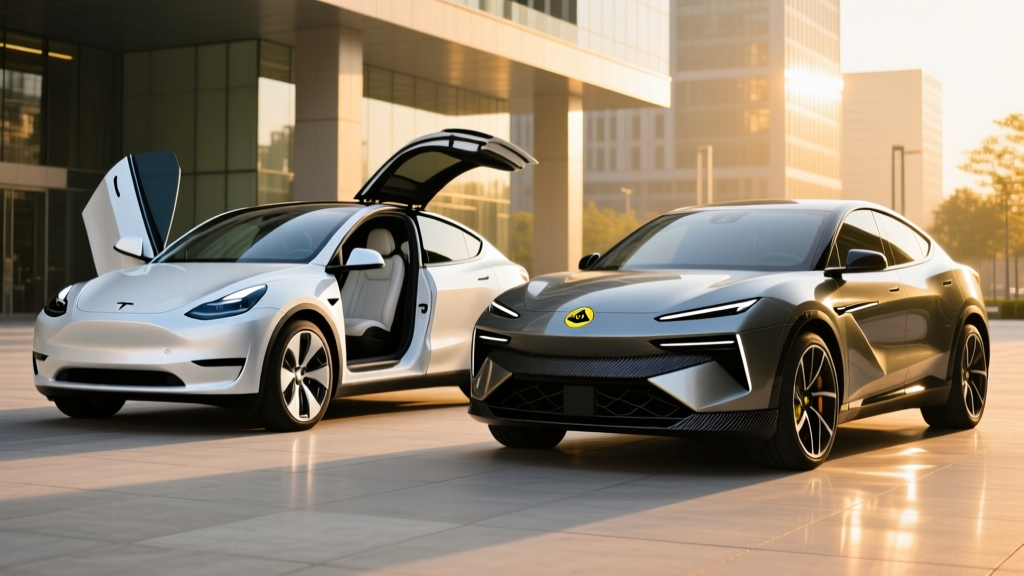
Searches pairing Tesla and Lotus usually point to one decision: should a performance-minded EV SUV buyer spend ~$50K on a refreshed Tesla Model Y, or stretch past $100K for the Lotus Eletre? Both are electric, both are quick, and both now share the NACS charging standard — but they target completely different buyers. Below is a spec-for-spec breakdown using 2026 model-year data, real-world range expectations, and current IRS §30D tax-credit rules.
Quick verdict: Tesla Model Y vs Lotus Eletre
The Tesla Model Y remains the default recommendation for most EV SUV shoppers: efficient, fast-charging, Supercharger-backed, and eligible for the full $7,500 federal credit for qualifying buyers. The Lotus Eletre is a low-volume luxury performance SUV for buyers who want Porsche Cayenne dynamics, bespoke interiors, and don't need to maximize value per dollar. Choose Tesla for daily commuting and road-trip ease; choose Lotus for driving engagement and exclusivity.
Spec table: Tesla Model Y vs Lotus Eletre (2026)
| Spec | Tesla Model Y Long Range AWD | Lotus Eletre S |
|---|---|---|
| EPA range | 320 mi | 315 mi (est.) |
| Battery (usable) | ~75 kWh, NMC | ~109 kWh, NMC |
| Peak DC fast charge | 250 kW | 350 kW |
| 10-80% DC time | ~25 min | ~20 min |
| Level 2 rate | 11.5 kW (~44 mi/hr) | 22 kW (~75 mi/hr) |
| 0-60 mph | 4.8 s | 4.5 s |
| Horsepower | 384 hp | 603 hp |
| Drivetrain | Dual-motor AWD | Dual-motor AWD |
| MPGe (combined) | 122 MPGe | ~85 MPGe (est.) |
| EPA efficiency | 28 kWh/100 mi | ~40 kWh/100 mi |
| Cargo (rear seats up) | 30 cu ft (+ 4 cu ft frunk) | 21 cu ft |
| Rear legroom | 41.6 in | ~39 in |
| Base MSRP | $48,990 | $104,900 |
| §30D credit eligible | Yes (if income/MSRP rules met) | No — exceeds SUV MSRP cap |
| Battery warranty | 8 yr / 120,000 mi | 8 yr / 100,000 mi |
Real-world range: what you'll actually see
EPA sticker: Tesla Model Y LR — 320 mi | Lotus Eletre S — ~315 mi
Real-world expectation: Highway cruising at 70-75 mph typically yields 85-90% of EPA for the Model Y (~270-290 mi) thanks to its slippery aero and modest 28 kWh/100 mi consumption. The Eletre, heavier and wider-tired, drops more aggressively on the highway — expect ~240-260 mi in mixed driving. In cold weather (sub-40°F), both lose 15-25% of range; the Model Y's standard heat pump helps it retain more efficiency than most rivals. Plan road-trip charging around ~230 mi usable for the Tesla and ~200 mi for the Lotus in winter conditions.
Source: fueleconomy.gov EV range methodology.
Charging: DC fast, home Level 2, and connector reality
| Charging level | Tesla Model Y | Lotus Eletre |
|---|---|---|
| Level 1 (120V, 1.4 kW) | ~5 mi/hr | ~5 mi/hr |
| Level 2 (240V home) | 11.5 kW / ~44 mi/hr | 22 kW / ~75 mi/hr |
| DC fast peak | 250 kW | 350 kW |
| 10-80% DC time | ~25 min | ~20 min |
| Connector | NACS (native) | NACS (2025+ models) |
Charging-curve reality: The Model Y's 250 kW peak is brief — it tapers significantly above 55% SoC, so the 10-80% time is driven by sustained mid-curve rates (~150-170 kW average). The Eletre's 800V architecture and 350 kW peak deliver a flatter curve, but only at 350 kW-capable stations (Electrify America and select Tesla Supercharger V4 stalls). On a typical 150 kW public charger, both vehicles will charge at roughly similar speeds — the Eletre's peak advantage disappears.
At home on a 48A Level 2 circuit (the common residential install), the Model Y replenishes ~44 miles of range per hour. The Eletre's onboard 22 kW charger is a standout — if your panel supports a 100A dedicated circuit, it can add ~75 miles per hour, filling its large 109 kWh pack overnight in roughly 5-6 hours vs. ~7-8 for the Tesla. Most homes need a panel upgrade to realize this; budget $1,500-$3,000 for that work.
Performance, drivetrain, and handling
The Model Y Long Range AWD delivers 384 hp and a 4.8-second 0-60 — brisk by any measure, and more than adequate for merging and passing. Its single-speed reduction gear and low center of gravity make it feel planted, though the ride is firm over broken pavement. The Performance trim (3.5s 0-60, ~$53K) closes the gap to the Eletre in straight-line speed.
The Lotus Eletre S produces 603 hp and hits 60 mph in 4.5 seconds, but its real advantage is chassis tuning: adaptive air suspension, rear-wheel steering, and torque-vectoring AWD give it cornering composure the Model Y can't match. The Eletre R variant (905 hp, 2.95s 0-60) exists for buyers chasing supercar numbers, at ~$150K+. Both vehicles are dual-motor AWD; neither offers a RWD base variant in the US market for 2026.
Pricing, trims, and federal tax credit eligibility
| Trim | MSRP | §30D credit | Effective price |
|---|---|---|---|
| Model Y Long Range AWD | $48,990 | Up to $7,500 | ~$41,490 |
| Model Y Performance | $52,990 | Up to $7,500 | ~$45,490 |
| Lotus Eletre S | $104,900 | $0 | $104,900 |
| Lotus Eletre R | $149,900 | $0 | $149,900 |
Tax-credit mechanics (IRS §30D, 2026 rules): The Model Y qualifies for up to $7,500 if the buyer meets all three requirements: (1) adjusted gross income under $150K single / $300K joint, (2) vehicle MSRP under the $80K SUV cap, and (3) battery components and critical minerals meet North American sourcing thresholds, which shift annually. The credit can now be transferred to the dealer at point of sale, reducing the purchase price directly. The Lotus Eletre, at $104,900+, exceeds the $80,000 SUV MSRP cap and is ineligible regardless of buyer income. Verify current-year sourcing requirements at IRS.gov before purchase — mineral-sourcing rules tighten each January.
Tech, interior, and driver assists
Tesla Model Y: The 2026 refresh keeps the minimalist 15.4-inch touchscreen as the single interface — no instrument cluster, no stalks (turn signals are on the wheel). Autopilot (SAE Level 2) is standard; FSD (Supervised) is a $8,000 add-on or $99/mo subscription. FSD remains Level 2 — you must keep hands on the wheel and eyes on the road. The cabin is airy with vegan leather, but material quality still lags luxury rivals. The 8-camera Tesla Vision suite handles parking, lane-keeping, and adaptive cruise competently.
Lotus Eletre: A 15.1-inch OLED touchscreen, a slim driver's display, and a 29-inch AR HUD give the Eletre a more layered cockpit. Standard features include a 23-speaker KEF Reference audio system, Nappa leather, and a panoramic glass roof. Lotus's Intelligent Adaptive Cruise and lane-centering are Level 2 — comparable to Tesla Autopilot in capability, less aggressive in lane-change behavior. The Eletre's cabin materials and build quality are a clear step above the Model Y, justifying much of its price premium.
Who should buy which?
Choose the Tesla Model Y if: you commute 30-80 miles daily, road-trip 2-4 times a year, want access to the Supercharger network without adapters, need cargo space for a family of four, and want to capture the $7,500 federal credit. Total 5-year cost of ownership (fuel, maintenance, insurance) runs roughly $38K-$44K depending on local electricity rates.
Choose the Lotus Eletre if: driving dynamics and cabin luxury are priorities, you have home Level 2 charging (ideally a 100A circuit to use the 22 kW onboard charger), you rarely road-trip beyond 200 miles without overnight stops, and the $100K+ price — with no federal credit — fits your budget without strain. Expect higher insurance premiums and limited service-center density vs. Tesla.
Pros and cons
Tesla Model Y Pros
- Best-in-class efficiency (28 kWh/100 mi)
- Supercharger network access, native NACS
- Eligible for $7,500 §30D credit
- Strong cargo + frunk utility (34 cu ft total)
- OTA updates continuously add features
Tesla Model Y Cons
- Minimalist interior feels sparse at this price
- No instrument cluster or turn-signal stalks
- FSD (Supervised) is expensive and still Level 2
- Ride quality firm on 20-inch wheels
Lotus Eletre Pros
- 350 kW peak DC charging on 800V architecture
- 22 kW Level 2 onboard charger (class-leading)
- Air suspension + rear-steer handling
- Luxury materials, KEF audio, AR HUD
Lotus Eletre Cons
- $104,900+ MSRP, no federal tax credit
- Low efficiency (~40 kWh/100 mi) = higher charging cost
- Limited US service-center network
- Real-world highway range closer to 240-260 mi
FAQ
Does the Lotus Eletre qualify for the federal EV tax credit?
No. The Eletre's MSRP exceeds the $80,000 SUV cap set by IRS §30D, making it ineligible regardless of buyer income or battery sourcing. The Tesla Model Y, under $53K, qualifies for up to $7,500 if income and sourcing requirements are met.
Is the Lotus Eletre faster than the Tesla Model Y?
In 0-60, the Eletre S (4.5s) is only marginally quicker than the Model Y LR (4.8s). The Model Y Performance (3.5s) beats the Eletre S, while the Eletre R (2.95s) outruns both. The Eletre's advantage is handling, not straight-line speed.
Can I charge a Lotus Eletre at a Tesla Supercharger?
Yes. 2025+ Eletre models sold in the US ship with a native NACS port, so they connect directly to V3 and V4 Superchargers without an adapter. Peak rates may be limited to ~150-200 kW at V3 stalls.
Which is cheaper to own over 5 years?
The Model Y, decisively. Lower purchase price, $7,500 credit eligibility, 28 vs ~40 kWh/100 mi efficiency (roughly 40% lower electricity cost per mile), and broader service access all compound. The Eletre is a luxury purchase, not a value one.