The Two Best-Selling Electric Crossovers, Head to Head
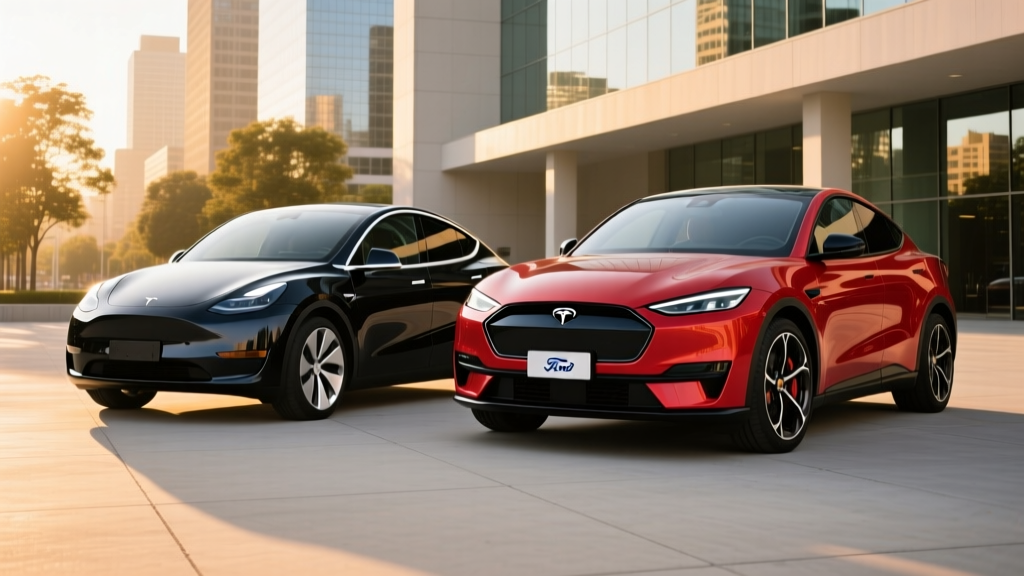
When EV shoppers search for "tesla and ford," they're almost always weighing the two best-selling electric crossovers in America: the 2026 Tesla Model Y (refreshed Juniper generation) and the 2026 Ford Mustang Mach-E. Both seat five, both start in the low-to-mid $40,000 range, and both now share the North American Charging Standard (NACS) connector. But the ownership experience, powertrain philosophy, and real-world efficiency diverge in ways that matter once you leave the dealership lot.
This review profiles both vehicles with exact EPA data, real-world range reconciliation, charging-curve realities, and 2026 federal tax credit eligibility so you can make a numbers-driven decision.
Spec Sheet: 2026 Tesla Model Y vs 2026 Ford Mustang Mach-E
| Spec | Tesla Model Y Long Range AWD | Ford Mustang Mach-E Premium AWD (Ext. Range) |
|---|---|---|
| EPA Range | 320 miles | 310 miles |
| Battery (usable) | 78.1 kWh, NMC | 91.0 kWh, NMC |
| Drivetrain | Dual-motor AWD | Dual-motor AWD |
| Horsepower | 384 hp | 346 hp |
| 0–60 mph | 4.8 sec | 5.1 sec |
| Peak DC Fast Charge | 250 kW | 150 kW |
| 10–80% DCFC Time | ~25 min | ~38 min |
| Level 2 Home Charge Rate | 11.5 kW (~44 mi/hr) | 10.5 kW (~36 mi/hr) |
| Efficiency (combined) | 122 MPGe / 28 kWh/100 mi | 101 MPGe / 34 kWh/100 mi |
| Cargo (rear seats up) | 30.2 cu ft (+ 4.1 cu ft frunk) | 29.7 cu ft (+ 4.7 cu ft frunk) |
| Rear Legroom | 41.6 in | 38.9 in |
| Base MSRP | $46,630 (LR AWD) | $45,995 (Premium AWD Ext.) |
| Battery Warranty | 8 yr / 120,000 mi | 8 yr / 100,000 mi |
Sources: EPA fueleconomy.gov, Tesla and Ford manufacturer spec sheets.
Real-World Range: What the EPA Sticker Doesn't Tell You
Tesla Model Y LR AWD: EPA 320 mi — expect ~270–285 mi sustained highway (70 mph), ~220–240 mi in sub-30°F winter.
Ford Mach-E Premium AWD Ext.: EPA 310 mi — expect ~260–275 mi sustained highway, ~210–230 mi in sub-30°F winter.
The Model Y's efficiency advantage is the story here. Tesla extracts 320 miles from a 78.1 kWh pack, while Ford needs a larger 91.0 kWh pack to deliver 310 miles. That 6 kWh/100 mi gap (28 vs 34) compounds on road trips: over 1,000 miles, the Model Y consumes roughly 60 fewer kWh, meaning one fewer charging stop on a typical DC fast-charging route.
Both vehicles use nickel-manganese-cobalt (NMC) cathode chemistry, which offers higher energy density than LFP but is more sensitive to sustained 100% state-of-charge storage. Daily charging to 80–90% is recommended for long-term battery health on both.
In cold weather, neither vehicle is class-leading. The Mach-E's available heat pump (standard on 2026 Premium trims) narrows the gap, but Tesla's integrated thermal management system has historically shown ~5–8% better cold-weather range retention in third-party testing. If you live above the 40th parallel, budget for 25–30% winter range loss on either vehicle.
Charging Speed: Where Tesla Still Holds the Edge
| Metric | Tesla Model Y | Ford Mustang Mach-E |
|---|---|---|
| Peak DC Rate | 250 kW | 150 kW |
| 10–80% Time | ~25 min | ~38 min |
| Sustained Avg (10–80%) | ~155 kW | ~105 kW |
| Level 2 (240V) Rate | 11.5 kW | 10.5 kW |
| Miles Added per Hour (L2) | ~44 mi | ~36 mi |
| Connector | NACS (native) | NACS (native, 2025+) |
Charging is where the physics gap becomes a time gap. The Model Y's 250 kW peak rate isn't sustained for the entire session — it tapers sharply above 60% SoC — but the average speed from 10–80% still hovers around 155 kW. The Mach-E peaks at 150 kW and sustains roughly 105 kW on average, adding about 13 minutes to a typical road-trip stop.
Starting with the 2025 model year, Ford transitioned the Mach-E to a native NACS charge port, eliminating the need for a CCS-to-NACS adapter at Tesla Superchargers. Both vehicles now access the Supercharger network natively, which remains the most reliable public DC network in North America by uptime metrics.
For home Level 2 charging, both vehicles charge overnight from 20% to 100% comfortably. The Model Y's slightly higher onboard charger rate (11.5 kW vs 10.5 kW) means a full recharge in roughly 7 hours vs 8.5 hours on a 48-amp hardwired Level 2 station — a marginal difference for most owners who plug in nightly.
Pricing, Trims, and Federal Tax Credit Eligibility
| Trim | MSRP | Est. After §30D Credit |
|---|---|---|
| Model Y Long Range AWD | $46,630 | ~$39,130* |
| Model Y Performance AWD | $51,630 | ~$44,130* |
| Mach-E Select RWD (Std. Range) | $39,995 | ~$36,245** |
| Mach-E Premium AWD (Ext. Range) | $45,995 | ~$38,495* |
| Mach-E GT AWD | $55,995 | ~$48,495* |
*Assumes full $7,500 §30D credit. **Assumes partial $3,750 credit (sourcing-dependent). Actual eligibility varies.
The IRS §30D clean vehicle credit is the most complex part of buying either vehicle. Here are the 2026 rules that apply:
- MSRP Cap: SUVs/crossovers must be under $80,000. Both vehicles clear this easily.
- Income Cap: Modified AGI must not exceed $150,000 (single), $225,000 (head of household), or $300,000 (joint). Above these thresholds, no credit.
- Battery Sourcing: The $7,500 credit splits into two halves — $3,750 for critical-mineral sourcing and $3,750 for battery-component manufacturing. Sourcing requirements tighten annually. As of 2026, both Tesla and Ford have shifted significant supply-chain sourcing to FTA-partner countries, but specific trim-level eligibility can change mid-year.
- Point-of-Sale Transfer: Both manufacturers allow you to transfer the credit to the dealer at purchase, reducing your out-of-pocket cost immediately rather than waiting for tax filing.
Always verify current eligibility on fueleconomy.gov before purchasing — battery sourcing compliance can shift between model years and even production batches.
Performance, Tech, and Daily Livability
The Model Y's 4.8-second 0–60 time (Long Range AWD) feels effortless thanks to Tesla's single-speed reduction gear and instant torque delivery. The Mach-E Premium AWD trails at 5.1 seconds — still quick by any measure — but the GT trim (463 hp, 3.5 sec) exists for buyers who want sports-car acceleration in a crossover body.
Tech & Infotainment:
Tesla's 15.4-inch center screen runs all vehicle functions, navigation, and media. There is no instrument cluster — speed and range live in the top-left corner of the main display. The interface is fast and responsive, but the lack of physical buttons (even for glove-box release) frustrates some buyers. Tesla's navigation with real-time Supercharger routing and automatic battery preconditioning remains the gold standard for road-trip planning.
Ford's 15.5-inch portrait screen runs SYNC 4A, with a 10.2-inch digital instrument cluster behind the wheel. Physical knobs for volume and climate are a welcome ergonomic choice. Wireless Apple CarPlay and Android Auto are standard — Tesla does not support either, relying on its native apps.
Driver Assistance:
Tesla's Autopilot (standard) handles highway lane-centering and adaptive cruise competently. Full Self-Driving (Supervised), a $8,000 add-on or $99/month subscription, adds city-street navigation but requires constant supervision. Ford's BlueCruise (available on Premium/GT trims) enables hands-off driving on pre-mapped divided highways (~130,000 miles of roads in North America). In practice, BlueCruise feels more polished for highway commuting, while FSD offers broader — if more variable — coverage.
Pros and Cons at a Glance
- Best-in-class efficiency (28 kWh/100 mi)
- Fastest DC charging in segment (250 kW peak)
- Supercharger network native access
- Strongest real-world range retention
- Over-the-air updates add features post-purchase
- No Apple CarPlay / Android Auto
- Minimalist interior polarizes buyers
- No physical buttons or instrument cluster
- FSD (Supervised) is expensive and inconsistent
- Service center wait times in some markets
- More conventional, intuitive cabin layout
- Wireless CarPlay & Android Auto standard
- BlueCruise hands-off highway driving
- GT trim offers 3.5-sec 0–60 performance
- Established dealer service network
- Lower efficiency (34 kWh/100 mi) = more charging stops
- Slower DC charging (150 kW peak)
- Heavier curb weight affects tire wear
- Real-world range further from EPA than Model Y
- Ext. Range battery adds cost and weight
Who Should Buy Which?
- Choose the Tesla Model Y if: You prioritize efficiency, road-trip charging speed, and access to the most reliable DC fast-charging network. Ideal for high-mileage commuters and frequent long-distance travelers who want the fewest stops and lowest electricity cost per mile.
- Choose the Ford Mach-E if: You prefer a traditional cockpit layout with physical controls, need wireless phone integration, and value dealer-based service. The GT trim suits driving enthusiasts. BlueCruise is a compelling choice for highway-heavy commuters in hands-off-corridor states.
For families, the Model Y's 2.7-inch rear legroom advantage matters on long drives. For towing, neither is a truck replacement — the Model Y is rated at 3,500 lbs and the Mach-E at 2,200 lbs (with the Ford towing package), both adequate for a small utility trailer but not a camper.
Frequently Asked Questions
What is the real-world range of the Tesla Model Y and Ford Mach-E?
The Model Y Long Range AWD delivers an EPA-estimated 320 miles, but expect 270–285 miles at sustained highway speeds and 220–240 miles in freezing weather. The Mach-E Premium AWD Extended Range posts 310 EPA miles, with real-world highway figures around 260–275 and winter range of 210–230 miles.
How fast do these vehicles charge at home and on the road?
On a DC fast charger, the Model Y peaks at 250 kW and reaches 10–80% in roughly 25 minutes. The Mach-E peaks at 150 kW and takes about 38 minutes for the same session. At home on a Level 2 (240V) charger, the Model Y adds ~44 miles per hour and the Mach-E adds ~36 miles per hour.
Does the Tesla Model Y or Ford Mach-E qualify for the $7,500 federal EV tax credit?
Both vehicles may qualify for all or part of the §30D federal clean vehicle credit, but eligibility depends on your income (AGI caps apply), the vehicle's MSRP (both are under the $80,000 SUV cap), and battery-critical-mineral and component sourcing requirements that change periodically. Verify on fueleconomy.gov at time of purchase. Point-of-sale transfer is available for both.
Is the Tesla Model Y worth buying over the Mach-E in 2026?
If your priority is lowest cost-per-mile, fastest charging, and the best road-trip infrastructure, the Model Y holds a measurable edge. If you prefer a conventional interior, wireless phone projection, and hands-off highway driving via BlueCruise, the Mach-E is the stronger pick. Neither is a wrong choice — the right answer depends on your commute pattern and cabin preferences.
What are the biggest ownership costs beyond the purchase price?
Insurance premiums for both vehicles run 15–25% above comparable gas crossovers, with Tesla typically costing more to insure due to repair-cost data. Electricity cost averages $0.13–0.17/kWh at home (national average), translating to roughly $0.04/mi for the Model Y and $0.05/mi for the Mach-E — about one-third the per-mile fuel cost of a 25-MPG gas crossover at $3.30/gallon.