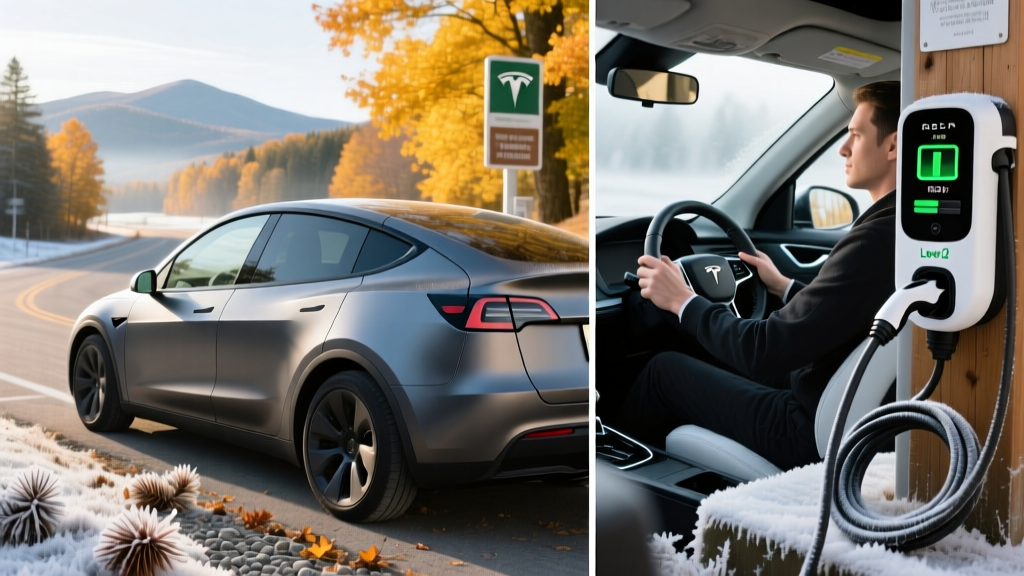
Vermont presents one of the most demanding environments for any electric vehicle: frigid winters, mountainous terrain, sparse public charging outside Burlington, and a rural lifestyle that demands real utility from a daily driver. The Tesla Model Y remains the best-selling EV in the state for good reason — but its EPA sticker doesn't tell the full story for Green Mountain State drivers.
This profile examines the 2026 Tesla Model Y through the lens of Vermont ownership: what happens to range when temperatures drop below freezing, how the Supercharger network covers I-89 and I-91 corridors, whether the federal tax credit applies, and how it stacks up against the Hyundai Ioniq 5, Ford Mustang Mach-E, and Subaru Solterra for New England buyers.
2026 Tesla Model Y: Quick Verdict for Vermont Drivers
The Model Y Long Range AWD is the trim that makes sense for Vermont. Its dual-motor all-wheel-drive system handles unplowed back roads confidently, the heat pump preserves range in cold weather better than most competitors, and Tesla's Supercharger network remains the most reliable DC fast-charging option along rural interstate corridors. The base Rear-Wheel-Drive trim saves money upfront but sacrifices the traction and range buffer that Vermont winters demand.
If you have home Level 2 charging and your daily commute stays under 60 miles round-trip, the Model Y Long Range will serve you well year-round. If you frequently drive the I-91 corridor to the Upper Valley or tackle Route 4 across the Green Mountains in January, plan for 25-35% range reduction and map your charging stops accordingly.
Range, Battery, and Efficiency: EPA Numbers vs. Vermont Reality
| Specification | Long Range AWD | Rear-Wheel Drive |
|---|---|---|
| EPA Estimated Range | 320 miles | 295 miles |
| Battery Capacity (usable) | ~75 kWh (NMC) | ~60 kWh (LFP) |
| Battery Chemistry | NMC (Nickel Manganese Cobalt) | LFP (Lithium Iron Phosphate) |
| EPA Efficiency | 122 MPGe (28 kWh/100mi) | 128 MPGe (26 kWh/100mi) |
| Drivetrain | Dual-Motor AWD | Single-Motor RWD |
The EPA's 320-mile estimate for the Long Range AWD assumes moderate temperatures and mixed driving. In Vermont conditions, expect the following:
- Summer highway (70°F, 70 mph on I-89): ~275-290 miles
- Fall/Spring mixed driving (50°F): ~280-300 miles
- Winter highway (20°F, heater on, 65 mph): ~210-240 miles
- Deep cold mountain driving (0°F, Route 4 elevation changes): ~190-220 miles
The Model Y's heat pump is among the most efficient in the industry, which helps. But physics wins: cold batteries hold less energy, cabin heating draws power, and winter tires increase rolling resistance. Budget a 30% range reduction for January planning.
The LFP battery in the Rear-Wheel-Drive trim is worth understanding. LFP chemistry offers longer cycle life and can be charged to 100% daily without degradation concerns — ideal for commuters who plug in every night. However, LFP cells lose more capacity in extreme cold than NMC, meaning the RWD trim's already-shorter range shrinks further in Vermont winters. For most Vermont buyers, the Long Range AWD with NMC chemistry is the pragmatic choice.
Source: fueleconomy.gov — 2026 Tesla Model Y
Charging Speed: Supercharger Network and Home Level 2
Charging infrastructure is where Tesla ownership in Vermont diverges sharply from competitors. Tesla's Supercharger network includes stations in Burlington, Montpelier, White River Junction, Brattleboro, and St. Johnsbury — covering the major I-89 and I-91 corridors. For a state with limited Electrify America or EVgo presence, this is a meaningful advantage.
| Charging Method | Peak Power | Speed / Time | Notes |
|---|---|---|---|
| DC Fast Charge (V3/V4 Supercharger) | 250 kW peak | 10-80% in ~22 minutes | Peak rate sustained to ~50% SoC, then tapers; preconditioning required for max speed |
| DC Fast Charge (CCS adapter, non-Tesla networks) | ~150-170 kW typical | 10-80% in ~30 minutes | Requires Tesla CCS adapter (included with 2026 models); speed limited by adapter and station |
| Level 2 Home (48A Wall Connector, 240V/60A circuit) | 11.5 kW | ~37 miles per hour of charging | Full charge in ~7-8 hours; requires 60A dedicated circuit |
| Level 2 Home (32A, 240V/40A circuit) | 7.7 kW | ~25 miles per hour of charging | Adequate for most daily needs; full charge in ~10 hours |
| Level 1 (120V standard outlet) | ~1.2 kW | ~3-4 miles per hour | Emergency/trickle only; impractical for daily use in winter |
Preconditioning matters. When you navigate to a Supercharger in the Model Y, the car automatically warms the battery to optimal charging temperature. Without this — for example, if you pull into a CCS station without preconditioning — your peak charge rate may drop to 100-120 kW, extending your stop to 35+ minutes. In Vermont winters, preconditioning is the difference between a 22-minute stop and a 40-minute stop.
Home charging reality: Most Vermont homes with 200A electrical panels can support a 60A circuit for the Tesla Wall Connector. Installation costs in Vermont typically run $800-$1,800 for a straightforward install (panel to garage, short wire run). Older homes with 100A panels may need a panel upgrade ($2,000-$4,000) or must settle for a 40A circuit delivering 32A to the car. Vermont's Green Mountain Power utility offers time-of-use rates that make overnight Level 2 charging roughly $0.12-$0.15/kWh — about $9-$11 for a full charge on the Long Range.
Performance and Winter Capability
| Metric | Long Range AWD | Rear-Wheel Drive |
|---|---|---|
| 0-60 mph | 4.8 seconds | 6.2 seconds |
| Horsepower | 384 hp (combined) | 295 hp |
| Torque | 376 lb-ft | 310 lb-ft |
| Top Speed | 125 mph | 135 mph |
| Towing Capacity | 3,500 lbs | 3,500 lbs |
The dual-motor AWD system in the Long Range provides torque vectoring that outperforms most mechanical AWD systems on icy Vermont roads. The instant torque delivery means no waiting for a transmission to downshift on snowy uphill grades. Traction control responds in milliseconds — faster than any driver can react to a skid.
That said, the Model Y rides on a relatively firm suspension tuned for highway comfort, not washboard dirt roads. Ground clearance is 6.6 inches — adequate for plowed roads and moderate snow, but less than a Subaru Outback (8.7 inches). If your Vermont lifestyle involves unmaintained camp roads or deep-rutted trails, you'll want dedicated winter tires (the OEM all-seasons are mediocre in snow) and realistic expectations about clearance.
Pricing, Trims, and Federal Tax Credit Eligibility
| Trim | Base MSRP | As-Tested (common config) | §30D Federal Credit Eligibility |
|---|---|---|---|
| Long Range AWD | $44,990 | $47,490 (w/ FSD, red paint) | Eligible — up to $7,500 (point-of-sale transfer available) |
| Rear-Wheel Drive | $39,990 | $41,490 (w/ blue paint, tow hitch) | Eligible — up to $7,500 (point-of-sale transfer available) |
The federal EV tax credit under IRS §30D provides up to $7,500 for qualifying buyers. However, eligibility depends on three factors that trip up many Vermont shoppers:
- MSRP Cap: SUVs must be under $80,000 — both Model Y trims qualify easily
- Buyer Income Cap: Modified AGI must not exceed $150,000 (single), $225,000 (head of household), or $300,000 (married filing jointly)
- Battery Sourcing: A percentage of critical minerals must be sourced from the US or FTA partners; battery components must be manufactured in North America. The Model Y's US-built battery pack currently satisfies these requirements for the full $7,500, but sourcing rules tighten annually
- Point-of-Sale Transfer: You can transfer the credit to Tesla at purchase, reducing your out-of-pocket cost immediately rather than waiting for a tax refund
Source: IRS.gov — Clean Vehicle Credits
Vermont-specific incentives: Vermont does not offer a state EV rebate as of 2026, but Green Mountain Power's EV charging programs and some municipal utilities (Burlington Electric Department, Washington Electric Cooperative) offer reduced EV electricity rates or charger rebates. Check your local utility before purchasing. Incentive amounts vary by jurisdiction and change frequently — consult official sources for current programs.
Interior, Cargo, and Daily Practicality
The Model Y's minimalist interior is polarizing, but its cargo utility is undeniable — and that matters for Vermont's gear-heavy lifestyle.
| Dimension | Measurement |
|---|---|
| Cargo Volume (rear seats up) | 30.2 cu ft |
| Cargo Volume (rear seats folded) | 72.1 cu ft |
| Front Trunk (Frunk) | 4.1 cu ft |
| Front Legroom | 41.8 inches |
| Rear Legroom | 37.0 inches |
| Seating Capacity | 5 (7-seat option available, tight third row) |
| Ground Clearance | 6.6 inches |
The 72.1 cu ft of cargo space with seats folded accommodates four sets of skis (in a bag), a week's worth of camping gear, or a Costco run without trouble. The frunk is useful for charging cables and winter emergency supplies (blanket, jumper cables for your 12V system, cat litter for traction).
Rear-seat legroom is adequate for adults on shorter trips but tight for tall passengers on longer drives. The glass roof creates an airy feel but offers no shade option — in summer, the cabin can get warm despite UV tinting. The 15.4-inch center touchscreen handles all vehicle functions, climate, and navigation. There are no physical buttons, which frustrates some drivers who want tactile controls for defrost or fan speed while wearing winter gloves.
Driver Assistance and Technology
Tesla's Autopilot and Full Self-Driving (Supervised) are SAE Level 2 driver-assistance systems. The driver must remain fully engaged, hands on the wheel (or providing steering torque), and eyes on the road at all times. These are not self-driving systems. Only Level 4 robotaxi services like Waymo operate without a human driver — and those are not available in Vermont.
The Model Y comes standard with Autopilot (adaptive cruise control + lane centering). The optional Full Self-Driving (Supervised) package ($8,000 or $99/month in 2026) adds automated lane changes, traffic light/stop sign recognition, and city street navigation. In practice, FSD handles Vermont's well-marked interstate highways competently but struggles with faded rural road lines, unpainted country roads, and construction zones — common conditions on Routes 7, 4, and 100.
Standard safety technology includes automatic emergency braking, blind-spot monitoring, lane departure warning, and 360-degree cameras. The Model Y earned a 5-star overall rating from NHTSA and Top Safety Pick+ from IIHS.
- Navigate unplowed or snow-covered lane markings
- Detect black ice or adjust driving behavior for road surface conditions
- Replace winter driving skills and judgment
- Operate safely without continuous driver supervision
Warranty and Long-Term Ownership
| Component | Coverage |
|---|---|
| Basic Vehicle | 4 years / 50,000 miles |
| Battery & Drive Unit (Long Range, NMC) | 8 years / 120,000 miles (minimum 70% capacity retention) |
| Battery & Drive Unit (RWD, LFP) | 8 years / 100,000 miles (minimum 70% capacity retention) |
Tesla's battery warranty guarantees that your pack will retain at least 70% of its original capacity during the warranty period. If it drops below that threshold, Tesla will replace or refurbish the battery at no cost. In practice, Tesla NMC batteries degrade approximately 8-12% over the first 100,000 miles based on fleet data — meaning most owners will never hit the warranty threshold.
For Vermont owners, the 8-year/120,000-mile coverage on the Long Range is reassuring given the state's harsh climate. Battery thermal management (active liquid heating and cooling) protects the pack during both extreme cold and Supercharger sessions. The drive units (motors) have proven highly reliable, with failure rates well below those of internal combustion powertrains.
One ownership note: Tesla's service network in Vermont is limited. There is a Service Center in South Burlington, and mobile service covers much of the state for minor issues. Major repairs may require a trip to Burlington or, in rare cases, to a facility in New Hampshire or Massachusetts. Factor this into your decision if you live in the Northeast Kingdom or southwestern Vermont.
Model Y vs. Competitors: Which EV Fits Vermont Best?
| Spec | Tesla Model Y LR AWD | Hyundai Ioniq 5 Limited AWD | Ford Mustang Mach-E Premium AWD | Subaru Solterra Limited |
|---|---|---|---|---|
| EPA Range | 320 mi | 290 mi | 290 mi | 222 mi |
| Battery (kWh) | ~75 (NMC) | 77.4 (NMC) | 72 (NMC) | 72.8 (NMC) |
| DC Fast Charge Peak | 250 kW | 240 kW | 150 kW | 100 kW |
| 10-80% Time | ~22 min | ~18 min | ~38 min | ~56 min |
| 0-60 mph | 4.8 sec | 5.1 sec | 5.1 sec | 6.5 sec |
| AWD System | Dual Motor | Dual Motor | Dual Motor | Dual Motor (w/ X-Mode) |
| Ground Clearance | 6.6 in | 6.1 in | 5.7 in | 8.3 in |
| Base MSRP (AWD) | $44,990 | $52,600 | $48,995 | $44,995 |
| Charging Network | Supercharger + NACS | CCS (limited VT) | CCS (limited VT) | CCS (limited VT) |
- You rely on public DC fast charging along Vermont's interstate corridors
- Maximizing range (especially in winter) is your top priority
- You value over-the-air updates and the Tesla app ecosystem
- You want the lowest cost per mile among AWD EVs in this class
- You want more ground clearance for unplowed roads (Subaru Solterra)
- You prefer a traditional dealership service experience (Hyundai, Ford)
- You want physical buttons and a more conventional interior layout
- You need the fastest possible DC charging at 350 kW stations outside Vermont (Ioniq 5)
Pros and Cons for Vermont Ownership
- Class-leading 320-mile EPA range provides a critical winter buffer
- Supercharger network covers I-89 and I-91 — Vermont's main corridors
- Heat pump minimizes cold-weather range loss vs. competitors
- Dual-motor AWD provides excellent traction on ice and snow
- LFP option (RWD) allows daily 100% charging without degradation worry
- 72 cu ft cargo space handles ski gear, camping equipment, and farm-market hauls
- Over-the-air updates continuously add features
- 6.6 inches ground clearance is less than Subaru or many crossovers
- Limited Tesla service presence — only one Service Center in South Burlington
- No physical buttons — glove-unfriendly touchscreen controls for climate/defrost
- Firm ride quality on Vermont's rough back roads and frost heaves
- CCS adapter required for non-Tesla DC chargers (included, but an extra piece to carry)
- Glass roof lacks a shade; cabin can overheat in direct summer sun
- FSD ($8,000) is not worth it for Vermont's poorly marked rural roads
Frequently Asked Questions
What is the real-world range of the Tesla Model Y in Vermont winters?
Expect 210-240 miles on the Long Range AWD in typical January conditions (20°F, highway speeds, cabin heat on). In extreme cold (below 0°F) with mountain driving, plan for 190-220 miles. Always maintain a 20% buffer — don't plan trips that use more than 80% of your expected range.
How fast does the Model Y charge at home and on the road?
On a home Level 2 Tesla Wall Connector (48A, 240V), you'll add ~37 miles of range per hour — enough to fully recharge overnight. At a V3 Supercharger (250 kW), 10-80% takes about 22 minutes with battery preconditioning. Without preconditioning in cold weather, expect 30-40 minutes.
How much does the Model Y cost after the federal tax credit?
The Long Range AWD starts at $44,990. If you qualify for the full $7,500 §30D credit (income under caps, MSRP under $80K, battery sourcing requirements met), your effective price drops to $37,490. You can transfer the credit at point of sale, reducing your purchase price immediately. Consult a tax professional to confirm your eligibility — rules change and individual circumstances vary.
Does the Tesla Model Y qualify for the federal EV tax credit?
Yes, as of 2026, both the Long Range AWD and Rear-Wheel Drive Model Y qualify for up to $7,500 under IRS §30D, provided the buyer meets income caps ($150K single / $300K married filing jointly). The vehicle is assembled in the US and meets current battery sourcing requirements. Verify current eligibility on IRS.gov before purchasing, as sourcing rules tighten annually.
Is the Model Y worth buying over the Subaru Solterra for Vermont?
It depends on your priorities. The Solterra offers 8.3 inches of ground clearance and Subaru's renowned AWD tuning for deep snow — advantages on unplowed roads. But the Model Y's 320-mile range (vs. Solterra's 222) and Supercharger access are decisive for road trips and winter driving where range drops significantly. If you rarely leave your town and have home charging, the Solterra's clearance wins. If you drive interstates or take longer trips, the Model Y is the more practical choice.
Can I charge a non-Tesla EV at Vermont Superchargers?
Tesla has opened select Supercharger stations to non-Tesla EVs via the Magic Dock (built-in CCS connector). In Vermont, a limited number of stations have this capability. Check the Tesla app for compatible locations. However, most Vermont Superchargers remain Tesla-only as of 2026.
What about the 7-seat Model Y — is it practical for Vermont families?
The optional third row ($3,000) fits children only and eliminates most rear cargo space when deployed. For families with small children who occasionally need extra seats, it works. For regular passenger hauling, a three-row SUV like the Kia EV9 is more practical. Most Vermont buyers are better served by the 5-seat configuration with its full cargo area.
Who Should Buy the Tesla Model Y in Vermont?
The Model Y Long Range AWD is the strongest all-around EV for Vermont drivers who:
- Have access to home Level 2 charging (or can install it)
- Commute 20-60 miles daily and want minimal charging hassle
- Drive the I-89 or I-91 corridors regularly and need reliable DC fast charging
- Need AWD traction and cargo versatility for an active New England lifestyle
- Want to minimize winter range loss with an efficient heat pump system
It is less ideal for buyers who prioritize ground clearance above all else, who lack any home charging option, or who live far from Burlington and want convenient dealership-style service. Those buyers should cross-shop the Subaru Solterra, Hyundai Ioniq 5, or consider a plug-in hybrid like the Toyota RAV4 Prime as a bridge solution until charging infrastructure expands in rural Vermont.
The Model Y isn't perfect, but for Vermont's specific combination of cold climate, rural highways, and limited public charging, it remains the EV that requires the fewest compromises.