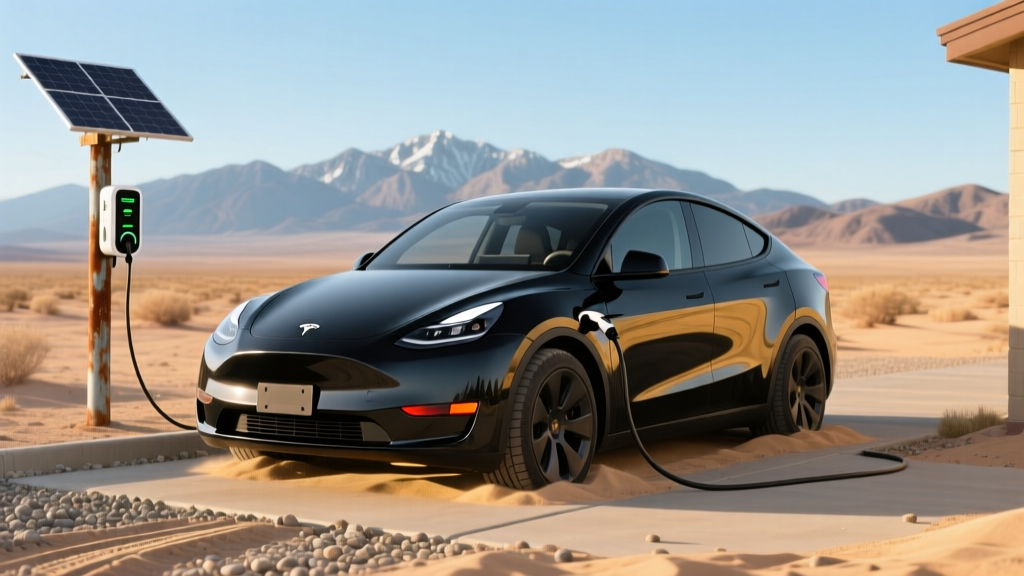
The Tesla Model Y remains the best-selling electric vehicle in the United States for good reason: it threads the needle between range, charging infrastructure, cargo utility, and price in a way no competitor has fully matched. But beyond its suburban-driveway dominance, the Model Y has quietly become the unofficial workhorse of one of the most talked-about underground transit systems in the country — the Tesla Loop in Las Vegas. Whether you're researching the Model Y as a daily driver or you've ridden one through the Vegas Convention Center tunnels and wondered what you were sitting in, this review covers every spec, cost, and real-world ownership detail that matters in 2026.
Quick Verdict: The Model Y in 2026
The refreshed Model Y (internally dubbed "Juniper") entered production in early 2025 and carries into 2026 with meaningful refinements: a quieter cabin, revised suspension tuning, a ventilated front-row seat upgrade, and a slightly larger battery pack on the Long Range variant. The base Rear-Wheel-Drive trim starts at $44,990 before incentives and delivers an EPA-estimated 320 miles of range. The Long Range AWD pushes that to 350 miles EPA, while the Performance trim sacrifices roughly 20 miles for a 3.5-second 0-60 mph sprint.
For buyers cross-shopping the Hyundai Ioniq 5, Ford Mustang Mach-E, or Chevrolet Blazer EV, the Model Y's decisive advantage remains the Supercharger network — over 60,000 connectors globally and the only network with near-universal reliability ratings. The Vegas Loop, which uses a fleet of Model Ys and Model 3s to shuttle convention attendees through 4.5+ miles of tunnels beneath the Las Vegas Convention Center and out to the Strip, is perhaps the most visible proof point of Tesla's vehicle-plus-infrastructure ecosystem.
Range, Battery, and Real-World Efficiency
- Rear-Wheel Drive: 320 miles EPA — expect ~260–280 miles at sustained highway speeds (70–80 mph); ~230–250 miles in freezing temperatures with cabin heat.
- Long Range AWD: 350 miles EPA — expect ~290–310 miles highway; ~255–275 miles in cold weather.
- Performance AWD: 330 miles EPA — expect ~270–290 miles highway; ~240–260 miles cold.
Real-world highway efficiency typically lands between 27–30 kWh/100mi depending on speed, elevation, and temperature. City driving with regenerative braking can push that to 24–26 kWh/100mi.
| Spec | RWD | Long Range AWD | Performance AWD |
|---|---|---|---|
| EPA Range | 320 mi | 350 mi | 330 mi |
| Battery (usable) | 60 kWh (LFP) | 78.1 kWh (NMC) | 78.1 kWh (NMC) |
| MPGe (combined) | 130 MPGe | 122 MPGe | 115 MPGe |
| Efficiency | 26 kWh/100mi | 28 kWh/100mi | 30 kWh/100mi |
| 0–60 mph | 6.5 sec | 4.8 sec | 3.5 sec |
| Horsepower | 295 hp | 384 hp | 456 hp |
| Drivetrain | RWD (single motor) | AWD (dual motor) | AWD (dual motor) |
| Top Speed | 135 mph | 135 mph | 155 mph |
LFP vs. NMC: What It Means for You
The base RWD trim uses a lithium iron phosphate (LFP) battery, while the Long Range and Performance trims use nickel manganese cobalt (NMC). The trade-offs matter:
- LFP advantages: Longer cycle life (can tolerate daily 100% charging without accelerated degradation), lower cost, no cobalt. Tesla recommends charging LFP packs to 100% at least once per week for calibration.
- LFP disadvantages: Lower energy density (hence the smaller 60 kWh pack and lower range), reduced performance in extreme cold, slightly heavier per kWh.
- NMC advantages: Higher energy density, better cold-weather performance, faster peak charging speeds.
- NMC disadvantages: Tesla recommends daily charge limit of 80% for longevity — you only charge to 100% for road trips. Higher replacement cost.
Charging Speed: DC Fast, Level 2, and the Supercharger Advantage
Charging speed is where the Model Y's ecosystem advantage becomes tangible. The 2026 Long Range AWD supports peak DC fast charging at 250 kW on V3 Superchargers and compatible CCS/NACS stations. In practice, the charge curve matters more than the peak number:
| Charging Level | Power | Speed / Time | Notes |
|---|---|---|---|
| Level 1 (120V household) | ~1.4 kW | ~3–4 miles/hour | Emergency/trickle only |
| Level 2 (240V home, 48A) | 11.5 kW | ~37 miles/hour; full charge in ~8 hrs | Requires NACS wall connector or J1772 adapter |
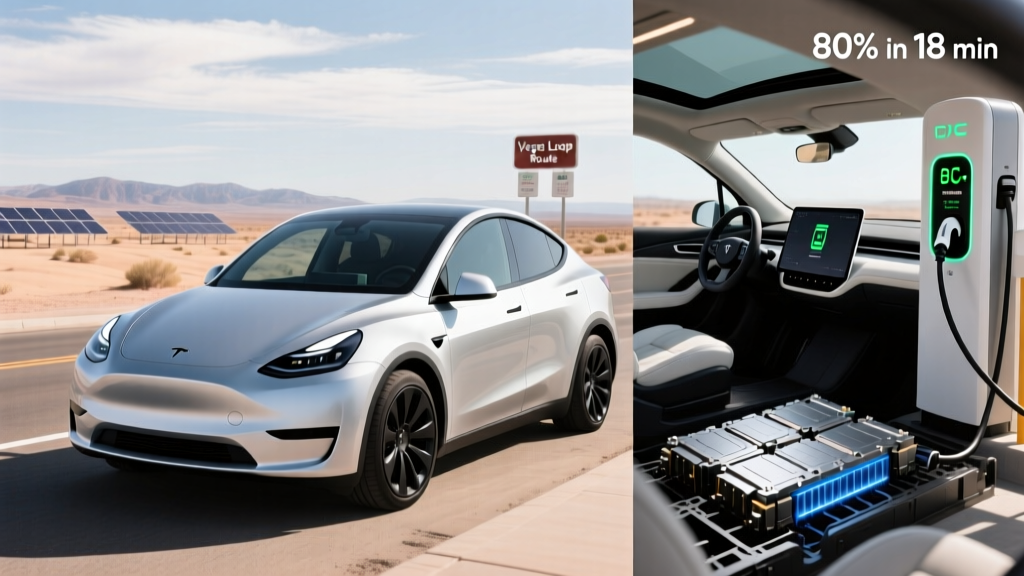
| DC Fast (V3 Supercharger) | Peak 250 kW | 10–80% in ~25 min (Long Range) | Sustains ~200 kW to ~50% SoC, then tapers |
| DC Fast (V4 Supercharger) | Peak 250 kW | 10–80% in ~25 min | V4 cabinets same peak for Model Y; CCS-native stalls |
| DC Fast (Electrify America / 350 kW stall) | Limited to ~170 kW via adapter | 10–80% in ~35 min | NACS-to-CCS adapter included; adapter adds slight overhead |
Charge Curve Reality
Tesla's 250 kW peak is not sustained. On a preconditioned Long Range Model Y at a V3 Supercharger, expect the following curve:
- 10–30% SoC: 220–250 kW (peak)
- 30–50% SoC: 180–210 kW
- 50–70% SoC: 120–150 kW
- 70–80% SoC: 70–100 kW (significant taper)
- 80–100% SoC: 25–50 kW (trickle — avoid DC fast charging above 80% unless necessary)
Preconditioning is critical. If you navigate to a Supercharger using the car's built-in navigation, the battery thermal management system begins warming the pack 10–20 minutes before arrival. Skipping this step (e.g., using a third-party app to navigate) can add 5–10 minutes to your 10–80% time, particularly in cold weather.
The Tesla Loop in Las Vegas: What It Is and Why It Matters
If you've searched "Tesla Loop Vegas," you're likely curious about The Boring Company's underground transit system that uses Tesla vehicles — primarily Model Ys and Model 3s — to move passengers beneath the Las Vegas Convention Center (LVCC) and, increasingly, to resorts along the Strip.
What the Vegas Loop Actually Is
The Las Vegas Convention Center Loop opened in 2021 with two stations and roughly 1.7 miles of tunnel. By 2025, expansion connected the LVCC to Resorts World, Encore, and Westgate, bringing the system to over 4.5 miles of tunnel. The long-term vision includes connections to Harry Reid International Airport, Allegiant Stadium, and downtown Las Vegas — though these phases remain in various stages of approval and construction.
The system operates with human drivers in most vehicles, though Tesla and The Boring Company have tested autonomous operation on closed sections. This is not a Level 4 robotaxi service in the Waymo sense — it is a point-to-point shuttle in a controlled, low-speed tunnel environment. Speeds in the tunnel typically range from 35–65 mph.
What Riding the Loop Tells You About Owning a Model Y
Convention-goers who ride the Vegas Loop are essentially experiencing a high-mileage, fleet-operated Model Y. The ride quality is firm but composed — the Juniper refresh improved noise isolation significantly over the pre-2025 model. The minimalist interior holds up well to heavy use, though the absence of physical buttons means everything (climate, mirrors, glovebox) routes through the 15.4-inch center touchscreen. For fleet operators, this simplicity reduces maintenance; for private owners, it's a personal-preference question.
According to Las Vegas Convention and Visitors Authority, the Loop has moved over 10 million passengers since opening, making it one of the highest-throughput private transit systems in the US.
Pricing, Tax Credits, and Total Cost
| Trim | Base MSRP | Federal §30D Credit | Effective Price | Income Cap |
|---|---|---|---|---|
| Rear-Wheel Drive | $44,990 | Up to $7,500 (if eligible) | From ~$37,490 | $150K single / $300K joint MAGI |
| Long Range AWD | $49,990 | Up to $7,500 (if eligible) | From ~$42,490 | $150K single / $300K joint MAGI |
| Performance AWD | $54,990 | Up to $7,500 (if eligible) | From ~$47,490 | $150K single / $300K joint MAGI |
§30D Tax Credit Eligibility — The Fine Print
Not every buyer qualifies for the full $7,500 federal EV tax credit. Under current IRS §30D rules, eligibility depends on:
- MSRP cap: SUVs (including the Model Y) must have an MSRP at or below $80,000. All 2026 Model Y trims clear this threshold.
- Income cap: Modified adjusted gross income (MAGI) must not exceed $150,000 (single), $225,000 (head of household), or $300,000 (married filing jointly).
- Battery sourcing: The credit splits into two halves — $3,750 for meeting critical-minerals requirements and $3,750 for meeting battery-component requirements. Sourcing rules tighten annually; check the IRS eligible-vehicle list at the time of purchase.
- Point-of-sale transfer: As of 2024, you can transfer the credit to the dealer at purchase, reducing your out-of-pocket cost immediately rather than waiting to claim it on your tax return. Tesla's checkout flow supports this.
Always verify eligibility with a tax professional and the IRS clean vehicle credit page before purchasing. Rules and sourcing requirements change, and this analysis reflects 2026 guidelines.
Interior, Cargo, and Daily Livability
The Model Y's hatchback crossover form factor is its secret weapon for families and road-trippers. Cargo volume behind the second row measures 30.2 cubic feet, expanding to 72.1 cubic feet with the rear seats folded. The front trunk (frunk) adds another 4.1 cubic feet — enough for a carry-on bag or charging cables.
Interior dimensions that matter:
- Front legroom: 41.8 inches
- Rear legroom: 37.9 inches (adequate for adults, tight for tall passengers on long trips)
- Headroom (front/rear): 40.7 / 37.7 inches
- Seating: 5-passenger standard; a 7-seat option (two small rear-facing third-row seats) is available on Long Range for $3,000, but the third row is realistically for children only and eliminates most cargo space when deployed.
The 15.4-inch center touchscreen controls nearly everything. The 2026 Juniper refresh added ambient lighting, ventilated front seats, power-folding second-row seats, and a rear-seat 8-inch touchscreen for climate and media — addressing longstanding complaints about rear-passenger comfort.
Driver Assistance: Autopilot and FSD (Supervised)
Tesla Autopilot and Full Self-Driving (Supervised) are Level 2 driver-assistance systems, not autonomous driving. The driver must remain attentive, keep hands on the wheel (or demonstrate engagement via torque/steering input), and be prepared to take over at any moment. No Tesla vehicle currently sold is capable of unsupervised self-driving. Level 4 autonomous operation (no driver required) is currently only available in geofenced commercial services like Waymo.
What's Included vs. What Costs Extra
- Basic Autopilot (standard): Traffic-aware cruise control, lane centering, automatic emergency braking, blind-spot monitoring. Competent for highway commuting.
- Enhanced Autopilot ($6,000): Adds auto lane change, navigate on Autopilot (highway on/off-ramp routing), auto park, and Smart Summon (low-speed parking-lot movement).
- FSD Supervised ($8,000 or $99/mo): Adds city-street traffic-light and stop-sign recognition, automatic turns, and broader urban navigation. Requires constant supervision. Performance varies significantly by city and road complexity.
In our experience, Basic Autopilot handles highway driving capably and is sufficient for most buyers. FSD Supervised has improved markedly since its 2023–2024 vision-only rewrite, but it still makes unpredictable decisions in complex urban scenarios — unprotected left turns, construction zones, and dense pedestrian areas remain weak points. The subscription model ($99/mo) makes it easier to trial without committing $8,000 upfront.
Warranty, Reliability, and Battery Longevity
Tesla's warranty structure is straightforward:
- Basic vehicle: 4 years / 50,000 miles
- Battery & drive unit (RWD): 8 years / 100,000 miles, minimum 70% capacity retention
- Battery & drive unit (Long Range / Performance): 8 years / 120,000 miles, minimum 70% capacity retention
The 70% retention threshold is the warranty trigger — if your battery degrades below 70% of original capacity within the warranty window, Tesla will repair or replace it. In practice, Tesla's battery degradation data (published in annual impact reports) shows NMC packs retaining approximately 85–88% capacity at 150,000 miles, and LFP packs showing even slower degradation curves due to the chemistry's inherent cycle-life advantage.
Out-of-warranty battery replacement for the Model Y currently ranges from $12,000–$16,000 depending on pack size and labor. That figure has declined from the $18,000–$22,000 range in 2022 as refurbished packs become available.
Reliability remains a mixed picture. According to IIHS, the Model Y earns top marks in crashworthiness. However, fit-and-finish complaints (panel gaps, paint quality, rattles) remain more common than on competitors from Hyundai or BMW. Tesla's service-center network has expanded, but wait times for body work can stretch to several weeks in metro areas.
Pros and Cons
Pros
- Class-leading Supercharger network access — 60,000+ connectors, highest reliability in the industry
- 350-mile EPA range on Long Range; real-world highway range still exceeds 290 miles
- 72.1 cu ft cargo volume with seats folded; hatchback versatility
- Over-the-air updates continuously add features and refine performance
- Strong resale value relative to non-Tesla EVs
- 250 kW peak DC fast charging with excellent preconditioning integration
- LFP battery on base trim allows daily 100% charging without degradation concerns
Cons
- Minimalist interior polarizes — no physical buttons, no traditional instrument cluster
- FSD Supervised ($8,000) remains a Level 2 system; value proposition is debatable
- Fit and finish still trails Hyundai, BMW, and Mercedes on panel gaps and materials
- Rear legroom (37.9 in) is tight for taller adults on long trips
- No Apple CarPlay or Android Auto — Tesla's native infotainment only
- Insurance premiums run 15–30% higher than comparable ICE crossovers in most states
- 7-seat option is impractical for anyone except small children
Who Should Buy the 2026 Model Y?
Choose the Model Y RWD if:
- You have home Level 2 charging and commute under 60 miles daily
- You want the lowest entry price and can live with 320 miles of range
- You prefer LFP chemistry and plan to charge to 100% daily
- You don't need AWD (mild-winter climates)
Choose the Model Y Long Range AWD if:
- You road-trip regularly and want 350 miles of EPA range with dual-motor traction
- You live in a cold-weather state and need the NMC pack's better low-temperature performance
- You want the best balance of range, performance, and price
Choose the Model Y Performance if:
- You prioritize acceleration (3.5-second 0–60) and track-capable braking
- You're willing to sacrifice ~20 miles of range and pay a $5,000 premium over Long Range
Look elsewhere if:
- You need a traditional instrument cluster, physical buttons, or Apple CarPlay
- You require more than 38 inches of rear legroom for adult passengers
- You want a luxury interior (consider the BMW iX, Genesis Electrified GV70, or Mercedes EQB)
Frequently Asked Questions
What is the real-world range of the 2026 Tesla Model Y?
The EPA rates the Long Range AWD at 350 miles, but real-world highway driving at 70–80 mph typically yields 290–310 miles. In freezing weather with cabin heat, expect 255–275 miles. The base RWD (320 EPA) drops to roughly 260–280 highway and 230–250 in cold conditions.
How fast does the Model Y charge at home and on DC fast chargers?
At home on a 240V Level 2 Tesla Wall Connector (48 amps / 11.5 kW), the Model Y gains roughly 37 miles of range per hour — a full charge takes about 8 hours. On a V3 Supercharger (250 kW peak), the Long Range achieves 10–80% in approximately 25 minutes with proper preconditioning. Charging slows significantly above 80%.
How much does the 2026 Model Y cost after the federal tax credit?
The base RWD starts at $44,990 MSRP. If you meet all IRS §30D requirements (income caps, battery sourcing rules), the effective price drops to approximately $37,490. The Long Range AWD drops from $49,990 to roughly $42,490, and the Performance from $54,990 to roughly $47,490. Verify your eligibility with a tax professional — credit amounts vary based on battery-component and critical-mineral sourcing, which change annually.
Does the 2026 Model Y qualify for the full $7,500 federal EV tax credit?
The Model Y's MSRP is well under the $80,000 SUV cap, so price is not the barrier. Eligibility depends on your MAGI (under $150K single / $300K joint) and whether the specific vehicle's battery meets the 2026 critical-minerals and component-sourcing thresholds. The credit can be split — you may qualify for $3,750, $7,500, or $0 depending on sourcing. Check the fueleconomy.gov EV tax credit page for the current eligible-vehicle list.
Is the Model Y worth buying vs. the Hyundai Ioniq 5 or Ford Mach-E?
The Model Y wins on Supercharger access, cargo volume (72.1 cu ft vs. Ioniq 5's 59.3), and software integration. The Ioniq 5 charges faster on paper (350 kW peak on 800V architecture; 10–80% in ~18 min) and offers a more comfortable ride and physical climate controls. The Mach-E provides a more traditional cockpit layout. If public charging reliability is your top concern, the Model Y's Supercharger advantage is decisive. If interior comfort and controls matter more, test-drive all three.
What is the Tesla Vegas Loop, and can I ride it?
The Vegas Loop is The Boring Company's underground tunnel system beneath the Las Vegas Convention Center and surrounding resorts, using Tesla Model Y and Model 3 vehicles as shuttles. It's free for LVCC convention attendees and open to the public at connected resort stations. As of 2026, the system spans over 4.5 miles with stations at LVCC, Resorts World, Encore, and Westgate. Vehicles are driven by human operators — this is not a Level 4 autonomous service.
How long will the Model Y battery last before replacement?
Tesla's own fleet data shows NMC Model Y packs retaining 85–88% capacity at 150,000 miles. LFP packs (base RWD) degrade even more slowly. At average US driving distances (~14,000 miles/year), the battery should outlast the vehicle's economic life. The 8-year / 100,000–120,000-mile warranty covers replacement if capacity drops below 70%. Out-of-warranty replacement currently costs $12,000–$16,000.