Quick Verdict: The Tesla Model Y and V2L Explained
If you've been searching for Tesla Model Y V2L capability, here's the straight answer: as of the 2026 model year, the Tesla Model Y does not natively support vehicle-to-load (V2L) power output. You cannot plug a standard 120V appliance into the Model Y and run it from the traction battery the way you can with a Hyundai Ioniq 5, Ford F-150 Lightning, or Kia EV6.
That said, the Model Y remains one of the most capable electric SUVs on the market for range, charging speed, and Supercharger network access. Tesla does offer a low-voltage 12V/16V accessory power socket (cigarette-lighter style) in the cabin rated for roughly 150 watts — enough to charge laptops or run small electronics, but far short of the 1,500–3,600 watts that true V2L systems deliver. And Tesla has hinted at future vehicle-to-everything (V2X) capabilities in firmware updates, but nothing has shipped as of early 2026.
Below, we break down the full 2026 Tesla Model Y profile — range, charging, pricing, tax credits — so you can decide whether the absence of V2L is a dealbreaker or a minor footnote in an otherwise strong package.
2026 Tesla Model Y: Full Spec Sheet
| Specification | Long Range RWD | Long Range AWD | Performance |
|---|---|---|---|
| EPA Range | 320 mi | 308 mi | 277 mi |
| Battery (usable) | ~75 kWh (NMC) | ~75 kWh (NMC) | ~75 kWh (NMC) |
| Drivetrain | Rear-Wheel Drive | Dual-Motor AWD | Dual-Motor AWD |
| Horsepower | ~346 hp | ~384 hp | ~456 hp |
| 0–60 mph | 5.8 sec | 4.8 sec | 3.5 sec |
| Max DC Fast Charge | 250 kW | 250 kW | 250 kW |
| 10–80% DCFC Time | ~27 min | ~27 min | ~27 min |
| Level 2 Charge Rate | 11.5 kW (44 mi/hr) | 11.5 kW (44 mi/hr) | 11.5 kW (44 mi/hr) |
| Efficiency (MPGe) | 123 MPGe | 117 MPGe | 111 MPGe |
| Base MSRP | $44,990 | $47,990 | $52,490 |
| Cargo Volume (rear seats up) | 30.2 cu ft (76.2 cu ft folded) | ||
| Rear Legroom | 41.6 in | ||
| Battery Warranty | 8 yr / 120,000 mi | ||
| V2L Support | No (12V accessory socket only, ~150W) | ||
Real-World Range: What the EPA Sticker Doesn't Tell You
EPA Estimated Range: 320 miles (Long Range RWD), 308 miles (Long Range AWD), 277 miles (Performance)
Real-World Expectation: Expect roughly 270–290 miles on a highway road trip at 70–75 mph in moderate temperatures. In cold weather (below 30°F), range can drop 20–30%, yielding as little as 200–220 miles on the Long Range AWD before you need to stop. City driving with heavy regenerative braking can match or slightly exceed EPA figures.
Tesla's efficiency engineering is among the best in the industry. The Model Y's heat pump — standard on all 2026 trims — recovers waste heat from the powertrain to warm the cabin, reducing the cold-weather penalty compared to older EVs without thermal management. Still, physics is physics: the NMC battery's internal resistance rises in freezing temperatures, and cabin heating draws significant energy regardless of heat-pump efficiency.
On a fueleconomy.gov comparison, the Model Y Long Range AWD's 117 MPGe combined is competitive with the Hyundai Ioniq 5 (114 MPGe) and slightly behind the BMW iX xDrive50 (119 MPGe). Efficiency is measured in watt-hours per mile; the Model Y averages roughly 280 Wh/mi, which is excellent for a crossover of its size and weight.
Charging Speed: DC Fast, Level 2, and the Supercharger Advantage
| Charging Level | Power (kW) | Speed (mi/hr added) | Notes |
|---|---|---|---|
| Level 1 (120V household) | ~1.4 kW | ~3–4 mi/hr | Emergency/top-up only |
| Level 2 (240V, 48A Wall Connector) | 11.5 kW | ~44 mi/hr | Full charge in ~7–8 hours |
| DC Fast Charge (V3 Supercharger) | 250 kW peak | ~1,000+ mi/hr (peak) | 10–80% in ~27 min |
| DC Fast Charge (V4 Supercharger) | 250 kW peak | ~1,000+ mi/hr (peak) | Newer stations; same vehicle limit |
The Model Y's charging architecture peaks at 250 kW on Tesla V3 and V4 Superchargers. In practice, the charge curve is aggressive in the 10–50% state-of-charge window, then tapers significantly above 80%. This is standard for NMC lithium-ion chemistry — charging the last 20% can take as long as the first 60%. For road-trip planning, Tesla's navigation system automatically preconditions the battery when you navigate to a Supercharger, warming it to optimal temperature for maximum charge acceptance.
At home, the Tesla Wall Connector on a 60-amp circuit delivers up to 11.5 kW (48 amps), adding roughly 44 miles of range per hour of charging. An overnight session (8 hours) easily replenishes a full day's driving for most owners. If your home electrical panel supports only a 40-amp circuit, expect roughly 7.7 kW (32A) and about 30 mi/hr — still adequate for daily use.
One key advantage: with Tesla's NACS connector now adopted as the North American standard, the Model Y has native access to the growing Supercharger network (20,000+ stalls in the US) without adapters. Non-Tesla EVs are gaining Supercharger access via NACS adapters or built-in NACS ports, but the Model Y remains a first-class citizen on the network.
Why Doesn't the Model Y Have V2L? And What Can You Do Instead?
V2L (vehicle-to-load) allows an EV's traction battery to power external AC devices — think running a coffee maker at a campsite, powering tools at a job site, or providing emergency backup during a blackout. Competitors like the Hyundai Ioniq 5 (up to 3.6 kW via an interior V2L outlet or external adapter), Kia EV6, Ford F-150 Lightning (Pro Power Onboard at up to 9.6 kW), and the Rivian R1S all offer this feature.
Tesla has not implemented V2L on the Model Y for several likely reasons:
- Hardware: V2L requires an onboard inverter capable of converting DC battery voltage to 120V/240V AC. The Model Y does not currently include this hardware.
- Software: Tesla would need to manage discharge limits, protect battery longevity, and integrate V2L controls into the vehicle UI.
- Strategic focus: Tesla has prioritized Tesla Powerwall and Megapack for home/grid storage rather than vehicle-based power export.
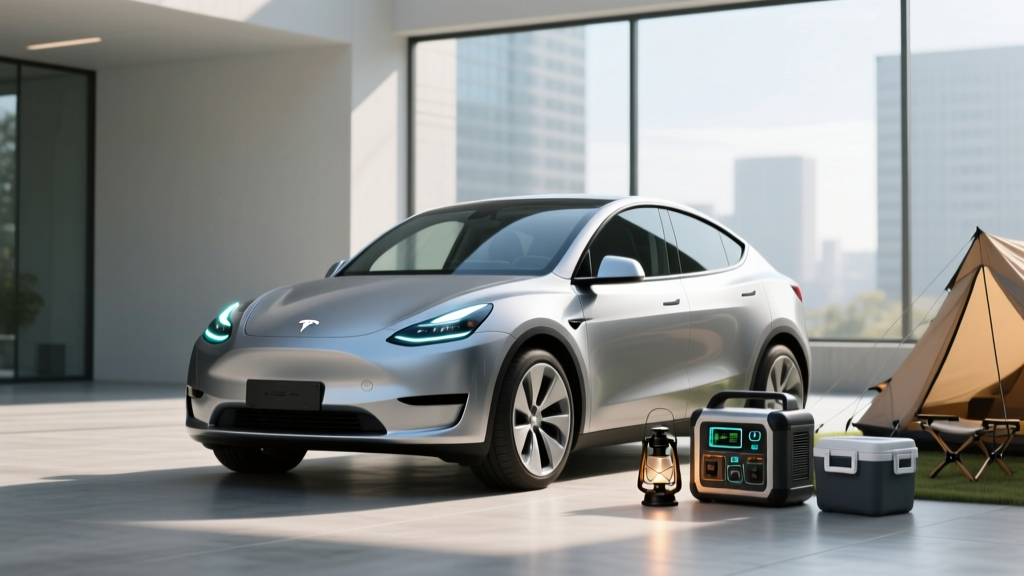
Workarounds: Some owners use a pure-sine-wave inverter connected to the 12V/16V low-voltage system for very light loads (under 150W), but this is not true V2L and will not power appliances. Portable power stations (EcoFlow, Jackery, Bluetti) charged from the Model Y's accessory socket or a home outlet remain the practical solution for camping or emergency power needs.
Tesla has filed patents related to bidirectional charging and has discussed V2X capabilities in earnings calls, but as of 2026, no production Tesla vehicle supports V2L, V2H (vehicle-to-home), or V2G (vehicle-to-grid). If this feature is a priority, the F-150 Lightning, Ioniq 5, or EV6 are stronger choices.
Pricing, Trims, and Federal Tax Credit Eligibility
| Trim | Base MSRP | Est. Destination | §30D Credit (max) | Effective Price* |
|---|---|---|---|---|
| Long Range RWD | $44,990 | $1,390 | Up to $7,500 | ~$38,880 |
| Long Range AWD | $47,990 | $1,390 | Up to $7,500 | ~$41,880 |
| Performance | $52,490 | $1,390 | Up to $7,500 | ~$46,380 |
*Effective price assumes full $7,500 §30D credit. Actual credit depends on battery sourcing, buyer income, and tax liability. Point-of-sale transfer available at participating dealers.
All 2026 Model Y trims fall under the IRS §30D SUV MSRP cap of $80,000, so pricing is not a barrier to credit eligibility. However, the full $7,500 credit is subject to several requirements:
- Buyer income caps: Modified adjusted gross income (MAGI) must not exceed $300,000 (joint filers), $225,000 (head of household), or $150,000 (single).
- Battery sourcing: A percentage of critical minerals and battery components must be sourced from the US or free-trade-agreement countries. These thresholds increase annually. For 2026, verify current sourcing compliance on Tesla's website or the IRS qualified vehicles list.
- Point-of-sale transfer: As of 2024, buyers can transfer the credit to the dealer at purchase, reducing the purchase price directly rather than waiting for a tax refund. Tesla participates in this program.
- Tax liability: If transferred at point of sale, the credit is not limited by your tax liability. If claimed on your tax return, the credit is non-refundable and cannot exceed your total tax owed.
Always confirm eligibility with a tax professional and check the latest fueleconomy.gov tax credit listings before purchasing, as battery-sourcing compliance can change with supply-chain updates mid-model-year.
Interior, Tech, and Driver Assistance
The 2026 Model Y continues Tesla's minimalist interior approach — a 15.4-inch center touchscreen handles nearly all vehicle controls, navigation, media, and climate functions. There is no traditional instrument cluster; speed and range information appears on the upper-left corner of the main display. The refresh (sometimes called the "Juniper" update, rolling across the lineup) brought improved materials, ventilated front seats, ambient lighting, power-folding second-row seats, and a rear-seat entertainment screen.
Tesla Autopilot and FSD (Supervised): Every Model Y ships with basic Autopilot (Traffic-Aware Cruise Control and Autosteer) as standard. Full Self-Driving (Supervised) remains an optional $8,000 add-on (or $99/month subscription as of early 2026). FSD adds Navigate on Autopilot, Auto Lane Change, Autopark, and Smart Summon.
SAE Automation Level: Level 2
Both Autopilot and FSD (Supervised) are SAE Level 2 driver-assistance systems. The driver must remain fully engaged, keep hands on the wheel (or demonstrate attention via the cabin camera), and be prepared to take over at any moment. These are not self-driving systems. Only Level 4 services like Waymo operate without a human driver in defined geographic areas.
Cargo space: 30.2 cubic feet behind the second row, expanding to 76.2 cu ft with seats folded. The front trunk (frunk) adds additional storage for charging cables or a small bag. Rear legroom is a generous 41.6 inches, making the Model Y comfortable for tall passengers on longer trips.
Pros, Cons, and the Bottom Line
Pros
- Class-leading Supercharger network access (native NACS)
- Excellent efficiency (~280 Wh/mi) and strong EPA range
- 250 kW DC fast charging with battery preconditioning
- Spacious cargo area and comfortable rear seating
- Strong resale value and low depreciation relative to EV peers
- Over-the-air updates continuously add features
- Qualifies for up to $7,500 federal tax credit (subject to sourcing/income rules)
Cons
- No V2L / V2H / V2G capability
- Touchscreen-dependent controls frustrate some drivers (no physical buttons for climate, wipers)
- FSD (Supervised) is expensive and still requires full driver attention
- Ride quality can feel firm on rough pavement
- Panel gaps and build consistency still trail legacy automakers
- No Apple CarPlay or Android Auto integration
- 250 kW peak charge rate trails some 800V competitors (Ioniq 5 at 350 kW peak)
Should You Buy the Model Y — or Look Elsewhere for V2L?
Choose the Tesla Model Y if: You prioritize range, Supercharger access, efficiency, and a proven EV ecosystem — and V2L is not a priority. It's the best-selling EV in the US for good reason.
Choose the Hyundai Ioniq 5 if: You want built-in V2L (3.6 kW), 800V architecture with 350 kW peak DC charging, and physical buttons — though you'll trade some range and Supercharger convenience (though NACS adoption is closing this gap).
Choose the Ford F-150 Lightning if: You need serious V2L/V2H power (up to 9.6 kW via Pro Power Onboard) and truck utility, and you're willing to accept lower efficiency and a larger vehicle footprint.
Choose the Kia EV6 if: You want V2L, 800V fast charging, a sportier driving feel, and a more conventional interior layout.
Frequently Asked Questions
Does any Tesla vehicle have V2L?
No. As of the 2026 model year, no production Tesla — including the Model Y, Model 3, Model S, Model X, or Cybertruck — supports vehicle-to-load (V2L), vehicle-to-home (V2H), or vehicle-to-grid (V2G) power export. Tesla has discussed bidirectional charging in investor presentations, but no hardware or software update has been released to enable it.
Can I use an aftermarket inverter to get V2L from my Model Y?
Not safely at meaningful power levels. The Model Y's 12V/16V accessory socket is rated for approximately 150 watts — enough for a laptop charger but not for appliances, power tools, or home backup. Connecting a high-wattage inverter directly to the traction battery is extremely dangerous, voids your warranty, and risks fire or electrocution. If you need portable power, invest in a dedicated power station (EcoFlow Delta, Bluetti AC200, etc.) and charge it from a wall outlet or the car's accessory socket over time.
What is the real-world range of the 2026 Model Y?
The EPA rates the Long Range RWD at 320 miles, Long Range AWD at 308 miles, and Performance at 277 miles. In real-world highway driving at 70–75 mph, expect roughly 270–290 miles (Long Range). In cold weather below 30°F, range drops 20–30%, so plan for 200–230 miles between charges on winter road trips. City driving with regenerative braking often matches or slightly exceeds EPA estimates.
How fast does the Model Y charge at home and on the road?
At home on a 240V Level 2 Tesla Wall Connector (48A), the Model Y charges at up to 11.5 kW, adding about 44 miles of range per hour — a full overnight session covers most daily needs. On a Tesla V3 or V4 Supercharger, it peaks at 250 kW DC, achieving a 10–80% charge in approximately 27 minutes. Charge speed tapers significantly above 80% SoC to protect battery health.
Does the 2026 Model Y qualify for the $7,500 federal EV tax credit?
All Model Y trims are under the $80,000 SUV MSRP cap for §30D eligibility. The full $7,500 credit depends on your income (MAGI under $300K joint / $150K single), battery critical-mineral and component sourcing compliance (thresholds increase annually), and whether you claim it on your tax return or transfer it at point of sale. Check the IRS clean vehicle credit page and Tesla's current sourcing disclosures before purchasing. Consult a tax professional for personalized guidance.
Is the Model Y worth buying without V2L?
For the vast majority of EV buyers — commuters, families, road-trippers — V2L is a nice-to-have rather than a necessity. The Model Y excels where it matters most for daily ownership: range, efficiency, charging infrastructure, and total cost of ownership. If you specifically need vehicle-to-load power for job-site tools, camping appliances, or home backup during outages, the Ford F-150 Lightning (9.6 kW Pro Power Onboard) or Hyundai Ioniq 5 (3.6 kW V2L) are better fits. For everyone else, the Model Y's strengths outweigh this single missing feature.
What EVs have the best V2L capability in 2026?
The top V2L-capable EVs include: Ford F-150 Lightning (up to 9.6 kW, Pro Power Onboard with bed and cabin outlets), Hyundai Ioniq 5 (up to 3.6 kW, interior outlet + external adapter), Kia EV6 (up to 3.6 kW via adapter), Rivian R1S/R1T (camping-focused outlets), and VW ID.4 (limited V2L on select trims). Power output, outlet location, and whether an adapter is required vary by model — always check the specific trim's V2L rating before purchasing.