The Tesla Model Y has dominated U.S. EV sales for years, but one feature has stubbornly remained absent from its spec sheet: Vehicle-to-Load (V2L) — the ability to power external devices directly from the car's battery. As competitors like the Hyundai Ioniq 5, Ford F-150 Lightning, and Kia EV9 have embraced bidirectional power, buyers increasingly search for Tesla Model Y V2L capability. With the Juniper refresh now in full swing for the 2026 model year, has Tesla finally closed the gap?
The short answer: no native V2L outlet exists on the 2026 Model Y, but the story is more nuanced than a flat "no." Below, we cover the full vehicle profile — range, charging, pricing, tax-credit eligibility, and workarounds — so you can decide whether the Model Y still fits your needs or if a competitor's bidirectional power should push you elsewhere.
2026 Tesla Model Y Juniper: Quick Verdict
The refreshed Model Y (internally codenamed "Juniper") brings a redesigned interior with ambient lighting, a front light bar, ventilated seats, rear touchscreen, and improved NVH (noise, vibration, harshness). The powertrain and battery architecture carry over with minor efficiency gains. The Long Range AWD remains the volume seller, now rated at 320 miles EPA. But if you're specifically hunting for V2L to power camping gear, job-site tools, or home backup, the Model Y still requires third-party workarounds rather than a built-in 120V/240V outlet.
| Specification | Value |
|---|---|
| EPA Range | 320 miles |
| Battery (usable) | ~75 kWh (NMC) |
| Drivetrain | Dual-motor AWD |
| Horsepower | 384 hp |
| 0-60 mph | 4.8 seconds |
| Max DC Fast Charge | 250 kW peak |
| 10-80% DC Charge Time | ~27 minutes |
| Level 2 (Home) Charge Rate | 11.5 kW (~44 mi/hr) |
| Efficiency | 122 MPGe / 28 kWh/100 mi |
| Cargo Volume (rear seats up) | 30.2 cu ft |
| Cargo Volume (rear seats folded) | 72.1 cu ft |
| Rear Legroom | 41.6 in |
| Towing Capacity | 3,500 lbs |
| Battery/Drive Unit Warranty | 8 years / 120,000 miles |
| Base MSRP (Long Range AWD) | $48,990 |
Range & Real-World Efficiency: What to Actually Expect
Tesla's Long Range AWD Model Y is EPA-rated at 320 miles for 2026. The rear-wheel-drive (RWD) variant with its LFP battery is rated at approximately 279 miles. These are solid figures, but the EPA test cycle favors mixed city/highway driving with moderate climate loads.
EPA sticker: 320 miles (Long Range AWD). In practice, expect ~265–285 miles on a sustained highway trip at 70-75 mph, and as low as ~230–250 miles in sub-freezing winter conditions due to cabin heating demand and reduced battery efficiency. The RWD LFP model will deliver closer to 225–240 miles in cold weather. Preconditioning the battery while plugged in mitigates some cold-weather range loss.
Efficiency on the Long Range AWD comes in at 28 kWh/100 miles (combined), per fueleconomy.gov. That's among the best in the compact electric SUV class, trailing only the Hyundai Ioniq 5 (29 kWh/100 mi) and edging out the Ford Mustang Mach-E. On a road trip, this efficiency translates to roughly $0.04–$0.06 per mile when charging at home on a national-average residential rate of ~$0.17/kWh.
Charging Speed: DC Fast, Level 2, and the Supercharger Advantage
The 2026 Model Y Long Range retains a 250 kW peak DC fast-charging rate on Tesla's V3 and V4 Superchargers. The RWD variant with LFP chemistry maxes out at roughly 170 kW. Tesla quotes a 10-80% charge in about 27 minutes for the Long Range; the RWD takes closer to 32-35 minutes.
| Charge Level | Power / Voltage | Miles Added per Hour | Notes |
|---|---|---|---|
| Level 1 (120V household) | ~1.4 kW | ~4-5 mi/hr | Emergency/trickle only |
| Level 2 (240V home) | 11.5 kW | ~44 mi/hr | Full charge in ~7-8 hrs |
| DC Fast (Supercharger V3) | 250 kW peak | ~160 mi in 15 min | Tapers significantly above 80% |
| DC Fast (CCS adapter / NACS) | Up to 150-250 kW | Varies by station | Non-Tesla networks supported via NACS |
Charging-curve reality: The 250 kW peak is not sustained. In real-world testing, the Model Y pulls peak power only between roughly 10-30% SoC, tapering to ~150 kW by 50% and dropping below 75 kW past 80%. This is why the 10-80% metric matters far more than peak kW marketing claims. Always precondition the battery by entering a Supercharger as your navigation destination — this warms the pack and unlocks the fastest charge curve.
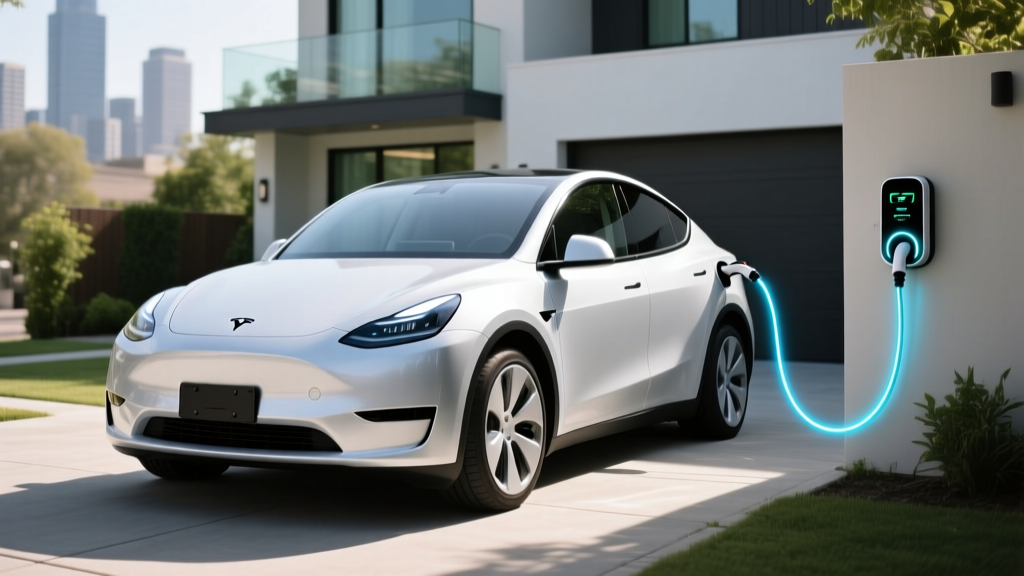
At home, a Level 2 Wall Connector on a 60-amp circuit delivers the full 11.5 kW (48 amps continuous). That's enough to replenish a full day's driving (40-60 miles) in about 1-1.5 hours overnight. Installation typically runs $500-$1,500 depending on panel proximity and local permitting.
Does the 2026 Tesla Model Y Have V2L?
This is the question driving search interest, so let's be direct: the 2026 Tesla Model Y does not include a native V2L (Vehicle-to-Load) outlet. There is no built-in 120V or 240V AC outlet that lets you plug in appliances, tools, or camping gear directly from the high-voltage battery.
The Model Y does retain a 12V auxiliary system (now a lithium-ion 12V battery in Juniper models), but this is not designed for sustained high-draw loads. Tesla's 12V system powers vehicle electronics, not external devices at meaningful wattages.
Workarounds for Tesla Owners Who Need Portable Power
- Portable power stations (Jackery, EcoFlow, Bluetti): Charge these at home and top them off from the Model Y's 12V system while driving (limited to ~100-150W draw via the 12V port). This is a workaround, not true V2L.
- Inverter on the 12V system: Some owners connect a small 150-300W inverter to the 12V battery terminals, but this is not recommended by Tesla and can void warranty coverage if it causes electrical issues.
- Choose a competitor with native V2L: If V2L is a must-have, the Hyundai Ioniq 5 (120V/3.6 kW outlet), Ford F-150 Lightning (up to 9.6 kW Pro Power Onboard), Kia EV9, and Rivian R1S/R1T all offer factory-supported bidirectional power.
Tesla's Cybertruck does support limited power output via its bed outlets, and Tesla has signaled interest in vehicle-to-home (V2H) integration with Powerwall. But as of the 2026 model year, the Model Y remains focused on driving efficiency and Supercharger network access rather than bidirectional power features.
Pricing, Trims, and Federal Tax Credit Eligibility
The 2026 Model Y lineup is streamlined:
| Trim | MSRP | Est. After §30D Credit | Drivetrain | EPA Range |
|---|---|---|---|---|
| RWD (LFP) | $44,990 | ~$37,490* | RWD | 279 mi |
| Long Range AWD | $48,990 | ~$41,490* | Dual-motor AWD | 320 mi |
| Performance AWD | $52,490 | ~$44,990* | Dual-motor AWD | 303 mi |
*Assumes full $7,500 §30D credit eligibility. See tax-credit checklist below.
All Model Y trims fall under the IRS $80,000 MSRP cap for SUVs under §30D rules. The point-of-sale transfer option lets dealers apply the credit as a down-payment reduction at purchase, rather than waiting for a tax refund at filing time.
- Buyer income cap: AGI ≤ $150,000 (single), $225,000 (head of household), $300,000 (joint)
- MSRP cap: ≤ $80,000 for SUVs (Model Y qualifies)
- Battery sourcing: Critical minerals and battery components must meet phased-in domestic/FRTA sourcing thresholds (check IRS.gov for current-year percentages)
- FEOC restriction: Vehicles with battery components from a "foreign entity of concern" may be disqualified — verify current eligibility at the point of sale
- Point-of-sale transfer: Available; reduces purchase price at delivery
Important: Tax credit rules change frequently. The RWD model's LFP battery has historically faced sourcing challenges under §30D critical-mineral requirements. Verify current eligibility with your tax professional and the dealer before relying on the full $7,500 figure.
Performance, Tech, and Interior: What Juniper Changed
The Juniper refresh doesn't alter the Model Y's fundamental performance character. The Long Range AWD still delivers 384 hp and a 4.8-second 0-60 mph time — quick enough for confident highway merging and passing without the tire-shredding intensity of the Performance trim (3.5 seconds to 60).
Where Juniper does make a difference:
- NVH reduction: Additional acoustic glass and improved insulation make the cabin noticeably quieter at highway speeds compared to pre-2025 models.
- Ventilated front seats: A long-requested feature, finally standard on all trims.
- Rear-seat touchscreen: A small display for rear passengers to control climate and media — similar to the Model S/X approach.
- Ambient lighting and new materials: A front light bar and softer-touch surfaces close the interior quality gap with Korean and German competitors.
- Autopilot hardware: The AI4 (HW4) suite remains standard, with cameras providing a 360° view. Note: Tesla's Full Self-Driving (Supervised) is a Level 2 driver-assist system per SAE classification — the driver must remain fully engaged at all times. This is not autonomous driving.
The 15.4-inch center touchscreen continues to serve as the primary interface for virtually all vehicle controls. There is still no traditional instrument cluster — speed and navigation info appear in the upper-left corner of the main display. Whether this minimalist approach is a pro or a con depends entirely on your tolerance for screen-based controls.
Pros, Cons, and the Bottom Line
- Best-in-class Supercharger network access (20,000+ stalls in North America)
- Excellent efficiency (28 kWh/100 mi) translates to low per-mile cost
- 320-mile EPA range covers most road-trip needs with one stop
- Strong resale value relative to EV segment average
- Over-the-air updates continuously add features
- Spacious cargo area (72.1 cu ft with seats folded)
- 8-year/120,000-mile battery and drive unit warranty
- No V2L capability — a growing dealbreaker for outdoor/work users
- No native Apple CarPlay or Android Auto
- 250 kW peak DC charge rate trails 350 kW-capable competitors (Ioniq 5, EV6)
- Minimalist interior still polarizing; no physical climate or volume controls
- FSD purchase ($8,000) remains expensive for a Level 2 system
- Insurance premiums tend to run 15-25% higher than comparable gas SUVs
- LFP RWD model has reduced cold-weather range vs. NMC Long Range
Who Should Buy the 2026 Model Y?
The Model Y remains ideal for commuters and families who prioritize Supercharger network reliability, strong efficiency, and a proven platform. If your typical week involves 30-60 miles of daily driving with home Level 2 charging, the Model Y is arguably the lowest-friction EV ownership experience available.
If you need V2L for camping, tailgating, job-site power, or home backup, look at the Hyundai Ioniq 5, Ford F-150 Lightning, or Kia EV9 instead. The Model Y simply doesn't serve that use case.
Frequently Asked Questions
Can I add V2L to a Tesla Model Y aftermarket?
Not safely or officially. While small 12V inverters exist, Tesla does not support aftermarket bidirectional power hardware, and connecting one risks voiding your electrical warranty. If V2L is essential, buy a vehicle with factory-supported output.
What is the real-world range of the 2026 Model Y Long Range?
Expect approximately 265-285 miles on a highway road trip at 70-75 mph in moderate temperatures. In winter (below 32°F), plan for 230-250 miles. The EPA sticker says 320 miles, but sustained highway driving and cold weather reduce that meaningfully.
How fast does the Model Y charge at home and on the road?
At home on a 240V Level 2 Wall Connector (11.5 kW), you'll add roughly 44 miles per hour of charging — enough for a full overnight charge. On a V3 Supercharger, the 10-80% charge takes about 27 minutes at a 250 kW peak, though the rate tapers significantly above 50% SoC.
Does the Tesla Model Y qualify for the $7,500 federal tax credit?
The Model Y qualifies under the $80,000 SUV MSRP cap. However, full $7,500 eligibility depends on your AGI (income limits apply), battery-sourcing requirements, and FEOC restrictions that change periodically. Verify current status on IRS.gov and with your dealer at purchase.
Is the Model Y worth buying over the Ioniq 5 or Mach-E?
If Supercharger access, efficiency, and resale value top your list, yes. If V2L, 350 kW DC charging speed, or physical controls matter more, the Ioniq 5 or Mach-E may be a better fit. The Model Y wins on network infrastructure; competitors win on feature breadth.
What battery chemistry does the Model Y use?
The Long Range AWD and Performance trims use NMC (nickel manganese cobalt) chemistry, which offers higher energy density but recommends an 80% daily charge limit for longevity. The RWD trim uses LFP (lithium iron phosphate), which can be charged to 100% daily without degradation concerns but sacrifices some range and cold-weather performance.
What's the battery warranty?
Tesla covers the Model Y battery and drive units for 8 years or 120,000 miles (whichever comes first) with a minimum 70% capacity retention threshold. This is competitive with the industry standard, though Hyundai/Kia offer 10-year/100,000-mile coverage on their EV batteries.