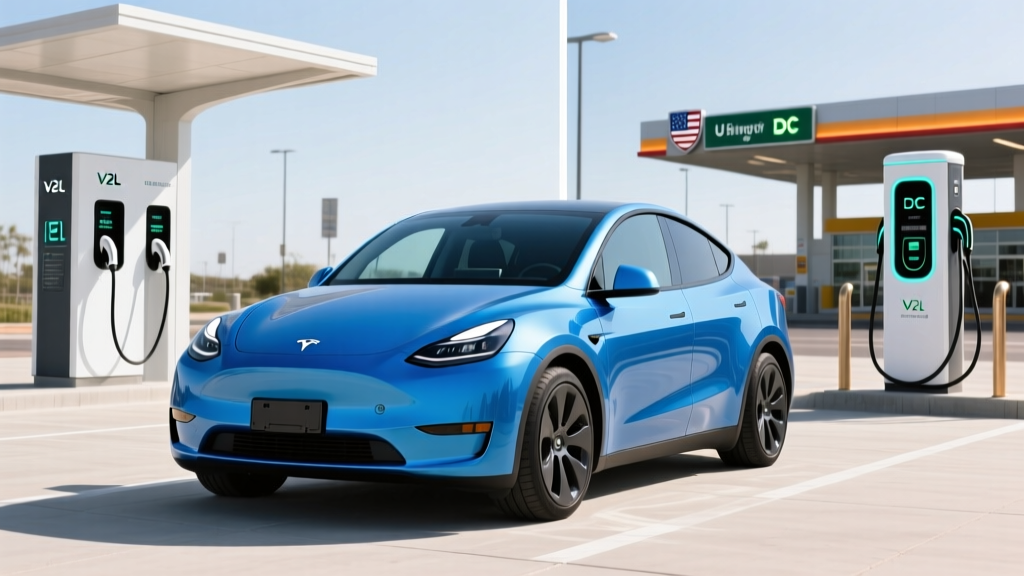
If you've been following Tesla forums or Chinese EV social media, you've likely seen the search term Tesla Model Y V2L China trending among owners and prospective buyers. Vehicle-to-Load (V2L) — the ability to use your EV's battery to power external devices, appliances, or even your home during an outage — has become a marquee feature on competing electric SUVs from Hyundai, Kia, and Ford. So does the Tesla Model Y sold in China (or the US) actually offer V2L? And how does the Chinese-market Model Y compare to the US-spec Juniper refresh?
This deep-dive review covers everything a 2026 buyer needs to know: V2L availability by region, real-world range, charging performance, battery chemistry, pricing after federal tax credits, and whether the Model Y still holds its crown against a rapidly closing competitive field.
Tesla Model Y V2L: China vs. the United States
Let's address the keyword question directly. As of the 2026 model year, the Tesla Model Y does not officially support V2L in any market — not in China, not in the United States, and not in Europe. While Tesla holds patents related to bidirectional charging and has hinted at future V2L/V2H (Vehicle-to-Home) capabilities, no production Model Y variant currently ships with an enabled V2L outlet or software toggle.
The confusion largely stems from two factors:
- Chinese-market accessories: Third-party vendors in China sell J1772/GB/T adapter dongles marketed as "V2L" devices for Teslas. These are not factory-supported and do not draw from the high-voltage traction battery the way a true V2L system does.
- Competitor marketing: The Hyundai Ioniq 5, Kia EV6, and Ford F-150 Lightning all offer robust V2L (3.6 kW or higher), and Chinese EV brands like BYD include V2L as standard. This has created an expectation among Chinese buyers that the Model Y should match — but Tesla has not yet complied.
2026 Tesla Model Y Core Specs at a Glance
Whether you're shopping in Shanghai or San Francisco, the 2026 Model Y Juniper refresh brought meaningful updates to efficiency, cabin materials, and suspension tuning. Here are the official figures by trim:
| Spec | Long Range RWD | Long Range AWD | Performance AWD |
|---|---|---|---|
| EPA Range | 320 mi | 302 mi | 277 mi |
| Battery (usable) | ~75 kWh (NMC) | ~75 kWh (NMC) | ~75 kWh (NMC) |
| Max DC Fast Charge | 250 kW | 250 kW | 250 kW |
| 10–80% DCFC Time | ~24 min | ~24 min | ~24 min |
| Level 2 Charge Rate | 11.5 kW (44 mi/hr) | 11.5 kW (44 mi/hr) | 11.5 kW (44 mi/hr) |
| 0–60 mph | 5.8 sec | 4.8 sec | 3.5 sec |
| Horsepower | 346 hp | 384 hp | 456 hp |
| Drivetrain | RWD (single motor) | AWD (dual motor) | AWD (dual motor) |
| MPGe (combined) | 123 MPGe | 117 MPGe | 111 MPGe |
| Base MSRP | $44,990 | $47,990 | $52,490 |
Source: fueleconomy.gov and Tesla US spec sheets. Chinese-market specs (sold via Gigafactory Shanghai) differ slightly in battery supplier (CATL LFP for Standard Range) and pricing (starting ~¥249,900 / ~$34,500 USD equivalent).
Real-World Range: What the EPA Sticker Doesn't Tell You
The EPA-rated 320 miles on the Long Range RWD is among the best in the compact electric SUV class, but real-world results depend heavily on conditions:
- Highway (70–80 mph, mild weather): Expect 265–285 miles. The Model Y's aerodynamic efficiency (~250 Wh/mi) is excellent, but sustained high-speed driving always cuts range 10–15%.
- City / mixed driving: Closer to 300–310 miles, thanks to regenerative braking recapturing energy in stop-and-go traffic.
- Cold weather (below 32°F / 0°C): Plan for 20–30% range loss, yielding roughly 220–250 miles on the LR RWD. The Juniper heat pump helps, but battery chemistry (NMC) is inherently less cold-tolerant than LFP in terms of usable capacity at low temperatures.
- Towing (up to 3,500 lbs rated): Range drops dramatically to ~150–180 miles. Towing with an EV remains a significant constraint across the industry.
Charging Speed: DC Fast Charge and Home Level 2
Tesla's Supercharger network remains the gold standard for reliability, and the 2026 Model Y leverages it well. However, the peak 250 kW rate is not sustained across the full charging session — as with all EVs, the charge curve tapers significantly above ~50–60% SoC to protect battery health.
| Charging Level | Power | Speed (approx.) | Use Case |
|---|---|---|---|
| Level 1 (120V household) | ~1.4 kW | ~4 mi/hr | Emergency / overnight trickle |
| Level 2 (240V home, 48A) | 11.5 kW | ~44 mi/hr | Daily home charging (full charge ~7–8 hrs) |
| DC Fast (Tesla Supercharger V3) | Peak 250 kW | 10–80% in ~24 min | Road trips; adds ~175 mi in 15 min |
| DC Fast (CCS adapter, non-Tesla) | Up to 250 kW (varies) | 10–80% in ~26 min | Electrify America, EVgo, etc. |
Charging curve reality check: The Model Y will peak near 250 kW only between roughly 10–30% SoC, then taper to ~150 kW by 50%, ~75 kW by 70%, and ~40 kW above 85%. A 10–80% session at a V3 Supercharger averages around 170–180 kW sustained — still excellent, but don't expect the full 250 kW for the entire session. Always precondition the battery via the car's navigation-routed charging for optimal speed.
Pricing, Trims, and Federal Tax Credit Eligibility
The 2026 Model Y lineup is streamlined into three trims. Here's what you'll pay, and how the IRS §30D federal EV tax credit factors in:
| Trim | Base MSRP | Federal Credit (§30D) | Effective Price |
|---|---|---|---|
| Long Range RWD | $44,990 | Up to $7,500* | ~$37,490* |
| Long Range AWD | $47,990 | Up to $7,500* | ~$40,490* |
| Performance AWD | $52,490 | Up to $7,500* | ~$44,990* |
*Critical §30D eligibility caveats (2026 rules):
- MSRP cap: SUVs must have an MSRP ≤ $80,000. All Model Y trims qualify.
- Buyer income cap: AGI must not exceed $150,000 (single), $225,000 (head of household), or $300,000 (joint). Check your modified AGI against IRS §30D guidelines.
- Battery sourcing: The full $7,500 requires meeting both critical-mineral and battery-component sourcing thresholds. Tesla sources from multiple suppliers, and the exact credit amount (full $7,500, partial $3,750, or $0) can shift quarterly based on supply-chain compliance. Confirm current eligibility on the IRS qualified vehicles list before purchasing.
- Point-of-sale transfer: As of 2024, buyers can transfer the credit to the dealer at purchase, reducing the out-of-pocket price immediately rather than waiting for a tax refund.
Cargo Space, Interior, and Standout Tech
The Juniper-refreshed Model Y improved cabin materials and ride quality, though it remains a minimalist-interior vehicle by design:
- Cargo (rear seats up): 30.2 cu ft
- Cargo (rear seats folded): 72.0 cu ft
- Front trunk (frunk): 4.1 cu ft
- Rear legroom: 41.6 inches
- Front headroom: 41.0 inches
Standout tech features:
- 15.4-inch center touchscreen with Tesla's latest UI and integrated navigation
- 8-inch rear passenger touchscreen (Juniper addition)
- Ambient lighting and ventilated front seats (new for Juniper)
- Tesla Autopilot (SAE Level 2) standard; Full Self-Driving (Supervised) available as a $8,000 option or $99/month subscription
- Over-the-air updates, Sentry Mode, and Tesla app integration
- Supercharger network access (now also open to NACS-equipped non-Teslas)
Notable drawbacks:
- No V2L or bidirectional charging capability
- No Apple CarPlay or Android Auto — Tesla's proprietary system only
- Turn-signal stalks removed in Juniper (steering-wheel buttons instead — divisive)
- Visibility compromised by thick rear pillars; camera reliance is heavy
- Insurance costs tend to run 15–25% higher than comparable non-Tesla SUVs
Model Y vs. Key Competitors: Is It Still Worth Buying?
The compact electric SUV segment has matured dramatically. Here's how the Model Y Long Range AWD stacks up against its top rivals:
| Attribute | Tesla Model Y LR AWD | Hyundai Ioniq 5 Limited AWD | Ford Mustang Mach-E Premium AWD |
|---|---|---|---|
| EPA Range | 302 mi | 290 mi | 290 mi |
| Max DC Charge | 250 kW | 240 kW (800V) | 150 kW |
| 10–80% Time | ~24 min | ~18 min | ~38 min |
| V2L | No | Yes (3.6 kW) | No |
| 0–60 mph | 4.8 sec | 5.1 sec | 5.1 sec |
| Cargo (seats up) | 30.2 cu ft | 27.2 cu ft | 29.7 cu ft |
| Starting MSRP (AWD) | $47,990 | $54,200 | $48,995 |
| Charging Network | Supercharger (native) | NACS (Supercharger access) | NACS (Supercharger access) |
- Class-leading EPA range (320 mi LR RWD)
- Supercharger network reliability and coverage
- Spacious cargo area with flat load floor
- Excellent efficiency (123 MPGe combined)
- OTA updates add features over time
- Strong resale value relative to EV peers
- No V2L — a growing expectation in this class
- 250 kW peak charge rate trails 800V competitors (Ioniq 5/EV6)
- No Apple CarPlay / Android Auto
- Steep FSD upsell; base Autopilot is adequate but not exceptional
- Cold-weather range loss typical of NMC chemistry
- Higher insurance premiums than rivals
Battery Chemistry, Warranty, and Longevity
The US-market Model Y Long Range and Performance trims use NMC (nickel manganese cobalt) lithium-ion cells, supplied primarily by Panasonic and LG Energy Solution. The Chinese-market Standard Range Model Y (not sold in the US) uses LFP (lithium iron phosphate) cells from CATL — which offer longer cycle life and can be charged to 100% regularly without degradation concerns, but at the cost of lower energy density and heavier weight.
Battery & powertrain warranty:
- 8 years / 120,000 miles (Long Range and Performance)
- Guaranteed minimum 70% battery capacity retention over the warranty period
- Out-of-warranty battery replacement: estimated $12,000–$16,000 based on current Tesla service pricing
Real-world degradation data from Tesla's fleet suggests ~10% capacity loss over the first 100,000 miles, after which the curve flattens. Most Model Y batteries are projected to retain 80%+ capacity at 150,000 miles — well beyond the average ownership period.
Who Should Buy the 2026 Tesla Model Y?
- You prioritize maximum EPA range and proven charging-network reliability
- You want the most cargo space in the compact electric SUV segment
- You value OTA updates and Tesla's software ecosystem
- You take frequent road trips and want Supercharger convenience
- V2L is a must-have feature (consider Ioniq 5, EV6, or F-150 Lightning)
- You want the fastest possible DC charging (800V platforms like Ioniq 5 charge 10–80% in ~18 min)
- You prefer Apple CarPlay / Android Auto integration
- You need an LFP battery option for daily 100% charging (US Model Y is NMC only)
The 2026 Model Y remains the sales-volume benchmark in its class for good reason: best-in-class efficiency, a mature charging ecosystem, and strong practicality. But the V2L gap is increasingly conspicuous, especially for buyers comparing against Korean and Chinese competitors who treat bidirectional power as standard equipment. If Tesla enables V2L via a future OTA or hardware retrofit, the Model Y's dominance becomes harder to challenge. Until then, it's a superb EV — just not a power bank on wheels.
Frequently Asked Questions
Does the Tesla Model Y in China have V2L?
No. The Chinese-market Model Y (built at Gigafactory Shanghai) does not have factory-supported V2L as of the 2026 model year. While China's EV market widely features V2L on competitors like BYD, NIO, and XPeng, Tesla has not enabled the feature on any Model Y variant globally.
What is the real-world range of the 2026 Model Y?
The EPA rates the Long Range RWD at 320 miles and the Long Range AWD at 302 miles. In real-world highway driving at 70–80 mph, expect ~265–285 miles (summer) and ~220–250 miles (winter). City driving with regenerative braking gets closer to EPA figures.
How fast does the Model Y charge at home and on the road?
At home on a 240V Level 2 charger (48A), the Model Y charges at 11.5 kW, adding roughly 44 miles of range per hour — a full charge takes about 7–8 hours. On a Tesla V3 Supercharger, it peaks at 250 kW and charges from 10–80% in approximately 24 minutes, though the rate tapers significantly above 60% SoC.
Does the 2026 Tesla Model Y qualify for the $7,500 federal tax credit?
The Model Y qualifies for up to $7,500 under IRS §30D, but eligibility depends on your income (AGI ≤ $150K single / $300K joint), the vehicle's MSRP (all trims are under the $80K SUV cap), and battery-sourcing compliance. The credit amount can be $7,500, $3,750, or $0 depending on critical-mineral and component sourcing thresholds, which shift periodically. Always verify on the IRS qualified vehicles list before purchasing.
Is the Model Y still the best electric SUV to buy in 2026?
It depends on your priorities. For range, efficiency, cargo space, and charging-network reliability, the Model Y is still the segment leader. For faster DC charging (800V), V2L capability, or CarPlay support, the Hyundai Ioniq 5 or Kia EV6 may be a better fit. For towing or truck utility, the Ford F-150 Lightning or Rivian R1S are stronger choices.
Will Tesla add V2L to the Model Y in the future?
Tesla has filed patents for bidirectional charging and has referenced V2L capability in Cybertruck marketing. There is no confirmed timeline for Model Y V2L support. It's possible via a future hardware revision or accessory, but as of early 2026, Tesla has made no official announcement.
What's the battery warranty on the Model Y?
Tesla covers the battery and drive unit for 8 years or 120,000 miles (whichever comes first) on Long Range and Performance trims, guaranteeing at least 70% capacity retention. Standard Range trims carry an 8-year/100,000-mile warranty.