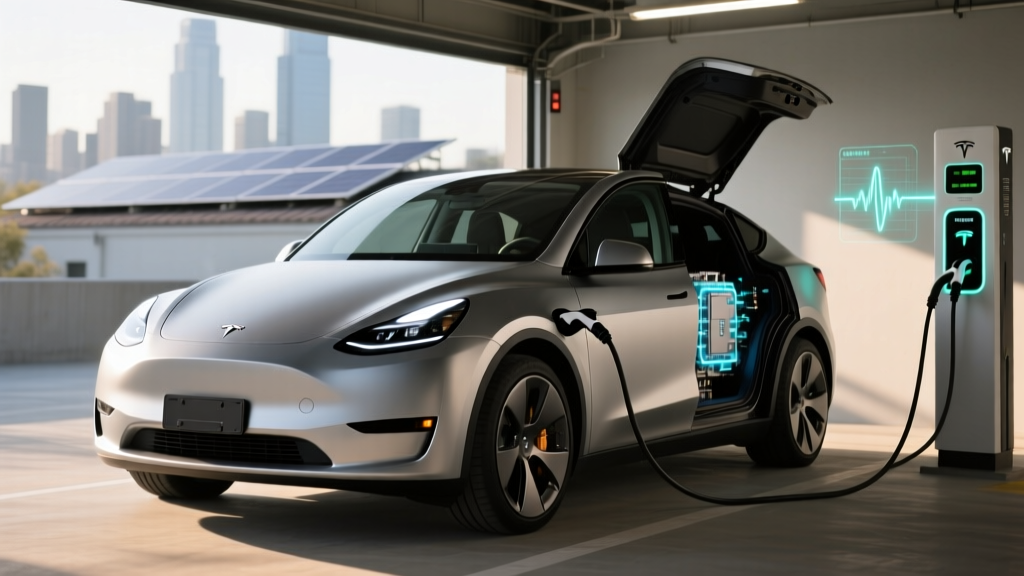
The Tesla Model Y remains the benchmark compact electric SUV, and for 2026 Tesla has refreshed the platform with what enthusiasts call V14 hardware — the latest iteration of Tesla's in-house Full Self-Driving (FSD) computer paired with the Juniper design update. If you've been searching for v14 tesla specs, you're likely weighing whether this hardware generation justifies a purchase now or if you should wait. This review breaks down the 2026 Model Y Long Range AWD with exact numbers on range, charging curves, real-world efficiency, and whether the §30D federal tax credit actually applies to your build.
Real-World Range vs. EPA Sticker
EPA Estimated Range: 320 miles (Long Range AWD)
Expect in practice: 270–290 miles at sustained 70 mph highway speeds; 240–260 miles in sub-30°F winter conditions with cabin heat. City driving with regen braking recovers energy and can push real-world results to 300+ miles in mild weather.
2026 Model Y Specs at a Glance
| Specification | 2026 Model Y Long Range AWD |
|---|---|
| EPA Range | 320 miles |
| Battery Capacity | ~78 kWh usable (NMC chemistry) |
| Drivetrain | Dual-Motor AWD |
| Horsepower | 384 hp combined |
| 0–60 mph | 4.8 seconds |
| Max DC Fast Charge | 250 kW peak |
| 10–80% DC Charge Time | ~25 minutes |
| Level 2 Home Charge Rate | 11.5 kW (~44 miles/hour) |
| MPGe (Combined) | 122 MPGe |
| Efficiency | 28 kWh/100 mi |
| Cargo Volume | 30.2 cu ft (rear seats up) / 72.1 cu ft (folded) |
| Rear Legroom | 41.6 inches |
| Base MSRP | $48,990 (before destination) |
| Battery Warranty | 8 years / 120,000 miles |
The Long Range AWD uses an NMC (nickel manganese cobalt) battery pack. Unlike the RWD Model Y — which has shifted to LFP (lithium iron phosphate) chemistry for lower cost and longer cycle life — the Long Range prioritizes energy density to hit that 320-mile EPA target. The trade-off: LFP tolerates daily 100% charges better, while NMC benefits from an 80% daily charge limit with 100% reserved for road trips. Tesla's battery management system enforces this through the charge-limit slider in the app.
Charging Speed: DC Fast, Level 2, and the Curve Reality
| Charging Level | Power (kW) | Speed (miles added/hr) | Typical Use Case |
|---|---|---|---|
| Level 1 (120V household) | ~1.4 kW | ~5 mi/hr | Emergency / overnight trickle |
| Level 2 (240V home wall connector) | 11.5 kW | ~44 mi/hr | Daily home charging |
| DC Fast (Tesla Supercharger V3/V4) | Up to 250 kW peak | ~1,000+ mi/hr (peak) | Road trips, 10–80% in ~25 min |
The 250 kW peak number requires context. Like all EVs, the Model Y follows a charging curve — it hits peak rate only at a low state of charge (around 10–20%) and with a preconditioned battery. As SoC climbs past 50%, the rate tapers. By 80%, you're typically seeing 50–80 kW. This is why Tesla (and the EPA) quote 10–80% times rather than 0–100%. If you arrive at a Supercharger at 15% SoC with a warm battery, expect roughly 25 minutes to 80%. Arrive cold without preconditioning and add 5–10 minutes as the battery warms.
For home charging, the Tesla Wall Connector on a 60-amp circuit delivers the full 11.5 kW (48 amps continuous). That's roughly 44 miles of range per hour — plug in at 10 PM and wake up to a full battery by 6 AM for all but the longest commutes. Installation costs typically run $800–$2,000 depending on panel proximity and whether your home needs a service upgrade. Always get a quote from a licensed electrician before committing.
V14 FSD Hardware: What It Actually Does
SAE Automation Level: Level 2
Tesla's FSD (Supervised) with V14 hardware is a Level 2 driver-assistance system per SAE International definitions. The driver must remain engaged, hands on or near the wheel, and eyes on the road at all times. This is not self-driving. Only Level 4 services like Waymo operate without a human driver in geofenced areas.
The V14 computer (Hardware 4, or HW4 in Tesla's internal naming) powers the current FSD Supervised stack. It processes input from the vehicle's camera suite — Tesla removed ultrasonic sensors and radar in favor of a pure-vision approach called Tesla Vision. The V14 chip offers significantly more compute throughput than the older HW3, enabling higher-resolution camera processing and more complex neural network inference in real time.
In practice, FSD Supervised handles highway lane-keeping, on-ramp to off-ramp navigation, and city-street turns with increasing competence. But limitations remain: construction zones with shifted lanes, heavy rain obscuring cameras, and unprotected left turns across busy intersections still require driver takeover. Expect to intervene several times per 30-minute urban drive. The system is best understood as an advanced cruise control with lane-change capability, not a replacement for an attentive driver.
The V14 hardware also enables improved cabin camera monitoring for driver attention and slightly better low-light image processing. FSD costs $8,000 as a one-time purchase or $99/month as of 2026, though Tesla periodically adjusts pricing and bundles it into promotional offers.
Pricing, Trims, and Federal Tax Credit Eligibility
| Trim | Base MSRP | Destination | Estimated Out-the-Door |
|---|---|---|---|
| Model Y Long Range AWD | $48,990 | $1,390 | ~$50,380 |
| Model Y Performance | $52,490 | $1,390 | ~$53,880 |
| Model Y RWD (LFP battery) | $44,990 | $1,390 | ~$46,380 |
The 2026 Model Y Long Range AWD starts at $48,990 before the $1,390 destination fee. Add common options — $1,000 for Ultra Red paint, $1,500 for 20-inch Induction wheels (which reduce range to ~303 miles EPA) — and a typical build lands around $51,000–$53,000 before incentives.
Does the Model Y Qualify for the §30D Federal Tax Credit?
Tax credit eligibility under IRS §30D depends on several factors that change frequently:
- MSRP Cap: SUVs/vans must have an MSRP at or below $80,000. The Model Y qualifies on all trims.
- Buyer Income Cap: Modified adjusted gross income must not exceed $150,000 (single), $225,000 (head of household), or $300,000 (joint filers).
- Battery Sourcing: Critical minerals and battery components must meet phased-in domestic-content and free-trade-agreement thresholds. As of 2026, these requirements are stringent — Tesla sources many cells from U.S. and FTA-partner facilities, but eligibility can shift with supply chain changes.
- Point-of-Sale Transfer: Eligible buyers can transfer the credit to the dealer at purchase, reducing the purchase price directly rather than waiting for a tax refund.
As of early 2026, many Model Y configurations qualify for a partial or full $7,500 credit, but you must verify your specific build's battery sourcing on Tesla's website at time of order and confirm your income eligibility. Consult a tax professional — this is not tax advice, and rules are subject to legislative change.
Interior, Cargo, and Daily Livability
The Juniper-refreshed Model Y interior is a meaningful step up from the 2020–2024 generation. Ambient lighting, ventilated front seats, a rear-seat touchscreen, and improved sound insulation make the cabin feel closer to its luxury-compact-SUV price point. The minimalist dashboard remains — a single 15.4-inch center touchscreen controls everything, including the glovebox and mirror adjustments. Some buyers love the simplicity; others miss physical buttons for climate and volume.
Cargo space is a genuine strength: 30.2 cubic feet behind the second row and 72.1 cubic feet with the 60/40 split rear seats folded. The rear trunk opening is wide and low, making it easy to load strollers, groceries, or camping gear. There's also a small front trunk (frunk) suitable for a charging cable bag or a small soft cooler. Rear legroom at 41.6 inches is generous for adults on longer trips.
The panoramic glass roof creates an airy cabin but contributes to cabin heat gain in summer. Tesla includes a tinted panel, and many owners add an aftermarket sunshade for parked-vehicle heat management in hot climates.
How the 2026 Model Y Stacks Up Against Competitors
Range & Efficiency Winner: Tesla Model Y
320 miles EPA and 28 kWh/100mi remains best-in-class for the segment. The Hyundai Ioniq 5 comes close at ~310 miles but with a larger battery.
Charging Speed Winner: Hyundai Ioniq 5 / Kia EV6
800V architecture enables 10–80% in ~18 minutes at a 350 kW charger. The Model Y's 250 kW peak is slower on comparable infrastructure.
Interior Quality Winner: BMW iX (different price class) / Ioniq 5 (similar price)
The Juniper refresh narrows the gap, but Hyundai's materials and physical controls edge ahead for traditionalists.
Charging Network Winner: Tesla Model Y
Access to the Supercharger network — the most reliable and widespread DC fast-charging ecosystem in North America — remains a significant ownership advantage.
The closest rival is the Hyundai Ioniq 5, which offers similar range, faster peak charging (on 350 kW chargers), and a more conventional interior layout at a slightly lower starting price. The Ford Mustang Mach-E is another strong contender with competitive range and a more engaging driving feel. But for buyers who prioritize the Supercharger network, over-the-air updates, and Tesla's software ecosystem, the Model Y still occupies a unique position.
Pros, Cons, and Who Should Buy
Pros
- 320-mile EPA range with strong real-world efficiency (28 kWh/100mi)
- Supercharger network access — best public charging reliability in the U.S.
- Spacious cargo area (72.1 cu ft max) with practical liftback design
- Continuous OTA updates add features post-purchase
- Strong resale value relative to EV segment average
- Juniper interior is a meaningful quality improvement
Cons
- Touchscreen-only controls frustrate some drivers (no physical volume knob or climate buttons)
- 250 kW peak charging is outpaced by 800V rivals on 350 kW chargers
- FSD Supervised requires constant driver attention — not a substitute for self-driving
- Firm ride quality on larger 20-inch wheel option
- Premium pricing before incentives vs. Ioniq 5 and Mach-E
- Glass roof heat soak in hot climates without aftermarket shade
Who Is the 2026 Model Y For?
Choose the Model Y Long Range AWD if: You road-trip regularly and value Supercharger access, need versatile cargo space for a growing family, and want best-in-segment efficiency. The 320-mile range handles most single-day drives without a charge stop.
Look elsewhere if: You want the fastest possible DC charging (consider Ioniq 5/EV6 with 800V), prefer physical buttons and a traditional cockpit layout, or don't have reliable home charging access and depend entirely on public infrastructure outside the Supercharger network.
Frequently Asked Questions
What is the real-world range of the 2026 Tesla Model Y Long Range?
The EPA rates it at 320 miles, but expect 270–290 miles at highway speeds in moderate temperatures. Cold weather (below 30°F) with cabin heating can drop that to 240–260 miles. City driving with frequent regen braking can exceed the EPA estimate in mild conditions.
How fast does the Model Y charge at home and on the road?
At home on a Level 2 Tesla Wall Connector (11.5 kW), you add roughly 44 miles of range per hour — a full overnight charge for most commutes. On a Tesla Supercharger (V3/V4), the peak rate is 250 kW, with a 10–80% charge taking approximately 25 minutes when the battery is preconditioned.
Does the 2026 Model Y qualify for the $7,500 federal EV tax credit?
It can, depending on your income (under $150K single / $300K joint), the specific battery sourcing of your build, and the MSRP cap (the Model Y qualifies as an SUV under $80K). Eligibility rules under IRS §30D are complex and shift with supply chain and legislative changes. Verify at point of sale and consult a tax professional.
Is Tesla's V14 FSD hardware actually self-driving?
No. FSD (Supervised) with V14 hardware is an SAE Level 2 driver-assistance system. You must remain fully engaged — hands near the wheel, eyes on the road — at all times. It handles many highway and some city driving tasks but requires frequent driver intervention, especially in construction zones, bad weather, and complex intersections.
How does the Model Y compare to the Hyundai Ioniq 5 and Ford Mach-E?
The Model Y leads in range efficiency and charging network access (Superchargers). The Ioniq 5 charges faster on 350 kW infrastructure (10–80% in ~18 min) and has a more conventional interior. The Mach-E offers a sportier driving feel. All three are strong choices — the best pick depends on whether you prioritize network reliability (Tesla), charge speed (Hyundai/Kia), or driving dynamics (Ford).
What is the battery warranty on the 2026 Model Y?
Tesla covers the battery and drive unit for 8 years or 120,000 miles (whichever comes first) on the Long Range AWD, with a minimum 70% capacity retention threshold during that period. The LFP-equipped RWD model has an 8-year/100,000-mile battery warranty.