The Screen Is the Car: Tesla's UI Philosophy in 2026
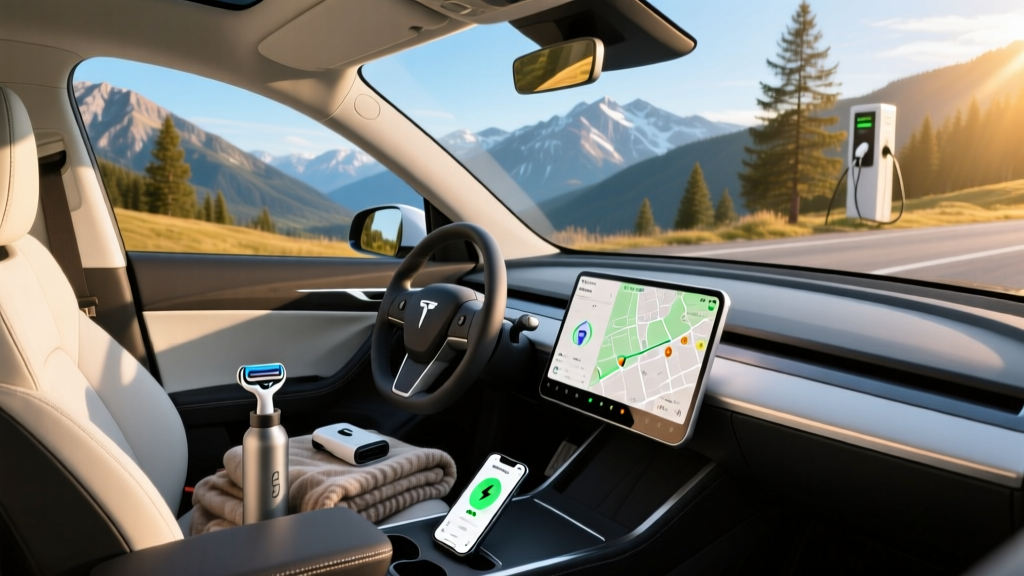
If you've never driven a Tesla, the first thing that strikes you isn't the acceleration or the silence — it's the absence of buttons. The 2026 Tesla Model Y Juniper refresh carries forward the brand's defining design choice: a single 15.4-inch landscape touchscreen that controls virtually every vehicle function. Climate, mirrors, glovebox, windshield wipers, drive mode — all routed through the Tesla user interface. For some buyers, this minimalism is liberating. For others, it's a dealbreaker. After living with the updated Model Y for several weeks of commuting and road-trip duty, here's how the interface holds up against the practical demands of daily driving.
The Juniper update (introduced for the 2025 model year and carried into 2026) brought subtle but meaningful changes: a ventilated front seat option, updated interior materials, a rear-seat touchscreen, and an ambient lighting strip that runs the cabin's perimeter. But the core UI architecture remains unmistakably Tesla — and that's both its greatest strength and its most polarizing limitation.
2026 Tesla Model Y: Core Specs at a Glance
| Spec | Value |
|---|---|
| EPA Range | 320 miles |
| Battery (usable) | ~78 kWh, NMC (2170 cells) |
| Drivetrain | Dual-motor AWD |
| Horsepower | 384 hp (combined) |
| 0-60 mph | 4.8 seconds |
| Peak DC Fast Charge | 250 kW (V3 Supercharger) |
| 10-80% DC Fast Charge | ~25 minutes |
| Level 2 Home Charge (11.5 kW) | ~44 miles/hour |
| EPA Efficiency | 111 MPGe / 30 kWh/100mi |
| Cargo (rear seats up) | 30.2 cu ft |
| Cargo (rear seats folded) | 72.1 cu ft |
| Rear Legroom | 40.5 in |
| Battery Warranty | 8 years / 120,000 miles |
| Base MSRP (Long Range AWD) | $46,630 |
Inside the Tesla User Interface: What It's Actually Like
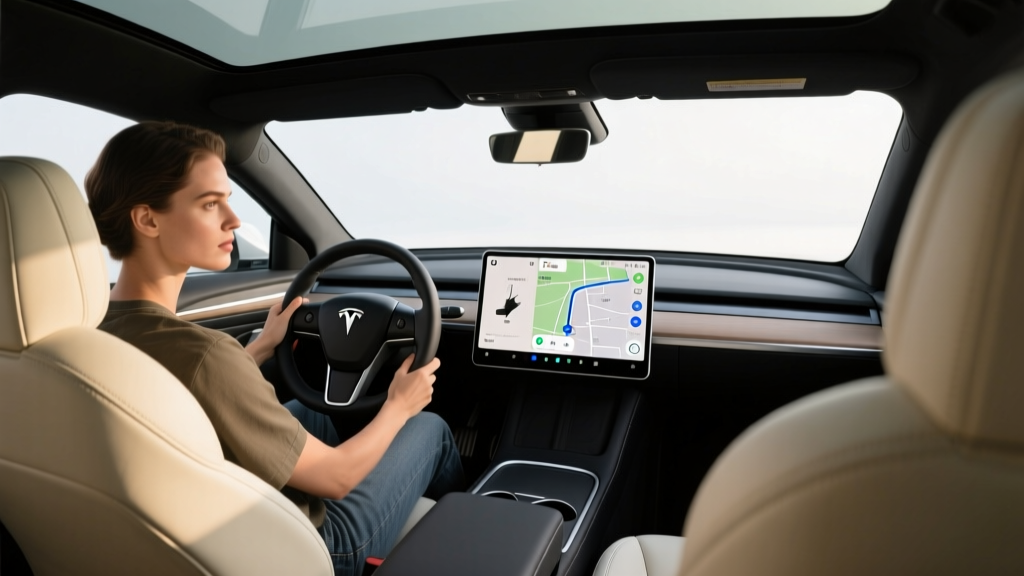
The Model Y's cabin is dominated by a single 15.4-inch touchscreen running Tesla's proprietary operating system. There is no traditional instrument cluster behind the steering wheel. Speed, range, navigation, and driver-assist visualization all live on the left third of the main display. The remaining two-thirds handle navigation, media, phone, climate controls, and vehicle settings.
What Works Well
Tesla's UI is responsive — arguably the most responsive in the EV segment. Swipe latency is negligible, map rendering is smooth, and the navigation system integrates real-time Supercharger availability, battery preconditioning, and route-based SoC prediction better than any competitor. When you enter a destination, the car calculates whether you'll need a charge stop, preconditions the battery for optimal DC charging speed upon arrival, and displays projected state of charge at each waypoint. This integration between UI and powertrain is where Tesla's vertical control pays dividends.
The Juniper refresh added a rear 8-inch touchscreen for passengers, which handles climate adjustments, media, and entertainment — a meaningful improvement for family duty. Over-the-air (OTA) updates continue to refine the interface; Tesla pushed several UI improvements in late 2025 that reorganized the climate control bar and added customizable shortcut tiles.
Where the Minimalism Hurts
The persistent criticism of the Tesla user interface remains valid: adjusting side mirrors, opening the glovebox, and changing wiper speed all require navigating touchscreen menus. While Tesla has added steering-wheel scroll wheels that handle some secondary functions (volume, following distance, mirror adjustment when the menu is open), the cognitive load of menu-diving while driving is real. Competitors like the Hyundai Ioniq 5 and Ford Mustang Mach-E retain physical buttons for climate and mirror adjustment — a deliberate choice that reduces eyes-off-road time.
Turn signal activation is via a steering-column stalk (Tesla retained this after briefly experimenting with button-based signals on the Cybertruck), which is a relief. But windshield washer fluid, defrost intensity, and cabin vent direction all require screen taps.
The EPA rates the 2026 Model Y Long Range AWD at 320 miles. In mixed driving (55/45 city/highway) at 65-70°F, expect roughly 290-310 miles. Sustained highway driving at 75+ mph drops this to approximately 260-280 miles. In cold weather (below 32°F), range loss of 15-25% is typical — plan for 240-270 miles on a full charge in winter. The heat pump (standard on all 2026 Model Y trims) helps mitigate cabin-heating energy draw, but cold battery chemistry still reduces usable capacity.
Charging Speed: Supercharger Network and Home Setup
Tesla's charging ecosystem remains a core competitive advantage, though the gap has narrowed as other networks expand and NACS adoption spreads across the industry.
| Level | Power | Speed | Use Case |
|---|---|---|---|
| Level 1 (120V) | ~1.4 kW | ~4-5 mi/hr | Emergency / overnight trickle |
| Level 2 (240V, 48A) | 11.5 kW | ~44 mi/hr | Home overnight, full charge in ~8 hrs |
| DC Fast (V3 Supercharger) | 250 kW peak | 10-80% in ~25 min | Road trips, rapid top-ups |
| DC Fast (V4 Supercharger) | Up to 325 kW (future) | Model Y capped at ~250 kW | Current Model Y can't exceed 250 kW |
At a V3 Supercharger, the Model Y Long Range peaks at approximately 250 kW but sustains that rate only briefly (roughly 10-30% SoC). The charge curve tapers progressively: by 60% SoC, you're pulling roughly 120-140 kW; by 80%, it drops below 60 kW. This is normal lithium-ion behavior but worth understanding — the advertised "250 kW" is a peak, not a sustained rate. A 10-80% session takes approximately 25 minutes under ideal conditions (preconditioned battery, warm ambient temperature, V3 stall availability).
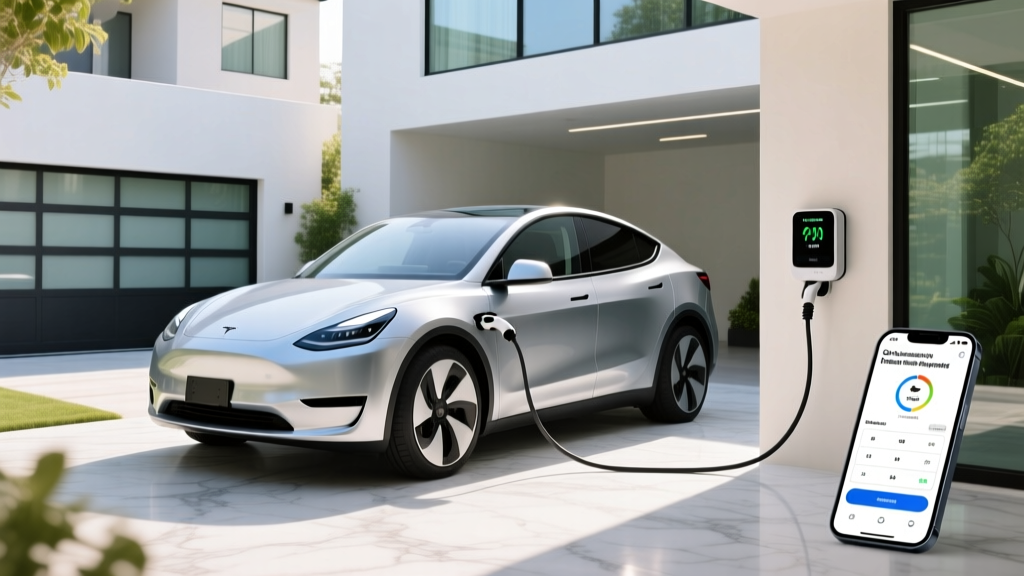
For home charging, the Model Y's onboard charger accepts up to 11.5 kW (48 amps) on a Level 2 circuit. This requires a 60-amp dedicated circuit installed by a licensed electrician. Expect home installation costs of $800-$2,000 depending on panel proximity and local permitting — more if your electrical panel needs a 200-amp upgrade. Tesla's Wall Connector ($420) is a solid choice, but any J3400 (NACS) Level 2 unit will work.
Autopilot and FSD: Level 2, Not Self-Driving
Tesla Autopilot and Full Self-Driving (Supervised) are SAE Level 2 driver-assistance systems. The driver must remain fully engaged, hands on or near the wheel, and eyes on the road at all times. These systems handle lane centering, adaptive cruise, and in some cases lane changes and navigation on-ramps — but they are not autonomous. Only Level 4 services like Waymo operate without a driver.
The Model Y comes standard with Tesla Autopilot (Traffic-Aware Cruise Control + Autosteer). The optional FSD (Supervised) package — currently $8,000 as a one-time purchase or $99/month — adds Navigate on Autopilot (highway on/off-ramp handling), Auto Lane Change, Autopark, and Smart Summon. FSD's vision-only approach (Tesla removed ultrasonic sensors and radar in prior model years) has improved markedly, but it still struggles with construction zones, faded lane markings, and complex unprotected left turns. Treat it as an advanced cruise system, not a chauffeur.
For buyers comparing ADAS across brands: Hyundai's Highway Driving Assist 2 and Ford's BlueCruise offer comparable Level 2 functionality at lower cost or included in the vehicle price. Tesla's FSD is the most ambitious but also the most expensive, and its "supervised" branding is a reminder that liability remains with the driver.
Pricing, Trims, and Federal Tax Credit Eligibility
| Trim | MSRP | Est. After §30D Credit |
|---|---|---|
| Long Range RWD | $44,990 | ~$37,490* |
| Long Range AWD | $46,630 | ~$39,130* |
| Performance AWD | $51,490 | ~$43,990* |
*Estimated price assumes full $7,500 federal tax credit via IRS §30D point-of-sale transfer. Eligibility requires buyer AGI below $150,000 (single) / $300,000 (joint), vehicle MSRP under $80,000 (SUVs), and compliance with battery critical-mineral and component sourcing rules. Rules are subject to change — verify current eligibility at IRS.gov and consult a tax professional.
As of early 2026, the Model Y qualifies for the $7,500 federal credit when purchased new, and Tesla supports the point-of-sale transfer — meaning the $7,500 can be applied as a down-payment reduction at delivery rather than waiting for a tax refund. This is a significant cash-flow advantage. However, battery sourcing requirements under §30D are tightening annually, and eligibility can shift between model years. Always confirm at the time of purchase.
Who Should Buy the 2026 Model Y — and Who Shouldn't
- You want access to the Supercharger network (still the most reliable DC network in North America, even as it opens to NACS competitors)
- You value OTA updates that genuinely add features over time
- You prefer a screen-first interface and don't mind menu-diving for climate/mirror adjustments
- Cargo space and practicality matter — 72.1 cu ft with seats folded is best-in-class for the segment
- You want strong efficiency (111 MPGe) paired with dual-motor AWD capability
- You need physical buttons for climate, mirrors, or wipers — consider the Hyundai Ioniq 5 or Kia EV6
- You want a traditional instrument cluster or head-up display — Tesla offers neither
- You need a third row (the Model Y's optional third row was discontinued; consider the Kia EV9 or Rivian R1S)
- You're uncomfortable with Tesla's vision-only ADAS approach and want redundant radar/ultrasonic sensors
- 320-mile EPA range with excellent real-world efficiency
- Supercharger network access (most reliable DC charging in the US)
- Best-in-class cargo volume (72.1 cu ft)
- Responsive, continually updated UI with deep powertrain integration
- Strong $7,500 federal tax credit eligibility via POS transfer
- Heat pump standard — better cold-weather efficiency than many competitors
- No physical buttons — all vehicle controls via touchscreen
- No instrument cluster or head-up display
- FSD (Supervised) costs $8,000 extra and remains Level 2
- Ride quality is firm; road noise is noticeable at highway speed
- DC fast charge capped at 250 kW (slower than Ioniq 5's 350 kW peak)
- Insurance premiums tend to run higher than segment average
How It Compares: Model Y vs. Key Rivals
The Model Y's most direct competitors in 2026 include the Hyundai Ioniq 5, Ford Mustang Mach-E, and Chevrolet Equinox EV. The Ioniq 5 charges faster (350 kW peak on 800V architecture, 10-80% in ~18 minutes) and offers physical climate buttons, but its cargo space (56.2 cu ft max) trails the Tesla significantly. The Mach-E provides a more traditional cabin layout with a separate instrument cluster and physical knobs, but its EPA range (up to 312 miles on Extended Range RWD) slightly undercuts the Model Y, and Ford's DC charging network partnerships are less seamless than Tesla's native Supercharger integration. The Equinox EV is the value play — starting around $33,000 before credits — but its range (up to 319 miles on 3RS trim) comes with slower DC charging and a less refined UI.
On efficiency, the Model Y's 111 MPGe combined is competitive but not dominant; the Ioniq 5 achieves 114 MPGe in its most efficient trim. Where Tesla wins is the integration: navigation, battery preconditioning, and Supercharger routing work as a unified system that no competitor has fully matched.
Frequently Asked Questions
What is the real-world range of the 2026 Tesla Model Y?
The EPA rates it at 320 miles. Real-world mixed driving yields 290-310 miles in mild weather, 260-280 on sustained highway trips at 75+ mph, and 240-270 miles in freezing temperatures. Preconditioning the battery and using seat heaters instead of cabin heat can recover some winter range.
How fast does the Model Y charge at home and on the road?
At home on a Level 2 (240V, 48A) circuit, the Model Y charges at up to 11.5 kW — adding roughly 44 miles of range per hour, or a full charge overnight in about 8 hours. On a V3 Supercharger (250 kW peak), a 10-80% session takes approximately 25 minutes with a preconditioned battery. The charge curve tapers significantly above 60% SoC.
Does the 2026 Model Y qualify for the $7,500 federal EV tax credit?
As of early 2026, yes — the Model Y qualifies for the full $7,500 under IRS §30D, and Tesla supports point-of-sale transfer so the credit reduces your purchase price at delivery. Eligibility depends on your adjusted gross income (under $150K single / $300K joint), the vehicle's MSRP (under $80K for SUVs), and battery sourcing compliance. Always verify at IRS.gov before purchasing.
Is the Tesla user interface safe to use while driving?
Tesla's UI is responsive and logically organized, but adjusting climate, mirrors, or wipers requires looking at the screen. The National Highway Traffic Safety Administration (NHTSA) has not issued specific findings against Tesla's screen-based controls, but independent studies show that any eyes-off-road time increases crash risk. Competitors with physical buttons (Hyundai, Ford, BMW) reduce this specific distraction vector.
Is the Model Y worth buying over the Ioniq 5 or Mach-E?
It depends on priorities. Choose the Model Y for maximum cargo space, Supercharger network access, and the most integrated navigation/charging UI. Choose the Ioniq 5 for faster DC charging (350 kW peak), physical buttons, and a slightly more engaging design. Choose the Mach-E for a traditional cabin layout and available hands-free BlueCruise on mapped highways. All three are strong — the "best" depends on whether you value charging infrastructure, cabin ergonomics, or UI sophistication most.
What's the battery warranty on the 2026 Model Y?
Tesla covers the Model Y's battery and drive unit for 8 years or 120,000 miles (whichever comes first), with a guaranteed minimum 70% capacity retention over that period. This is competitive with the segment standard, though Hyundai offers 10 years/100,000 miles on the Ioniq 5's battery.